Allopurinol: Hydrazine Cannot Be Designed Out, So Five ppm Becomes the Number
Allopurinol↗ is a five-membered pyrazole fused to a pyrimidinone, and the two nitrogens that hold the pyrazole together come from hydrazine. There is no alternative. That single structural fact decides the rest of the impurity strategy: the genotoxic impurity is a reagent residue rather than a degradation product, its acceptable level is set by arithmetic on the daily dose, and it is invisible to the chromatographic method that releases the batch.
Note: product names shown in red (marked with ↗) are links - click through to the product page for structure, CAS number, purity and lead time.
A small molecule with an unusually awkward ring
Key points
- Allopurinol is C5H4N4O, 136.11, CAS 315-30-0, dosed at 100 to 300 mg a day in gout and up to 800 mg a day in tophaceous disease.
- The pyrazole N-N bond comes from hydrazine, which ICH M7(R2) places in Class 2, so the residue is a reagent problem rather than a degradation problem[1].
- At 300 mg a day the 1.5 microgram per day threshold of toxicological concern works out to 5 ppm; at 800 mg it is 1.9 ppm[1].
- Four of the five European Pharmacopoeia impurities are the last four route intermediates, an ester and an amide each captured before and after formylation.
Allopurinol is C5H4N4O, 136.11, CAS 315-30-0, and it is one of the few drugs whose structure is best described by what it is not. It is not a purine: the six-membered ring carries a carbonyl at C4 and the nitrogen pattern of a pyrimidinone, fused to a pyrazole rather than an imidazole. The result is 1H-pyrazolo[3,4-d]pyrimidin-4-ol, a planar solid with low aqueous solubility and no useful chromophore beyond the heteroaromatic system.
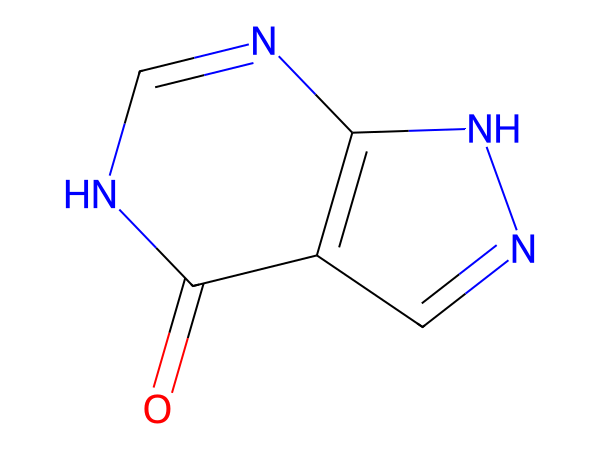
Allopurinol inhibits xanthine oxidase and is itself a substrate, giving oxypurinol (CAS 2465-59-0) as an active metabolite. Doses run from 100 to 300 mg a day in gout and up to 800 mg a day in tophaceous disease, which places allopurinol in the group where percentage limits are easy to meet and absolute limits are not.
The catalogue carries 31 allopurinol entries and both the EP and the USP list it, so the impurity vocabulary is not a matter of opinion.
The N-N bond is the route, not a feature of the route
Look at the pyrazole. Two adjacent nitrogen atoms, one of them bearing hydrogen, both part of the aromatic system. Adjacent N-N bonds are not something a medicinal chemist assembles by amination or by reductive cyclization of a dinitrile; they are installed as a unit. The unit is hydrazine, and every commercial route to allopurinol begins with it.
The published hydrazine literature is explicit about this. A recent review of hydrazine determination in pharmaceuticals lists allopurinol among the APIs manufactured with hydrazine hydrate as a synthetic reagent, alongside isoniazid, carbidopa, hydralazine and pantoprazole[2]. That list is worth reading twice, because it is not a list of similar problems. In isoniazid the hydrazide is the pharmacophore and hydrazine is what the molecule becomes when the hydrazide hydrolyses. In allopurinol the hydrazine has already done its work before the ring exists; what remains is unreacted reagent and its condensation residues.
The consequence is strategic. A degradation impurity can be suppressed by formulation and packaging. A reagent-derived one can only be purged by the process and then verified analytically, and an insensitive method makes process development invisible.
Arithmetic first: the dose sets the limit, not the guideline
ICH M7(R2) places hydrazine in Class 2, known to be mutagenic, and applies the threshold of toxicological concern of 1.5 micrograms per day for lifetime exposure[1]. Convert that into a concentration and the number depends entirely on how much drug the patient swallows.
| Daily dose | Basis | Concentration equivalent | What it means for the method |
|---|---|---|---|
| 100 mg | low-dose gout | 15 ppm | an order of magnitude of headroom |
| 300 mg | standard gout dose | 5 ppm | LOQ must sit near 0.25 ppm |
| 600 mg | moderate tophaceous disease | 2.5 ppm | method noise dominates the decision |
| 800 mg | severe tophaceous disease | 1.9 ppm | below the LOQ of most published assays |
| 800 mg, up to one month | limited treatment period | 150 ppm | the short-term limit changes the whole argument |
Table note: concentrations are arithmetic from the 1.5 microgram per day TTC and the 120 microgram per day limit for a treatment period of one month or less, both from ICH M7(R2)[1], divided by the daily dose. They are framework values, not compendial limits.
The last row is the one argued about in a filing. A patient on 800 mg a day for four weeks of tumour lysis prophylaxis is not a lifetime exposure, and two sponsors can quote two very different numbers for the same product and both be right, provided the treatment duration sits next to the number.
Why the release method cannot see hydrazine
Hydrazine is 32.05, fully miscible with water, and has no chromophore. On a conventional reversed-phase column it elutes with the solvent front, and on a photodiode array it is a blank. The compendial related-substances method, which is designed to separate heteroaromatic species that absorb between 210 and 280 nm, is not a hydrazine method and was never meant to be.
The published solutions all take the same route: derivatize the hydrazine into something that absorbs or fluoresces, then separate the derivative from the matrix. o-Phthalaldehyde↗ gives a fluorescent adduct and is the most sensitive option reported for this API. A validated UHPLC-fluorescence method on a 50 by 2.1 mm C18 column, with phosphate buffer at pH 2 and acetonitrile, achieved a limit of detection of 0.03 ppm and a limit of quantification of 0.25 ppm in allopurinol drug substance and in its formulations[3]. That is the right order of magnitude for a 5 ppm limit.
The simpler alternative is automated zone fluidics with on-line solid-phase extraction, also using o-phthalaldehyde. It reaches a limit of quantification of 2.7 ppm with recoveries between 93 and 106 percent[4]. Useful for process monitoring, marginal for a 1.9 ppm specification. The difference between the two methods is not effort, it is whether the acceptance criterion can be supported at all.
Derivatization measures free hydrazine. Hydrazones, azines and other condensation products formed with carbonyls are not derivatized until they hydrolyse, so a method validated only on spiked free hydrazine reports less than the total hydrazine-derived residue, and the gap widens with age. If an aldehyde appears anywhere downstream, the validation needs a hydrolysis step or a justification for omitting it.
The specification is the route, read backwards
Here the catalogue data does something the guidelines cannot: it shows the synthesis. Four of the five European Pharmacopoeia impurities of allopurinol are the last four intermediates of the route, and they come in pairs.
| Entry | Structure | Formula, mass | Position in the route |
|---|---|---|---|
| EP impurity D, CAS 6994-25-8 | ethyl 3-amino-1H-pyrazole-4-carboxylate | C6H9N3O2, 155.15 | first pyrazole formed from hydrazine |
| EP impurity E, CAS 31055-19-3 | ethyl 5-formylamino-1H-pyrazole-4-carboxylate | C7H9N3O3, 183.16 | same ester, formylated but not yet cyclized |
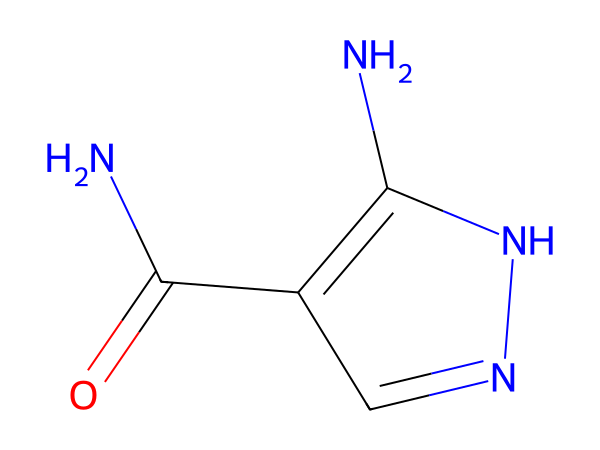
| EP impurity A, CAS 5334-31-6 | 3-amino-1H-pyrazole-4-carboxamide | C4H6N4O, 126.12 | ester converted to amide |
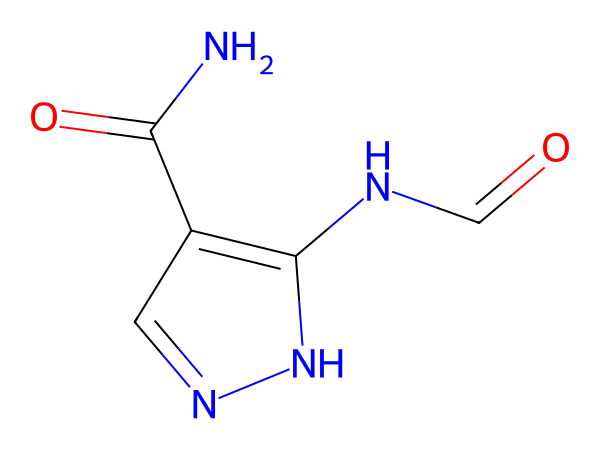
| EP impurity B, CAS 22407-20-1 | 5-formylamino-1H-pyrazole-4-carboxamide | C5H6N4O2, 154.13 | one formyl group away from the drug |
| EP impurity C, CAS 1346604-13-4 | 5-(4H-1,2,4-triazol-4-yl)-1H-pyrazole-4-carboxamide | C6H6N6O, 178.15 | side product of the formamide step |
Table note: masses and formulas from PubChem records for each CAS number; the pairing is inferred from the structures and is consistent with the compendial impurity list.
The pairs are the interesting part. Impurity D and impurity E are an ester and its formyl derivative; impurity A and impurity B are the corresponding amide and its formyl derivative. That is not a random collection of degradants. It is a snapshot of two parallel sequences, ester going to amide, each captured both before and after formylation. Any process that runs through an ester, amidates it, formylates the amino group and then cyclizes will leave exactly these four species behind if any step goes to 90 percent instead of 99.
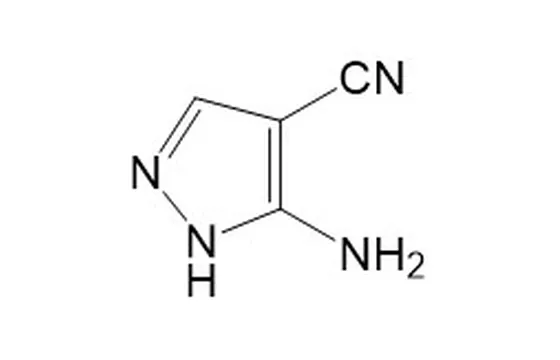
Two further entries close the picture. The aminopyrazole carbonitrile, CAS 16617-46-2, is the nitrile analogue one oxidation state away from the amide, and it appears whenever the nitrile route is used instead of the ester route. The N-methyl pyrazolopyrimidinone, CAS 5334-56-5, is the drug with a methyl on the pyrimidine nitrogen, which is what a methanol wash and a hot hold will produce.
None of this is a criticism of the process. It is why buying the EP set gives an analyst the four species most likely to be present in a real batch.
What the deficiency letter asks for
Three questions come up repeatedly for hydrazine-bearing APIs, and all three have a specific answer.
The first is a purge argument. Hydrazine is charged early, so the honest way to present it is a spiking study across the actual isolation steps: add hydrazine at a known level before the first crystallization, measure it in the isolated intermediate, then in the crude and in the final API. A purge factor quoted without the step-by-step data is an assertion, not evidence.
The second is method sensitivity. If the specification is 1.9 ppm, the quantification limit should sit at or below about 0.4 ppm to leave room for the acceptance criterion. The UHPLC-fluorescence method at 0.25 ppm does that[3]; methods in the 2 to 3 ppm range do not, and a filing that pairs a 2 ppm limit with a 2.7 ppm LOQ will be questioned on the arithmetic alone.
The third is the total-versus-free question described above, and it is the one that most often goes unanswered. State whether the procedure measures free hydrazine or total hydrazine after hydrolysis, and if free, say what fraction of the residue could be bound as a hydrazone under the worst plausible condition.
Related-substance limits sit in a different framework. ICH Q3A(R2) sets the reporting threshold at 0.05 percent for a new drug substance, the identification threshold at 0.10 percent or 1.0 mg per day whichever is lower, and the qualification threshold at 0.15 percent or 1.0 mg per day[5]. At 800 mg a day, 1.0 mg corresponds to 0.125 percent, so the absolute limb of the identification threshold binds before the percentage does. That is a second place where high dose changes the answer, and it is worth showing the calculation rather than quoting the table.
The CDE block above reports accepted filings and applicants, not approvals. It shows how many suppliers run the same hydrazine chemistry.
The same enzyme inhibition that makes the drug work is why it is dangerous with azathioprine, whose active 6-mercaptopurine metabolite depends on xanthine oxidase for clearance.
Where allopurinol cannot be grouped with other hydrazine drugs
The temptation is to file all hydrazine APIs under one control strategy. They do not belong together, and the differences are instructive.
Isoniazid carries a hydrazide as its pharmacophore. Hydrazine is what appears when that hydrazide hydrolyses, so its level rises with storage and with residual moisture, and the relevant experiment is a stability study rather than a purge study. Allopurinol has the opposite profile: the hydrazine is consumed before the ring closes, and the residue is a function of charge ratio and workup, not of time on the shelf.
Carbidopa uses hydrazine to install a hydrazino substituent that remains in the molecule, so the reagent and the pharmacophore are the same nitrogen pair, and the purge question becomes a question about the completeness of the substitution. Febuxostat, the other xanthine oxidase inhibitor in this catalogue, is not a hydrazine case at all: it is a thiazole carbonitrile built without an N-N bond, which is exactly why it never appears in hydrazine residue discussions despite doing the same job in the same patient.
The pair allopurinol and febuxostat is the cleanest illustration of the point. Two drugs, one mechanism, one indication, and completely different genotoxic dossiers, because the ring systems differ. Impurity risk follows structure, not therapeutic class.
Practical points that get missed
Do not set the limit from a compendial number alone. The compendial monograph is written for a defined maximum daily dose. If the product is a 300 mg tablet and the filing claims up to 800 mg for tophaceous gout, the limit has to be justified for 800 mg, and the arithmetic in the table above is the justification.
Spike the derivatization at the limit, not at a convenient concentration. o-Phthalaldehyde chemistry is fast but pH-sensitive, and a method optimized at 10 ppm will not necessarily hold its recovery at 1 ppm. The published method selected pH 2 and a 5 minute reaction time by optimization at the specification limit, which is the correct design[3].
Watch the methanol. The N-methyl impurity, CAS 5334-56-5, is small and polar, a marker for methanol contact at elevated temperature, and invisible to a method that starts its gradient at 20 percent organic.
Purge data belong to the step that removes, not the one that introduces. Hydrazine charged in step one is controlled in the first isolation, so a purge factor quoted from the final crystallization alone is an avoidable weakness.
Check the formulation. Binders and disintegrants carrying residual formaldehyde shift the free-to-bound hydrazine balance without breaking the specification, which changes what the method is measuring.
Choosing reference standards for this file
The practical question is which solids to keep on the shelf. For allopurinol the set is small: the drug substance for system suitability, EP impurity A and EP impurity B because they are closest to the finished ring, and impurity D as the ester end of the sequence. The rest of the 31-entry catalogue is for investigations, not routine work.
The catalogue holds the full allopurinol series, including the EP A to E set, the formylated intermediates and the N-methyl analogue, so a method can be built on certified solids rather than on relative retention times. The substance is also monographed in the Chinese Pharmacopoeia, which writes its own related-substances system around the same structures[6]: Allopurinol reference standards and related entries.
Frequently Asked Questions
Is hydrazine a degradation product of allopurinol or only a reagent residue?
Why is 5 ppm the figure that keeps appearing?
Can the related-substances method be extended to cover hydrazine?
What limit of quantification is actually needed?
Do bound forms of hydrazine matter?
Why are four of the EP impurities route intermediates rather than degradants?
Is the N-methyl impurity worth a specification?
How does the allopurinol case differ from febuxostat?
Related Substances and Reference Standards
- Allopurinol (31 impurity / derivative entries)
- Isoniazid (17 impurity / derivative entries)
- Febuxostat (86 impurity / derivative entries)
- Carbidopa (34 impurity / derivative entries)
References and Sources
- ICH, ICH M7(R2) Assessment and Control of DNA Reactive (Mutagenic) Impurities in Pharmaceuticals: Class 2 classification, the 1.5 microgram per day threshold of toxicological concern and the 120 microgram per day limit for treatment of one month or less, accessed 2026-11-06
- Journal of Analytical Methods in Chemistry (2026), Tracing hydrazine in pharmaceuticals: toxicological concerns, extraction approaches and analytical method development, including allopurinol among the APIs manufactured with hydrazine hydrate, accessed 2026-11-06
- Journal of Pharmaceutical and Biomedical Analysis, 187 (2020) 113354, UHPLC-fluorescence method for the determination of trace levels of hydrazine in allopurinol and its formulations, validated using the total-error concept: limit of detection 0.03 ppm and limit of quantification 0.25 ppm, accessed 2026-11-06
- Journal of Pharmaceutical and Biomedical Analysis, 177 (2020) 112887, Automated fluorimetric determination of the genotoxic impurity hydrazine in allopurinol pharmaceuticals using zone fluidics and on-line solid phase extraction: limit of quantification 2.7 ppm, recovery 93.3 to 105.8 percent, accessed 2026-11-06
- ICH, ICH Q3A(R2) Impurities in New Drug Substances: reporting, identification and qualification thresholds expressed as a percentage and as an absolute daily amount, accessed 2026-11-06
- Chinese Pharmacopoeia Commission, Pharmacopoeia of the People's Republic of China, allopurinol monograph and the general chapters on related substances, accessed 2026-11-06
This article was prepared by the CATO technical team. Regulatory, pharmacopoeial and published literature content cited above is attributed in the reference list. It is provided for technical exchange and search reference only and does not constitute a quality specification or regulatory advice. For any specific substance, the applicable test methods, limits and filing requirements are governed by the current regulations, pharmacopoeial monographs and official publications.
Product information on this site is provided for research search and selection reference only and is not a quality specification; technical data, purity and structural confirmation are governed by the shipped COA and our written confirmation. All products mentioned are for research use only, not for human or animal diagnostic or therapeutic use.