Apremilast Has One N-H Bond, and the Nitroso Entry Is Not on It
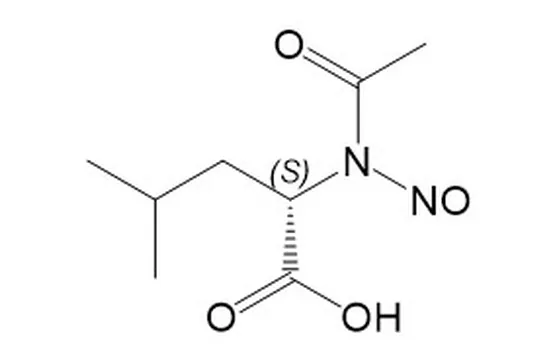
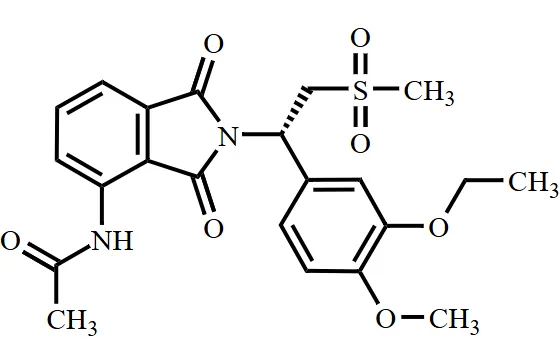
Apremilast↗ is C22H24N2O7S, 460.49, given as 30 mg twice a day. The catalogue carries 150 entries for the molecule and exactly one of them is N-nitroso, and that entry is not a nitrosated drug. It is N-nitroso-N-acetyl-L-leucine, C8H14N2O4, 202.21, the nitrosated form of the acid used to resolve the chiral amine intermediate. Once that is clear, the nitrosamine assessment stops being a question about the finished molecule and becomes a question about a reagent stream.
Note: product names shown in red (marked with ↗) are links - click through to the product page for structure, CAS number, purity and lead time.
Key points
Key points
- Apremilast is C22H24N2O7S, 460.49, dosed at 30 mg twice daily, so the daily intake is 60 mg and the 1.5 microgram daily TTC of ICH M7 converts to 25 ppm in the drug substance[1,2,3].
- The molecule has two nitrogens. The phthalimide nitrogen is fully substituted and carries no hydrogen. The acetamide nitrogen carries the only N-H in the molecule, which makes N-nitrosoacetamide the only nitrosamine the drug itself can form[2].
- The catalogue entry numbered 165 is N-nitroso-N-acetyl-L-leucine, C8H14N2O4, 202.21. It is 29.00 mass units above N-acetyl-L-leucine, 173.21, which is the resolving acid for the 273.35 chiral amine intermediate also listed in the same series[2].
- The catalogue carries 150 entries under 149 distinct numbers that run to 176, so the top number is not a count of impurities. Number 1 appears twice with two different CAS numbers and two different formulae[2].
- A nitrosamine absent from a supplier list is not a nitrosamine absent from the route. N-nitrosoacetamide on the intact drug would be C22H23N3O8S, 489.48, and that entry does not exist in this series.
The nitrosamine conversation around small-molecule APIs has settled into a routine that is easy to apply mechanically: count the secondary amine nitrogens, look for the N-nitroso analogue in the supplier catalogue, and if it is there, ask for a limit. That routine works when the nitrosamine sits on the drug. It fails on apremilast, and it fails in the direction that matters, because the one nitroso entry in the series belongs to a resolving agent and the nitrosamine that the drug could actually form is missing from the list entirely.
Two nitrogens, and only one of them can be nitrosated
Read the structure before reading the specification. Apremilast is an isoindoline-1,3-dione with a 4-acetamido substituent, and the ring nitrogen carries a 1-(3-ethoxy-4-methoxyphenyl)-2-(methylsulfonyl)ethyl chain[2]. That nitrogen is a tertiary imide nitrogen: three bonds, no hydrogen, no nitrosation pathway short of breaking the ring. The acetamide group at C4 of the ring is a secondary amide and does carry a hydrogen, and secondary amides are among the most readily nitrosated functional groups in organic chemistry, because the resulting N-nitrosoamide is stabilised by the carbonyl.
So the drug has exactly one nitrosation site, and it is the acetyl group that was installed to protect an aniline. That is worth pausing on. The 4-amino group on the phthalimide ring comes from reduction of a 4-nitro precursor, and the acetyl cap is what stops that aniline from acylating anything else in the process. The same cap is the only handle nitrous acid has on the molecule. Protection chemistry and nitrosamine risk are sitting on the same two atoms.
The mass arithmetic is simple and it is the reason the absence matters. Adding NO and losing H moves the molecule by 29.00, so the nitrosated drug would be C22H23N3O8S at 489.48, against 460.49 for the parent[2]. No entry at 489.48 exists in this series. That is a statement about a catalogue, not about a process.
What the numbering actually counts
The series lists 150 entries. The numbers on those entries run from 1 to 176, and there are 149 distinct numbers, which means one number is used twice before any chemistry is considered. Number 55 appears as a free base at C12H19NO4S, 273.35, and again as its N-acetyl-L-leucine salt, where the listed formula and molecular weight are identical to the free base[2]. A salt cannot have the same formula as its free base: the counter-ion adds mass.
Number 1 appears twice with different CAS numbers, 635705-72-5 at C20H22N2O6S, 418.46, and 608142-27-4 at 273.35. Number 13 appears twice, once at C22H24N2O8S, 476.50, and once as a dimer at C45H48N4O14S2, 933.01[2]. None of this is a scandal. It is what a working catalogue looks like when it is assembled from many suppliers over many years, each with its own numbering. It does mean that a specification written by copying catalogue numbers is a specification written against a filing system rather than against a molecule.
The practical consequence is that the count of entries tells you how much commercial interest exists in the molecule, not how many impurities exist. Apremilast has been filed 71 times at CDE by 27 companies, which is a better proxy for the number of impurity questions that have actually been argued
.The 273.35 fragment and the acid that resolves it
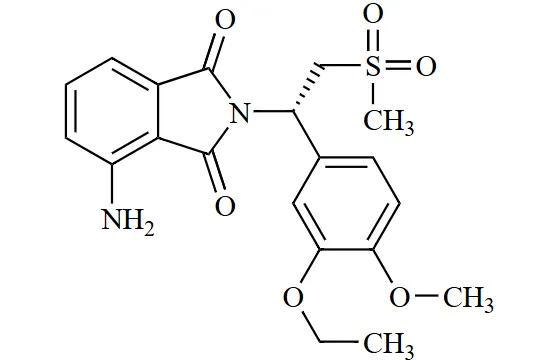
C12H19NO4S at 273.35 is the chiral amine: 1-(3-ethoxy-4-methoxyphenyl)-2-(methylsulfonyl)ethan-1-amine[2]. Count the atoms: twelve carbons for the aryl ring, the ethoxy methyl and ethyl, and the two carbons of the sulfonyl ethyl chain; one nitrogen; four oxygens, two on the sulfone and two on the ethers; one sulfur. The arithmetic closes exactly, and it identifies the fragment as the half of the molecule that has to be resolved before the phthalimide is closed.
That amine is chiral and it is resolved as a diastereomeric salt with N-acetyl-L-leucine, C8H15NO3, 173.21[4]. The salt is then broken, the free amine is carried forward, and the acid goes back into the solvent stream. This is where the catalogues become informative: the same series carries the amine, the amine salt, and N-nitroso-N-acetyl-L-leucine at 202.21, which is 173.21 plus 29.00[2]. Someone put that nitroso compound into a reference-standard catalogue because somebody else needed to quantify it.
N-acetyl amino acids are secondary amides. They nitrosate on the amide nitrogen under exactly the conditions that nitrosate an acetamide: nitrous acid, or any nitrite in the presence of acid. A stoichiometric resolving agent that is recovered and reused is a nitrosation substrate that cycles through the plant many times, which is a different exposure pattern from a single synthetic step.
The nitrosamine that is not in the catalogue
Two assessments follow, and they are not the same assessment. The first is the one the catalogue supports: N-nitroso-N-acetyl-L-leucine as a carry-over from the resolution, controlled by testing the acid inventory and by purging the salt. The second is the one the catalogue does not support: N-nitrosoacetamide on the intact drug, 489.48, controlled by preventing nitrite from meeting the acetamide nitrogen anywhere in the last three steps and in the formulation.
The second one is easy to dismiss because the entry is missing. Missing entries are the normal state of the world: a catalogue lists what has been made and sold, not what can be made. ICH M7 asks for an assessment of what the route can produce, and the answer here follows from the structure rather than from the list, because a secondary amide with a hydrogen on the nitrogen is the textbook substrate[3].
The same logic applies to the aniline that precedes the acetyl cap. Primary aromatic amines do not give stable N-nitrosamines, they give diazonium chemistry, and that is a different hazard category, but it is still a hazard that depends on nitrite availability in the same steps. The process question is therefore uniform: where can nitrite arrive, and what is downstream of that point.
25 ppm: the arithmetic at 60 mg a day
Dose decides whether any of this is measurable. Apremilast is taken as 30 mg twice daily, which is 60 mg a day[1]. The ICH M7 default limit is 1.5 micrograms of a nitrosamine per day, and 1.5 micrograms divided by 60 milligrams is 25 parts per million, or 0.0025 per cent[3].
Put that next to the ordinary organic impurity thresholds. The qualification threshold of ICH Q3A for a drug substance dosed above 2 g a day is 0.10 per cent, which at 60 mg is 60 micrograms a day[5]. A nitrosamine sitting at the qualification threshold is therefore 40 times the M7 limit. The two frameworks do not overlap on this molecule, and a specification that quotes only Q3A has not addressed nitrosamines at all.
The comparison table is worth keeping because the same arithmetic decides whether an analytical method is fit for purpose. At 25 ppm, a 30 mg tablet contains 0.75 micrograms of the nitrosamine. Dissolve that tablet in 10 mL and you are looking for 75 nanograms per millilitre, which is a mass-spectrometry problem, not a UV problem.
| Species | Formula | MW | Relation to parent | Limit at 60 mg/day |
|---|---|---|---|---|
| Apremilast | C22H24N2O7S | 460.49 | parent | not applicable |
| N-desacetyl apremilast | C20H22N2O6S | 418.46 | minus C2H2O, 42.03 | Q3A 0.10 per cent |
| N-nitrosoacetamide on the drug | C22H23N3O8S | 489.48 | plus NO, minus H, 29.00 | 25 ppm as a nitrosamine |
| N-acetyl-L-leucine | C8H15NO3 | 173.21 | resolving acid | not a drug impurity |
| N-nitroso-N-acetyl-L-leucine | C8H14N2O4 | 202.21 | plus NO, minus H, 29.00 | 25 ppm as a nitrosamine |
Note what the table does not say. It does not say that 25 ppm is the right limit for either nitroso compound. M7 gives a default for nitrosamines with a defined structure-activity relationship; where the structure supports a compound-specific limit, the limit changes, up or down, and the justification has to be written. The table says only that the default, applied to a 60 mg dose, lands at 25 ppm and not at the 0.10 per cent that a Q3A-only specification would suggest[3,6].
Where nitrite enters this route
Nitrite is rarely a starting material. It arrives in five ways that matter: as sodium nitrite in a diazotisation or nitrosation step somewhere upstream, as a contaminant in water or in an amine raw material, as a corrosion inhibitor in a cooling loop, as a rubber additive that leaches from gaskets and diaphragms, and as a degradation product of nitrate-containing excipients in the formulation. For an oral solid, the fourth and fifth dominate in practice, and both are invisible on a batch record[7].
The apremilast route has a nitro group at the start of the phthalimide half, which means the plant is already handling nitrate chemistry and has already had to answer the question of what happens to nitrite in the reduction step. That history is an advantage: the nitrite inventory is documented somewhere. The resolution and the acetylation are downstream of it, and the question is whether the documentation follows the stream that far.
The formulation side is simpler and often forgotten. A 30 mg tablet at 25 ppm contains 0.75 micrograms of nitrosamine. Nothing in the excipient list of a conventional immediate-release tablet is a nitrite source at that scale, but the film coat and the packaging are worth a look, and the stability protocol should include one nitrosamine test at the long-term condition rather than at release only.
Detection at 25 ppm, and why UV cannot do it
A nitroso compound on an acetamide has a weak n to pi star transition, and at 25 ppm it is invisible to a conventional 210 nm or 254 nm detector under the peak of a 460 Da parent injected at 1 mg per mL. The published related-substance method for this molecule runs an XBridge C18 column, 4.6 by 150 mm, 3.5 micrometre particles, with water adjusted to pH 3.0 with formic acid and an acetonitrile gradient, and it resolves twelve related substances, three process-related and nine degradation products, seven of them reported for the first time[8]. That method is the right starting point for the ordinary impurities and the wrong tool for the nitrosamine.
The nitrosamine needs its own method: LC with tandem mass spectrometry, either electrospray or atmospheric pressure chemical ionisation, with the nitroso compound monitored on its own transition, and with a column and mobile phase chosen so that the nitroso compound does not co-elute with the parent. The mass difference is 29.00, which is small enough that a single quadrupole on a crowded chromatogram will not do the job. Isotope-labelled internal standards are the practical way to hold recovery at these levels, and the recovery experiment has to be run in the presence of the tablet matrix, not in mobile phase.
One more methodological point that catches people: N-nitrosoamides are thermally labile in the inlet. Source temperature and the interface have to be chosen so that the compound survives long enough to be detected, and the method has to demonstrate that the parent drug does not decompose to the nitroso compound inside the instrument. A standard addition experiment at 25 ppm, at the top of the range, answers that question directly.
What the standards need to be
Three standards carry this assessment, and they are not interchangeable. The first is the parent, used for retention time and for the system suitability solution. The second is N-desacetyl apremilast, C20H22N2O6S, 418.46, which is the hydrolysis product of the acetyl cap and therefore the compound that tells you whether the acetamide is being lost in the bottle as well as in the process[2]. The third is N-nitroso-N-acetyl-L-leucine, 202.21, which is the only nitroso reference material that exists for this molecule in the catalogue.
For the nitroso compound, the certificate matters more than the label. A 202.21 standard used at 75 nanograms per millilitre should be supplied with a purity assigned by a quantitative method, a hygroscopicity statement, and a salt or hydrate form, because the difference between the free acid and a sodium salt of a 202 Da molecule is tens of per cent on a mass basis. Catalogues that list the same formula for a salt and its free base, as this series does for entry 55, are telling you that the formula field cannot be trusted as a weighing basis[2].
The glutarimide neighbours do not share this problem
Lenalidomide and pomalidomide are the obvious comparison, because they are also amino-substituted imides with an acetyl-like cap on an aromatic amine, and the immunomodulatory drug class shares the isoindoline core. The difference is the ring size and the substitution pattern: a six-membered glutarimide with a free imide N-H behaves quite differently from a five-membered phthalimide whose nitrogen carries an alkyl chain. On lenalidomide the imide nitrogen itself can be nitrosated, which is why the nitrosamine discussion for that molecule starts one atom earlier than it does here.
That comparison is useful for a specific reason. It shows that the nitrosamine question is not answered by the class, it is answered by which nitrogen is left with a hydrogen. Two molecules that look alike on a slide can have their only nitrosatable nitrogen in different rings, and the assessment has to be redone for each. Pomalidomide follows the same rule: its imide is unsubstituted, so the site inventory is different again.
The full apremilast series carries the amine intermediate, the salt, and the nitroso acid side by side, which is unusual and useful, because a supplier who lists all three has already accepted that the resolution step is part of the impurity story. That is the same logic that makes sitagliptin phosphate worth reading: its chiral amine is also resolved and also appears in the catalogue as a separate entry.
What to ask for in a dossier
Four questions close this out, and each has a documentary answer rather than an analytical one. Where is nitrite introduced in the route, and what is downstream of that point? Is the recovered N-acetyl-L-leucine tested for the nitroso compound before reuse, and at what limit? Does the acetamide nitrogen see any nitrite in the last three steps or in formulation? And does the stability protocol include one nitrosamine test at the long-term condition, on the finished product, rather than on the drug substance only?
The answers are cheap to produce if the process is documented and expensive to produce afterwards. What is not acceptable is the substitution of a catalogue search for an assessment: the presence of 202.21 in a supplier list proves that somebody once needed to measure the nitrosated resolving acid. It says nothing about whether the drug forms its own nitrosamine, and it is the second question that the regulator will ask.
Frequently Asked Questions
Does apremilast contain a nitrosatable secondary amine?
Why is the nitroso entry in the catalogue on the resolving acid?
Is 25 ppm the correct limit for the nitrosamine?
Can a UV method at 210 nm control the nitroso compound?
What is the significance of the duplicated numbers in this series?
Does the missing N-nitrosoacetamide entry prove it does not form?
Where should nitrite control sit for an oral solid?
Related Substances and Reference Standards
- Apremilast (161 impurity / derivative entries)
- Lenalidomide (- impurity / derivative entries)
- Pomalidomide (- impurity / derivative entries)
References and Sources
- DailyMed, US National Library of Medicine, Apremilast tablets, prescribing information: 30 mg twice-daily dosing after titration, and storage requirements, accessed 2026-11-22
- PubChem, National Library of Medicine, Apremilast, CAS 608141-41-9: molecular formula C22H24N2O7S, molecular weight 460.5, and the IUPAC name showing the 4-acetamido-isoindoline-1,3-dione core, accessed 2026-11-22
- International Council for Harmonisation, ICH M7(R2), Assessment and control of DNA reactive (mutagenic) impurities in pharmaceuticals to limit potential carcinogenic risk, accessed 2026-11-22
- PubChem, National Library of Medicine, N-Acetyl-L-leucine, CAS 1188-37-0: the resolving acid whose amide nitrogen carries the nitroso group in catalogue entry 165, accessed 2026-11-22
- International Council for Harmonisation, ICH Q3A(R2), Impurities in new drug substances: reporting, identification and qualification thresholds, accessed 2026-11-22
- US Food and Drug Administration, Control of nitrosamine impurities in human drugs: guidance for industry, accessed 2026-11-22
- European Medicines Agency, Nitrosamine impurities in human medicinal products: regulatory overview and the assessment report framework, accessed 2026-11-22
- Journal of Pharmaceutical and Biomedical Analysis, Identification and characterization of process-related substances and degradation products in apremilast: process optimization and degradation pathway elucidation, 2017, accessed 2026-11-22
This article was prepared by the CATO technical team. Regulatory, pharmacopoeial and published literature content cited above is attributed in the reference list. It is provided for technical exchange and search reference only and does not constitute a quality specification or regulatory advice. For any specific substance, the applicable test methods, limits and filing requirements are governed by the current regulations, pharmacopoeial monographs and official publications.
Product information on this site is provided for research search and selection reference only and is not a quality specification; technical data, purity and structural confirmation are governed by the shipped COA and our written confirmation. All products mentioned are for research use only, not for human or animal diagnostic or therapeutic use.