Aripiprazole: Two Fragments, One Active Metabolite and a Nitrosamine That Is Not on the Drug
Aripiprazole↗ is three pieces held by one ether bond, and almost every named impurity is either one of the pieces or the whole molecule with a single chlorine moved. That makes its limit-setting unusually explicit, and it puts the nitrosamine risk somewhere most assessments never look.
Note: product names shown in red (marked with ↗) are links - click through to the product page for structure, CAS number, purity and lead time.
A molecule in three pieces, joined by an ether and a butyl chain
Key points
- Aripiprazole, C23H27Cl2N3O2, 448.4, CAS 129722-12-9, is a dihydroquinolinone lactam joined through a butyl chain to a dichlorophenylpiperazine[1].
- Its two fragments are separately catalogued because they are also the two starting materials: 163.17 and 231.12[1].
- One lettered impurity, EP E at 446.4, is the drug's own active metabolite; two others, EP C and EP D, are monodeschloro regioisomers at one formula[1,2].
- The API carries no secondary amine, so the nitrosamine risk sits on a degradation fragment rather than on the drug: 260.12 is that fragment plus NO minus H[1].
Aripiprazole is assembled from three pieces that behave very differently in a stability programme. At one end sits a 3,4-dihydroquinolin-2-one — a lactam fused to a benzene ring, with the phenolic oxygen at position 7 carrying the rest of the molecule. In the middle is a butyl chain. At the other end is a piperazine bearing a 2,3-dichlorophenyl group. C23H27Cl2N3O2, 448.4, CAS 129722-12-9[1].
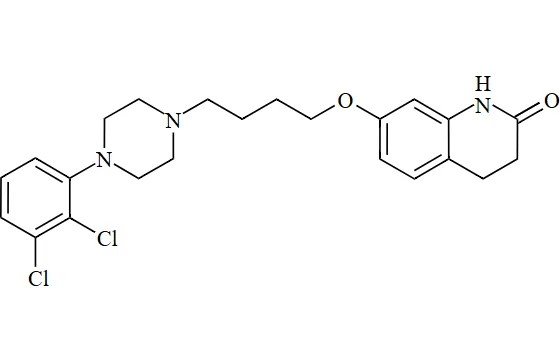
Two bonds define the impurity map. The ether link between the quinolinone oxygen and the butyl chain is the only easily cleaved connection in the molecule, and cleaving it releases both fragments at once. The carbon-chlorine bonds on the phenyl ring are the other weak point, and losing one of them gives a family of monochloro analogues that differ from the drug by 35.5 Da.
So most named aripiprazole impurities are not modified versions of the whole molecule. They are either one of the two fragments or the whole molecule with a single substituent changed, and that changes how a method is built: the fragments elute far from the drug, the monochloro analogues elute close to it.
The two fragments at 163.17 and 231.12 are also the raw materials
The two fragments are worth naming precisely, because both are also raw materials and both are sold as impurities under several labels.
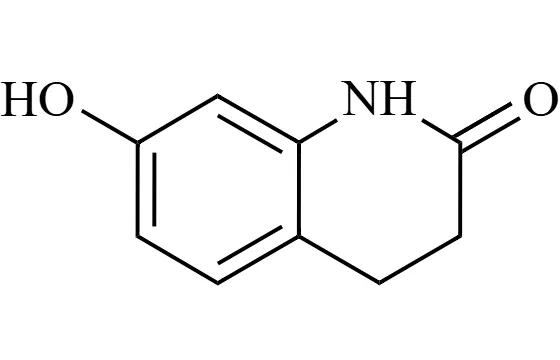
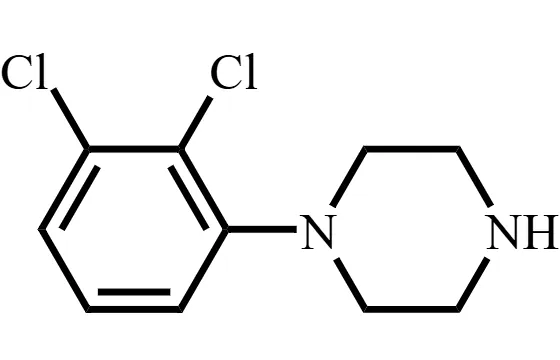
7-Hydroxy-3,4-dihydrocarbostyril, C9H9NO2 at 163.17, is the lactam half. It is small, it is phenolic, and it has a lactam N-H, which makes it far more polar than the drug. 1-(2,3-Dichlorophenyl)piperazine, C10H12Cl2N2 at 231.12, is the amine half: a secondary amine, strongly basic, aromatic, and the fragment that later becomes the nitrosamine precursor.
Because these are starting materials, they enter a batch from two directions and they leave it by two routes: unreacted carry-over and hydrolysis of the finished molecule. That double origin matters at the review stage. A specification that treats them purely as process impurities invites the question of why they also appear in accelerated stability samples, and the answer is that the ether bond hydrolyses.
The catalogue reflects the commercial reality of that fragment: five entries share the hydrochloride formula C10H12Cl2N2·HCl and five the free base, which is what a positional isomer of the dichlorophenyl ring would also weigh. Distinguishing 2,3- from 2,4- and 3,4-substitution is chromatographic, not mass spectrometric.
Two monochloro analogues at one formula, separated only by position
Losing one chlorine gives C23H28ClN3O2 at 413.9, and two entries carry that formula: one recorded as deschloroaripiprazole and one as the 2-deschloro isomer. The formula is identical; the difference is which position retains its chlorine.
This is the most easily mishandled group in the set. A monochloro analogue is 35.5 Da lighter than the drug, which is a comfortable mass difference, but the two isomers are not distinguishable by mass at all, and their ultraviolet spectra are nearly identical because the chromophore is the same quinolinone and the same phenyl ring. Everything rests on retention.
Retention depends on the position of the chlorine in a predictable way. A chlorine ortho to the piperazine nitrogen crowds the bond and reduces conjugation; moved para it extends the conjugated system and raises lipophilicity. So the para isomer elutes later, and the assignment can be reasoned rather than guessed, then confirmed with a standard.
EP impurity E: the impurity that is also the active metabolite
The entry at C23H25Cl2N3O2, 446.4, is two hydrogens below the drug, and it is dehydroaripiprazole: the dihydroquinolinone oxidised to the fully conjugated quinolinone. 448.4 minus 2.02 is 446.4, and the change turns a saturated lactam into an aromatic one.
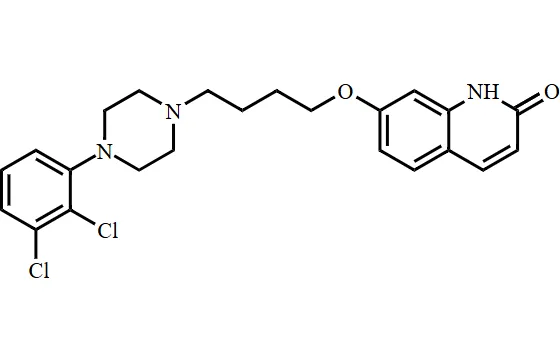
That single oxidation has three consequences that no other impurity in this set combines. It is a degradation product, formed on storage by oxidation of the benzylic position. It is a process impurity, because the last synthetic step is a reduction that can be left incomplete. And it is pharmacologically active: dehydroaripiprazole is the drug's principal active metabolite, with a long half-life and its own contribution to exposure[2].
An impurity that is also an active metabolite cannot be qualified by the ordinary route. ICH Q3A asks whether a degradation product above the qualification threshold has been qualified in safety studies, and the answer for this one is unusual: the substance has been studied extensively in humans, but as a metabolite, at concentrations generated in vivo, not as a spiked impurity in a tablet. Those are different questions, and a dossier that answers the second by pointing at the first will be asked to explain itself.
So the limit for EP E needs two justifications at once: the toxicological coverage that already exists, and the pharmacological contribution at the specified level. The second is harder, because the metabolite is active at low concentrations and a 0.15 per cent specification at a milligram dose is a small absolute amount.
Two N-oxides at 464.4, and why the nitrogen matters
Oxidation of the two piperazine nitrogens gives a second isobaric pair. N1 sits on the dichlorophenyl ring, N4 on the butyl chain, and both can carry an oxygen: C23H27Cl2N3O3 at 464.4, one oxygen above the drug, appears twice in this catalogue.
The two are chemically distinct in a way that matters. The N1-oxide loses the aromatic character of the aniline-type nitrogen, and its lone pair can no longer conjugate with the ring, which changes both its spectrum and its basicity. The N4-oxide keeps that conjugation intact and simply becomes a more polar centre. On a C18 column the N1-oxide moves earlier, and the gap is larger than 16 Da would suggest.
Both are partly reversible in solution, which matters before treating them as stable degradants. An N-oxide that re-forms the amine during sample preparation will under-report, and a peak that shrinks between injections points at the diluent rather than the column.
The dimer at 922.8, and the gradient that hides it
The largest entry in the set is the dimer: C48H56Cl4N6O4 at 922.8, catalogued as EP impurity G. Two aripiprazole units would weigh 896.7, so the recorded formula carries C2H2 more than the sum of two molecules.
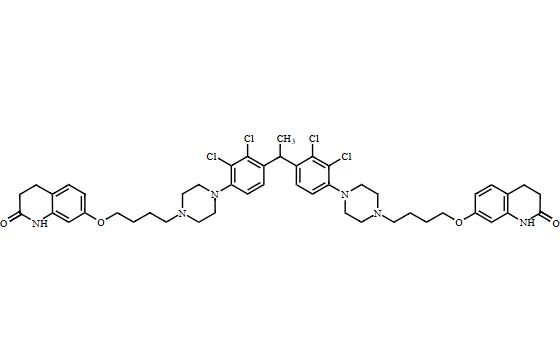
The extra C2H2 is diagnostic: it points to a linkage built from the butyl chains, with two molecules joined and two carbons retained in the bridge. For an analyst the practical point is simpler. A 923 Da species is much larger than the drug, elutes very late on a reversed-phase gradient, and is easy to miss if the gradient ends before it leaves the column.
Dimer limits are usually set as a group rather than as individual structures, and that is the right approach here, because the chromatographic region is distinct and the individual structures are hard to establish without synthesis. What matters is the gradient: a method that stops at thirty minutes may simply not see the dimer, and a specification for it is then meaningless.
The nitrosamine sits on a degradant, not on the drug
The nitrosamine question for aripiprazole has an unusual answer. The drug has no secondary amine: the piperazine nitrogens are both tertiary, one bonded to the aryl ring and one to the butyl chain, and the only N-H in the molecule belongs to the lactam, which is an amide and not a nitrosatable amine in the usual sense.
So the nitrosamine risk does not sit on the API. It sits on EP impurity B, 1-(2,3-dichlorophenyl)piperazine, which is a secondary amine and which is present in every batch at some level, both as carry-over and as a hydrolysis product. Nitrosation of that fragment gives 1-(2,3-dichlorophenyl)-4-nitrosopiperazine: C10H11Cl2N3O at 260.12, which is 231.12 plus NO minus H[1].
That entry exists in this catalogue, labelled as the N-nitroso derivative of EP impurity B, and its existence is the practical argument. A nitrosamine risk assessment for this molecule that stops at the API structure will conclude there is nothing to assess. A risk assessment that follows the degradation map will find a secondary amine, an aromatic ring that stabilises the nitrosamine, and a plausible nitrosating source in any formulation containing nitrite-bearing excipients.
Two details sharpen the assessment. The fragment is basic enough to be protonated at gastric pH, which slows nitrosation, but it is also small and volatile, so it distributes through a formulation in a way the parent does not. And the nitrosamine of an arylpiperazine is a different potency proposition from the nitrosamines of dialkylamines, which is exactly why compound-specific or read-across data are needed rather than a default potency class[3].
Limits in milligrams: percentages for Q3A, ppm for the nitrosamine
Aripiprazole is dosed in milligrams, which settles one question and opens another. Settled: every threshold in ICH Q3A is percentage-governed, because the 1.0 mg per day cap cannot bind below a gram of daily intake[4]. Open: the same arithmetic makes a nitrosamine limit very small in percentage terms.
| Daily dose | 1.5 micrograms per day, as ppm | 0.10 per cent, as micrograms | Ratio |
|---|---|---|---|
| 5 mg | 300 | 5.0 | about 1 to 3 |
| 10 mg | 150 | 10.0 | about 1 to 7 |
| 30 mg | 50 | 30.0 | about 1 to 20 |
Table note: the TTC of 1.5 micrograms per day is from ICH M7(R2)[5] and the 0.10 per cent identification threshold from ICH Q3A(R2)[4]. Doses are arithmetic examples across the milligram range, not label doses; substitute the maximum daily dose of the product in question. The ratio column is the absolute amount each criterion allows.
Read the last column as the answer to a design question. At the low end the two numbers are within a factor of three, so a method that can measure the identification threshold can also see the nitrosamine. At the high end the nitrosamine limit is twenty times lower in absolute terms, and a method validated only to 0.05 per cent is blind to it. That is the reason nitrosamine methods are specified separately and in mass terms rather than folded into a percentage-based related-substances method.
The fragment limits are a separate argument. EP impurity B is a secondary amine that is also a starting material, so its limit belongs in two places: the starting-material specification, where it is a reagent, and the drug substance specification, where it is a degradant. Setting only the second leaves the first uncontrolled.
Brexpiprazole transfers, iloperidone does not, olanzapine is a different failure
Three comparisons bound the argument.
Brexpiprazole is the closest analogue: a quinolinone ether linked through a butyl chain to a piperazine, with a benzothiophene instead of a dichlorophenyl. The ether hydrolysis, the fragment pair and the dehydro analogue all exist in principle, but the thiophene changes the oxidation chemistry, so the degradant that dominates here is not the one that dominates there. Method logic transfers; the impurity list does not.
Iloperidone is the instructive negative case. It contains a piperidine and no piperazine, and its aryl group is a fluoroacetophenone rather than a dichlorophenyl, so there is no N-aryl piperazine to hydrolyse and no nitrosatable fragment of the kind described here. A nitrosamine assessment copied from aripiprazole will look thorough and will have examined the wrong bond.
Olanzapine shows a different failure mode in the same class: its thiophene ring oxidises readily and those degradants dominate the profile (the olanzapine oxidation case). Two antipsychotics can share a patient population and nothing else.
Standards for a molecule whose impurities are its starting materials
This catalogue holds 108 aripiprazole entries, 14 of them EP-lettered. The entries carrying this argument are the drug at 129722-12-9, the two fragments at 22246-18-0 and 41202-77-1, the monochloro pair at 203395-81-7 and 203395-82-8, the dehydro metabolite at 129722-25-4, the N1-oxide at 573691-09-5, the dimer at 1797986-18-5 and the N-nitroso fragment at 2989508-28-1. [See every aripiprazole entry](Aripiprazole)
Two handling notes. The fragment standards are volatile amines: keep them as salts or in acidic solution, because a free base that adsorbs to glass gives a calibration curve with a memory. And the dimer needs a gradient long enough to elute it; if the method ends at thirty minutes, the dimer specification has never been tested.
show how crowded this molecule is, which is the argument for buying the named standards: with 14 lettered impurities plus two fragment series, a laboratory that identifies peaks by relative retention is one column change away from an incorrect dossier.Frequently Asked Questions
Does aripiprazole itself carry a nitrosamine risk?
Is dehydroaripiprazole an impurity or a metabolite?
Can EP impurity C and D be distinguished by mass?
Why does my assay miss the dimer?
Which limit applies to the two fragment impurities?
Is the N-oxide stable enough to calibrate against?
Do the monochloro analogues have to be controlled individually?
At milligram doses, is the percentage criterion always the binding one?
Related Substances and Reference Standards
- Aripiprazole (111 impurity / derivative entries)
- Brexpiprazole (142 impurity / derivative entries)
- Iloperidone (43 impurity / derivative entries)
- Olanzapine (50 impurity / derivative entries)
References and Sources
- U.S. National Library of Medicine, PubChem, Aripiprazole, CAS 129722-12-9, C23H27Cl2N3O2, 448.4; 7-hydroxy-3,4-dihydrocarbostyril, CAS 22246-18-0, C9H9NO2, 163.17; 1-(2,3-dichlorophenyl)piperazine, CAS 41202-77-1, C10H12Cl2N2, 231.12; dehydroaripiprazole, CAS 129722-25-4, C23H25Cl2N3O2, 446.4; aripiprazole N1-oxide, CAS 573691-09-5, C23H27Cl2N3O3, 464.4; aripiprazole dimer, CAS 1797986-18-5, C48H56Cl4N6O4, 922.8; deschloroaripiprazole, CAS 203395-81-7, and 2-deschloroaripiprazole, CAS 203395-82-8, both C23H28ClN3O2, 413.9; 1-(2,3-dichlorophenyl)-4-nitrosopiperazine, CAS 2989508-28-1, C10H11Cl2N3O, 260.12, accessed 2026-11-14
- Scientific Reports, Influence of ABCB1 polymorphisms on aripiprazole and dehydroaripiprazole plasma concentrations: dehydroaripiprazole measured as a circulating species in treated patients, accessed 2026-11-14
- U.S. Food and Drug AdministrationRecommended acceptable intake limits for nitrosamine drug substance-related impurities: the carcinogenic potency categorisation approach and its default potency classes
- International Council for Harmonisation, ICH Q3A(R2), Impurities in new drug substances: reporting, identification and qualification thresholds, and the 1.0 mg and 1.5 mg per day alternatives, accessed 2026-11-14
- International Council for Harmonisation, ICH M7(R2), Assessment and control of DNA reactive (mutagenic) impurities: the 1.5 microgram per day threshold of toxicological concern and its relation to compound-specific limits, accessed 2026-11-14
This article was prepared by the CATO technical team. Regulatory, pharmacopoeial and published literature content cited above is attributed in the reference list. It is provided for technical exchange and search reference only and does not constitute a quality specification or regulatory advice. For any specific substance, the applicable test methods, limits and filing requirements are governed by the current regulations, pharmacopoeial monographs and official publications.
Product information on this site is provided for research search and selection reference only and is not a quality specification; technical data, purity and structural confirmation are governed by the shipped COA and our written confirmation. All products mentioned are for research use only, not for human or animal diagnostic or therapeutic use.