Aspirin's 0.10 Percent Is Four Different Numbers, and Its Impurities Grow by One Acetyl at a Time
Aspirin is one substance sold across a fiftyfold dose range, and that single fact reorganises its impurity file. A threshold written as a percentage is a different quantity at 75 mg and at 4 g, and at the top of the range the absolute cap in ICH Q3A drops the identification threshold below the reporting threshold. The chemistry adds a second thread: salicylic acid is both the starting material and the hydrolysis product, and it goes on to build a series of esters whose masses differ by exact increments.
One molecule, four dose bands
Key points
- Aspirin is sold from 75 mg to 4 g a day, a fiftyfold span, and the impurity thresholds in ICH Q3A are percentages with a 1.0 mg per day cap[1].
- At 1 g per day the cap and the 0.10 per cent identification threshold land on the same number; above that the cap binds, and at 4 g the identification threshold falls to 0.025 per cent, below the 0.05 per cent reporting threshold.
- Salicylic acid is EP impurity A and has two origins, the acetylation step and ester hydrolysis, and it is also the building block of the ester cascade[2].
- The higher esters differ by exact increments: 120.11 for a salicyloyl unit, 42.04 for an acetyl, and two aspirin molecules minus water for EP impurity F[3][4].
Aspirin is acetylsalicylic acid, C9H8O4, 180.16, an acetyl ester on the phenolic oxygen of salicylic acid[5]. The ester is the whole idea: it survives the stomach better than the free phenol and it acetylates cyclooxygenase once absorbed. It is also the bond that fails.
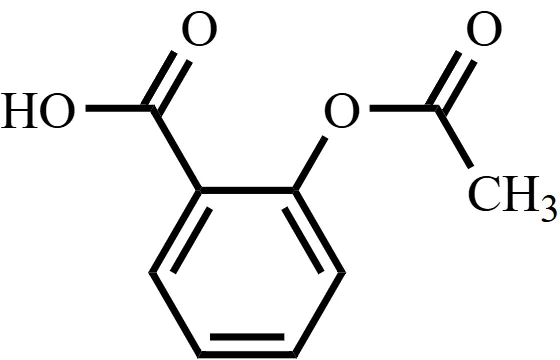
What makes this molecule unusual is not its chemistry but its dosing. The same substance is taken at 75 to 100 mg a day for platelet inhibition, at 325 to 650 mg every four to six hours for pain, and at 4 g a day or more for anti-inflammatory effect. That is a fiftyfold range for one monograph, and every impurity threshold written as a percentage means something different at each end of it.
Most impurity debates are about analytical capability. This one is about arithmetic, and the arithmetic can be done on the back of an envelope before any method is developed.
The thresholds are percentages with a mass cap
ICH Q3A sets three thresholds for a drug substance: 0.05 per cent for reporting, 0.10 per cent or 1.0 mg per day for identification, whichever is lower, and 0.15 per cent or 1.0 mg per day for qualification[1]. Read the second and third clauses carefully. Each is a percentage and a mass, and the lower of the two applies.
For most products the percentage wins, because the mass cap corresponds to an implausibly large relative amount. Aspirin is one of the few where the cap takes over, and the crossover is at a gram a day.
| Daily dose | 0.05 % equals | 0.10 % equals | 1.0 mg cap equals | Identification threshold |
|---|---|---|---|---|
| 75 mg | 37.5 µg | 75 µg | 1.33 % | 0.10 % |
| 100 mg | 50 µg | 100 µg | 1.00 % | 0.10 % |
| 325 mg | 163 µg | 325 µg | 0.31 % | 0.10 % |
| 500 mg | 250 µg | 500 µg | 0.20 % | 0.10 % |
| 1000 mg | 500 µg | 1.00 mg | 0.10 % | 0.10 %, both clauses coincide |
| 2000 mg | 1.00 mg | 2.00 mg | 0.05 % | 0.05 %, the cap governs |
| 4000 mg | 2.00 mg | 4.00 mg | 0.025 % | 0.025 %, below the reporting threshold |
Table note: thresholds from ICH Q3A(R2)[1]; the mass equivalents are calculated from the daily dose shown and are not pharmacopoeial values.
The last row is the one worth carrying into a review meeting. At 4 g a day, an impurity present at 0.03 per cent is above the identification threshold and below the reporting threshold. The usual sequence — report, then identify, then qualify — has no gap left in it, because there is nothing that needs reporting but not identifying.
The same 0.10 per cent is ten times stricter on the low-dose tablet
The absolute level is what the patient receives, and that is where the dose bands separate. At 100 mg a day, 0.10 per cent is 100 µg; at 4 g a day, the identification threshold of 0.025 per cent is 1.0 mg. The low-dose product therefore allows a tenth of the mass, while its percentage limit is four times looser.
This is the practical reason a single set of limits cannot be lifted from an analgesic tablet and applied to a cardiovascular tablet of the same substance. The percentage is a property of the method; the mass is a property of the patient. When the two disagree, the mass is the one that has to be defended.
It also changes what a stability study is for. On the 4 g product, a 0.02 per cent rise in salicylic acid is a specification event. On the 75 mg product, the same relative rise is 11 µg and the limit never moves. Two products, one degradation pathway, and quite different consequences for the same analytical result.
Salicylic acid is impurity A, and it has two origins
EP impurity A in this catalogue is salicylic acid, C7H6O3, 138.12, at CAS 99-96-7[2]. It arrives by two routes that a specification cannot distinguish.
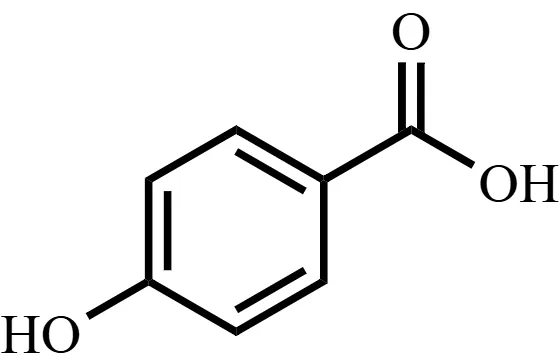
The first is incomplete acetylation. Aspirin is made by acetylating salicylic acid, and any unreacted starting material that survives crystallisation is impurity A with a process history. The second is hydrolysis of the product: water attacks the ester, acetic acid is released, and salicylic acid appears. The two are chemically identical and analytically indistinguishable.
That matters because the correct response is opposite in each case. A process origin calls for better conversion or a recrystallisation study; a degradation origin calls for moisture control and a packaging change. The way to separate them is not a better assay but a batch trend: a level that is constant across zero-time samples of several batches is process; a level that climbs with time in the stability chamber is degradation. One number from one batch answers nothing.
There is a third, quieter pathway. Salicylic acid is a phenol and a carboxylic acid in the same molecule, so it is a substrate for further acylation, which is where the rest of the impurity file comes from.
The ester cascade: 120.11, then 42.04
The lettered impurities above A are not a random collection. Their masses fall on a grid, and the spacing tells you how they were built.
| Entry | CAS | Formula | Mass | Difference from the one above |
|---|---|---|---|---|
| Salicylic acid, EP A | 99-96-7 | C7H6O3 | 138.12 | starting point |
| Salsalate, EP E | 552-94-3 | C14H10O5 | 258.23 | + 120.11, one salicyloyl unit |
| Acetylsalicylsalicylic acid, EP D | 530-75-6 | C16H12O6 | 300.27 | + 42.04, one acetyl |
| Acetylsalicylsalicylsalicylic acid | 85531-16-4 | C23H16O8 | 420.37 | + 120.11, one more salicyloyl |
| EP F | 1466-82-6 | C18H14O7 | 342.30 | two aspirin minus one water |
Table note: formulas and CAS from the catalogue records[3][4]; masses calculated from the formulas.
Two increments account for the family. A salicyloyl unit adds C7H4O2, which is 120.11; an acetyl adds C2H2O, which is 42.04. Both are the arithmetic of a reaction mixture in which an acylating agent is present in excess and the substrate carries two nucleophiles, a phenol and a carboxylate. Esterification can run through either, and it can run twice.
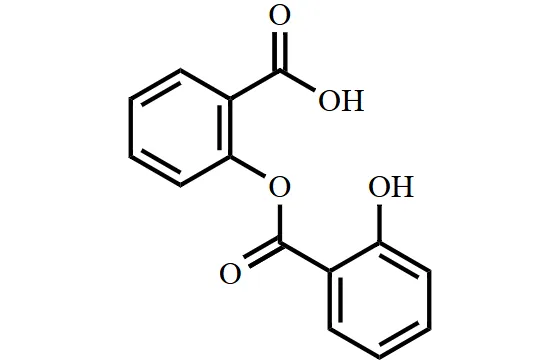
Salsalate is the simplest case: two salicylic acid molecules joined through the phenol of one and the acid of the other, with water lost. It is a marketed drug in its own right, which is worth remembering when it appears as an impurity — the toxicology is not the constraint, the specification is.
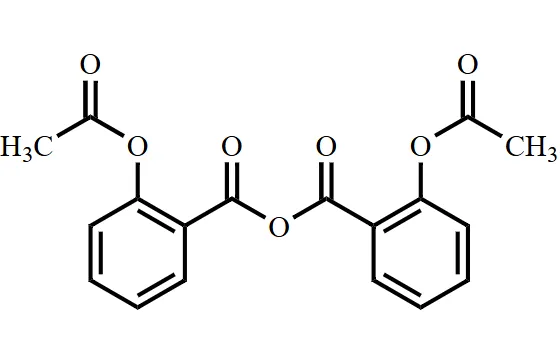
Impurity F is the cleanest demonstration that this is arithmetic and not speculation. C18H14O7 at 342.30 is exactly two aspirin molecules, C18H16O8 at 360.32, less one water. A dimeric ester of aspirin explains the formula without any further assumption, and a moisture-driven condensation explains how it forms.
Same formula, wrong position
The catalogue carries one entry with the molecular formula of aspirin itself that is not aspirin: 5-acetylsalicylic acid, C9H8O4, 180.16, at CAS 13110-96-8[6]. As the name says, the acetyl sits on a ring carbon rather than on the phenolic oxygen.
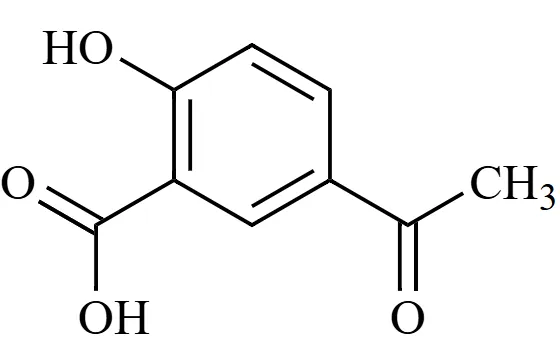
Every consequence follows from that one difference. The mass is identical, so a single-quadrupole method cannot tell them apart; the fragment ions are close enough that even tandem mass spectrometry needs care; the ultraviolet spectra are those of two acylated benzoic acids and differ little. What differs is retention, and retention is only useful if someone injected the standard.
There is also a specificity question for the assay. An isocratic method developed for aspirin and salicylic acid, with a run time chosen to separate those two, has no reason to resolve a third species that elutes near the main peak. The 0.10 per cent limit then applies to a peak that is being integrated as part of the main one, and the reported purity is slightly optimistic in a way no system suitability test will catch.
The general rule is worth stating: when a catalogue carries two entries with one formula, the method must be shown to resolve them, not assumed to.
Acetic acid, moisture, and the enteric paradox
Hydrolysis of aspirin consumes water and produces salicylic acid and acetic acid. The acetic acid is volatile, which is why a bottle of old tablets smells of vinegar and why that smell is a better field test than most people expect. It is also an acid in a solid that now contains less water than it did, and ester hydrolysis of this kind is catalysed by acid and by base, so the reaction changes its own environment as it proceeds.
The formulation response is conventional: keep water out. Anhydrous excipients, low moisture specification on the granulation, a desiccant in the pack, and a moisture barrier. Where the product is a tablet rather than a powder, the residual moisture after drying is the variable that correlates with salicylic acid on stability, not the ambient humidity of the plant.
Enteric coating introduces a paradox that is rarely written down. The coat exists to keep aspirin out of the stomach, where it irritates the gastric mucosa; it dissolves at intestinal pH. But alkaline pH is exactly where ester hydrolysis is fastest, so the coated product delivers its dose into the compartment where the molecule is least stable. The coating protects the patient, not the drug, and a stability programme that only considers the coated tablet as a whole will not see the difference — the coat is intact and the assay is fine until it is not.
For the drug product, the thresholds come from ICH Q3B, which applies its own table and its own absolute caps[7]. The logic is the same as in Q3A: a percentage and a mass, whichever is lower, assessed against the dose actually taken. The numbers differ; the arithmetic does not.
Where aspirin stops being a model for its neighbours
Ibuprofen is the easy comparison and the wrong one. It is a propionic acid with no ester, no phenolic oxygen and no hydrolysable group, so its impurity file is about synthesis and about the racemate, not about water. Nothing in the aspirin ester story transfers to it, and a stability protocol copied across would test the wrong variable.
Paracetamol is closer in appearance and further in consequence. Its amide hydrolyses to 4-aminophenol, an aromatic amine with its own toxicological limit and its own colour chemistry; the degradant is a different kind of hazard, not a milder version of the same one. Aspirin's degradant, by contrast, is a drug that is sold on its own, so the limit is driven by dose arithmetic rather than by a toxicological threshold.
The salicylates are the family where the distinctions blur. Salsalate is the ester of two salicylic acids and is itself a product; Diflunisal is a difluorophenyl salicylate with no acetyl to lose. In each case the same two functional groups appear in different combinations, and the impurity file follows the combination rather than the class.
Filing activity reflects how mature this molecule is: CDE public records show 390 accepted filings from 221 applicants as of 16 November 2026[8]. Those are acceptance records, not approvals, and the volume says nothing about current competition — only that the impurity file has been examined, repeatedly, by almost everyone.
This catalogue holds 34 aspirin entries, of which the lettered series runs A, B, D, E and F; C is not carried. For a molecule whose impurities are built from two repeating increments, the useful purchase is the set that lets you prove the increments: see all aspirin entries.
Frequently Asked Questions
Why does the identification threshold fall below the reporting threshold at high dose?
Salicylic acid is a licensed drug. Does that mean it needs no toxicological limit?
Can a single related-substances method cover both a 75 mg and a 500 mg tablet?
The higher esters are present at very low levels. Why buy standards for them?
Does the enteric coating protect aspirin from hydrolysis?
Why is acetic acid relevant to a specification that does not test for it?
Is 5-acetylsalicylic acid really a separate substance from aspirin?
Related Substances and Reference Standards
- Ibuprofen (85 impurity / derivative entries)
- Acetaminophen (48 impurity / derivative entries)
- Diflunisal (15 impurity / derivative entries)
References and Sources
- ICH (International Council for Harmonisation), ICH Q3A(R2): Impurities in New Drug Substances (reporting 0.05 per cent; identification 0.10 per cent or 1.0 mg per day, whichever is lower; qualification 0.15 per cent or 1.0 mg per day), accessed 2026-11-16
- PubChem, Salicylic acid, CID 135: C7H6O3, 138.12 (catalogue entry acetylsalicylic acid EP impurity A, CAS 99-96-7), accessed 2026-11-16
- PubChem, Acetylsalicylsalicylic acid, CID 10745: C16H12O6, 300.26 (catalogue entry acetylsalicylic acid EP impurity D, CAS 530-75-6), accessed 2026-11-16
- PubChem, Salsalate, CID 5161: C14H10O5, 258.23 (catalogue entry acetylsalicylic acid EP impurity E, CAS 552-94-3), accessed 2026-11-16
- PubChem (National Center for Biotechnology Information), Acetylsalicylic acid, CID 2244: C9H8O4, 180.16, accessed 2026-11-16
- PubChem, 5-Acetylsalicylic acid, CID 83151: C9H8O4, 180.16 (catalogue entry, CAS 13110-96-8), accessed 2026-11-16
- ICH, ICH Q3B(R2): Impurities in New Drug Products (degradation product thresholds and absolute caps), accessed 2026-11-16
- Center for Drug Evaluation, NMPA (CDE), Accepted filing records for aspirin, retrieved 16 November 2026: 390 records from 221 applicants. Acceptance records are not approvals, accessed 2026-11-16
This article was prepared by the CATO technical team. Regulatory, pharmacopoeial and published literature content cited above is attributed in the reference list. It is provided for technical exchange and search reference only and does not constitute a quality specification or regulatory advice. For any specific substance, the applicable test methods, limits and filing requirements are governed by the current regulations, pharmacopoeial monographs and official publications.
Product information on this site is provided for research search and selection reference only and is not a quality specification; technical data, purity and structural confirmation are governed by the shipped COA and our written confirmation. All products mentioned are for research use only, not for human or animal diagnostic or therapeutic use.