Azathioprine Is Two Rings and One Sulfur: Reading Its Impurity Series as a Route Document
Azathioprine↗ is C9H7N7O2S, 277.26, and it is built from two rings that have nothing to do with each other, joined by a single sulfur. That bond is the drug: it hydrolyzes to release 6-mercaptopurine, and it is the bond that fails in the bottle. Read the impurity series with that in mind and it stops looking like a random list. Four entries are the imidazole half with the wrong leaving group, four are the purine half part-way through oxidation, and one carries a nitrogen the drug does not have at all.
Note: product names shown in red (marked with ↗) are links - click through to the product page for structure, CAS number, purity and lead time.
One sulfur holds two unrelated molecules together
Key points
- Azathioprine is C9H7N7O2S, 277.26: a hypoxanthine-based purine joined to a 1-methyl-4-nitroimidazole by one thioether bond, and the label asks for storage in a dry place protected from light[1,2].
- Four entries in the impurity series are the imidazole half with a different leaving group at the same carbon: chloride, thiol, hydroxyl and amino. That is a substitution reaction inventory, not a degradation pattern[3,4].
- The purine half oxidizes. 6-Mercaptopurine, 152.18, is both EP impurity B and the active metabolite; 6-thiouric acid, 184.18, and hypoxanthine, 136.11, are one and two oxidation steps further on[5,6].
- One entry, thiamiprine at 292.28, carries an extra ring nitrogen that no degradation route can install. It can only have arrived with the purine starting material[7].
Azathioprine is C9H7N7O2S, 277.26. The purine is a hypoxanthine skeleton with the 6-position carrying sulfur instead of oxygen, and that sulfur is bonded to C5 of a 1-methyl-4-nitroimidazole[2]. It is a 50 mg tablet, dosed by body weight, and the label asks for storage in a dry place, protected from light, in a tight light-resistant container[1].
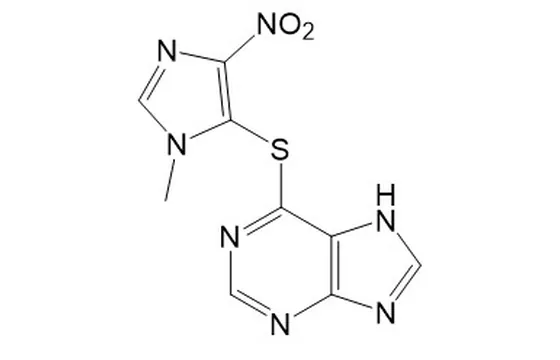
Most prodrugs hide a polar group behind an ester. This one hides a thiol behind a thioether, and the two halves are pharmacologically unrelated. The purine is the antimetabolite. The nitroimidazole is the mask: it makes the compound orally available and keeps the thiol from being conjugated before it is absorbed. It also leaves the drug as a fragment, not as part of it.
That structure dictates the impurity strategy. A molecule made of two rings joined by one bond will be accompanied by whatever else could have formed that bond, and by whatever happens to the two rings afterwards. Both appear in the series, and they appear separated: the imidazole entries look like process chemistry, and the purine entries look like oxidation.
Four imidazole entries, one leaving group
Line up the imidazole fragments and the pattern is immediate. Each is the same ring with a different substituent at the same carbon, the carbon that carries the sulfur in the drug.
| Entry | Substituent at C5 | CAS | Formula | MW | What put it there |
|---|---|---|---|---|---|
| EP impurity C | Cl | 4897-25-0 | C4H4ClN3O2 | 161.55 | Unreacted alkylating fragment[3] |
| EP impurity D | SH | 6339-54-4 | C4H5N3O2S | 159.17 | Sulfide instead of the purine thiolate[4] |
| EP impurity E | OH | 73703-74-9 | C4H5N3O3 | 143.10 | Hydrolysis of the same carbon |
| EP impurity A | NH2 | 4531-54-8 | C4H6N4O2 | 142.12 | Ammonia or ammonium in the workup |
Table note: formulae and molecular weights from the PubChem records for each CAS number; the assignments to EP letters follow the catalog entries for this substance.
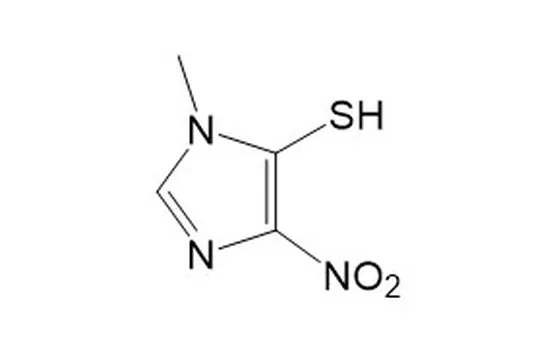
Read the right-hand column as a list of nucleophiles: water, ammonia, sulfide, and nothing at all. Each is one side reaction away from the product in an aqueous displacement run with an ammonium salt and a sulfur nucleophile. The set is diagnostic of the step rather than of storage, because degradation does not produce a chloro compound in a tablet that contains no chloride source.
The practical consequence is that these four entries are controlled by process understanding, not by stability data. If a batch shows EP impurity E at 0.08 percent and EP impurity C at 0.01 percent, the question is not what happened in the stability chamber. The question is the water content and the stoichiometry of one step.
The purine side oxidizes, and one product is the drug itself
The purine half behaves like a thiopurine, which is to say it oxidizes readily and its sulfur can be replaced by oxygen. The series records that ladder in full.
| Species | Formula | MW | Relation to the one before |
|---|---|---|---|
| 6-Mercaptopurine, EP impurity B | C5H4N4S | 152.18 | The thioether hydrolyzed; also the active metabolite[5] |
| 6-Thiouric acid | C5H4N4O2S | 184.18 | Plus two oxygens at C2 and C8[6] |
| Hypoxanthine, EP impurity F | C5H4N4O | 136.11 | Sulfur replaced by oxygen, 16.07 mass units lost |
| 6,6-Thiodipurine | C10H6N8S | 270.28 | Two 6-mercaptopurine units joined by sulfur, less hydrogen sulfide[8] |
Table note: the last column is arithmetic on the formulae, not a mechanistic assignment. 2 x 152.18 minus 34.08 for hydrogen sulfide is 270.28, which is the recorded molecular weight of the dipurine sulfide.
One row deserves separate attention. EP impurity B is 6-mercaptopurine, which is the drug the patient is being given, in the sense that every pharmacological effect of azathioprine is mediated by it. A degradant that is the active substance is a different kind of problem from a degradant that is an inert by-product: one percent of it is one percent more active drug, delivered without the masking group that shapes absorption.
So the 6-mercaptopurine limit is simultaneously a purity limit and a potency limit, and a specification that reports total impurities without reporting that one has measured the wrong thing. The two halves cannot be summed either: a 0.4 percent 6-mercaptopurine result and a 0.4 percent thiouric acid result are not equivalent events.
The impurity that carries a nitrogen the drug does not have
One entry breaks the pattern. Thiamiprine, C9H8N8O2S, 292.28, is 15.02 mass units above the drug, which is the mass of NH. The drug has seven nitrogens; this has eight, and the extra one sits at C2 of the purine as an amino group, where the drug has a hydrogen[7].
Run through the possible origins. Hydrolysis cleaves the thioether and changes nothing on the ring. Oxidation adds oxygen. Photolysis does not aminate a purine. Installing an amino group at C2 needs ammonia and an activated ring position, and the finished molecule has neither.
That leaves the starting material. 2-Amino-6-mercaptopurine, thioguanine, is the direct analogue of 6-mercaptopurine, and it alkylates the same chloroimidazole in the same way. If the 6-mercaptopurine lot carries a little thioguanine, the next step converts it faithfully into thiamiprine. The impurity is a record of the supplier, not of the process.
This is the most useful single observation in the series, because it tells you where to look and what to ask for. The response is not a recrystallization. It is a tighter specification on 2-amino-6-mercaptopurine in the incoming purine, and a spiking experiment showing how much of it survives the coupling and the isolation.
What the thresholds actually bind at 140 mg a day
A 70 kg patient at 2 mg per kg takes 140 mg a day, which is well under the 2 g ceiling where ICH Q3A changes its numbers. So the general thresholds apply as written: reporting at 0.05 percent, identification at 0.10 percent or 1.0 mg per day, qualification at 0.15 percent or 1.0 mg per day[9]. Converted, those are 70, 140 and 210 micrograms a day.
Now put the mutagenic threshold beside them. A threshold of toxicological concern of 1.5 micrograms a day is 0.0011 percent of a 140 mg dose, ninety times below the general identification threshold[9]. Whether any of these fragments is mutagenic is a question for the battery, not for this page. If one of them is, the general limits are irrelevant and the specification has to be built on the arithmetic rather than the 0.10 percent default.
That is the asymmetry worth carrying away from this molecule. Its general impurities sit comfortably inside a percentage regime, because the dose is large enough. A single mutagenic species among them would not, and the four imidazole entries include a nitroaromatic chloride, which is the kind of structure that gets tested rather than argued about.
Where metal ions decide which degradant you see
Hydrolysis of the thioether is expected to give 6-mercaptopurine. It does not always. A study of azathioprine with a diruthenium system found an unusual hydrolysis that produced hypoxanthine instead of the expected thiol, with the sulfur replaced rather than released[10].
The observation is worth more than its exotic context. It says that the ratio of 6-mercaptopurine to hypoxanthine in a stressed sample is not a fixed property of the molecule: it depends on what the sample is in contact with. Stainless steel frits, metal ions leached from excipients, and an unbuffered mobile phase all move that ratio.
For a method this matters twice. Once in sample preparation, where contact time with metal surfaces should be short and consistent. Once in interpretation, where a hypoxanthine peak in a product that contains no hypoxanthine source other than its own thiol is evidence about the container, not necessarily about the batch.
Method design around a thiol and a masked thiol
The two halves are 125.08 mass units apart and both absorb in the same ultraviolet region, which makes a single-wavelength assay possible and a small 6-mercaptopurine peak easy to lose. A stability-indicating HPLC method with diode array detection has been published for azathioprine, including a compatibility study with folic acid, which is commonly co-prescribed in the same patient[11].
Three practical requirements follow from the chemistry rather than from the literature. Keep the mobile phase acidic, because a thiolate is a different chromatographic species from a thiol and the transition happens across a narrow pH window. Keep a metal-complexing agent or an inert column hardware in the system, because the thiol will find metals. And run a blank injection after every high-concentration standard, because thiol carryover is not visible as a peak shape problem and does not correct itself.
The fourth requirement is about identity rather than separation. Azathioprine, 6-mercaptopurine and hypoxanthine differ by 125, 16 and 16 mass units, and a single quadrupole will separate them on mass alone, so the mass confirmation is easy. What is not easy is proving that the small peak at 4.6 minutes is 6-mercaptopurine and not one of the imidazole fragments eluting in the same window. That needs a standard and a spiked sample, not a mass trace.
How many products share this specification
The Chinese filing record for azathioprine is compact, and compactness is useful here: the impurity questions raised by one applicant are raised by all of them, on a molecule where the two halves fail for different reasons.
The count is accepted filings rather than approvals, and it should be read as the number of dossiers that had to explain a 2-aminopurine they did not put there.
What transfers to other sulfur drugs, and what does not
Captopril is the obvious comparison because it also carries a thiol, and the comparison is instructive precisely where it fails. Captopril↗ oxidizes to a disulfide dimer of itself, two sulfurs, symmetric. Azathioprine has one sulfur in a thioether, so the analogous dimer is a sulfide bridge, one sulfur between two purines, and that is what the series records at C10H6N8S[8]. Anyone who reaches for a disulfide structure here will draw the wrong molecule.
Methotrexate shares the purine-like antimetabolite logic and shares none of the chemistry: a pteridine ring with no sulfur does not produce a thiol ladder, and its degradation is dominated by photolysis and by the glutamate tail. The lesson transfers, the entries do not.
Anastrozole is a closer analogue in one respect: its specification is also a list of what happened at a single bond. There the bond is a benzylic carbon and the entries are halides and alcohols; here the bond is a thioether and the entries are four nucleophiles. Both specifications are route documents wearing the clothes of stability data.
Folic acid deserves a mention for a different reason: it is the excipient-adjacent partner in the compatibility study, and a photolabile pteridine next to a photolabile nitroimidazole is a combination where the light-protection statement on the label is doing real work rather than being boilerplate.
Five failures that recur on this molecule
One: summing the imidazole fragments and the purine fragments into a single total. They arise from different steps, are controlled by different levers, and one of them is the active drug.
Two: treating 6-mercaptopurine as an ordinary unspecified degradant. It is EP impurity B, it is the metabolite, and its level is a potency statement.
Three: assuming hypoxanthine means the batch is old. Metal contact moves the 6-mercaptopurine to hypoxanthine ratio in either direction[10].
Four: missing the 2-aminopurine because it was never on the target list. It arrives with a starting material and will not appear in a forced degradation study at all[7].
Five: running the photostability study without a clear-glass arm, on a molecule whose label already asks for light protection[1].
Standards that match the two halves
This catalog carries 18 entries under azathioprine, numbered to 19 with gaps at 9, 12 and 16, and it is organized the way the chemistry is: four imidazole fragments, the purine ladder, and the 2-amino outlier. EP impurity C is the chloride at CAS 4897-25-0, EP impurity D the thiol at 6339-54-4, EP impurity E the hydroxyl at 73703-74-9, and EP impurity A the amine at 4531-54-8. On the purine side, 6-mercaptopurine is available as the free thiol at CAS 50-44-2 and as the sodium salt at 55774-33-9, followed by 6-thiouric acid at 2002-60-0 and the dipurine sulfide at 90947-51-6. Thiamiprine, the 2-amino outlier, is at CAS 5581-52-2. The full list with formulae is on the variety page: Azathioprine reference standards.
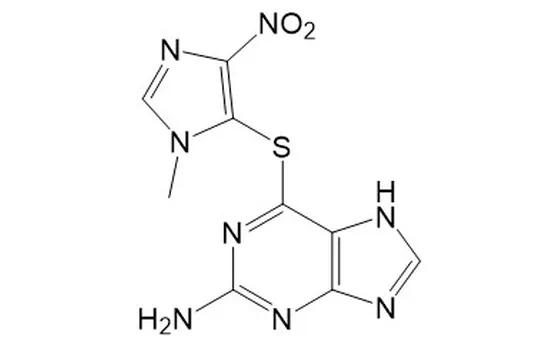
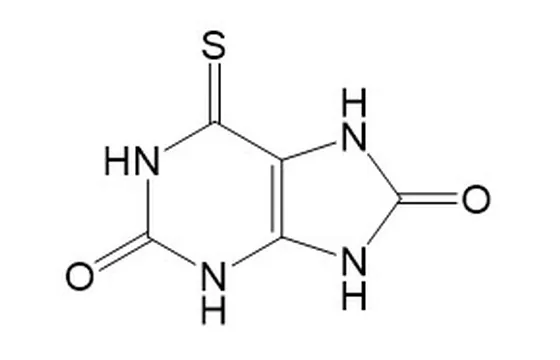
A working set for method development is five items: the drug, 6-mercaptopurine, the hydroxy-imidazole, 6-thiouric acid, and thiamiprine. That covers both halves, the main degradant, and the one entry that has to be explained rather than measured.
Frequently Asked Questions
Is azathioprine a prodrug or an active drug in its own right?
Why does the impurity series contain four different imidazole compounds?
Is a 6-mercaptopurine result a purity result or a potency result?
How can thioguanine end up in an azathioprine batch?
What limit applies to these impurities at a 140 mg daily dose?
Why does hypoxanthine appear in a product that contains no hypoxanthine?
Should the assay be run at low pH?
Does the light-protection statement on the label settle the photostability question?
Related Substances and Reference Standards
- Azathioprine (18 impurity / derivative entries)
- Captopril (- impurity / derivative entries)
- Anastrozole (- impurity / derivative entries)
References and Sources
- DailyMed, US National Library of Medicine, Azathioprine tablets, prescribing information: 50 mg strength, weight-based dosing, and the direction to store in a dry place, protect from light, and dispense in a tight, light-resistant container as defined in the USP, accessed 2026-11-22
- PubChem, National Center for Biotechnology Information, Azathioprine, CID 2265, C9H7N7O2S, 277.26, with the 6-thio substituent of the purine bonded to C5 of 1-methyl-4-nitroimidazole, accessed 2026-11-22
- PubChem, National Center for Biotechnology Information, 5-Chloro-1-methyl-4-nitroimidazole, CAS 4897-25-0, CID 21010, C4H4ClN3O2, 161.55, accessed 2026-11-22
- PubChem, National Center for Biotechnology Information, 5-Mercapto-1-methyl-4-nitroimidazole, CAS 6339-54-4, CID 95824, C4H5N3O2S, 159.17, accessed 2026-11-22
- PubChem, National Center for Biotechnology Information, 6-Mercaptopurine, CAS 50-44-2, CID 667490, C5H4N4S, 152.18, recorded in the catalog as azathioprine EP impurity B, accessed 2026-11-22
- PubChem, National Center for Biotechnology Information, 6-Thiouric acid, CAS 2002-60-0, CID 3032417, C5H4N4O2S, 184.18, the purine oxidized at C2 and C8, accessed 2026-11-22
- PubChem, National Center for Biotechnology Information, Thiamiprine, CAS 5581-52-2, CID 3379405, C9H8N8O2S, 292.28, the 2-amino analogue of azathioprine, accessed 2026-11-22
- PubChem, National Center for Biotechnology Information, 6,6-Thiodipurine, CAS 90947-51-6, CID 5192092, C10H6N8S, 270.28, two purine units joined through a single sulfur, accessed 2026-11-22
- International Council for Harmonisation, ICH Q3A(R2), Impurities in New Drug Substances, Attachment 1: reporting 0.05 percent, identification 0.10 percent or 1.0 mg per day, qualification 0.15 percent or 1.0 mg per day for a maximum daily dose of 2 g or less, accessed 2026-11-22
- Biosensors, MDPI, Detection of hypoxanthine from inosine and unusual hydrolysis of the immunosuppressive drug azathioprine through a diruthenium system, in which hydrolysis gives hypoxanthine rather than the expected 6-mercaptopurine, accessed 2026-11-22
- Analytical Methods, Royal Society of Chemistry, Development of an HPLC-DAD stability-indicating method and compatibility study of azathioprine and folic acid, accessed 2026-11-22
This article was prepared by the CATO technical team. Regulatory, pharmacopoeial and published literature content cited above is attributed in the reference list. It is provided for technical exchange and search reference only and does not constitute a quality specification or regulatory advice. For any specific substance, the applicable test methods, limits and filing requirements are governed by the current regulations, pharmacopoeial monographs and official publications.
Product information on this site is provided for research search and selection reference only and is not a quality specification; technical data, purity and structural confirmation are governed by the shipped COA and our written confirmation. All products mentioned are for research use only, not for human or animal diagnostic or therapeutic use.