Budesonide Is Two Epimers and One Acetal: Why the Ratio, Not the Peak Count, Is the Specification
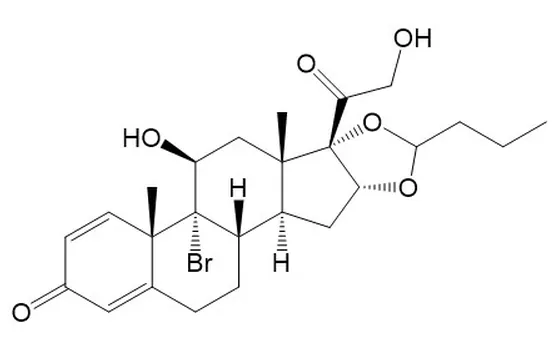
Budesonide↗ is supplied as a mixture of two epimers, and that mixture is the substance rather than a defect in it. The specification that governs it is a ratio, the bond that creates the ratio is the bond that fails in water, and the step used to correct the ratio leaves brominated steroids and a Class 2 solvent in the file.
Note: product names shown in red (marked with ↗) are links - click through to the product page for structure, CAS number, purity and lead time.
One formula, two epimers, and a third record with the same mass
Key points
- Budesonide is C25H34O6, 430.5, a 16,17-acetal of 16alpha-hydroxyprednisolone whose acetal carbon carries a propyl chain and a hydrogen, so the acetal centre is chiral and the substance is a 22S and 22R pair[1].
- The USP monograph constrains the C-22S epimer to 40.0 to 51.0 per cent of the summed area of the two epimer peaks, which makes the ratio part of the definition rather than an impurity limit[2].
- Hydrolysis opens the acetal to 16alpha-hydroxyprednisolone, which is EP impurity A, C21H28O6, 376.4, plus butyraldehyde, C4H8O, 72.11; the fragments account for the API and one molecule of water[4].
- The epimer ratio is corrected with 48 per cent hydrobromic acid, which is why the catalog carries 9alpha-bromobudesonide, EP impurity J, C25H33BrO6, 509.4, and several other brominated steroids[2][7].
Budesonide is a 16,17-acetal of 16alpha-hydroxyprednisolone closed with butyraldehyde, C25H34O6, 430.5[1]. The carbon that carries the propyl chain, C22, is part of the dioxolane ring and bears a hydrogen, so it is a stereocentre, and the acetal forms from both faces of the oxocarbenium ion during synthesis. The product is therefore a mixture, not a single compound.
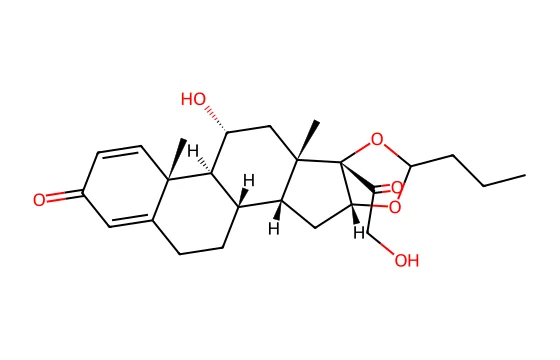
That one sentence explains most of the analytics that follow. The two epimers are diastereomers. They share a molecular formula, a UV spectrum and a fragmentation pattern, and they differ only in the configuration of a single bond. In this catalog they are listed individually: (22S)-budesonide, CAS 51372-28-2, and (22R)-budesonide, CAS 51372-29-3, which the catalog records as dexbudesonide[1]. A third entry, EP impurity C, carries the same C25H34O6 formula, so three separate records in one catalog share the mass of the active substance.
Two consequences follow immediately. A mass spectrometric identity test cannot separate the API from either epimer or from EP impurity C, so identity rests on retention. And because the pair is the substance, the number that matters in the specification is a ratio, not a count of peaks.
What 40.0 to 51.0 per cent actually constrains
The USP monograph controls the C-22S epimer at 40.0 to 51.0 per cent of the sum of the areas of the two epimer peaks[2]. Read that as a statement about identity rather than purity. The window is about eleven percentage points wide and sits where the acetalization of 16alpha-hydroxyprednisolone with n-butyraldehyde naturally lands, which is the tell: the limit exists to keep the substance inside the range the toxicology and the clinical data were generated in, not to cap a contaminant.
The analytical trap is a method that reports total budesonide by summing the pair. A drift from 45 to 41 per cent passes such an assay untouched. The chromatogram looks unchanged, the assay is nominally on target, and the substance has moved to the edge of its own definition. The ratio has to be reported as a value with its own acceptance criterion, and the method has to be validated for the precision of that value, not only for the accuracy of the total.
An orthogonal check is cheap here. Quantitative NMR resolves the epimers through the propyl chain signals and returns a weight ratio directly, without a calibration curve and without a standard for either form[3]. The same work shows that the choice of nucleus and solvent depends on the excipients, which is the practical obstacle in a nasal spray or a nebulizer suspension rather than in the raw material. For a substance whose main specification is a ratio between two forms of one molecule, that is worth the instrument time.
The acetal opens in both directions
Hydrolysis of the acetal gives 16alpha-hydroxyprednisolone, which is also EP impurity A, C21H28O6, 376.4, together with butyraldehyde, C4H8O, 72.11[4]. The arithmetic closes: 430.5 plus 18.02 of water gives 448.5, and 376.4 plus 72.1 gives 448.5. Nothing is missing and nothing is assumed.
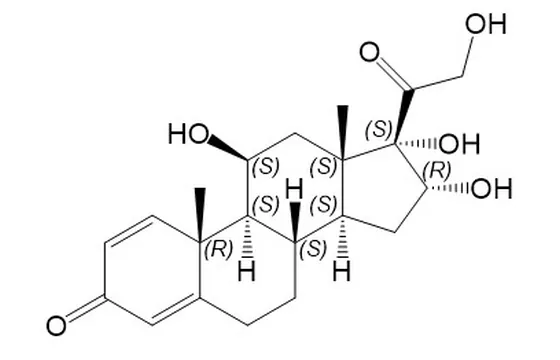
The mechanism matters more than the balance. Protonation of an acetal oxygen, loss of the alcohol, and attack of water on the oxocarbenium ion gives a hemiacetal that can either close back or open. While butyraldehyde remains in the same phase, the same pathway runs in reverse, so a sealed vial approaches an equilibrium rather than an endpoint. This is why a forced degradation experiment in a sealed container can report less hydrolysis than a stability study of the same formulation, and why the two results are not in conflict.
The hydrolysis becomes effectively irreversible only when the aldehyde leaves the system, either by evaporation, since butyraldehyde boils near 75 degrees Celsius, or by oxidation to butyric acid, C4H8O2, 88.11. An aqueous formulation with a headspace and dissolved oxygen offers both routes, and an open dish offers them faster than a closed vial. Design the stress condition around the intended container, not around the convenience of the oven.
The duality of EP impurity A is the reason a single result cannot be interpreted. A level above the historical norm in a fresh batch points to incomplete acetalization. The same level at a stability point points to hydrolysis. Batch history separates the two, and so does the pattern: hydrolysis removes both epimers from the same pool, so the ratio alone will not tell you whether the loss was hydrolytic or whether the acetalization was incomplete.
One methylene at a time: the acetal series
Because the acetal carbon is the variable, the related substances form a homologous series in which each member differs by CH2, 14.02. The catalog contains the series, and two of its members are marketed drugs.
| Carbonyl used for the acetal | Fragment at C22 | Formula | M | What the catalog calls it |
|---|---|---|---|---|
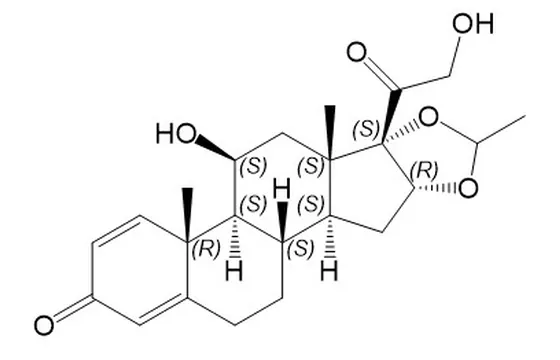
| acetaldehyde | CH(CH3), one hydrogen | C23H30O6 | 402.5 | EP impurity B, di-norbudesonide, mixture of diastereomers |
| acetone | C(CH3)2, no hydrogen | C24H32O6 | 416.5 | EP impurity F, which is the marketed drug desonide |
| butyraldehyde | CH(CH2CH2CH3), one hydrogen | C25H34O6 | 430.5 | budesonide |
Table note: formulas and molecular masses are the catalog and PubChem records for each CAS number; each step of one CH2 is 14.02. Only the two members that retain a hydrogen on C22 can exist as an epimer pair.
The acetone member is the one to notice. It is desonide, CAS 638-94-8, a topical corticosteroid with its own monograph and its own indications[5], and in a budesonide file it appears as EP impurity F. Two conclusions follow. Acetone is a ubiquitous laboratory solvent and a common cleaning residue, so a desonide peak may say more about the equipment than about the batch. And a limit on EP impurity F is a limit on a second active substance, which is a different argument from a limit on a degradant, because the toxicology of the second substance already exists and can be used.
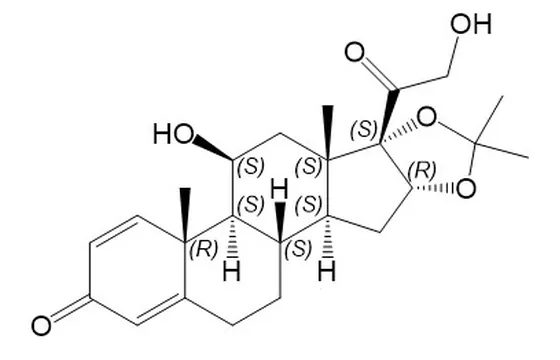
The acetone acetal has no hydrogen on C22 and therefore no epimer pair, while the acetaldehyde and butyraldehyde members each give two. That is why EP impurity B is described as a mixture of diastereomers, C23H30O6, 402.5, and budesonide is described as a pair of epimers. It is one structural consequence observed at two chain lengths.
What the epimer correction leaves behind
The classical acetalization runs 16alpha-hydroxyprednisolone with n-butyraldehyde in 1,4-dioxane over perchloric acid, and the epimer ratio is corrected afterwards with 48 per cent hydrobromic acid while the ratio is followed by HPLC[2]. That sequence accounts for three groups of entries that no degradation study would ever produce.
Brominated steroids are the first. EP impurity J is 9alpha-bromobudesonide, C25H33BrO6, 509.4, which is the API plus bromine minus hydrogen[7]. The catalog carries at least three further brominated entries at C23H27BrO5, C23H29BrO7 and C21H27BrO6. Bromine cannot come from water, light or oxygen, so it is a fingerprint of the epimer-correction step, and the purge factor for that step has to be demonstrated rather than assumed from a washing protocol.
1,4-Dioxane is the second. It is an ICH Q3C Class 2 solvent with a permitted daily exposure of 3.8 mg per day and a corresponding concentration limit of 380 ppm[6]. At an inhaled dose of 0.4 mg of budesonide, 380 ppm corresponds to roughly 0.15 micrograms per day, four orders of magnitude below the exposure limit. For a low-dose inhaled product the concentration limit is therefore not the constraint that matters, and the useful control is the measured amount per dose, which is a different test with a different validation package. The reverse is true for an oral viscous preparation dosed in milligrams.
Perchlorate is the third, and it is the uncomfortable one. Perchloric acid is not an organic solvent, so Q3C has no entry for it; chlorine is not one of the 24 elements covered by Q3D, so the elemental impurity framework has no line for it either. A residue that falls between two guidelines has no default limit and no default test, and the applicant has to write both, including the justification for whatever level the process can actually achieve.
Dose arithmetic that never reaches the absolute limit
ICH Q3B sets reporting at 0.05 per cent and identification at 0.10 per cent or 1.0 mg per day, whichever is lower[6]. Budesonide spans an unusually wide dose range for a single molecule: tens of micrograms from a nasal spray, a few hundred micrograms by inhalation, and milligrams in oral viscous preparations used in eosinophilic esophagitis.
At 0.4 mg per day, 0.05 per cent is 0.2 micrograms and 0.10 per cent is 0.4 micrograms. Reaching the 1.0 mg absolute cap would require an impurity at 250 per cent of the labelled dose. The absolute column of the threshold table therefore never binds for this substance at any dose it is used at, and every decision in the file is percentage-driven.
The consequence is easy to miss when a specification is copied from a template. The generic thresholds are not the operative limits. The limits that matter are the individual ones in the monograph, which is why a budesonide file cannot be argued from Q3B alone, and why the epimer ratio, which has no Q3B equivalent at all, carries more weight than any single named impurity.
Method design: separate the pair, then stop summing
Three practical points follow from the structure. The epimers are diastereomers, so a conventional C18 column resolves them and no chiral stationary phase is required; this is a selectivity problem, not an enantioselectivity problem. The chromophore is the cross-conjugated dienone, with an absorption maximum near 243 nm, which is adequate for the API and for the lettered impurities that retain the dienone, and inadequate for those that have lost it.
The third point is the one that costs files. Integration that sums the two epimer peaks produces a number insensitive to exactly the change the monograph exists to catch. Report the ratio separately, with its own criterion, and validate the ratio method for precision and for the resolution between the pair rather than for accuracy against a standard that is itself a mixture.
Photodegradation is a separate channel and needs its own experiment. A photodegradation impurity in a budesonide drug product has been isolated and characterized by LC-MS and NMR[8], which is the practical reason ICH Q1B exposure belongs in the protocol even for a molecule whose obvious liability is hydrolytic: the two routes give different products and different kinetics.
Where the budesonide logic stops
Three comparisons are worth making, and one is a trap.
Dexamethasone has no 16,17-acetal. Its stereocentres are fixed when they are made, and its 16-epimer is a different drug, betamethasone. That pair is separated by a configurational difference which no aqueous condition will close. Budesonide epimers are separated by a bond that water and acid will open and close, and that is the whole reason budesonide needs a ratio where dexamethasone needs an epimer limit.
Fluticasone propionate and mometasone furoate carry a 17-ester rather than a 16,17-acetal, so the question does not arise in the same form. Ciclesonide is the closer analogue: the same 16,17-acetal architecture with a cyclohexyl group in place of the propyl, so the same acetal questions apply, but its acceptance window belongs to its own monograph and cannot be borrowed from budesonide.
The trap is transferring the residual solvent logic. A route that uses 1,4-dioxane is a property of that route, not of the molecule: a specification copied from another supplier contains a test with no hazard behind it.
What the filing record says about how settled this is
Budesonide is a mature file in China and the acceptance record reflects it. Applicants have argued the epimer ratio, the acetal hydrolysis and the residual solvent question many times, which is good news for a reviewer and bad news for a submission that treats them as novel:
The practical reading is that a deficiency letter on this substance will not ask whether the ratio matters. It will ask which basis the calculation used, which form the standard was, and what the purge factor for hydrobromic acid is.
Reference standards for the pair
The catalog lists 70 budesonide entries, twelve of them carrying EP letters A through L, and both epimers as individual items, (22S)-budesonide at CAS 51372-28-2 and dexbudesonide at CAS 51372-29-3, which is what a ratio method actually needs on the bench: [see all budesonide entries](budesonide impurity and derivative entries)
Frequently Asked Questions
Is the 22R epimer an impurity in budesonide?
Why does EP impurity A behave like both a process impurity and a degradant?
Does acid hydrolysis of budesonide go to completion?
Do I need a chiral column for the epimer ratio?
Is 1,4-dioxane a genuine risk at an inhaled dose of 0.4 mg per day?
Why are there brominated steroids in a budesonide impurity catalog?
Is there a nitrosamine risk for budesonide?
How many EP-lettered impurities are there?
Related Substances and Reference Standards
- Budesonide (70 impurity / derivative entries)
- Dexamethasone (59 impurity / derivative entries)
References and Sources
- PubChem, National Center for Biotechnology Information, Budesonide, CID 5281004: C25H34O6, 430.5; the record and its isomer entries give the epimer naming and the individual (22S) and (22R) CAS numbers, accessed 2026-11-17
- Phull MS, Jadav SS, Bohara CS, Gundla R, Mainkar PS, Journal of Flow Chemistry 2022;12, Continuous flow process for preparing budesonide (USP control of the C-22S epimer at 40.0 to 51.0 per cent of the summed epimer area; 16alpha-hydroxyprednisolone with n-butyraldehyde in 1,4-dioxane over perchloric acid; 48 per cent HBr for epimer correction), accessed 2026-11-17
- Kuzmina NE, Moiseev SV, Severinova EY, Stepanov EA, Bunyatyan ND, Molecules 2022;27(7):2262, Identification and quantification by NMR spectroscopy of the 22R and 22S epimers in budesonide pharmaceutical forms, accessed 2026-11-17
- PubChem, National Center for Biotechnology Information, 16alpha-Hydroxyprednisolone, CID 11047056: C21H28O6, 376.4, the acetal hydrolysis product and EP impurity A, accessed 2026-11-17
- PubChem, National Center for Biotechnology Information, Desonide, CID 5311066: C24H32O6, 416.5, the acetone acetal of the same diol, listed in this catalog as EP impurity F, accessed 2026-11-17
- International Council for Harmonisation, ICH Quality Guidelines: Q3B(R2) Impurities in New Drug Products (0.05 per cent reporting, 0.10 per cent or 1.0 mg per day identification), Q3C(R8) Residual Solvents (1,4-dioxane Class 2, 3.8 mg per day, 380 ppm), Q1B(R2) Photostability Testing, accessed 2026-11-17
- PubChem, National Center for Biotechnology Information, 9alpha-Bromobudesonide, CID 15391898: C25H33BrO6, 509.4, EP impurity J, accessed 2026-11-17
- Bhutnar A, Khapare S, Desai A, Dsouza S, American Journal of Analytical Chemistry 2017;8:449-461, DOI 10.4236/ajac.2017.87034Isolation and characterization of photodegradation impurity in budesonide drug product using LC-MS and NMR spectroscopy
This article was prepared by the CATO technical team. Regulatory, pharmacopoeial and published literature content cited above is attributed in the reference list. It is provided for technical exchange and search reference only and does not constitute a quality specification or regulatory advice. For any specific substance, the applicable test methods, limits and filing requirements are governed by the current regulations, pharmacopoeial monographs and official publications.
Product information on this site is provided for research search and selection reference only and is not a quality specification; technical data, purity and structural confirmation are governed by the shipped COA and our written confirmation. All products mentioned are for research use only, not for human or animal diagnostic or therapeutic use.