Caspofungin Acetate: The Impurities That Q3C and Q3D Have No Table For
Caspofungin↗ is a fermentation product that was edited three times. Those three edits are what turned it into a drug, and they are also what put a thiol, a borane and a diamine into a molecule for which no solvent table and no elemental impurity table was written. The hard part of the residue package is therefore not the analysis. It is the classification.
Note: product names shown in red (marked with ↗) are links - click through to the product page for structure, CAS number, purity and lead time.
A lipohexapeptide that begins in a fermenter
Key points
- Caspofungin base is C52H88N10O15, 1093.3. The marketed form is the diacetate, 1213.4, dosed at 70 mg on day one and 50 mg a day thereafter, by infusion only.
- The published Merck route is three steps from pneumocandin B0: a phenylthioaminal, a borane reduction of a primary amide, and displacement of the thioaminal with ethylenediamine, at 45 percent overall yield[1].
- A thiol, a borane and a diamine are residual reagents, not residual solvents. ICH Q3C lists solvents and ICH Q3D lists twenty-four elements; neither framework has a row for them[2][3].
- No step uses a metal catalyst, which does not exempt the product from a Q3D assessment. Stainless steel, chromatography resins and fermentation media are sufficient reason to run one[3].
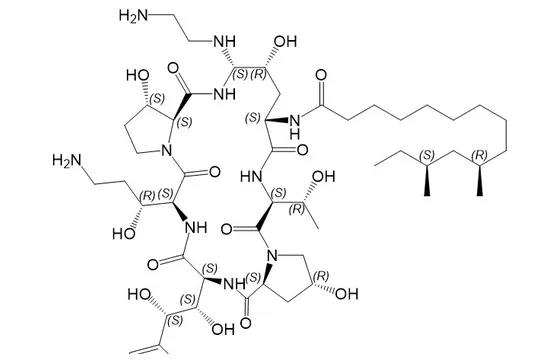
Caspofungin belongs to the echinocandins, a family of cyclic lipopeptides that inhibit beta-1,3-glucan synthase. The core is a cyclic hexapeptide closed through a tyrosine-derived residue, with a lipid chain attached to a dihydroxyornithine that sits in the ring. That lipid is why the molecule is amphiphilic, why it partitions into a fungal membrane, and why it cannot be given by mouth.
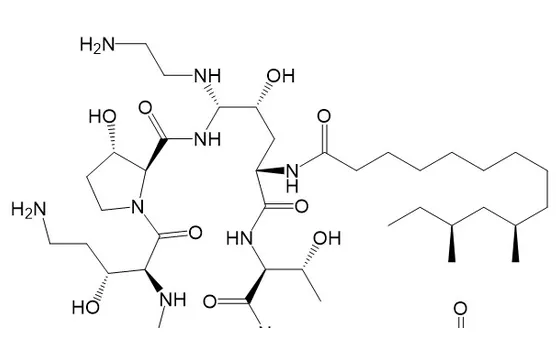
The drug substance is not the fermentation product. Pneumocandin B0, produced by the fungus Glarea lozoyensis, is the starting material, and the difference is one line long: the primary amide has become a methylamine, the hemiaminal hydroxyl has gone, and the position it vacated carries an ethylenediamine-derived amine[1]. Three functional group changes, three steps, and the whole residue discussion follows from them.
Caspofungin acetate has no oral fallback, so every impurity question lands on the injection. No bioavailability argument absorbs an impurity here, and no dissolution step sits between the specification and the patient.
Three steps, three residues that no table covers
The Merck process chemistry is worth reading closely, because it explains the residue list better than any impurity monograph[1]. The hemiaminal hydroxyl of pneumocandin B0 is converted into a phenylthioaminal, which is a leaving group; the primary amide is reduced to an amine with borane in a single operation; and the thioaminal is then displaced by ethylenediamine to install the basic side chain. The overall yield is reported as 45 percent.
Each operation introduces something the two ICH frameworks were not designed to classify. Thiophenol↗ is a volatile aromatic thiol with a low odor threshold and a documented toxicity profile, and it is neither a Class 1, Class 2 nor Class 3 solvent. Borane delivers boron, and boron is not one of the twenty-four elements in Q3D. Ethylenediamine is a low-molecular-weight diamine whose boiling point sits close enough to water that drying will not remove it selectively.
| Input from the route | What it leaves behind | Framework that applies | What the dossier needs |
|---|---|---|---|
| Thiophenol | free thiol, diphenyl disulfide, sulfurous odor bodies | none directly; Q3C does not list it | process-specific limit plus spiking and clearance data |
| Borane in tetrahydrofuran | boron species, borate salts; tetrahydrofuran | tetrahydrofuran is Class 2 at 720 ppm; boron has no Q3D entry | IC or ICP-MS for boron, with a justified limit |
| Ethylenediamine | free diamine, and its monoacetyl derivative | not a Q3C solvent; a reagent | derivatization HPLC or IC, plus wash-factor data |
| Acetic acid | the counterion itself, two equivalents | Class 3 as a solvent, but here it is stoichiometric | content by titration or ion chromatography, not a Q3C limit |
Table note: reagent list from the published process[1]; classification per ICH Q3C and Q3D[2][3].
The practical consequence is a documentation gap that appears in almost every echinocandin filing. The solvent section is easy. The reagent section is where reviewers stop, because there is no default limit to compare against and the applicant has to build the case from first principles: what the reagent is, how much is charged, where it partitions, and what the measured level is across three consecutive commercial batches.
Thiophenol is the sharpest case. With no PDE, the limit has to come from a toxicological assessment of that compound, written for a parenteral product where the entire dose reaches the circulation. The counter-argument, which works when the data exist, is depletion: the thioaminal is consumed in the next step, the thiol is removed in the first chromatography, and spiking shows clearance of several orders of magnitude.
Where the metal question actually sits
With no hydrogenation and no cross-coupling, caspofungin looks as if it has no elemental impurity story. That is the most common mistake in the Q3D section of a peptide filing.
Q3D requires a risk assessment for every product, and that assessment is about the product and the process, not about whether a catalyst appears in the scheme[3]. For a fermentation-derived peptide purified by column chromatography the plausible sources are stainless steel contact in fermenters, tanks and transfer lines, which contributes nickel, chromium, molybdenum and iron; chromatography resins and their housings; inorganic salts in the medium; and the water used throughout. None is exotic. All are in scope.
The arithmetic reviewers expect is the concentration-limit calculation, because a parenteral has no bioavailability cushion. Caspofungin is given as 50 mg in a 250 mL infusion. Taking the parenteral PDE for a Class 3 element from the Q3D table and dividing by the maximum daily volume gives a limit in the infusion that is two to three orders of magnitude below the oral PDE for the same element. Comparing the measured level with the oral PDE answers the wrong question.
The same logic explains why the option chosen matters. Option 1, the concentration-limit approach applied to every element, is the simplest and the most conservative. Option 2a, the common elemental impurity profile, works when the daily dose is under 10 g and the components are well characterized. Option 3, the directed risk assessment, is the only one that lets an applicant omit elements, and every omission needs a document behind it.
The acetate is a counterion, and it behaves like one
Caspofungin acetate is a diacetate: two molecules of acetic acid per molecule of drug, which is why the salt weighs 1213.4 and the base 1093.3. That stoichiometry is a structural fact, not a purity variable, and treating it as a residual solvent is a category error.
Acetic acid is a Class 3 solvent with a 5000 ppm limit under Q3C[2]. That limit applies to acetic acid carried over from a synthesis or a purification, not to acetic acid that is part of the crystal. If the salt is a diacetate, then the acetate content is roughly 9.9 percent by weight, which is about 99,000 ppm, and no Q3C limit could ever be met because the number is fixed by the stoichiometry. The correct specification is a content range around the theoretical value, measured by titration or by ion chromatography, with a mass balance that closes.
Two practical problems follow. The first is volatility: acetic acid leaves the solid on drying, and a sample dried harder than the validated method will show low acetate, a high assay on the anhydrous basis, and a mass balance that does not close. The second is pH: dilution changes the degree of dissociation, and the infusion pH can drift with the acetate content.
What seventeen catalogue entries say about the degradation space
This catalogue carries 17 caspofungin entries, and their formulas are more informative than their names. Sorted by relationship to the parent, the set falls into a small number of groups.
| Relationship to C52H88N10O15 | Catalogued example | What it implies |
|---|---|---|
| plus one oxygen, same hydrogen count | N5-hydroxycaspofungin, CAS 1671884-42-6, C52H88N10O16 | oxidation at a nitrogen, the hydroxylamine channel |
| plus one oxygen, two hydrogens fewer | CAS 1404083-47-1, C52H86N10O16 | oxidation with unsaturation, an oxo or imine species |
| one carbon fewer | CAS 2142583-73-9, C51H86N10O15 | demethylation on the lipid chain |
| two carbons and two nitrogens fewer | CAS 150283-04-8 and CAS 314080-31-4, both C50H82N8O16 | loss of the ethylenediamine arm with oxidation; two isomers |
| one carbon and two nitrogens more | CAS 2105820-54-8, C54H93N11O15 | an extra arginine-like residue, a fermentation congener |
Table note: formulas and CAS numbers as listed in this catalogue; the interpretations are structural inferences from the mass differences.
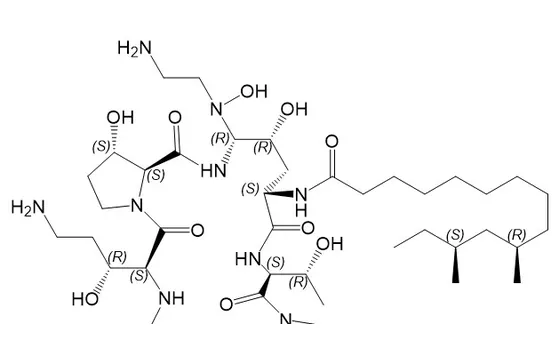
The pattern is clear and it is not about the reagents. The catalogue is dominated by oxidation and by modifications of the ring and the lipid chain, which is where a molecule with an aminal, four hydroxyls and a long lipid is fragile. Thiol-derived species are absent, not because they cannot form, but because they are controlled upstream as reagents and cleared in purification rather than carried into the specification as named impurities.
That asymmetry belongs in a filing. A reviewer who sees seventeen impurities, none reagent-derived, will ask whether clearance was demonstrated or whether the search was never done.
Detection at 1093 daltons with almost no chromophore
Caspofungin has no aromatic ring in the core and no conjugated system worth the name. It absorbs at the far end of the ultraviolet range, where the mobile phase, the acetate and the injection solvent also absorb. A method at 210 nm on a peptide this size gives a drifting baseline, a solvent front that overlaps the early species, and a signal-to-noise ratio that changes as the lamp ages.
Three approaches are used in practice. Charged aerosol detection gives a response roughly proportional to mass and largely independent of structure, which suits a molecule whose impurities differ from the parent by one oxygen or one methyl. Mass spectrometry gives exact mass, which is decisive here because 1093 is high enough that the isotope pattern carries composition information: an added oxygen moves the mass by 15.995 and leaves the envelope unchanged, while a demethylation moves it by 14.016 and does not. Derivatization with a chromophore is possible but adds a reagent to a method that already has to prove it does not discriminate between the parent and its N-hydroxy analogue.
The mobile phase deserves a note of its own. Trifluoroacetic acid↗ is the standard ion-pairing agent for peptides, and it suppresses the signal in mass detection while improving peak shape in ultraviolet. A method developed at 0.1 percent trifluoroacetic acid and then transferred to a mass detector loses an order of magnitude of sensitivity, which is why the two techniques usually run on separate gradients rather than on one compromised method.
What a filing has to defend
Chinese registration activity for the acetate is concentrated in a small number of applicants, which reflects the difficulty of the fermentation rather than the difficulty of the formulation.
Three questions recur. The first is reagent clearance: the applicant is asked to show, with spiked samples, that thiophenol and ethylenediamine are removed to a level that is justified rather than merely undetectable. The second is the elemental impurity assessment: reviewers ask why a fermentation product with four chromatography steps was assessed by Option 1 rather than Option 3, or the reverse, and either answer is acceptable if the reasoning is written down. The third is the acetate: what range is specified, how it is measured, and how the mass balance closes when the counterion is at the top of its range and the water content is at the bottom.
A fourth question arrives less often and is harder to answer: what happens to the specification if the fermentation yield is improved. A change of medium or strain changes the congener profile, and the congener profile is where the C50 and C54 entries come from. A specification built on three batches from one strain describes those three batches, not the process. Chinese Pharmacopoeia general chapters set parallel limits and are worth cross-checking[4].
Which echinocandins transfer, and which do not
The three older echinocandins share a cyclic hexapeptide core, and it is tempting to assume that their impurity strategies transfer. They do not, and the reasons are specific.
Micafungin sodium retains a sulfate ester on the dihydroxyornithine residue, which caspofungin does not have. That ester adds a hydrolysis pathway to a desulfated analogue, adds inorganic sulfate to the residue list, and adds a counterion controlled separately from the sodium. Its side chain is an acyl group installed in the final step, so the acylating reagent and its solvents join the residue list in a way that has no counterpart here.
Anidulafungin carries a terphenyl-based side chain and reaches the ring by a different sequence, with no thioaminal and no ethylenediamine. Its degradation chemistry is dominated by the side chain and by ring-opening rather than by the aminal, so a method transferred from caspofungin will resolve the wrong cluster. Rezafungin is the newest of the group and, like anidulafungin, keeps the benzylic alcohol that caspofungin lacks; removing that hydroxyl has been shown to restore activity against FKS-mutant strains, which makes the caspofungin deoxygenation the oldest version of a modification still being explored[5].
The one comparison that holds is chemical rather than regulatory. All four molecules contain the same aminal-rich macrocycle and share the same pH and temperature window during purification. That is a process similarity, not a specification similarity.
This catalogue carries 17 caspofungin entries, from the diacetate and the free base through the N-hydroxy analogue and the ring-modified congeners: caspofungin acetate reference standards. The echinocandin set continues with micafungin sodium and anidulafungin for laboratories running more than one product on the same platform.
Frequently Asked Questions
Is thiophenol a Class 2 or a Class 3 solvent under ICH Q3C?
If the route uses no metal catalyst, is a Q3D assessment still required?
Why is the acetate content not controlled as a residual solvent?
Does caspofungin need a chiral method?
Which detection mode suits the N-hydroxy impurity best?
How should boron be handled if it is not in Q3D?
Is the free base ever a drug substance?
Related Substances and Reference Standards
- Caspofungin Acetate (17 impurity / derivative entries)
- Micafungin Sodium (22 impurity / derivative entries)
- Anidulafungin (18 impurity / derivative entries)
- Rezafungin (15 impurity / derivative entries)
References and Sources
- The Journal of Organic Chemistry, 72 (2007)Synthesis of the antifungal beta-1,3-glucan synthase inhibitor CANCIDAS (caspofungin acetate) from pneumocandin B0: phenylthioaminal formation, one-step borane reduction of a primary amide, and stereoselective displacement with ethylenediamine, 45 percent overall yield. DOI 10.1021/jo062008i
- ICH, ICH Q3C(R8) Impurities: Guideline for Residual Solvents, including the Class 1, Class 2 and Class 3 classifications and the permitted daily exposure values, accessed 2026-11-05
- ICH, ICH Q3D(R2) Guideline for Elemental Impurities, including the twenty-four elements in scope and the option 1, 2a, 2b and 3 assessment approaches, accessed 2026-11-05
- Chinese Pharmacopoeia Commission, Pharmacopoeia of the People's Republic of China, general chapters on residual solvents, elemental impurities and peptide quality control, accessed 2026-11-05
- Journal of the American Chemical Society (2022), Benzylic dehydroxylation of echinocandin antifungal drugs restores efficacy against resistance conferred by mutated glucan synthase, accessed 2026-11-05
This article was prepared by the CATO technical team. Regulatory, pharmacopoeial and published literature content cited above is attributed in the reference list. It is provided for technical exchange and search reference only and does not constitute a quality specification or regulatory advice. For any specific substance, the applicable test methods, limits and filing requirements are governed by the current regulations, pharmacopoeial monographs and official publications.
Product information on this site is provided for research search and selection reference only and is not a quality specification; technical data, purity and structural confirmation are governed by the shipped COA and our written confirmation. All products mentioned are for research use only, not for human or animal diagnostic or therapeutic use.