Ceftriaxone Sodium: Five Impurities, Five Origins, and the One That Grows in the Light
Ceftriaxone↗ sodium has 29 entries in this catalogue and at least five chemically unrelated species among them, which is a lot for a molecule with no chiral centre. The drug is assembled from three reactive pieces, and each one can leave something behind. Sorting the list by origin rather than by retention time is what turns an impurity profile into a control strategy.
Note: product names shown in red (marked with ↗) are links - click through to the product page for structure, CAS number, purity and lead time.
A molecule with no chiral centre and a crowded impurity list
Key points
- Ceftriaxone is C18H18N8O7S3, free acid 554.6. The 3.5-hydrate of the disodium salt (CAS 104376-79-6) is 661.6, so a vial labelled 1 g contains about 1.19 g of salt. At 2 g/day the absolute identification threshold of 1.0 mg/day equals 0.05 percent, the same value as the reporting threshold[1].
- The methoxyimino bond is the only non-ring double bond in the molecule, and the active configuration is syn (Z). Its (E) isomer is a compendial impurity with an identical molecular formula, so no mass spectrometer can tell the two apart[2][3].
- The triazine thione and the benzothiazolyl thioester are process species whose levels are fixed at isolation, not degradation products that grow on storage.
- Two entries come from outside the synthesis: a benzothiazole rubber accelerator typical of elastomer closures[4], and a thiosemicarbazide that falls under ICH M7 rather than Q3A[5].
Three reactive pieces are bolted together to make ceftriaxone: a 7-aminocephalosporanic acid core, a 2-(2-aminothiazol-4-yl)-2-methoxyiminoacetyl side chain at C7, and a 2-methyl-5,6-dioxo-1,2,4-triazin-3-yl thiolate hung off C3 through a methylene. Three sulfur atoms, three chemistries, three separate ways to leave a residue. The catalogue lists 29 ceftriaxone entries, and the list reads less like a degradation cascade than like a reagent shelf.
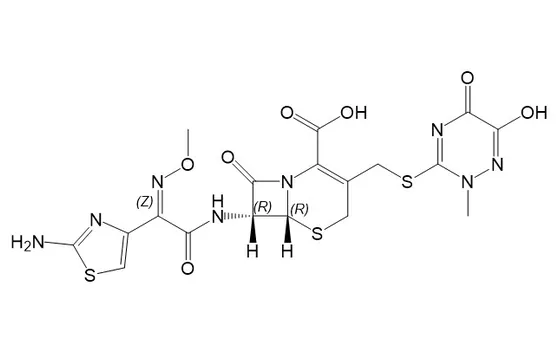
Sorting those entries by mechanism rather than by retention time is the useful move here, because each has a different control point: light for the isomer, pH and water content for the triazine fragment, washing for the ester, supplier qualification for the two that never enter the reaction. The dose arithmetic sharpens the point. Under ICH Q3A(R2) the identification threshold is 0.10 percent or 1.0 mg/day, whichever is lower[1]; divide 1.0 mg by the 2 g adult dose and the answer is 0.05 percent, which is exactly the reporting threshold. At the top of the dose range, every impurity that must be reported must also be identified.
| Daily dose | 0.10 percent as mass | 1.0 mg/day as percentage | Threshold that governs |
|---|---|---|---|
| 500 mg | 0.50 mg | 0.20 percent | 0.10 percent |
| 1 g | 1.00 mg | 0.10 percent | both, at the same value |
| 2 g | 2.00 mg | 0.05 percent | 0.05 percent |
| 4 g, as 100 mg/kg in a 40 kg patient | 4.00 mg | 0.025 percent | 0.025 percent |
Table note: calculated from the ICH Q3A(R2) identification threshold[1]. The 0.05 percent reporting threshold does not scale with dose.
Impurity one: the (E) isomer is a geometry problem
One bond in the side chain can rotate without breaking: the C=N of the methoxyimino group. That bond is also why the drug works, since the syn configuration puts the methoxy group where the target expects it. The 1978 characterization of HR 756, the compound that became cefotaxime, states the position plainly: the antibiotic was the syn isomer, and the anti form was a by-product of the synthesis rather than a variant of it[3].
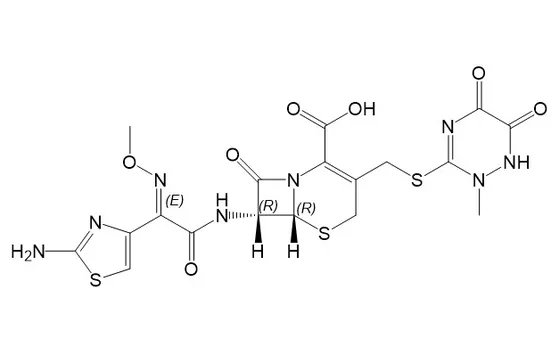
Ceftriaxone inherits the architecture. This catalogue lists the (E) form as EP impurity A, CAS 92143-31-2, formula identical to the parent. Two consequences follow. Analytically, isomers share nominal mass, isotope pattern and most fragments, so LC-MS returns a number without an identity, and a photodiode array purity check across the main peak will pass while the impurity grows under the tail. Peak purity detects co-elution of a different chromophore; here the chromophore is the same one. Regulatorily, the impurity is real, lettered and expected.
Light drives the rotation. ICH Q1B requires confirmatory photostability testing on the finished product in its immediate container, and for a clear aqueous solution the option that applies is the full study rather than the absence-of-change justification[2]. The isomer therefore appears in three places: the forced-degradation package, the photostability batch, and the autosampler of any sequence that runs past midnight with the room lights on. The third is the one that produces confusing data, because it is not a property of the batch.
Impurities two and three: a triazine fragment and an activated ester
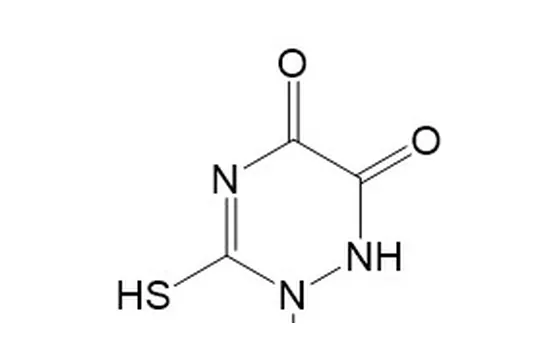
The C3 methylene bridge is the weakest link hydrolytically, because sulfur is a leaving group and the methylene is allylic to the dihydrothiazine ring. When the bond goes, the triazine leaves as 2-methyl-3-thioxo-1,2,4-triazinane-5,6-dione, C4H5N3O2S, catalogued as EP impurity C at CAS 58909-39-0. Its size is the analytical problem: at 159 Da it elutes near the void on a conventional gradient, in the same region as the injection front and the buffer salts.
The other fragment sits at the opposite end. Acylation of 7-ACA with a benzothiazolyl thioester is fast and clean, but the reagent is a reactive species that survives in mother liquors and can be carried through crystallization. It is catalogued as EP impurity D, CAS 80756-85-0, C13H10N4O2S3. The same formula appears in the cefotaxime catalogue, which is a reminder that this is a platform reagent, not a ceftriaxone artefact. Because the ester acylates anything nucleophilic, including residual water and unreacted 7-ACA, its control is a washing question rather than a stability question.
| Entry | CAS | Formula | Origin | Control point |
|---|---|---|---|---|
| (E) isomer, EP impurity A | 92143-31-2 | C18H18N8O7S3 | light-driven rotation; anti by-product | amber glass, ICH Q1B, in-process ratio |
| Triazine thione, EP impurity C | 58909-39-0 | C4H5N3O2S | hydrolysis of the C3 bridge | bulk pH, water content |
| Benzothiazolyl thioester, EP impurity D | 80756-85-0 | C13H10N4O2S3 | acylating reagent carried through isolation | washing, recrystallization |
| 2-methylthiosemicarbazide | 6938-68-7 | C2H7N3S | reagent used to build the triazine | purification plus ICH M7 intake |
| Dibenzothiazyl disulfide | 120-78-5 | C14H8N2S4 | rubber vulcanization accelerator | closure extractables and leachables |
Table note: CAS numbers and formulas as catalogued; origins derived from the synthetic sequence.
Impurities four and five come from outside the reaction
Dibenzothiazyl disulfide, C14H8N2S4, CAS 120-78-5, is a rubber vulcanization accelerator sold as Accelerator DM or MBTS. It has no chemical relationship to ceftriaxone, and it is in the catalogue because elastomer closures are a documented source of this class of compound in pharmaceutical products[4]. For a sterile powder in a vial closed with a bromobutyl stopper, the relevant study is an extractables and leachables programme on the closure, not a synthesis review.
The triazine ring, by contrast, is built from a thiosemicarbazide, and 2-methylthiosemicarbazide, C2H7N3S, CAS 6938-68-7, is listed here as a numbered impurity. Structurally it is a hydrazine derivative, which puts it inside ICH M7(R2) rather than Q3A: the concern is mutagenicity, and the specification cannot be derived by comparing batches[5]. It has to be derived by dividing an acceptable intake by the daily dose, which at 2 g/day yields a limit in the low parts-per-million range. The same logic covers the inorganic entries: edetate disodium at CAS 139-33-3 and sodium oxalate at CAS 62-76-0 are process aids and counter-ion residues, and oxalate matters twice because it also sequesters calcium.
Building the method around a single critical pair
Every other separation in a ceftriaxone method is routine. The critical pair is parent and (E) isomer, and the method should be designed as though that pair were the only thing being measured. Phosphate buffer at pH 6.5 to 7.0, a C18 column and detection at 254 to 270 nm resolve them on most modern phases. Resolution is not the hard part; proving that the resolution at hour twelve matches the resolution at time zero, after forty injections and a partly degassed mobile phase, is.
Three habits do most of the work. Prepare samples in amber glass and hold the autosampler at 5 degrees Celsius, because a clear vial on a bench under office lighting isomerizes measurably within a working day. Bracket the sequence with a suitability solution containing the (E) isomer at about 0.1 percent, injected first and last, and compare the ratios; an upward drift is telling you about the autosampler, not the batch. And do not quantify the isomer against a response factor borrowed from the parent without measuring it, since geometric isomers of this type often differ in molar absorptivity by a few percent.
Hydrate water adds a second variable. A 2023 comparison of ceftriaxone sodium products found that humidity-driven water movement did not change the crystal structure, but did redistribute hydrate water within the unit cell of some generic products, irreversibly at 25 degrees Celsius in products whose brand counterpart stayed stable at 40 degrees[6]. No chromatographic assay shows that, which is an argument for reading water content and X-ray powder diffraction alongside impurity data at the long-term condition.
The calcium question is a formulation problem with a chemical answer
Ceftriaxone is a dianion at physiological pH and its calcium salt is poorly soluble. That sentence explains three phenomena usually discussed separately: incompatibility with calcium-containing intravenous fluids, the neonatal contraindication introduced after a 2007 safety communication, and biliary pseudolithiasis, the reversible gallbladder sludge that is precipitated calcium ceftriaxone rather than a true stone.
An in vitro study published in 2025 tested ceftriaxone at 10, 20 and 40 mg/mL in 0.45 percent sodium chloride, Ringer lactate and Plasma-Lyte A. The 40 mg/mL admixture was physically incompatible beyond 5 hours in the first two fluids and beyond 8 hours in the third[7]. Two details matter: the effect is concentration-dependent, and it appears in a fluid containing no calcium at all. Calcium is the strongest precipitant, not the only one. The clinical signal is equally concrete. Among 79,038 neonates in a 259,149-record analysis, 3.8 percent of those given ceftriaxone and intravenous calcium within 48 hours died, against 0.3 percent given ceftriaxone alone, with a more than twofold increase in matched odds that extended beyond the neonatal period[8].
What actually shows up in a deficiency letter
Chinese registration activity for this molecule is heavy, so the impurity file gets read closely.
The questions cluster in four places. Identity of the (E) isomer comes first: is the peak at relative retention 1.08 really the isomer, and what is the evidence beyond retention time? A spiked confirmation with the EP reference standard, a UV overlay and a high-resolution mass or NMR confirmation on an isolated fraction closes it. Origin of the triazine fragment comes second, and the correct answer is a spike-and-recovery experiment showing that the fragment does not increase in spiked placebo or drug product under accelerated conditions, which proves process control rather than degradation.
The third is the genotoxic assessment of 2-methylthiosemicarbazide: a percentage limit is not an answer, because the compound sits outside Q3A. What is needed is a structural alert assessment, an Ames result where available, and an acceptable intake expressed against the maximum daily dose. The fourth is closure integrity and leachables, where a targeted screen for benzothiazole accelerators at filing is far cheaper than one supplied after the question.
Where the analogy holds, and where it quietly fails
The methoxyimino group is a family trait, which makes four cephalosporins look more alike than they are. Cefotaxime sodium shares the side chain and the same activated ester, and its catalogue repeats the C13H10N4O2S3 formula, so the process reasoning transfers almost unchanged. Cefepime hydrochloride also carries a methoxyimino group, but its C3 side chain is an N-methylpyrrolidine, which introduces a quaternary centre and a different degradation route.
Two cases must not be extrapolated. Cefuroxime axetil has the same oxyimino geometry, but its dominant problem is the axetil ester and the diastereomeric pair that comes with it, so conclusions about isomer control will be misdirected. Cefazolin sodium has no methoxyimino group at all, its side chain being a tetrazolylacetyl group, and ceftazidime carries a carboxypropoxyimino group with a pyridinium methyl at C3, so neither has this particular handle. The polymer story that dominates amoxicillin and piperacillin sodium is also not transferable: those polymerise through a free side-chain amine attacking a neighboring beta-lactam, and ceftriaxone has no such amine.
Four things that go wrong in practice
The (E) isomer is reported as an unknown at relative retention 1.08 because the reference standard was left out of the suitability mix; putting it in at 0.1 percent and requiring a resolution of at least 1.5 fixes the problem permanently. The triazine fragment is integrated against the solvent front, and its area then varies with injection volume; a shallow gradient start or a polar-embedded column, plus a check that the peak sits at least three column volumes after the void, removes most of that variability. Mass balance is calculated on the anhydrous basis while the batch is a 3.5-hydrate, a gap of roughly 10 percent of the weighed mass that can turn a 98.0 percent assay into an apparent 99.5 percent if water is not determined. And photostability is run on the powder in its vial, then extrapolated to the reconstituted solution, which is a different experiment: the vial protects the powder, the infusion bag does not.
This catalogue carries 29 ceftriaxone entries, including the (E) isomer, the triazine fragment, the benzothiazolyl ester and the thiosemicarbazide discussed above, each with structure and CAS: ceftriaxone sodium reference standards.
Frequently Asked Questions
Is the (E) isomer a degradation product or a process impurity?
Can LC-MS distinguish ceftriaxone from its (E) isomer?
Why does the pharmacopoeia assign a letter to the triazine fragment?
At what concentration is ceftriaxone incompatible with intravenous fluids?
Does the calcium contraindication apply to adults?
How should 2-methylthiosemicarbazide be limited?
Is a stopper leachables study really needed for a powder vial?
Related Substances and Reference Standards
- Ceftriaxone Sodium (29 impurity / derivative entries)
- Cefotaxime Sodium (23 impurity / derivative entries)
- Cefepime Hydrochloride (17 impurity / derivative entries)
- Cefazolin Sodium (32 impurity / derivative entries)
References and Sources
- ICH, ICH Q3A(R2) Impurities in New Drug Substances and Q3B(R2) Impurities in New Drug Products: reporting threshold 0.05 percent, identification threshold 0.10 percent or 1.0 mg per day, qualification threshold 0.15 percent or 1.0 mg per day, whichever is lower, accessed 2026-11-04
- ICH, ICH Q1B Photostability Testing of New Drug Substances and Products: confirmatory studies on the finished product in its immediate packaging, option 1 and option 2, accessed 2026-11-04
- Antimicrobial Agents and Chemotherapy (1978), HR 756, the syn isomer of a new methoxyimino cephalosporin with unusual antibacterial activity (the active antibiotic is the syn isomer; the anti form is a synthesis by-product), accessed 2026-11-04
- Toxics (2026, MDPI, open access), Extractables and Leachables in Pharmaceutical Products: Potential Adverse Effects and Toxicological Evaluation (elastomer-derived leachables including benzothiazole vulcanization accelerators), accessed 2026-11-04
- ICH, ICH M7(R2) Assessment and Control of DNA Reactive (Mutagenic) Impurities in Pharmaceuticals: structural alerts, threshold of toxicological concern 1.5 micrograms per day, compound-specific acceptable intakes, accessed 2026-11-04
- Scientific Reports (2023), Research on storage stability differences between ceftriaxone sodium products (hydrate water redistribution in the unit cell of generic products, irreversible at 25 degrees Celsius while the brand product remained stable at 40 degrees), accessed 2026-11-04
- European Journal of Hospital Pharmacy (2025), Physical compatibility of ceftriaxone and cefepime in 0.45 percent sodium chloride, Ringer lactate solution and Plasma-Lyte A (ceftriaxone 40 mg/mL incompatible beyond 5 hours in the first two fluids, beyond 8 hours in the third), accessed 2026-11-04
- Journal of Pediatric Pharmacology and Therapeutics (2021), Concomitant ceftriaxone and intravenous calcium therapy in infants (259,149 records, 79,038 neonates, 3.8 percent versus 0.3 percent mortality, more than twofold matched odds extending beyond the neonatal period), accessed 2026-11-04
This article was prepared by the CATO technical team. Regulatory, pharmacopoeial and published literature content cited above is attributed in the reference list. It is provided for technical exchange and search reference only and does not constitute a quality specification or regulatory advice. For any specific substance, the applicable test methods, limits and filing requirements are governed by the current regulations, pharmacopoeial monographs and official publications.
Product information on this site is provided for research search and selection reference only and is not a quality specification; technical data, purity and structural confirmation are governed by the shipped COA and our written confirmation. All products mentioned are for research use only, not for human or animal diagnostic or therapeutic use.