Celecoxib: Two EP Impurities Share the API Formula, and the USP Compound Has No Fluorine
Celecoxib↗ has both an EP and a USP monograph, which most teams treat as a safety net. In practice the two systems disagree about which molecule matters: the EP letters A and B point to two isomers that carry the API formula exactly, while the USP related compound D is a 303.38 structure with no fluorine left in it. Getting from one letter system to the other is a chemistry exercise, not a naming exercise.
Note: product names shown in red (marked with ↗) are links - click through to the product page for structure, CAS number, purity and lead time.
A diarylpyrazole with three separate risk points
Key points
- Celecoxib is C17H14F3N3O2S at 381.37[1], dosed at 200 mg twice daily, so 400 mg per day.
- EP Impurity A and EP Impurity B both have the API formula, 381.37 — they are positional isomers, not degradants.
- The catalogue's Impurity 2 sits at 411.36, thirty daltons above the API, which is an oxidation product rather than an isomer.
- USP Related Compound D is C15H17N3O2S at 303.38 and contains no fluorine, so the EP and USP letter systems describe different molecules.
Celecoxib (celecoxib API) is a 1,5-diarylpyrazole: a central pyrazole carrying a 4-methylphenyl group, a trifluoromethyl group and a 4-sulfamoylphenyl group. Each of the three substituents creates a different kind of impurity risk, and they do not overlap.
The trifluoromethyl group is the most stable part of the molecule and the least likely to degrade, but it is also the part that makes the compound distinctive in mass spectrometry: it contributes 69 Da and a characteristic isotope pattern. The sulfonamide is the most reactive: it is a primary aromatic sulfonamide, it oxidises, and it is the handle through which the molecule binds in the COX-2 side pocket. The 4-methylphenyl group is where the synthesis starts and where regioisomerism begins.
The consequence is that a celecoxib impurity profile needs three separate arguments — one for isomers, one for oxidation, and one for route-derived fragments — and a single generic gradient will not resolve all three at the level a modern specification requires.
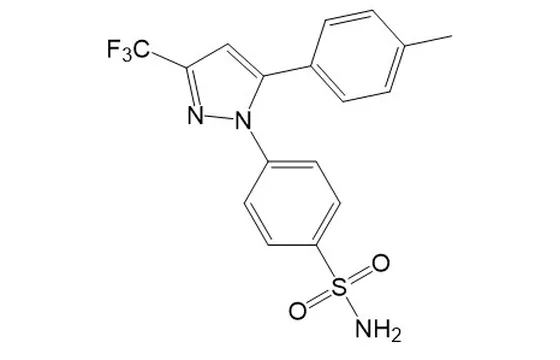
Two EP impurities with the formula of the API
The catalogue lists Celecoxib EP Impurity A as CAS 170570-01-1 and Celecoxib EP Impurity B as CAS 331943-04-5. Both are C17H14F3N3O2S at 381.37 — identical to celecoxib itself[2]. There is no mass difference to find, no oxygen added, no water lost.
An impurity with the same formula as the parent can only be a rearrangement. In a diarylpyrazole there is one obvious rearrangement available: which nitrogen of the pyrazole carries which aryl group, and therefore whether the two aryl groups end up 1,5 or 1,3 to each other. The 1,5 arrangement is celecoxib. The 1,3 arrangement has the same atoms, the same bonds and a different shape.
This is not a degradation pathway. Celecoxib does not rearrange into its regioisomer on storage; the barrier is far too high for a shelf-life process. The regioisomer is formed during synthesis, when the condensation of the diketone with the arylhydrazine can go through either nitrogen. It is a process impurity with a fixed level set by the route and by the purging power of crystallisation.
That distinction matters more than it looks. A process impurity does not grow on stability, so the release limit can sit close to the regulatory threshold without eating into shelf-life margin. A degradant with the same limit consumes margin every month. Two impurities that look identical on a mass spectrometer therefore require completely different specification strategies.
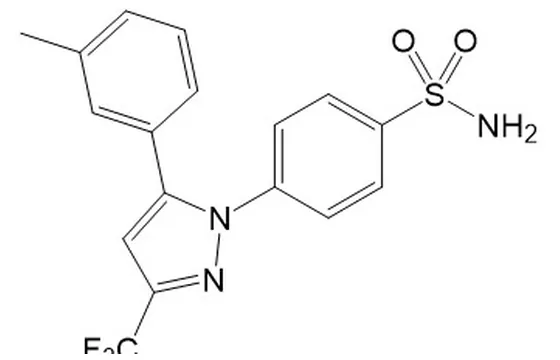
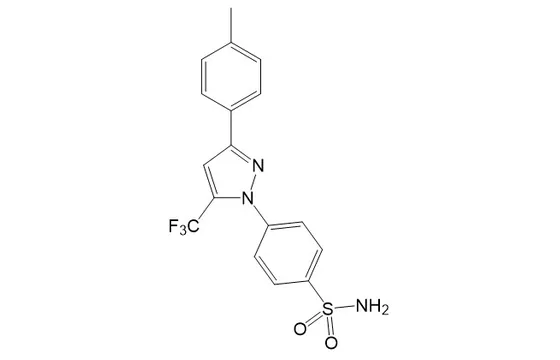
Where the regioisomer comes from
The last step of the celecoxib route is a cyclocondensation: a 1,3-diketone reacts with 4-sulfamoylphenylhydrazine to close the pyrazole ring. The diketone is unsymmetrical — one end carries the 4-methylphenyl group, the other the trifluoromethyl group — so the hydrazine can attack either carbonyl first, and the ring can close with either orientation.
Control is a matter of conditions rather than of purification alone. Solvent, temperature, acid catalysis and the order of addition all shift the ratio, and the crystallisation that follows purges the unwanted isomer to a degree that depends on how similar the two crystal lattices are. They are similar enough that the purge is not generous, which is why regioisomer levels in celecoxib are typically set by the route rather than rescued at the end.
For an analytical chemist the practical consequence is that the two isomers behave almost identically. Same ultraviolet spectrum, same mass, similar logP. Separation comes from shape rather than from polarity, so a column with aromatic selectivity or a mobile phase that exploits the small dipole difference is more useful than a longer gradient on a generic C18.
Identity is a separate problem. Retention time against an authentic standard is the working method, but the assignment of which peak is EP Impurity A and which is EP Impurity B should be traceable to a structural determination — nuclear Overhauser effects between the pyrazole proton and the two aryl rings settle the question in a way that chromatography cannot.
The 411.36 peak is a different story
The catalogue's Impurity 2, CAS 170571-01-4, is C17H12F3N3O4S at 411.36. Against the API at 381.37 that is +29.99 Da, which corresponds to adding two oxygens and losing two hydrogens. This is an oxidation product, and it behaves like one: it grows under peroxide stress, it grows on stability in the presence of oxygen, and it does not appear in fresh batches made under inert atmosphere.
Thirty daltons is a comfortable mass difference at unit resolution, which makes this the easiest of the celecoxib impurities to monitor and the hardest to ignore. It is also the one that most often drives the shelf-life claim, because the sulfonamide oxidation is slow but inexorable in a hygroscopic solid exposed to air.
The control levers are formulation and packaging rather than synthesis. Antioxidants are not usually an option in a capsule with a sulfonamide, so the practical measures are moisture control, oxygen-barrier packaging and a storage condition that keeps the Arrhenius rate low. A stability protocol that tests only 25 °C and 60% relative humidity will underestimate this impurity if the real risk is oxidative rather than hydrolytic.
Method design has to separate it from the parent and from the two isomers, which elute in a narrow window. A photodiode array is useful here for a different reason than for the isomers: the oxidation product loses part of the long-wavelength absorption, so the ratio of absorbance at 254 nm to that at 300 nm flags it as a different chromophore rather than a shifted peak.
USP Related Compound D has no fluorine
USP Related Compound D, CAS 3070439-43-6, is C15H17N3O2S at 303.38. Compare that with celecoxib at C17H14F3N3O2S, 381.37: two carbons and three fluorines fewer, three hydrogens more. There is no CF3 group in the molecule at all. The catalogue entry is USP Related Compound D, CAS 3070439-43-6.
A compendial related compound that sits on a completely different scaffold is not an anomaly; it is a reminder that pharmacopoeial letters are assigned per monograph, to whatever the monograph's authors decided to control. The USP system uses letters and numbers differently from the EP system, and the same letter in two monographs has no relationship whatsoever.
For a supplier catalogue this creates a mapping problem that looks trivial and is not. A product named Celecoxib Impurity 3↗, sold with the parenthetical EP Impurity A, and a product named Celecoxib Impurity 93, sold with the parenthetical USP Related Compound D, are two different molecules with wildly different masses. A purchasing list that mixes the two systems will contain both duplicates and gaps, and the duplicates will be invisible because the numbers are different.
The working rule is simple: buy by letter only when the letter is attached to a named pharmacopoeia in the product title, and verify the molecular formula against the monograph's own description before the standard enters a method. A formula check takes thirty seconds and prevents the most common reference-standard error in this product family.
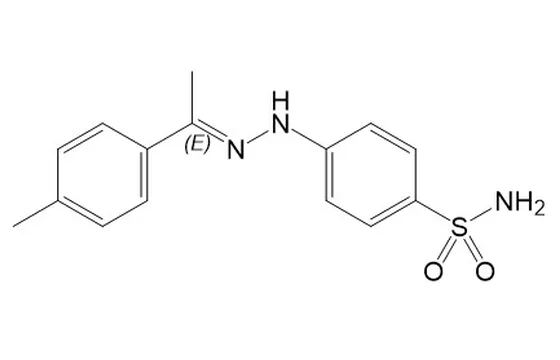
Sixty entries, numbers to 93, three letters
The celecoxib catalogue carries 60 entries with internal numbers running from 1 to 93 and gaps in between, which is the pattern described in the listed-versus-unlisted discussion. The letters that appear are A, B and D, matching the two monographs. The numbers are the supplier's own and do not correspond to either system, which is why the same CAS number can appear once under a number and once under a letter in the same list.
Reading the list by chemistry rather than by number produces four groups. Group one is the two regioisomers — EP A and EP B — which are process-derived and flat on stability. Group two is the oxidation family around 411, which grows on stability. Group three is the route fragments: material derived from the 4-methylacetophenone or the hydrazine, often smaller and more polar, sometimes carrying the sulfonamide but not the pyrazole. Group four is the labelled material and the synthetic intermediates that are not impurities of the drug substance at all.
Only the first three groups belong in a specification, and within them the decisions are driven by data. A regioisomer present at 0.05% in every batch is a specified impurity with a limit. A 411 oxidation product that reaches 0.08% after 24 months at 30 °C is a specified degradant with a tighter limit and a packaging consequence.
Where teams go wrong is buying all 60 entries and writing a method with 60 peaks. The specification then describes a product nobody makes, the validation package costs more than the batch, and the important peaks — the two isomers and the oxidation product — are buried among route fragments that never exceed the reporting threshold.
Limit arithmetic at 400 mg per day
Celecoxib is dosed at 200 mg twice daily, so the maximum daily dose is 400 mg. Under ICH Q3A(R2) the reporting threshold of 0.05% corresponds to 0.2 mg per day, and the identification and qualification threshold of 0.10% corresponds to 0.4 mg per day[3]. Neither the 1.0 mg absolute ceiling nor the 2 g dose band comes into play, so the percentages govern.
For the drug product, Q3B(R2) uses the same percentage logic with degradation-product thresholds[4]. A 200 mg capsule at 400 mg per day has a 0.2% identification threshold for a degradant, which is looser than the drug substance limit — a difference worth remembering when a batch passes release and fails the finished-product specification, or the reverse.
The two regioisomers are usually specified at 0.10% each with a total of 0.5% for other impurities, a combination that satisfies both monographs and leaves room for the oxidation product to grow. The oxidation product deserves its own line, because its trend is the one that determines the shelf life.
Any unspecified impurity limit of 0.10% is conventional and defensible, but it carries an obligation: every peak that could reach 0.10% must be identifiable on demand, which means keeping standards for the species that actually appear in stability, not for every number in a catalogue.
Method, standards and the certificate
A workable method resolves four regions: the polar route fragments near the solvent front, the two regioisomers in the middle, the parent, and the oxidation product after it. A C18 column with a phosphate buffer at pH 6–7 and a shallow acetonitrile gradient handles the middle and the end; the early region needs a separate injection or a different starting composition, because the polar fragments are gone before the gradient begins.
Detection at 254 nm is standard and adequate for the isomers, but the sulfonamide chromophore also absorbs strongly, so the method is sensitive to the oxidation product without any special wavelength. What it is not sensitive to is identity: the two isomers require an authenticated standard each, and the assignment should be confirmed by NMR at least once in the product's lifetime.
Validation follows Q2(R2)[5]: specificity against stressed samples, resolution between the isomer pair of at least 1.5, a relative response factor for each specified impurity, and an LOQ at or below the reporting threshold. The isomer pair is where most methods fail the resolution criterion on an aged column, so the robustness study should include column age as a variable rather than only pH and temperature.
On the certificate, check three things. Which letter system the standard belongs to, stated explicitly. The molecular formula, checked against the value in the monograph. And whether the standard is the free base — for celecoxib there is no salt, so a certificate that mentions a salt form is a warning sign rather than a detail.
None of this makes celecoxib unusually difficult. It makes it unusually instructive: two impurities that are the API's own formula, one that is thirty daltons heavier, and one that has lost its fluorine entirely. Four numbers, four completely different control strategies, and one monograph system that names them inconsistently.
Frequently Asked Questions
Why do Celecoxib EP Impurity A and B have the same molecular formula as celecoxib?
Is the celecoxib regioisomer a degradant?
What is the 411.36 impurity?
Why does USP Related Compound D contain no fluorine?
How many impurities does celecoxib actually have?
What identification threshold applies at 400 mg per day?
Can the two regioisomers be distinguished by LC-MS?
Should the oxidation product have its own specification line?
Related Substances and Reference Standards
- Celecoxib (60 impurity / derivative entries)
References and Sources
- PubChem, U.S. National Library of Medicine, Celecoxib, CID 2662: C17H14F3N3O2S, molecular weight 381.4, the 1,5-diarylpyrazole structure, accessed 2026-11-26
- PubChem, U.S. National Library of Medicine, Celecoxib EP Impurity A, CAS 170570-01-1, and EP Impurity B, CAS 331943-04-5: both C17H14F3N3O2S at 381.37, isomeric with the API, accessed 2026-11-26
- International Council for Harmonisation, ICH Q3A(R2), Impurities in new drug substances: reporting, identification and qualification thresholds, accessed 2026-11-26
- International Council for Harmonisation, ICH Q3B(R2), Impurities in new drug products: degradation product thresholds and qualification, accessed 2026-11-26
- International Council for Harmonisation, ICH Q2(R2), Validation of analytical procedures: specificity, resolution and relative response factors, accessed 2026-11-26
This article was prepared by the CATO technical team. Regulatory, pharmacopoeial and published literature content cited above is attributed in the reference list. It is provided for technical exchange and search reference only and does not constitute a quality specification or regulatory advice. For any specific substance, the applicable test methods, limits and filing requirements are governed by the current regulations, pharmacopoeial monographs and official publications.
Product information on this site is provided for research search and selection reference only and is not a quality specification; technical data, purity and structural confirmation are governed by the shipped COA and our written confirmation. All products mentioned are for research use only, not for human or animal diagnostic or therapeutic use.