Cholecalciferol Content Is a Ratio, Not a Number: Previtamin D3 and the Equilibrium Your Method Keeps Moving
Cholecalciferol↗ does not have a broken B ring by accident. The 9,10-seco structure that makes it a vitamin is also the reason the molecule sits in a reversible thermal equilibrium with its own previtamin, and every heating step in the analytical method moves that equilibrium.
Note: product names shown in red (marked with ↗) are links - click through to the product page for structure, CAS number, purity and lead time.
One formula, ten entries, and a reaction that runs backwards
Key points
- Cholecalciferol is C27H44O, 384.64, a 9,10-seco steroid: the B ring is open and the molecule carries a triene instead of a diene[1].
- The catalogue carries ten entries at C27H44O, and most of them are reached from one another by thermal, photochemical or acid-catalysed isomerisation rather than by oxidation.
- Cholecalciferol and previtamin D3 interconvert reversibly with temperature, which is why vitamin D3 content in official methods is defined as the sum of the two[2].
- At a 25 microgram daily dose, ICH Q3B permits 1.0 per cent of any isomer, so the threshold table constrains nothing here and the limit has to come from the equilibrium data and the monograph[3].
Most impurity work assumes a one-way street: the drug substance sits still and the environment chips pieces off it. Cholecalciferol breaks that assumption at the first step. The molecule is a steroid whose B ring has been opened by a photochemical electrocyclic reaction, and the ring can close again. What a laboratory calls the assay value is therefore a position in a distribution, not a quantity of substance.
That has a practical consequence which is easy to state and hard to design around: the same batch gives different results depending on the thermal history of the sample and of the standard, and both histories are set by the analyst, not by the manufacturer.
The open B ring is the whole problem
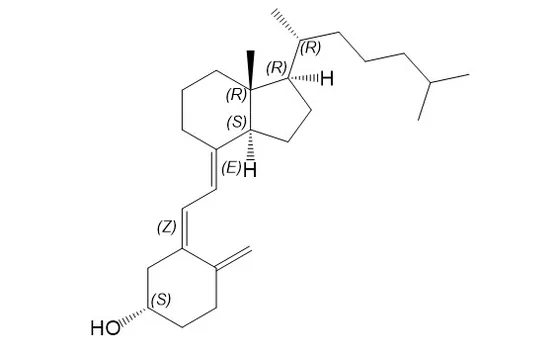
Cholecalciferol is 9,10-secocholesta-5,7,10(19)-trien-3-ol. The carbon skeleton keeps the four rings of cholesterol except that the bond between C9 and C10 is gone, so the A ring hangs off the rest of the molecule through a single bond and the conjugated system is a triene rather than the diene of 7-dehydrocholesterol. The 3-hydroxyl is retained and still hydrogen bonds, which is why the molecule is crystalline at all.
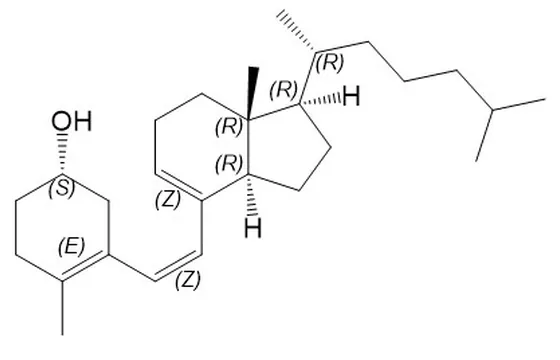
Opening a cyclohexadiene ring in a steroid is a six-electron electrocyclic reaction, and it is allowed in one direction of rotation under photochemical conditions and in the other under thermal conditions. Photochemistry drives the ring open; heat drives it closed. Both directions are accessible at temperatures a stability chamber can reach, and the equilibrium position between them shifts with temperature because the open form has more rotational freedom and therefore more entropy.
Previtamin D3 then slowly rearranges to cholecalciferol by a sigmatropic hydrogen shift from C19 to C9, and that step is what makes vitamin D3 the stable end of the pair at room temperature. It is also slow enough at 25 degrees that a sample can sit in the previtamin form long enough to be injected, which is the entire basis of the analytical problem.
Ten entries that differ only in geometry
The catalogue lists 36 cholecalciferol entries and ten of them share C27H44O. That is not ten unrelated impurities. It is one skeleton in a set of geometries, and the geometries are connected by reactions that run in a vial, a dryer or an injector.
Previtamin D3 and cholecalciferol differ by the position of one hydrogen and the configuration of the triene[4]. Lumisterol3 and tachysterol3 are the two photochemical by-products of the same irradiation: one has the hydrogen on the opposite face at C9, the other has a trans double bond where the previtamin has a cis one. Iodine moves cholecalciferol to trans-vitamin D3 and previtamin D3 to tachysterol, and acid moves the system to isotachysterol, which is how a laboratory can tell a thermal isomerisation from an acid-catalysed one[5].
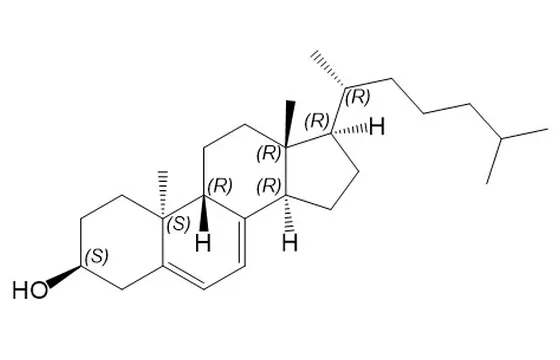
Two entries sit outside the thermal set and are often confused with it. 7-Dehydrocholesterol is the starting material, isobaric with the product, and distinguishable only because its conjugated diene absorbs at a longer wavelength than the triene[6]. The 3-epimer arises from keto-enol tautomerism at the allylic alcohol during synthesis and co-elutes with the parent on a surprising number of methods.
| Species | How it is reached | Formula and mass | What separates it |
|---|---|---|---|
| Cholecalciferol | the drug substance | C27H44O, 384.64 | reference |
| Previtamin D3 | thermal ring opening, reversible | C27H44O, 384.64 | triene geometry, ion ratio, retention |
| Lumisterol3 | hydrogen shift during irradiation | C27H44O, 384.64 | ring closed, no triene |
| Tachysterol3 | cis to trans isomerisation of previtamin | C27H44O, 384.64 | trans triene, absorbs further red |
| trans-vitamin D3 | iodine or acid on cholecalciferol | C27H44O, 384.64 | retention only |
| Isotachysterol3 | acid-catalysed rearrangement | C27H44O, 384.64 | retention only |
| 7-Dehydrocholesterol | the starting material | C27H44O, 384.64 | diene absorbs at longer wavelength |
| 3-Epicholecalciferol | epimerisation at C3 | C27H44O, 384.64 | retention, and not always resolved |
| 7,8-Epoxide | epoxidation of the diene | C27H44O2, 400.64 | mass, plus 16 |
Table note: eight of the nine species are isobaric at 384.64 and differ only in geometry or in the position of one hydrogen. Sources [2,4].
When the reaction reverses, degradation is the wrong word
A degradation product accumulates. An isomer redistributes. If a cholecalciferol sample is held at 40 degrees, previtamin D3 grows, the assay of cholecalciferol falls, and a report written from those two numbers says the substance degraded. Cool the same sample and the previtamin returns to cholecalciferol over time. Nothing was destroyed, and the mass balance was never broken.
This matters for how stability data are interpreted, not just for how they are reported. Arrhenius extrapolation assumes a one-way reaction with a rate constant that grows with temperature. A reversible isomerisation has an equilibrium constant that also moves with temperature, and in the direction that favours the open form, so the high-temperature data overstate what happens at 25 degrees. A six-month 40 degree study of cholecalciferol in an oily formulation therefore does not predict the shelf life of the same product at 25 degrees, and treating it as if it did is how a product gets an over-tight specification and a failed confirmatory batch.
The practical answer is to measure the pair, not the single peak, and to report total vitamin D activity as the sum. That is what official methods do, and it is not a convention chosen for convenience, it is the only definition that survives the chemistry[2].
Why the assay moves when the analyst heats the sample
Saponification is the step that does the damage, because it is the step that runs hot. A sample heated to 80 degrees for 30 minutes reaches an equilibrium position very different from one held at room temperature, and a standard that was never heated sits at a different position again. The result is a bias that looks like recovery loss and is not: the internal standard has equilibrated to a different extent than the analyte, so the ratio the method computes is wrong even though both peaks integrated cleanly.
The published recommendation is blunt: heat sample and standard under conditions that bring both to the same equilibrium position before injection, and only then is it unnecessary to integrate previtamin D3 separately[2]. Laboratories that skip that step and still integrate only the cholecalciferol peak are reporting a number that depends on their water bath.
Formulation adds a second variable. Cyclodextrin catalyses the interconversion between previtamin D3 and cholecalciferol, so a tablet or a powder blend containing a cyclodextrin or a similarly hydrophobic cavity will reach a different equilibrium position than the same amount of drug substance in oil, at the same temperature and in the same time[7]. Spray-dried vitamin D3 on a starch carrier, an oily drop formulation and a cyclodextrin complex are three different chemical systems, not three presentations of one.
The instrument is the third variable. Injection port temperature, transfer line temperature and even the residence time in a hot autosampler all shift the ratio, and the shift is not the same for sample and standard because their matrices differ. A method that specifies a column and a gradient but leaves inlet temperature to the instrument default has not been fully specified.
At microgram doses the threshold table stops constraining anything
Vitamin D3 is dosed in micrograms. One microgram is 40 international units, so a 1000 IU supplement is 25 micrograms, and even a weekly 50,000 IU regimen averages under 200 micrograms per day. Every one of those doses falls in the lowest band of ICH Q3B(R2), where the identification threshold is 1.0 per cent or 5 micrograms and the qualification threshold is 1.0 per cent or 50 micrograms[3].
Run the arithmetic at 25 micrograms per day. One per cent is 0.25 micrograms, far below the 5 microgram absolute limit, so the percentage governs and the permitted level is 1.0 per cent. The qualification threshold behaves the same way. In other words the guideline permits one per cent of any single isomer at every dose a vitamin D product actually uses, which is more permissive than the equilibrium itself, since a heated sample will exceed one per cent previtamin before it exceeds anything else.
So the threshold table is not the constraint. What constrains the specification is the monograph, which names the individual isomers and limits them by identity rather than by a percentage of an unspecified total, and the stability data, which show how far the equilibrium can move in that matrix. The ICH arithmetic is still worth doing, because a reviewer will ask for it, but its answer should be stated plainly: the general thresholds do not bind, and here is what does.
The comparison with the drug substance thresholds is the same story. ICH Q3A(R2) sets identification at 0.10 per cent or 1.0 mg per day for substances dosed below 2 g per day[8], and 1.0 mg per day is roughly forty times a whole daily dose of vitamin D3. The absolute column is meaningless at this scale, and the percentage column is what a specification would use if it used the table at all.
Reading the catalogue, and where vitamin D2 fits
The cholecalciferol variety page lists 36 entries including the drug substance, and the C27H44O group is the part worth reading closely, because that is where the isomer set lives. The two entries that are not isomers at all, the 7,8-epoxide at 400.64 and the various esters and adducts at higher mass, can be set aside immediately.
The ester entries deserve one sentence because they are a different product category. Cholecalciferol is sold as concentrates and as stabilized powders, and some catalogue entries are reaction products of the vitamin with a matrix component rather than impurities of the drug substance. The impurity reference standards index separates them by formula, which is the only reliable filter when names run from one to sixty-two.
Vitamin D2 is the comparison that matters. Ergocalciferol is C28H44O at 396.65, one methyl and one double bond more in the side chain, so mass spectrometry separates it from D3 cleanly and it is used as the internal standard for exactly that reason[9]. It isomerises by the same mechanism, which means the internal standard carries the same equilibrium problem as the analyte, and using it without equilibrating both is the bias described above rather than a correction for it.
The variety index is the fastest route to the other seco-steroids in the catalogue, and it is worth checking whether a given method has ever been validated on a matrix containing a cyclodextrin before assuming that a D3 result transfers between products.
Four mistakes worth avoiding
Reporting cholecalciferol alone. A single-peak assay after a hot saponification measures the equilibrium position of that particular water bath. Report the pair, or equilibrate the standard to match.
Treating a reversible isomer as a degradant in the stability table. The number will drift down and back up across time points, and a linear regression through those points has no meaning.
Extrapolating 40 degree data with an Arrhenius model. The equilibrium constant moves with temperature, so the high-temperature point is not on the same curve as the room-temperature one.
Assuming 7-dehydrocholesterol is visible by mass. It is isobaric with the product. Only the ultraviolet spectrum, or an authentic standard on a resolving column, tells them apart.
Frequently Asked Questions
Is previtamin D3 an impurity or part of the assay?
Why does the same batch give different assay results in two laboratories?
Does light or heat dominate cholecalciferol degradation?
Can I detect 7-dehydrocholesterol by LC-MS?
What does iodine do in these studies?
Does the ICH threshold table apply to a 25 microgram dose?
Can a cyclodextrin in the formulation change the impurity profile?
Related Substances and Reference Standards
- Cholecalciferol (- impurity / derivative entries)
- Ergocalciferol (- impurity / derivative entries)
References and Sources
- PubChem, National Center for Biotechnology Information, Cholecalciferol, C27H44O, 384.64, 9,10-secocholesta-5,7,10(19)-trien-3-ol, used here for the formula, the mass and the seco-steroid description, accessed 2026-11-20
- Journal of AOAC International, Gill et al., Differential Thermal Isomerization: Its Role in the Analysis of Vitamin D3 in Foods, 103(2):563-569, 2020: vitamin D3 defined as the sum of vitamin D3 and previtamin D3, with recommendations on equilibrating sample and standard to avoid analytical bias, accessed 2026-11-20
- International Council for Harmonisation, ICH Q3B(R2), Impurities in new drug products, Attachment 1: for doses below 1 mg per day, identification is 1.0 per cent or 5 micrograms and qualification 1.0 per cent or 50 micrograms, whichever is lower, accessed 2026-11-20
- PubChem, National Center for Biotechnology Information, Previtamin D3, CAS 1173-13-3, C27H44O, 384.64, the open-ring isomer related to cholecalciferol by a reversible thermal reaction, accessed 2026-11-20
- Food Chemistry, Elsevier, Mahmoodani et al., Degradation studies of cholecalciferol (vitamin D3) using HPLC-DAD, UHPLC-MS/MS and chemical derivatization, 219:373-381, 2017: thermal and reversible transformation to previtamin D3, iodine-driven formation of trans-vitamin D3 and tachysterol, and acid-driven formation of isotachysterol, accessed 2026-11-20
- PubChem, National Center for Biotechnology Information, 7-Dehydrocholesterol, CAS 434-16-2, C27H44O, 384.64, isobaric with cholecalciferol and distinguishable only through its conjugated diene chromophore, accessed 2026-11-20
- Journal of Biological Chemistry, Catalyzed thermal isomerization between previtamin D3 and vitamin D3 via beta-cyclodextrin complexation, 1995: a formulation excipient shifting the equilibrium position of the pair, accessed 2026-11-20
- International Council for Harmonisation, ICH Q3A(R2), Impurities in new drug substances: identification 0.10 per cent or 1.0 mg per day for substances dosed at or below 2 g per day, accessed 2026-11-20
- PubChem, National Center for Biotechnology Information, Ergocalciferol, vitamin D2, C28H44O, 396.65, used as the internal standard because the extra methyl and double bond in the side chain separate it from cholecalciferol by mass, accessed 2026-11-20
This article was prepared by the CATO technical team. Regulatory, pharmacopoeial and published literature content cited above is attributed in the reference list. It is provided for technical exchange and search reference only and does not constitute a quality specification or regulatory advice. For any specific substance, the applicable test methods, limits and filing requirements are governed by the current regulations, pharmacopoeial monographs and official publications.
Product information on this site is provided for research search and selection reference only and is not a quality specification; technical data, purity and structural confirmation are governed by the shipped COA and our written confirmation. All products mentioned are for research use only, not for human or animal diagnostic or therapeutic use.