Cinacalcet: The Secondary Amine Is the Drug, and the Nitrosamine Limit Is 8 ppm
Most nitrosamine articles are about a molecule that could have been made differently. Cinacalcet↗ is not one of them: the secondary amine that gets nitrosated is the nitrogen that binds the calcium-sensing receptor, so the risk sits inside the pharmacophore and the control strategy has to be built downstream of the synthesis instead of inside it.
Note: product names shown in red (marked with ↗) are links - click through to the product page for structure, CAS number, purity and lead time.
A secondary amine that the mechanism will not let you remove
Key points
- Cinacalcet hydrochloride is C22H23ClF3N, 393.9, CAS 364782-34-3; the base is C22H22F3N, 357.4, and it is a secondary amine carrying a 1-naphthyl ethyl group and a 3-trifluoromethylphenyl propyl chain[1].
- The N-H is the pharmacophore. It is the hydrogen-bond donor the calcium-sensing receptor reads, so no route change removes it and the nitrosamine risk is structural rather than process-driven.
- N-nitroso cinacalcet is C22H21F3N2O, 386.4, CAS 3036581-83-3, and it is already a catalogued substance because every applicant has had to measure it[1].
- The label titrates 30, 60, 90, 120 and 180 mg once daily[2], so the default 1.5 microgram per day threshold of concern[3] becomes 8.3 ppm at the top of the range and 50 ppm at the bottom.
Cinacalcet is a calcimimetic, and its mechanism is the reason its impurity work looks the way it does. The molecule is a secondary amine: one nitrogen bearing a 1-naphthyl ethyl group and a 3-trifluoromethylphenyl propyl chain. The N-H is not decoration. It is the hydrogen-bond donor that the calcium-sensing receptor reads, and the effect disappears if the nitrogen is methylated away[1].
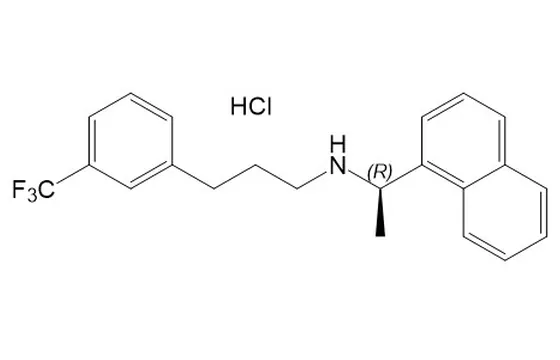
Everything that follows comes from that sentence. A secondary amine can be nitrosated, and a nitrosated secondary amine is a nitrosamine drug substance-related impurity: a different regulatory object from an ordinary organic impurity, with its own acceptable intake, its own method and its own section in a deficiency letter. A molecule that could hide its amine behind a methyl group would have a different problem. Cinacalcet cannot, because the methyl group would be the drug.
The salt adds a second layer. Cinacalcet is dispensed as the hydrochloride, so it brings its own acid into any solution where nitrite is present, and nitrosation is acid-catalysed.
One stereocenter and two rings: four variables on one formula
The molecule has one stereocenter, at the carbon bearing the naphthyl group, and the drug is the R configuration. This catalogue carries the S enantiomer as CAS 1217809-88-5 under the label USP Related Compound D. It is an enantiomer and not a diastereomer, so no C18 method will resolve it.
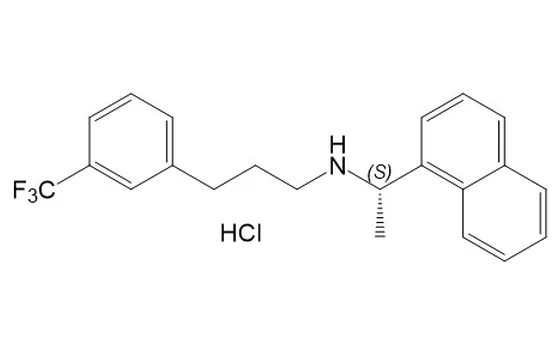
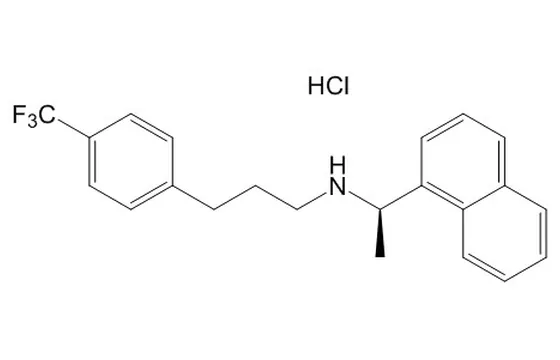
Chirality is only the first variable. The two aromatic rings bring their own, and they are independent. The naphthalene can be attached at the 1 position, which is the drug, or at the 2 position. The trifluoromethyl group can sit meta to the propyl chain, which is the drug, or para. Each is a one-step error in a different starting material, and each produces the same formula, the same mass and a different shape.
Six entries carry C12H13N, the naphthyl ethylamine fragment: the R and S forms of the 1-isomer, the 2-isomer, and hydrochlorides. That cluster is not a set of degradation products. It is a set of starting materials, and its size is a reminder that a chiral amine bought from a supplier is a four-dimensional specification.
Three entries with the drug formula, and one that is heavier for a reason
Three entries carry the formula of the drug. The rest differ in mass or in the position of a substituent, and the difference tells you which step to look at.
| Entry | CAS | Formula and mass | Variable, and the step it implicates |
|---|---|---|---|
| Cinacalcet hydrochloride | 364782-34-3 | C22H23ClF3N, 393.9 | none |
| USP Related Compound D | 1217809-88-5 | same | S configuration; the chiral amine feed |
| USP Related Compound C | 1428118-39-1 | same | para rather than meta CF3; the aryl feed |
| Impurity 7 | 2200269-28-7 | same | 2-naphthyl; the naphthyl ethylamine feed |
| USP Related Compound B | 1271930-15-4 | C32H31F6N, 543.6 | a second arylpropyl chain on the same nitrogen |
| N-nitroso cinacalcet | 3036581-83-3 | C22H21F3N2O, 386.4 | N=O on the amine; nitrite, not the route |
Table note: formulas, masses and positions from the PubChem records for each CAS number[1]; the right-hand column names the step each variable implicates, which is an inference from structure rather than a published route.
One row stands out on mass. USP Related Compound B is 543.6, which is 186.2 above the base, and 186.2 is a 3-trifluoromethylphenyl propyl group minus a hydrogen. It is not a dimer: two molecules of base would be 714.8, and C32H31F6N contains one nitrogen. It is the tertiary amine formed when the reductive amination alkylates the same nitrogen twice, and its size is a direct read-out of how well that step was controlled.
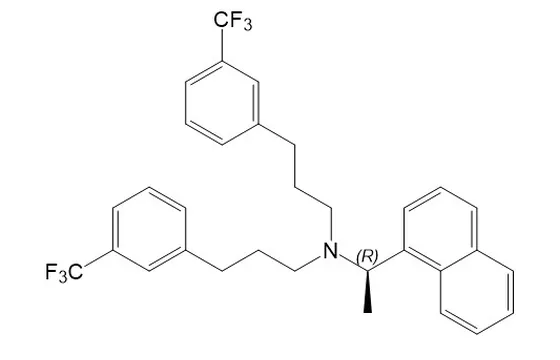
That row carries the argument. Alkylating the nitrogen a second time removes the N-H, and a tertiary amine cannot be nitrosated without dealkylation first. So the heaviest and most obviously wrong impurity in the profile is the one with no nitrosamine risk, while the drug carries all of it. Ranking by peak size and ranking by hazard point in opposite directions.
Nitrosation chemistry: what has to be present, and what does not count
Nitrosation needs two things: the amine, which the drug supplies, and a nitrosating species, which it does not. The species is nitrous acid or a nitrosyl equivalent, and the practical sources are nitrite in water, nitrite in an excipient, and nitrous acid generated from nitrate by residual reductants. Each is a raw-material or environmental specification, not a synthesis step.
The benzylic position makes cinacalcet more exposed than a plain alkylamine. A 1-naphthyl ethyl group stabilises the developing positive charge on the adjacent carbon, so the nitrogen is more nucleophilic than its basicity alone suggests. The hydrochloride supplies the acid, water supplies the mobility, nitrite supplies the rest.
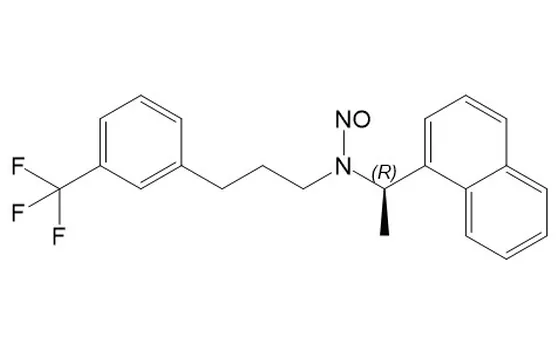
Where no compound-specific limit exists, the default is a total threshold of concern of 1.5 micrograms per day[3]. Where a substance-specific acceptable intake has been derived, it replaces the default, and the derivation runs through the potency categories in the FDA guidance on nitrosamine drug substance-related impurities, which assign an intake in nanograms per day from structural features[4]. Either way the number that constrains a method is a concentration, and concentration depends on dose.
One correction, because it circulates in risk assessments. An N-oxide is not a nitrosamine and does not fail a nitrosamine specification. This catalogue carries four entries at C22H22F3NO, one oxygen above the base. They matter as evidence of oxidative exposure and as a species one reduction away from the secondary amine, not as a nitrosamine control point.
Eight ppm at 180 mg: the arithmetic that decides the method
The label titrates through 30, 60, 90, 120 and 180 mg once daily, so daily intake varies six-fold across the approved range[2]. A nitrosamine limit in parts per million therefore has six values for the same molecule, and a specification written at the starting dose is not the one that protects the patient at 180 mg.
| Daily dose | 1.5 micrograms per day as a concentration | On column at 1 mg per mL, 10 microlitres | Tighter than 0.10 per cent by |
|---|---|---|---|
| 30 mg | 50 ppm | 500 pg | 20 times |
| 60 mg | 25 ppm | 250 pg | 40 times |
| 90 mg | 16.7 ppm | 167 pg | 60 times |
| 180 mg | 8.3 ppm | 83 pg | 120 times |
Table note: arithmetic from the 1.5 microgram per day threshold of concern[3] and the label titration scheme[2]; the column load assumes a 1 mg per mL solution and a 10 microlitre injection. The last column uses the ICH Q3A identification threshold of 0.10 per cent as a reference point only.
The last two columns decide the method. At 180 mg the limit is 8.3 ppm, and 8.3 ppm of a 1 mg per mL solution is 8.3 nanograms per millilitre, or 83 picograms on a 10 microlitre injection. That is below the reliable detection limit of a photodiode array detector at 223 nm and inside the working range of a triple quadrupole. The choice is not a preference.
The comparison column makes a second point. The nitrosamine limit at 180 mg is about 120 times tighter than the ordinary identification threshold for the same product, so a batch can pass assay, dissolution and every organic impurity limit and still fail on a peak a conventional method never saw.
A response factor of 1.79, and the 44 per cent it hides
The published stability-indicating method for cinacalcet hydrochloride shows both the strength and the trap of related-substances work. On a 100 by 2.1 mm reversed-phase column at 223 nm, with pH 6.6 phosphate buffer and acetonitrile at 0.3 mL per minute and 35 degrees Celsius, the authors resolved the drug from the naphthyl ethylamine, a regioisomer and two further peaks, and validated linearity from the limit of quantification to 0.3 per cent[5].
The response factors are the part to read twice. Relative to the drug, the naphthyl ethylamine responds at 1.79, the regioisomer at 0.99, and the two remaining peaks at 0.89 and 0.88[5]. A factor of 1.79 means the impurity gives 79 per cent more signal per unit mass. Quantify it by area per cent and the result is not slightly low; it is low by 44 per cent, because the reported figure is a ratio of areas and not of masses.
That single number changes a batch decision. An uncorrected 0.09 per cent for the naphthyl ethylamine is a corrected 0.16 per cent, which is above the qualification threshold, so a batch that looked compliant is not. Every impurity outside roughly 0.8 to 1.2 needs a correction factor in the calculation or its own standard.
The 223 nm wavelength explains why the correction bites harder here. Cinacalcet's naphthalene absorbs strongly there, but the naphthyl ethylamine has no amide or arylpropyl chain diluting that chromophore, so per unit mass it absorbs more. Wavelength and response factor are one decision seen from two sides.
What transfers from fluoxetine, ranitidine and sildenafil, and what does not
Four other nitrosamine cases define the boundary of what can be copied, and they are worth separating because the remedies are different.
Fluoxetine hydrochloride is the closest analogue and the same trap: its secondary amine is also the pharmacophore, also cannot be alkylated away, and also has to be controlled by nitrite and moisture rather than by a route change. What differs is the amine itself, an aliphatic methylamine rather than a benzylic one, so nitrosation is slower and the arithmetic, at 20 to 60 mg per day, is far more generous.
Ranitidine hydrochloride is a different mechanism entirely. Its nitrosamine does not form on the intact drug; it forms after the side chain cleaves and releases dimethylamine, which is then nitrosated. That is why NDMA never appeared in the impurity profile, and why a specification built around the parent molecule would have missed it.
Sildenafil citrate is the third pattern. The drug has no secondary amine at all, so nitrosation can only happen on the desmethyl degradant, which puts the control point on a degradation product and makes the risk grow with storage rather than with the route.
Valsartan is the case that does not belong in this list, and is included to make that point. Its NDMA came from a solvent, dimethylformamide, in one manufacturing process. Nothing in the molecule predicted it and no structural argument about amines would have found it. Three of these four cases are structural; one is a solvent specification, and confusing them produces risk assessments that model the wrong thing.
What a deficiency letter asks, in the order it asks
A deficiency letter on a molecule like this tends to ask four things in a predictable order: the risk assessment and whether it covers secondary-amine impurities as well as the parent; the method and its limit of quantification against the limit; the control strategy at the source; and the behaviour at the top of the dose range.
The first is the one usually answered too narrowly. Modelling work on approved products has shown that secondary-amine-related impurities can add to the total nitrosamine burden in ways a parent-only model misses[6]. For cinacalcet the relevant set is small, because most of the profile is tertiary or aromatic, but the assessment has to say so explicitly rather than by omission.
The second is settled by arithmetic. If the limit at 180 mg is 8.3 ppm, the method needs a limit of quantification at or below about 2.5 ppm to show control with margin, which means MS detection and a validated transition. A UV method cannot be validated to that level and should not be offered.
The third is where the engineering sits: nitrite limits on water and excipients, moisture barrier packaging, and a sequence that avoids acidic aqueous conditions in the presence of nitrite. None of it is a synthesis change, because the amine cannot be changed. The fourth is the one applicants forget; a limit validated at 30 mg and applied to a 180 mg tablet is six times too loose.
Reference standards for a molecule with four positional variables
This catalogue holds 105 cinacalcet hydrochloride entries. The six that carry this argument are the drug at 364782-34-3, the S enantiomer at 1217809-88-5, the para-trifluoromethyl regioisomer at 1428118-39-1, the 2-naphthyl regioisomer at 2200269-28-7, the over-alkylated tertiary amine at 1271930-15-4 and N-nitroso cinacalcet at 3036581-83-3. [See every cinacalcet entry](Cinacalcet Hydrochloride)
Three handling notes follow. N-nitroso cinacalcet belongs in the freezer as the solid, not on the bench as a dilute solution, because a working standard left for a week is a standard of unknown concentration. The tertiary amine at 543.6 elutes late and disappears from a short run, so the method needs a flush long enough to see it. And the two regioisomers differ from the drug by a substituent position on a ring, a change in shape rather than size, so their relative retention is method-dependent and does not transfer between columns.
show a filing base of 58 applicants. That is the practical reason a defensible nitrosamine position matters here: the impurity chemistry is settled, and what separates one dossier from another is whether the control strategy was argued from the structure or copied from a template.Frequently Asked Questions
Can the nitrosamine risk be designed out of cinacalcet?
Is 1.5 micrograms per day the right limit for N-nitroso cinacalcet?
Why is a relative response factor of 1.79 a problem?
Which impurity tells you the reductive amination was over-run?
Is the N-oxide an impurity I need to control for nitrosamines?
Does the hydrochloride salt make nitrosation worse?
Can one method cover both the regioisomers and the enantiomer?
Related Substances and Reference Standards
- Cinacalcet Hydrochloride (105 impurity / derivative entries)
- Fluoxetine Hydrochloride (46 impurity / derivative entries)
- Ranitidine Hydrochloride (33 impurity / derivative entries)
- Valsartan (71 impurity / derivative entries)
References and Sources
- U.S. National Library of Medicine, PubChem, Cinacalcet hydrochloride, CAS 364782-34-3, C22H23ClF3N, 393.9; cinacalcet base, CAS 226256-56-0, C22H22F3N, 357.4; the S enantiomer, CAS 1217809-88-5; the para-trifluoromethyl regioisomer, CAS 1428118-39-1; the 2-naphthyl regioisomer, CAS 2200269-28-7; the tertiary over-alkylated amine, CAS 1271930-15-4, C32H31F6N, 543.6; N-nitroso cinacalcet, CAS 3036581-83-3, C22H21F3N2O, 386.4, accessed 2026-11-13
- U.S. National Library of Medicine, DailyMed, Sensipar (cinacalcet hydrochloride) tablets, prescribing information: starting dose 30 mg once daily, titration through 30, 60, 90, 120 and 180 mg once daily, accessed 2026-11-13
- International Council for Harmonisation, ICH M7(R2), Assessment and control of DNA reactive (mutagenic) impurities in pharmaceuticals to limit potential carcinogenic risk: the 1.5 microgram per day total threshold of concern and the options for compound-specific limits, accessed 2026-11-13
- U.S. Food and Drug AdministrationRecommended acceptable intake limits for nitrosamine drug substance-related impurities in drug products: the potency category framework and acceptable intake values in nanograms per day (guidance document, cited by title; no stable public URL in this environment)
- Scientia Pharmaceutica, Development and validation of a stability-indicating RP-UPLC method for the estimation of impurities in cinacalcet hydrochloride API and its formulation: 223 nm detection, pH 6.6 phosphate buffer with acetonitrile, and relative response factors of 1.79 for the naphthyl ethylamine, 0.99 for the regioisomer and 0.89 and 0.88 for two further peaks, accessed 2026-11-13
- Journal of Pharmaceutical Sciences, Simulation of nitrosamine drug substance-related impurities from secondary amine-related impurities in approved human drug products, accessed 2026-11-13
This article was prepared by the CATO technical team. Regulatory, pharmacopoeial and published literature content cited above is attributed in the reference list. It is provided for technical exchange and search reference only and does not constitute a quality specification or regulatory advice. For any specific substance, the applicable test methods, limits and filing requirements are governed by the current regulations, pharmacopoeial monographs and official publications.
Product information on this site is provided for research search and selection reference only and is not a quality specification; technical data, purity and structural confirmation are governed by the shipped COA and our written confirmation. All products mentioned are for research use only, not for human or animal diagnostic or therapeutic use.