Clarithromycin Dissolves Best in the Medium That Destroys It
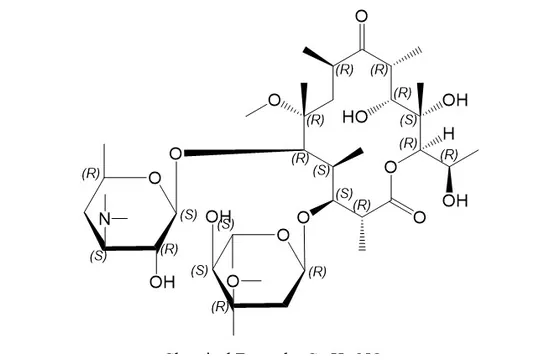
Clarithromycin↗ is erythromycin with a methyl on the one hydroxyl that lets the parent fall apart in stomach acid. The methyl worked, but it moved the degradation rather than removing it, and left a molecule that dissolves best in the medium that destroys it.
Note: product names shown in red (marked with ↗) are links - click through to the product page for structure, CAS number, purity and lead time.
A 14-membered lactone, two sugars, and one methyl that changed the drug
Key points
- Clarithromycin is 6-O-methylerythromycin A, C38H69NO13, 747.96, CAS 81103-11-9: a 14-membered lactone with desosamine, cladinose and one tertiary amine[1].
- The protonation that makes it soluble at gastric pH also makes it react there; solubility and stability run in opposite directions across the pH scale[2].
- Blocking the C6 hydroxyl removes the erythromycin hemiketal pathway and leaves glycosidic cleavage of cladinose as the dominant acid reaction: C30H55NO10, 589.8, exactly one cladinose lighter[1,3].
- At one gram per day the percentage thresholds of ICH Q3A and its absolute caps coincide exactly, a coincidence few other doses reproduce[4].
Clarithromycin is erythromycin A with a methyl on the C6 hydroxyl. Underneath sits a 14-membered macrolactone with a ketone at C9, desosamine at C5, cladinose at C3, and a tertiary dimethylamine. Add that one methyl and the molecule becomes acid-tolerant enough to swallow. C38H69NO13, 747.96, CAS 81103-11-9[1].
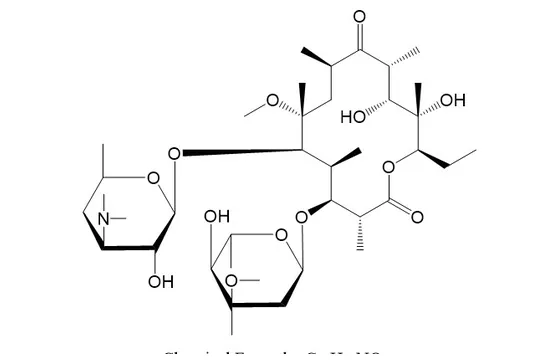
Three features drive every analytical decision. The ring carries four hydroxyls and a ketone, all hydrogen-bonding, none conjugated. Both sugars hang from acetals, which are acid-labile. The amine is the only ionizable group, so it is the only lever pH has on solubility. The consequence is an almost total absence of ultraviolet chromophore: the C9 ketone absorbs weakly near 280 nm and nothing else absorbs above 210 nm, which fixes detection at the edge of the range where mobile-phase absorbance and lamp drift both matter.
Soluble where it is unstable: the pH inversion that decides the method
Clarithromycin is a weak base. In the stomach it is protonated and dissolves readily; at intestinal pH it is largely neutral and solubility collapses. which is why such drugs are formulated as immediate-release tablets.
The complication is that the acid which dissolves it also destroys it. Work on clarithromycin solid dispersions states the conflict directly: solubility improves under acidic conditions through amine protonation, while the same conditions drive chemical degradation, so a formulation that dissolves faster in the stomach also degrades faster there[2]. The two properties cannot be optimized separately.
Dissolution is where this bites first. In an acidic medium at 37 degrees Celsius for thirty to sixty minutes, the amount in solution at any time point is the difference between dissolution and hydrolysis. A faster-wetting formulation gives a higher early value and a lower plateau, and the same curve can be read as better or worse depending on which phase is inspected. The fix is a shorter run, a cooler vessel, or a medium in which the molecule is chemically stable yet still soluble enough to discriminate.
The same arithmetic governs forced degradation, where an acid condition that is routine for a neutral molecule will consume a large fraction of this sample within an hour at room temperature.
What acid removes first, and the arithmetic that names it
Erythromycin A falls apart in acid by an intramolecular route: the C6 hydroxyl reaches the C9 ketone, forms a cyclic hemiketal and dehydrates to an inactive enol ether. A methoxy at C6 cannot make that attack, which is why clarithromycin survives the stomach and its parent does not.
Removing that route does not make the molecule inert; it promotes a different one. The cladinose bond is an acetal, and acetals hydrolyse in acid. The measured outcome is a decladinose product, which the chromatographic literature on this drug names as its acid degradation product[3]. The arithmetic is unambiguous: 747.96 minus cladinose, C8H14O3 at 158.17, gives 589.79.
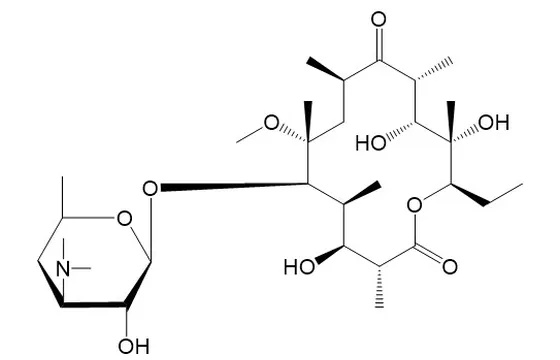
Its neighbours carry the story further. One step on is C30H51NO8 at 553.8, the same skeleton minus two waters; 589.8 minus 36.03. Dehydration of a polyol macrolide does not stop at one water, and each loss removes a hydrogen-bond donor, moving the substance earlier on a reversed-phase column.
Water also leaves without cladinose. The entry at C38H67NO12, 729.9, is the intact drug minus one water, recorded as a 10,11-unsaturated 11-deoxy derivative, which is what dehydration at the C9 to C11 region looks like once the ketone is engaged. 747.96 minus 18.02 is exact. A dehydrated degradant and the parent differ by 18 Da and one double bond, so they co-elute readily and are easy to confuse when identification rests on retention time.
One formula, five entries: a hydroxylation, an epimer pair and an N-oxide
One formula here carries five entries: C38H69NO14 at 764.0, one oxygen more than the drug. That oxygen can arrive in two chemically unrelated ways, and both are present.
| Entry | CAS | Formula and mass | What the oxygen did |
|---|---|---|---|
| 14-hydroxy, configuration R | 116836-41-0 | C38H69NO14, 764.0 | hydroxylation at C14, one new stereocenter |
| 14-hydroxy, configuration S | 116836-40-9 | C38H69NO14, 764.0 | same position, opposite configuration |
| 14-hydroxy, unspecified | 110671-78-8 | C38H69NO14, 764.0 | same substance, configuration not stated |
| EP impurity A | 124412-58-4 | C38H69NO14, 764.0 | published as Clarithromycin F, with 14-hydroxyclarithromycin among its synonyms |
| N-oxide | 118074-07-0 | C38H69NO14, 764.0 | oxygen on the desosamine nitrogen, no new stereocenter |
Table note: formulae and masses from the PubChem records for each CAS number[1]; entry labels as printed in this catalogue, which does not follow a single numbering authority.
Four rows describe the same C14 hydroxylation with the configuration specified or left open; the fifth is a different reaction. A C14 hydroxyl creates a stereocenter and therefore a diastereomeric pair on an ordinary C18 column. N-oxidation creates no stereocenter, but it neutralises the only basic centre, and the retention of the molecule collapses.
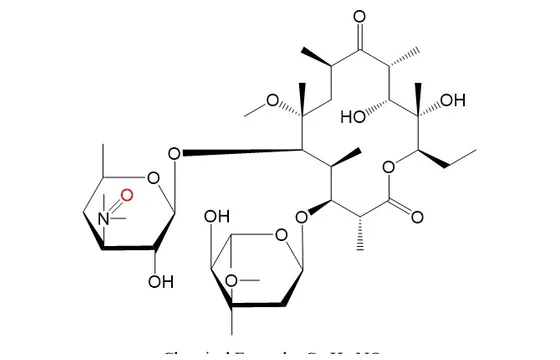
The group matters more than its size suggests. 14-hydroxyclarithromycin is the principal active metabolite in humans, which is why it appears in bioanalytical assays beside the parent[3]. A 764.0 peak therefore forces a choice: a metabolite that should not be in a tablet, or an oxidised degradant that should not be in a bulk substance.
Over-methylation: three entries that differ by a single CH2
The same chemistry runs the other way. Clarithromycin is made by methylating a protected erythromycin at C6, and that reaction is not perfectly regioselective. Three entries share C39H71NO13 at 762.0, one CH2 above the drug, and one is recorded as 6,11-di-O-methylerythromycin[1].
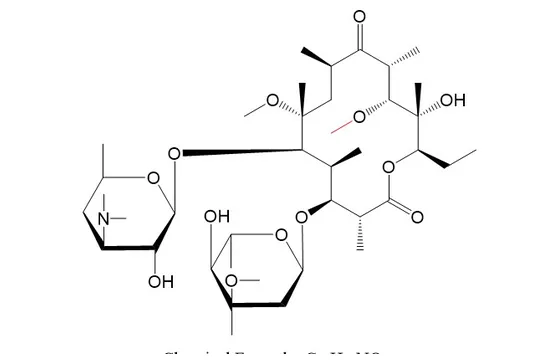
A second methyl at C11 removes a hydroxyl from the hydrogen-bonding network of the ring and adds 14 Da to a mass that is already hard to confirm, because macrolides fragment by sequential loss of sugars and water rather than into a few diagnostic ions. Three entries at one formula means three positional isomers that no mass spectrometer will separate. This is a process problem, not a storage problem: it is set at the methylation step and does not grow on stability, so a programme that only looks at degradation never sees it. Control belongs on the methylated intermediate, where the isomers are fewer and the separation is easier.
Designing forced degradation that is not redundant
A forced degradation package built from the usual acid, base, peroxide, heat and light will give a dense chromatogram and little information. Acid has to be titrated rather than prescribed: because glycosidic cleavage is fast, the useful condition is the shortest one giving five to fifteen per cent loss, so run three strengths against three times and use the combination that lands in that window.
Hydrolysis must also be separated from dissolution. In a tablet, acid stress is applied to a suspension that is dissolving at the same time, so the observed rate mixes two processes. Stressing an extracted solution and a whole tablet separately tells you whether a peak is a chemical product or an undissolved excipient eluting in the same window.
Oxidation is the condition most often over-applied. Peroxide attacks the tertiary amine to give the N-oxide, one of the 764.0 entries, and it does so quickly; a sample left overnight in peroxide is dominated by a product that also forms slowly on storage. The informative measurement is the ratio of N-oxide to hydroxylated products at low conversion, because that ratio separates an oxidative degradant from an impurity carried in from fermentation. Light is worth including precisely because the answer is likely negative: with no conjugated chromophore, photodegradation is not a strong pathway here, and a documented negative result under ICH Q1B conditions removes a category of questions at review.
Detection without a chromophore, and the three pairs that break methods
Macrolide methods transfer worse than methods for aromatic molecules, for a structural reason. With no chromophore everything is detected at the edge of the ultraviolet range, where mobile-phase absorbance, lamp age and the exact water content of the aqueous component matter more than they do at 254 nm. Two laboratories can run the same gradient and get different selectivity because one batch of acetonitrile has a different ultraviolet cut-off.
Selectivity is the other half. A published study of clarithromycin impurity analysis identified three critical pairs and used a hydrophobic subtraction model to screen nearly six hundred column characterisations, narrowing fifteen tested columns to ten that could resolve all three[5]. Without that infrastructure the practical rule is narrower: this method has three known trouble spots, and a column borrowed from another macrolide is a guess until the three pairs have been injected.
System suitability should be built around the pairs, not around plate count. Resolution between the drug and the nearest degradant, plus a second requirement between the two 764.0 substances, is a specification that fails when the column is failing.
Limits at one gram per day, where percentages and caps coincide
Clarithromycin is given as 500 mg twice daily in the eradication regimens where it appears, one gram of drug per day[6]. That number is convenient, because one gram is exactly where the two halves of the ICH Q3A identification threshold meet.
| Threshold | Percentage | Mass at 1 g per day | Absolute cap | Which governs |
|---|---|---|---|---|
| Reporting | 0.05 | 500 micrograms | none | percentage |
| Identification | 0.10 | 1.0 mg | 1.0 mg | they are equal |
| Qualification | 0.15 | 1.5 mg | 1.5 mg | they are equal |
Table note: percentages and absolute caps from ICH Q3A(R2)[4]; the mass column is arithmetic against a one gram daily intake, not a published limit.
Above one gram the caps govern and a percentage limit becomes more permissive than the cap; below one gram the percentages govern and the caps are unreachable. Clarithromycin sits on it, so 0.10 per cent and 1.0 mg per day describe the same limit.
Qualification deserves more attention than it usually gets. 0.15 per cent of one gram is 1.5 mg per day of a glycoside that differs from the drug by a sugar, so either qualify a batch at that level or set the limit at or below identification and say why. Importing the argument from a lower-dose macrolide is a common and easily detected error. In the finished product the subject is degradation products, so ICH Q3B(R2) applies the same three tiers[4].
What transfers from azithromycin, erythromycin and roxithromycin
Azithromycin is a 15-membered azalide: a ring nitrogen replaces a carbon, the C9 ketone is gone, and with it the hemiketal chemistry. Its acid behaviour differs for a structural reason and its degradant list is not a scaled version of this one. The detection strategy transfers; the impurity list does not, and its nitrosamine question is a separate problem (azithromycin nitrosamine analysis).
Erythromycin is the control experiment. Its acid route runs through the C6 hydroxyl and the C9 ketone, precisely what the methyl was added to block. Side-by-side acid stress on the two is the cleanest evidence that the 6-O-methyl group is doing the work credited to it.
Roxithromycin closes the argument from the other side: it is the 9-oxime O-ether, so the ketone is capped and no hemiketal can form. This is also why oxime entries sit in catalogues beside clarithromycin. C38H70N2O13 at 763.0 and C39H72N2O13 at 777.0 are the oxime and its O-methyl ether, each with E and Z forms, and they belong to the chemistry of the C9 handle rather than to the impurity profile of a clarithromycin batch[1]. Finding them on a supplier list is not evidence that a batch contains them.
Choosing standards for a molecule with 16 lettered impurities
This catalogue holds 35 clarithromycin entries, 16 of them EP-lettered. The entries carrying this argument are the drug at 81103-11-9, the decladinose product at 118058-74-5, the 14R and 14S hydroxylations at 116836-41-0 and 116836-40-9, the N-oxide at 118074-07-0, and the over-methylated 6,11 isomer at 81103-14-2. [See every clarithromycin entry](Clarithromycin)
Two handling notes. An aqueous diluent is a poor choice unless the pH is controlled, because an acidic one generates the decladinose product in the autosampler; a sample prepared at 09:00 and injected at 11:00 is not the same sample. And weigh the N-oxide separately rather than spiking it into a mix with the hydroxylated standards, because a formula and a nominal mass are all they share.
show how many applicants have already had to answer these questions, which is the practical argument for starting method development from named standards rather than from observed peaks.Frequently Asked Questions
Is clarithromycin more or less acid-stable than erythromycin?
Why does my dissolution profile plateau lower than expected?
Can the N-oxide and 14-hydroxyclarithromycin be told apart by mass spectrometry?
Which clarithromycin impurity is the same substance as the active metabolite?
Do I need a chiral method?
Why are there oxime entries in a clarithromycin catalogue?
At what dose does ICH Q3A stop being percentage-driven?
Is the decladinose product pharmacologically relevant?
Related Substances and Reference Standards
- Clarithromycin (35 impurity / derivative entries)
- Azithromycin (92 impurity / derivative entries)
- Erythromycin (30 impurity / derivative entries)
- Roxithromycin (31 impurity / derivative entries)
References and Sources
- U.S. National Library of Medicine, PubChem, Clarithromycin, CAS 81103-11-9, C38H69NO13, 747.96; decladinose clarithromycin, CAS 118058-74-5, C30H55NO10, 589.8; 14R-hydroxyclarithromycin, CAS 116836-41-0, and the 14S epimer, CAS 116836-40-9; clarithromycin N-oxide, CAS 118074-07-0, C38H69NO14, 764.0; 6,11-di-O-methylerythromycin, CAS 81103-14-2, C39H71NO13, 762.0; the 10,11-didehydro dehydration product, CAS 144604-03-5, C38H67NO12, 729.9, accessed 2026-11-14
- Molecular PharmaceuticsInterplay of degradation, dissolution and stabilization of clarithromycin and its amorphous solid dispersions: solubility improves under acidic conditions through amine protonation while the same conditions drive acid-catalysed degradation
- Journal of Chromatography BSimultaneous HPLC assay of clarithromycin, its 14-hydroxy metabolite and its decladinose acid degradation product in gastric juice, plasma and tissue
- International Council for Harmonisation, ICH Q3A(R2), Impurities in new drug substances, and Q3B(R2), Impurities in new drug products: reporting, identification and qualification thresholds of 0.05, 0.10 and 0.15 per cent, with 1.0 mg and 1.5 mg per day alternatives, accessed 2026-11-14
- Journal of Pharmaceutical and Biomedical AnalysisSelecting optimal columns for clarithromycin impurity analysis according to the quantitative relationship of the hydrophobic subtraction model: three critical pairs of solutes and fifteen columns screened against nearly six hundred column characterisations
- Journal of Gastroenterology and HepatologyBismuth-containing quadruple therapy for Helicobacter pylori eradication, in which the clarithromycin arm is 500 mg twice daily
This article was prepared by the CATO technical team. Regulatory, pharmacopoeial and published literature content cited above is attributed in the reference list. It is provided for technical exchange and search reference only and does not constitute a quality specification or regulatory advice. For any specific substance, the applicable test methods, limits and filing requirements are governed by the current regulations, pharmacopoeial monographs and official publications.
Product information on this site is provided for research search and selection reference only and is not a quality specification; technical data, purity and structural confirmation are governed by the shipped COA and our written confirmation. All products mentioned are for research use only, not for human or animal diagnostic or therapeutic use.