Clindamycin Hydrochloride: An Acetonide, a 7-Epimer, and a Palmitate That Is Not an Impurity of This Salt
Clindamycin↗ is 7-chloro-7-deoxylincomycin, and that single phrase explains its impurity profile. Everything else in the molecule arrives finished from a fermentation broth; the chemist replaces one hydroxyl with one chlorine. So the impurities split three ways: what the chlorination carbon does, what the producing organism put there, and what belongs to a different product that shares the plant.
Note: product names shown in red (marked with ↗) are links - click through to the product page for structure, CAS number, purity and lead time.
A fermentation product with exactly one synthetic handle
Key points
- Clindamycin is C18H33ClN2O5S, 425.0, CAS 18323-44-9; the hydrochloride is 461.4 and carries one chlorine at C7, one methylthio ether and two amide nitrogens[1].
- It is a fermentation product with one chemical modification, and that modification is a substitution at C7, which is also the only centre in the synthetic part of the molecule[2].
- ICH Q3A(R2) excludes fermentation products and semi-synthetic products derived from them, so its thresholds are borrowed here and the pharmacopoeial monograph is the binding text[3].
- The high-mass entries in the catalogue that carry one chlorine and one sulfur are fatty-acid esters of clindamycin palmitate, a different product, and cannot be impurities of the hydrochloride salt[4].
Clindamycin is a lincosamide: a methylthio sugar glycosidically joined to a propylproline, with the sugar and the amino acid connected through an amide. A chlorine sits on the three-carbon chain that links them. The hydrochloride is the marketed salt, 461.4, and the catalogue also carries a hydrate (CAS 58207-19-5) that appears in oral liquids and in older monographs[1].
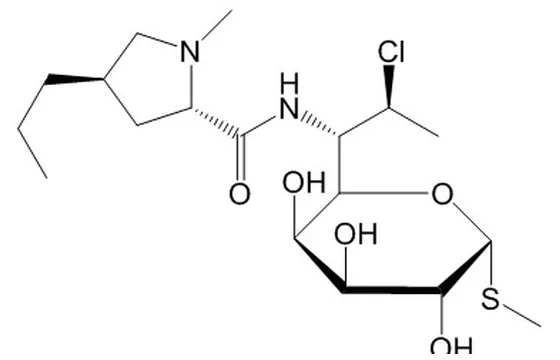
Two features of that structure matter for everything that follows. There is no chromophore beyond the amide and the thioether, which is why the compendial methods sit at 210 nm and why the baseline is difficult. And the molecule has fixed stereochemistry at eight positions, of which one is in the part the chemist touches. That asymmetry between how much of the molecule is fixed and how little of it is made is what makes this impurity profile unusual.
C7 is the only carbon the chemist touches
Lincomycin↗ already has the sugar, the proline and the amide. The difference between lincomycin and clindamycin is a single atom at C7: hydroxyl in the fermentation product, chlorine in the drug. The industrial step activates that hydroxyl and displaces it with chloride, and a displacement at a secondary carbon is a substitution that inverts the centre when it runs through a tight transition state and racemises it when it does not[2]. Both outcomes are chemically available, and the second one has a catalogue number.
EP impurity C, CAS 16684-06-3, C18H33ClN2O5S, 425.0, is 7-epiclindamycin: the same atoms, the same mass, the same fragments, one centre inverted[4]. On a method that resolves the rest of the profile it will sit close to the drug, and on any method that does not it will be counted as part of the main peak. This is the single most important impurity in the product, and it is invisible to every technique except a chromatographic one.
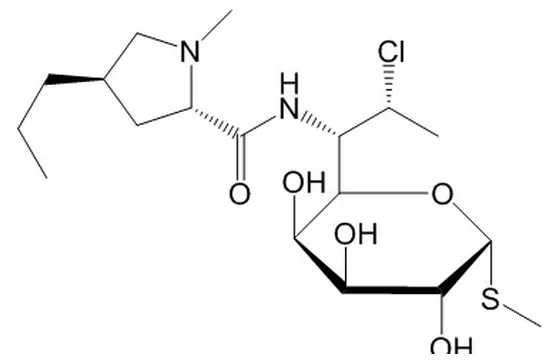
The catalogue complicates the word epimer in a useful way. EP impurity F, CAS 1440605-46-8, also carries C18H33ClN2O5S, but the compound record writes its proline as the (2R,4R) ring where the drug has (2S,4R)[4]. That is an epimer at the proline alpha carbon, not at C7, and it comes from a different failure: the amino acid was racemised before it was joined, or the amide was formed under conditions that racemised it. Two entries, one formula, two different centres, two different parts of the process.
A third pair extends the point. Dehydroclindamycin, CAS 909032-77-5, and the entry at CAS 1440605-51-5 are both C18H31ClN2O5S, 423.0, and both lose two hydrogens from the pyrrolidine ring, one to a 2,3-dihydropyrrole and one to an exocyclic propylidene[4]. Same formula, same nominal mass, different conjugation. Neither is an epimer, and a method built only for epimers will not find either.
Clindamycin B comes from the fermenter, not the reactor
The most common structural variant in this product is one methylene short. Clindamycin B, which is EP impurity B, CAS 18323-43-8, C17H31ClN2O5S, 411.0, carries a 4-ethyl proline where the drug carries 4-propyl[4]. No chlorination condition can create that difference, and no recrystallisation can remove it selectively, because the homologue differs from the drug by a single CH2 in a lipophilic side chain and tracks it through every solvent system.
It is there because the producing organism makes it. Lincomycin fermentations yield lincomycin B alongside lincomycin, and the B fraction is carried through the same isolation, the same chlorination and the same crystallisation. The catalogue shows this directly: alongside clindamycin B it carries lincomycin B hydrochloride, CAS 11021-35-5, C17H33ClN2O6S, 429.0 — the same fermentation variant before the chlorine was installed[4].
That pairing is worth more than a single number on a certificate. If a batch shows lincomycin B, the chlorination did not reach that fraction of the feed, which is a reactor problem. If it shows clindamycin B but no lincomycin B, the chlorination went to completion on a feed that already contained the homologue, which is a fermentation and starting-material problem. The two results look similar on a chromatogram and point at different departments.
Two further entries extend the same logic upward in mass. CAS 14042-43-4 and CAS 17179-55-4 are both C19H36N2O6S, 420.6, and both are one carbon heavier than lincomycin, but not in the same place: the first has an ethyl thioether on the sugar, the second a 4-butyl proline[4]. One carbon added at either end of a molecule that is already assembled by an organism, and the formula cannot tell you which.
| Entry | Formula | Difference from the drug | Where the control point is |
|---|---|---|---|
| Clindamycin B (EP impurity B) | C17H31ClN2O5S, 411.0 | 4-ethyl proline, one CH2 fewer | lincomycin hydrochloride specification |
| Lincomycin B hydrochloride | C17H33ClN2O6S, 429.0 | the same variant, C7 hydroxyl not replaced | chlorination conversion |
| Impurity at CAS 14042-43-4 | C19H36N2O6S, 420.6 | ethyl thioether instead of methyl | fermentation, sulfur donor |
| Impurity at CAS 17179-55-4 | C19H36N2O6S, 420.6 | 4-butyl proline instead of 4-propyl | fermentation, proline side chain |
Table 1. Homologue impurities of clindamycin and the process step that sets each one. Formulas and names from the public compound records [4].
The acetonide: a protecting group with no monograph row
Two entries in this catalogue are larger than the drug by exactly C3H4. CAS 17017-21-9 is C21H38N2O6S, 446.6, and the compound record names it as the 3,4-O-isopropylidene derivative of lincomycin. CAS 147650-54-2 is C21H37ClN2O5S, 465.0, the same protection on the chlorinated molecule[4]. Adding C3H4 to a vicinal diol is what an acetonide does: three carbons in, one water out.
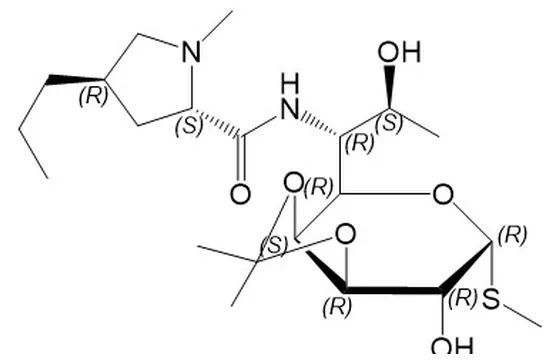
The presence of both forms is the process fingerprint. The 3,4-diol of the sugar is protected before C7 is activated, because an unprotected diol competes with the C7 hydroxyl for the activating reagent and gives a mixture no one wants to purify. The acetonide is then removed in a separate hydrolysis. Read together, the two catalogue entries say that the protection exists and that it can leak: an intermediate carrying it, and a product still carrying it, are both registered articles.
What makes this impurity awkward is that no framework owns it. It is not a solvent, so ICH Q3C has no row for it. It is not an element, so Q3D has nothing to say. It is unlikely to appear in a pharmacopoeial specified-impurity list, because monographs are written around what is commonly found rather than around one company's protecting group. It therefore falls into the unspecified bucket, gets a generic limit that nobody chose deliberately, and is qualified at whatever level the batch happened to contain.
The analytical side is easy by comparison. At 465.0 the acetonide sits far above every other impurity in the product, and a single-quadrupole scan at that mass finds it without method development. For a deprotection step, that is a much better control than a loss-on-drying specification, which cannot distinguish residual water from residual acetonide.
Sulfur is the second stereocenter, and oxidation creates it
The methylthio ether on the sugar is the only soft nucleophile in the molecule, and it oxidises readily. The sulfoxide, CAS 22431-46-5, C18H33ClN2O6S, 441.0, and the sulfone, CAS 887402-22-4, C18H33ClN2O7S, 457.0, are both in the catalogue[4].
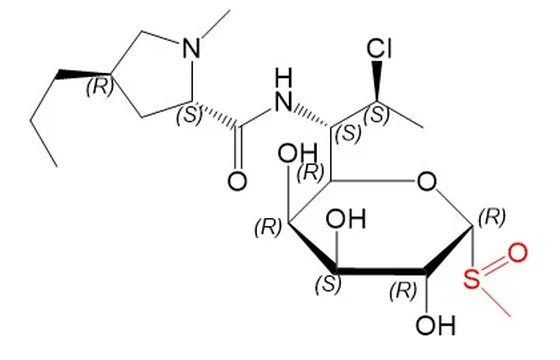
Oxidation at sulfur creates a stereocenter, because the sulfur then carries a lone pair, an oxygen, the methyl and the sugar carbon. When the rest of the molecule is already chiral, the two sulfoxides are diastereomers, not enantiomers, and a reversed-phase column separates them. The catalogue carries three entries with the formula C18H33ClN2O6S — impurities 30, 96 and 103 — which is what a diastereomeric pair plus one further isobar looks like in a commercial listing[4].
There is a second-order problem. A limit written as an area percentage assumes that the impurity and the drug respond equally at the detection wavelength. Oxidising the thioether removes the sulfur lone pairs that contribute what little absorbance this molecule has in the low ultraviolet, so the assumption is weakest exactly where the limit matters. A response factor for the sulfoxide has to be measured, not inherited from the parent.
The ester ladder belongs to a different product
Six entries in this catalogue have 30 to 36 carbons and exactly one chlorine and one sulfur. Every one of them is a fatty-acid ester at the sugar's 2-hydroxyl, and every one of them belongs to clindamycin palmitate rather than to the hydrochloride salt[4]. The palmitate is a separate marketed product, an oral suspension with a sixteen-carbon ester that improves palatability and modifies absorption.
| Entry | Formula | Acyl chain | Mass |
|---|---|---|---|
| Clindamycin myristate | C32H59ClN2O6S | C14, tetradecanoate | 635.3 |
| Clindamycin B palmitate | C33H61ClN2O6S | C16 on the B homologue | 649.4 |
| Clindamycin palmitate | C34H63ClN2O6S | C16, hexadecanoate | 663.4 |
| Clindamycin palmitate sulfoxide | C34H63ClN2O7S | C16, sulfur oxidised | 679.4 |
| Clindamycin heptadecanoate | C35H65ClN2O6S | C17, an odd-chain acid | 677.4 |
| Clindamycin stearate | C36H67ClN2O6S | C18, octadecanoate | 691.4 |
Table 2. The ester series in the clindamycin catalogue. Each mass is the neutral ester; the hydrochloride of the palmitate is 699.9. Data from the public compound records [4] and from the published characterisation of palmitate impurities [5].
Two consequences. First, an API that has never met palmitic acid cannot contain the palmitate ester, so these entries are not impurities of the hydrochloride at all; treating them as such inflates the unspecified-impurity count and buries the real ones. Second, the plant and the catalogue page are shared, and a search for a numbered clindamycin impurity will return the palmitate hydrochloride without warning. Buying that standard for a hydrochloride project is a common and quiet mistake.
Detection at a wavelength nobody likes
Clindamycin has no useful chromophore. The amide absorbs below 220 nm, the thioether contributes a weak transition, and the sugars contribute nothing. The compendial methods therefore work at 210 nm, where the mobile phase itself absorbs and the baseline is a gradient artefact rather than a line[6].
Three practical consequences follow. Mobile-phase quality dominates reproducibility, because at 210 nm a few ppm of UV-active impurity in the acetonitrile is a drifting baseline that looks like a broad peak. Gradient drift has to be subtracted, not ignored, or late-eluting unspecified impurities get integrated into the ramp. And sensitivity is not the limiting factor — selectivity is, because every hard case in this product is a pair of compounds with the same mass.
The published mass spectrometric characterisation of the related impurities is the right tool for building a suspect list and the wrong tool for quantification[6]. Use it to decide which of the isobaric families to look for, then build the chromatographic method that separates them. The two unknown impurities isolated from clindamycin hydrochloride raw material are a reminder that the list is not closed[7].
Where mass does help is on the homologues. Clindamycin B is 14 units lighter, the acetonide is 40 units heavier, the C19 entries are 14 units heavier, and the esters are hundreds of units away. A single-quadrupole scan resolves all of those. What it cannot resolve is 7-epi against the drug, the two proline epimers against each other, or one sulfoxide diastereomer against the other.
What Q3A does not cover here, and what to separate instead
The scope paragraph of ICH Q3A(R2) excludes peptides, oligonucleotides, radiopharmaceuticals, and fermentation products together with semi-synthetic products derived from them[3]. Clindamycin is both. The 0.05, 0.10 and 0.15% table is therefore borrowed logic here, not an obligation, and a reviewer who knows the scope will ask what the limits rest on.
The honest answer has two parts. The pharmacopoeial monograph is the binding text, and it is written around a specified list that reflects what the product actually contains. Everything outside that list needs a justification built from the batch history, the spiking experiments and the clearance data for each unit operation — which is a heavier document than a threshold table, and the reason companies default to the table when nobody is looking.
The filing record shows how much of this has already been argued in public[8]:
- Is 7-epiclindamycin resolved from the main peak, and by how much? A resolution figure on a stressed sample, not on a standard mix.
- Is the proline C2 epimer in the panel? It shares the drug's formula and will not appear in a method built for C7.
- Is the acetonide reported? It is the only direct measure of deprotection, and no framework requires it.
- Are both sulfoxide diastereomers integrated, or is the pair summed? Summing hides the response-factor problem.
- Are the C17 homologues attributed to the right step? Lincomycin B and clindamycin B answer different questions.
The catalogue carries 40 numbered clindamycin impurities between 1 and 130, plus the EP letters, which covers every family discussed above: the full clindamycin hydrochloride listing is the practical place to start. The same fermentation logic applies to lincomycin hydrochloride, the upstream material, and to vancomycin hydrochloride, where the related substances are congeners rather than process residues. Macrolides sit on the other side of the line: azithromycin and clarithromycin are semi-synthetic as well, but their impurities are dominated by acid-catalysed rearrangement rather than by a single substitution.
Frequently Asked Questions
Is clindamycin a fermentation product or a synthetic drug?
Why is 7-epiclindamycin the impurity that matters most?
Can clindamycin B be removed by recrystallisation?
What does finding lincomycin B in the API tell you?
Why is an isopropylidene protecting group in an impurity list?
How many sulfoxide peaks should a clindamycin method show?
Are the palmitate entries usable as clindamycin hydrochloride impurities?
Related Substances and Reference Standards
- Clindamycin Hydrochloride (51 impurity / derivative entries)
- Lincomycin Hydrochloride (27 impurity / derivative entries)
- Vancomycin Hydrochloride (21 impurity / derivative entries)
- Azithromycin (92 impurity / derivative entries)
- Clarithromycin (34 impurity / derivative entries)
References and Sources
- U.S. National Library of Medicine, PubChem, Clindamycin: C18H33ClN2O5S, molecular weight 425.0, with the hydrochloride at 461.4 and the hydrate recorded separately; structure used for the C7 substitution described here, accessed 2026-11-11
- Applied Microbiology and Biotechnology, 2004, Lincomycin, clindamycin and their applications: the fermentation origin of the lincosamide skeleton and the single synthetic modification that gives clindamycin, accessed 2026-11-11
- International Council for Harmonisation, ICH Q3A(R2), Impurities in New Drug Substances: preamble scope, which excludes fermentation products and semi-synthetic products derived therefrom, and Attachment 1 thresholds, accessed 2026-11-11
- U.S. National Library of Medicine, PubChem, Compound records for the clindamycin impurity series: clindamycin B, 7-epiclindamycin, the proline epimer, the two dehydro entries, the acetonides, the sulfoxide and sulfone, the C19 homologues and the fatty-acid esters, with systematic names used to assign each structure, accessed 2026-11-11
- Journal of Pharmaceutical and Biomedical Analysis, 2008, Identification, isolation and characterization of impurities of clindamycin palmitate hydrochloride, accessed 2026-11-11
- Journal of Pharmaceutical and Biomedical Analysis, 2006, Separation and characterization of clindamycin and related impurities in bulk drug by high-performance liquid chromatography with electrospray tandem mass spectrometry, accessed 2026-11-11
- Journal of Separation Science, 2014Isolation and identification of two unknown impurities from the raw material of clindamycin hydrochloride
- Center for Drug Evaluation, National Medical Products Administration of China, Public accepted-filing records for clindamycin hydrochloride counted by application type and applicant: 407 accepted filings from 197 applicants as retrieved on 11 November 2026, accessed 2026-11-11
This article was prepared by the CATO technical team. Regulatory, pharmacopoeial and published literature content cited above is attributed in the reference list. It is provided for technical exchange and search reference only and does not constitute a quality specification or regulatory advice. For any specific substance, the applicable test methods, limits and filing requirements are governed by the current regulations, pharmacopoeial monographs and official publications.
Product information on this site is provided for research search and selection reference only and is not a quality specification; technical data, purity and structural confirmation are governed by the shipped COA and our written confirmation. All products mentioned are for research use only, not for human or animal diagnostic or therapeutic use.