Crizotinib's Genotoxic Risk Arrives in Blocks, Not in the Molecule
Crizotinib↗ is C21H22Cl2FN5O, 450.34, given as 250 mg twice a day. Five hundred milligrams a day turns the ICH M7 default of 1.5 micrograms into 3 ppm, which is three orders of magnitude below the 0.15 per cent qualification threshold that a Q3A-only specification would apply. The alerts that matter on this molecule are not in the drug. They arrive with the building blocks: a mesylate ester, a protected pyrazole boronate, and an aryl bromide, each of which the catalogue records as a numbered impurity.
Note: product names shown in red (marked with ↗) are links - click through to the product page for structure, CAS number, purity and lead time.
Key points
Key points
- Crizotinib is C21H22Cl2FN5O, 450.34, dosed at 250 mg twice daily. At 500 mg a day the M7 default of 1.5 micrograms per day is 3 ppm, while the Q3A qualification threshold of 0.15 per cent is 750 micrograms a day, 500 times higher[1,2,3,4].
- The catalogue holds 173 entries, 172 of them numbered, with the top number at 212 and formulae recorded for only 61. Most of the numbered entries are building-block fragments rather than drug-related degradants[2].
- Two entries close the arithmetic for a mesylate: C11H21NO5S at 279.35 is N-Boc-4-piperidinyl methanesulfonate, and C6H13NO3S at 179.23 is a second sulfonate fragment. Alkyl sulfonates are class 3 alerts under M7[2,3].
- A boron-containing fragment at C19H32BN3O4, 377.29, and a second at C8H14BN3O2, 195.03, mark the Suzuki step. Boron is not a mutagenicity alert, but it is an elemental question and Q3D does not cover it[2,5].
- Three entries share the parent formula C21H22Cl2FN5O at 450.34, and two share C8H7Cl2FO at 209.04. Formula arithmetic cannot separate a regioisomer from the drug or an enantiomer from its mirror image[2].
The useful question about a genotoxic impurity is not whether the molecule is mutagenic. It is which stream carries the alert and how far downstream that stream reaches. Crizotinib answers that question in an unusually legible way, because its catalogue is dominated by fragments: the chiral alcohol that supplies the ethoxyaryl ether, the bromopyrazole that supplies the hinge-binding heterocycle, the boronate that couples them, and the mesylate that activates the piperidinol. Read as a fragment inventory, the series tells you where the chemistry happens, and therefore where the controls have to sit.
A molecule with one alert and several carriers
The drug itself, C21H22Cl2FN5O at 450.34, contains no alkylating function, no N-nitroso site, no epoxide and no Michael acceptor[2]. Its nitrogens are an aminopyridine, a pyrazole and a piperidine, and none of them is a secondary amine that could be nitrosated without first being substituted. On a structure-activity reading the API is clean, which is exactly why a genotoxicity assessment written only around the API would conclude that there is nothing to control.
The carriers are elsewhere. 1-(2,6-Dichloro-3-fluorophenyl)ethanol, C8H7Cl2FO at 209.04, supplies the (R)-ethoxyaryl group and is chiral[2]. 5-Bromo-2-aminopyridine and a protected aminopyrazole supply the heterocyclic core. A boronate ester supplies the coupling partner. N-Boc-4-hydroxypiperidine is activated as its mesylate before it is attached. Each of those is a discrete chemical entity with its own hazard profile, and each appears in the series as a numbered entry, because a supplier who sells crizotinib impurities sells the fragments too.
That is the practical point. M7 asks for an assessment of what the route can deliver into the drug substance, and the route delivers fragments. The number of entries at 450.34 in this catalogue is three. The number of entries below 400 Da is over a hundred.
The catalogue as a fragment inventory
Of 173 entries, 61 carry a formula on the product page, and the distribution of those formulae is the story. The most frequent single formula is C21H22Cl2FN5O, the parent, shared by three entries: the drug, entry 2 and entry 55. Next comes C8H7Cl2FO at 209.04, shared by entries 14 and 197, followed by C8H8ClFO at 174.60 for entries 195 and 196, and C13H10BrCl2FN2O at 380.04 for entries 3 and 8[2].
Duplicated formulae are not an error in this case, they are a signature. Two entries with the same formula and the same nominal mass are either regioisomers, stereoisomers, or the same compound sold twice under different numbers. On a molecule whose only stereocentre is the benzylic carbon of the ethoxyaryl group, C8H7Cl2FO at 209.04 is the building block and its enantiomer, and no formula table can tell you which is which. That distinction has to be carried by the name, the CAS number and the certificate, and it is the reason chiral purity for this molecule is a standard-selection problem before it is an analytical one.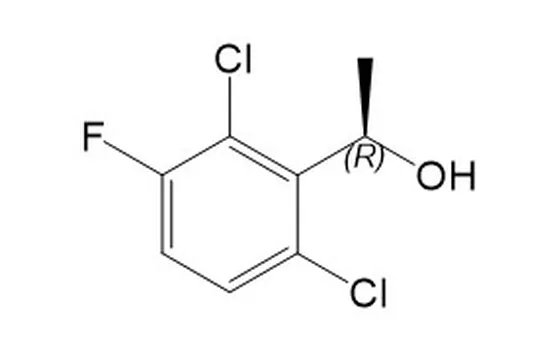
The same logic explains entries 6 and 7 at C13H11Cl2FN2O, 301.14, and entries 3 and 8 at C13H10BrCl2FN2O, 380.04. The 380.04 series carries bromine and the 301.14 series does not, and the difference is 78.92 mass units, which is the difference between bromine and hydrogen. Those are two states of the same intermediate: before and after the bromine is replaced in the coupling, or before and after it is introduced. Either way, the pair is a step marker rather than a degradation pair.
The same reading applies to the registration record. Crizotinib has been filed 75 times at CDE by 14 companies, which is a better proxy for how many impurity questions the molecule has already generated than any count of catalogue entries
.The mesylate, and why 279.35 is the entry that matters
N-Boc-4-hydroxypiperidine is C10H19NO3 at 201.26. Convert the hydroxyl to a mesylate and you add SO2CH3 and lose one hydrogen: 201.26 plus 79.09 minus 1.01 gives 279.34, which is C11H21NO5S, and that formula appears in the series as entry 5 at 279.35[2]. The arithmetic closes to two decimal places, which is as close as formula arithmetic ever gets, and it identifies the entry as the activated piperidinol rather than as a drug-related substance.
Alkyl sulfonates are class 3 alerts under M7: they are direct-acting alkylators, they do not need metabolic activation, and their acceptable intake is driven by the alkylating group rather than by the whole molecule[3]. A mesylate of a secondary alcohol that is made and consumed in the same vessel is a small inventory with a short residence time, which is the best case. It becomes a worse case when the mesylate is isolated, stored, or charged in excess, because the unreacted ester is then a carry-over risk into the coupling and, if the purge is weak, into the drug substance.
Two structural details decide the control strategy. First, the mesylate is hydrolytically labile, so aqueous quench converts it to the alcohol, which is itself a listed impurity at 201.26 rather than an alert. That means the quench is a control point and not just a workup. Second, the piperidine nitrogen in that intermediate is Boc-protected, so the fragment cannot nitrosate; the nitrosamine question for this molecule does not arise at the piperidine until deprotection, and by then the mesylate is gone.
The boronate: not a mutagen, still a specification item
Entries 12 and 189 share C19H32BN3O4 at 377.29, and entry 18 is C8H14BN3O2 at 195.03. Both carry boron, and both sit at masses consistent with a protected pyrazole boronate and its smaller boronic acid counterpart[2]. Boron is not a mutagenicity alert. Boronic acids are not alkylators, and the mutagenicity concern that surrounds them is a manufacturing-hygiene question rather than a DNA-reactivity question.
It is still a specification item, for two reasons. The first is that Q3D covers twenty-four elements and boron is not one of them, so there is no guideline limit and any limit has to be justified from toxicology or from process capability[6]. The second is that boron-containing residues are invisible to the UV methods used for related substances, so a specification that tests only by HPLC has no information about them at all. An ICP-OES or ICP-MS method on the drug substance, or a validated purge study on the coupling, is the only way to close the question.
There is a third reason that is specific to this route. The Suzuki coupling is the step where the two halves of the molecule meet, and it is also the step most likely to leave both partners in the crude: the boronate if the charge is high, the aryl bromide if the charge is low. Those two failure modes look identical on an impurity profile at 450.34, because neither of them is the drug. They differ entirely in what they are, and a mass-directed method separates them in one injection.
3 ppm: the arithmetic at 500 mg a day
Crizotinib is dosed at 250 mg twice daily, so the daily intake is 500 mg[1]. The ICH M7 default of 1.5 micrograms per day divided by 500 mg is 3 parts per million, or 0.0003 per cent[3]. Against that, the Q3A qualification threshold of 0.15 per cent at the same dose is 750 micrograms a day, and the reporting threshold of 0.05 per cent is 250 micrograms a day[4]. The two frameworks differ by a factor of 500, and they are not describing the same phenomenon.
The number that decides whether a method is adequate is the one in the capsule. A 250 mg capsule at 3 ppm contains 0.75 micrograms of the alert. Extract that capsule into 25 mL and the target concentration is 30 nanograms per millilitre. That is a triple-quadrupole problem. It is not a 210 nm problem, and it is not a charged-aerosol detector problem at the low end.
| Fragment | Formula | MW | Delta from parent | Alert class |
|---|---|---|---|---|
| Crizotinib | C21H22Cl2FN5O | 450.34 | parent | none |
| 2-Keto crizotinib | C21H20Cl2FN5O2 | 464.32 | plus O, minus H2, 13.98 | none |
| Boc-piperidinyl mesylate | C11H21NO5S | 279.35 | building block | class 3, alkyl sulfonate |
| Chiral alcohol | C8H7Cl2FO | 209.04 | building block | none, but enantiomer |
| Pyrazole boronate | C19H32BN3O4 | 377.29 | building block | elemental, outside Q3D |
| Brominated block | C13H10BrCl2FN2O | 380.04 | plus Br, minus H, 78.92 | none established |
A word on the brominated entry. Aryl bromides are not alkylating agents and are not class 3 alerts; the mutagenicity database on them is thin and structure-dependent, and M7 does not assign a default limit to an aryl bromide as such. That does not make the entry irrelevant, because the brominated block is the partner that must be consumed in the coupling, and an unconsumed partner at 380.04 is a purge question rather than a TTC question. Mixing the two arguments produces a dossier that argues about the wrong number.
The published method, and what a code name cannot tell you
There is one published genotoxicity-relevant method for this API, and it is worth reading closely because of what it does and does not disclose[6]. The method separates a potential genotoxic impurity on an Agilent Eclipse XDB C8 column, 150 by 4.6 mm, 3.5 micrometre particles, with 0.1 per cent formic acid in water and 0.1 per cent formic acid in acetonitrile at 0.4 mL per minute, 40 degrees Celsius, 5 microlitres injected, and detection by electrospray positive-ion multiple reaction monitoring.
The validation numbers are solid: linear from 2 to 40 nanograms per millilitre with a correlation coefficient of 0.9999, a limit of detection of 0.397 nanograms per millilitre, a limit of quantitation of 1.985 nanograms per millilitre, recoveries between 95.6 and 102.7 per cent at three levels, and relative standard deviations between 0.4 and 0.7 per cent. The monitored transition is m/z 205.3 to 121.0.
What the paper does not give is the structure. The analyte is identified only by an internal code, WHT1408-Q2H, and an [M+H]+ at 205.3 places it well below the drug at 450.34, in the mass region of the building blocks rather than in the region of drug-related degradants. A 205 Da analyte with a 121 Da fragment is consistent with a substituted phenyl fragment from the ethoxyaryl half, but consistent is not the same as identified, and no one can write a structure-activity justification, a class assignment or a compound-specific acceptable intake from a code name and two mass-to-charge ratios[6].
That is the transferable lesson. A method can be fully validated and still not support a limit, because the limit is a property of the structure and the method is a property of the analyte. When a supplier hands over a dossier with a validated method for an unnamed impurity, the first question is not about the linearity range, it is about the structure.
Standards that make the assessment possible
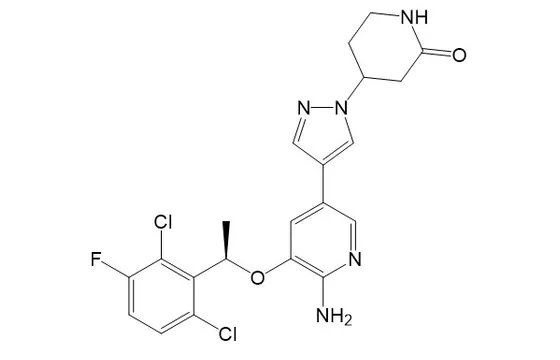
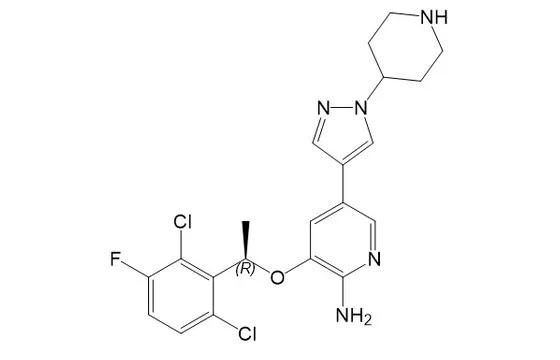
The standards needed here fall into three groups, and they serve different purposes rather than duplicating each other. The first is the parent, 877399-52-5, used for retention and for the system suitability solution. The second is the oxidative degradant, 2-keto crizotinib at C21H20Cl2FN5O2, 464.32, which is the piperidine ketone and the one entry in the series that is unambiguously a drug-related degradation product rather than a fragment[2].
The third group is the fragment set: the chiral alcohol at C8H7Cl2FO, 209.04, the brominated block at 380.04, and the boronate at 377.29[7]. These are not degradants and they should not be qualified as such. They are purge markers, and their value is that they let you prove a step is under control by measuring what did not get through, which is often cheaper than measuring what did.
The kinase-inhibitor neighbours do not share the fragment problem
Lorlatinib is the closest structural relative in this catalogue, and the comparison isolates what is specific to crizotinib. Lorlatinib↗ is a macrocycle: the two halves of the molecule are tethered, so the coupling partners cannot survive as separate species in the same way, and its impurity profile is dominated by ring-opening and by macrocycle homologues rather than by free fragments. That changes both the alert inventory and the analytical strategy, because a macrocycle impurity is a large-molecule problem while a fragment impurity is a small-molecule problem in a large-molecule dossier.
Almonertinib goes further in the same direction, with a large entry count dominated by process-related structures and a nitrosamine flag on the molecule itself. The contrast is instructive: on almonertinib the nitrosamine assessment is central and the fragment question is secondary, while on crizotinib the order is reversed. Two kinase inhibitors, two completely different dossiers, because the chemistry that makes the API also decides which control strategy is load-bearing.
The full crizotinib series makes the point by sheer proportion: 173 entries, of which the overwhelming majority fall below 400 Da. A specification written against that list without separating fragments from degradants will spend its analytical budget on purge markers and its genotoxicity budget on the wrong compound.
What to ask before the dossier is written
Four questions. Is the mesylate isolated or consumed in situ, and what is the validated purge across the coupling and the deprotection? Is the boronate charged in excess, and is there an elemental method for boron on the drug substance or a purge study that makes one unnecessary? Is the chiral alcohol controlled for enantiomeric purity at the building-block specification, or only at the drug substance? And for the genotoxic impurity measured by the published method, what is the structure, and therefore what is the acceptable intake that the method is being validated against?
Each question has a documentary answer, and each answer is cheaper before the dossier is assembled than after. The one answer that does not work is a catalogue search. Finding an entry at 279.35 proves that someone needed a mesylate standard; it does not prove that the mesylate is controlled, and it certainly does not prove the control is validated at 3 ppm[8].
Frequently Asked Questions
Is crizotinib itself a genotoxic impurity risk?
Why does a 500 mg daily dose change the limit so much?
Is a mesylate ester really a class 3 alert?
Why is boron not covered by Q3D?
Can formula arithmetic distinguish the three entries at 450.34?
What is wrong with a method validated for an unnamed impurity?
Where should the chiral alcohol be controlled?
Related Substances and Reference Standards
- Crizotinib (172 impurity / derivative entries)
- Lorlatinib (- impurity / derivative entries)
- Almonertinib (- impurity / derivative entries)
References and Sources
- DailyMed, US National Library of Medicine, Crizotinib capsules, prescribing information: 250 mg twice-daily dosing and the recommended duration of treatment, accessed 2026-11-22
- PubChem, National Library of Medicine, Crizotinib, CAS 877399-52-5: molecular formula C21H22Cl2FN5O, molecular weight 450.3, and the (R)-1-(2,6-dichloro-3-fluorophenyl)ethoxy substituent, accessed 2026-11-22
- International Council for Harmonisation, ICH M7(R2), Assessment and control of DNA reactive (mutagenic) impurities: hazard classes and the 1.5 microgram per day threshold of toxicological concern, accessed 2026-11-22
- International Council for Harmonisation, ICH Q3A(R2), Impurities in new drug substances: reporting, identification and qualification thresholds, accessed 2026-11-22
- International Council for Harmonisation, ICH Q3D(R2), Guideline for elemental impurities: the twenty-four element list and permitted daily exposures, accessed 2026-11-22
- PubChem, National Library of Medicine, 1-(2,6-Dichloro-3-fluorophenyl)ethanol, CAS 330156-50-8: the chiral building block recorded as catalogue entries 14 and 197 at C8H7Cl2FO, 209.04, accessed 2026-11-22
- Se Pu (Chinese Journal of Chromatography), Determination of genotoxic impurity in the bulk drug of crizotinib by HPLC-ESI-MS/MS: MRM transition m/z 205.3 to 121.0, LOD 0.397 ng/mL, LOQ 1.985 ng/mL, 2025, accessed 2026-11-22
- International Council for Harmonisation, ICH Q2(R2), Validation of analytical procedures: the parameters that a method for a trace genotoxic impurity has to demonstrate, accessed 2026-11-22
This article was prepared by the CATO technical team. Regulatory, pharmacopoeial and published literature content cited above is attributed in the reference list. It is provided for technical exchange and search reference only and does not constitute a quality specification or regulatory advice. For any specific substance, the applicable test methods, limits and filing requirements are governed by the current regulations, pharmacopoeial monographs and official publications.
Product information on this site is provided for research search and selection reference only and is not a quality specification; technical data, purity and structural confirmation are governed by the shipped COA and our written confirmation. All products mentioned are for research use only, not for human or animal diagnostic or therapeutic use.