Dasatinib Loses 61 Percent of Its Exposure When Gastric Acid Is Suppressed: What That Number Means for Your Dissolution Method
Dasatinib↗ is insoluble in water, and its label documents what happens when the stomach stops making acid: 61 per cent of exposure lost with an H2 antagonist, 43 per cent with a proton pump inhibitor. Those two numbers are a dissolution experiment run in humans, and they should decide how the quality control method is built.
Note: product names shown in red (marked with ↗) are links - click through to the product page for structure, CAS number, purity and lead time.
The label already ran the experiment your method is supposed to predict
Key points
- Dasatinib is C22H26ClN7O2S, 488.01 as the anhydrous free base, and the label describes the drug substance as insoluble in water[1].
- A 100 mg dose taken 10 hours after famotidine lost 61 per cent of its AUC and 63 per cent of its Cmax; a 100 mg dose after omeprazole at steady state lost 43 per cent and 42 per cent[1].
- In a simulated stomach-duodenum model, moving the gastric compartment from pH 2 to pH 4.5 removed about 90 per cent of the dasatinib AUC, and vitamin C restored it[2].
- The failure is physical rather than chemical: drug dissolves in the stomach and precipitates in the duodenum, so a method that checks recovery at one pH cannot see it.
Dissolution methods are usually written to prove that a batch resembles the reference product at one time point in one medium. For a weak base with pH-dependent solubility that is the wrong instrument. The question is whether the tablet delivers drug into solution across the pH range the gut presents, and the label says the answer changes by a factor of two between a normal stomach and a suppressed one.
That makes the medium decision unusually consequential. A medium chosen to guarantee sink conditions passes every batch and predicts nothing. A medium chosen to reproduce the collapse discriminates, and then has to be defended as not being artificially harsh.
Two numbers, one two-hour window, and what they imply
The label gives three instructions and two measurements[1]. Do not coadminister H2 antagonists or proton pump inhibitors; if an antacid is used, give it at least two hours before or after the dose; do not give antacids simultaneously. The measurements are the famotidine and omeprazole effects, which differ because the two agents suppress acid to different depths.
Read them as a dose-response curve in pH. Famotidine↗, which raises gastric pH modestly, removes 61 per cent of exposure. Omeprazole at steady state, which holds gastric pH near neutral for most of the day, removes 43 per cent. The ordering only looks wrong until you notice the timing differs: famotidine was given 10 hours before, omeprazole was at steady state. Both share the condition that the stomach was not acidic when the tablet arrived.
The antacid instruction is the tell. Two hours apart is acceptable, simultaneous is not, so the window of vulnerability is minutes rather than hours. That is the signature of a dissolution-rate phenomenon, not an equilibrium solubility one: the drug must dissolve while it is still in an acidic compartment, and neutralising the acid at the moment of arrival closes that window.
The in vitro model reproduces the shape. In a two-compartment stomach-duodenum system, dasatinib supersaturated in the duodenum when the gastric compartment was at pH 2, and a shift to pH 4.5 removed about 90 per cent of the AUC infinity[2]. Lamotrigine↗, run as a control, was unaffected, which rules out a general artefact of the model.
Insoluble is the mechanism, not a footnote
The label states that the drug substance is insoluble in water and slightly soluble in ethanol and methanol[1]. The structure predicts it: lattice energy is carried by amide and aminopyrimidine hydrogen bonds, and the basic centres that could protonate are tied up in that network rather than exposed to water[3].
Protonation is what changes it. Below the pKa of the most basic centre the molecule is a cation and the salt is far more soluble than the free base; above it the neutral species dominates and solubility collapses. The label does not give a pKa and the exact value is not the point. The point is that the curve is steep in the pH region where gastric pH moves, which is why two pH units can remove most of the absorbed dose.
The monohydrate matters in a small but real way. The label gives 488.01 for the anhydrous free base, so the hydrate adds 18.02 and the material on the balance is 506.03. A specification written on the anhydrous basis but weighed as the monohydrate is 3.6 per cent off before any analysis begins.
Sink, and why 140 milligrams breaks it
Sink is usually taken as three times the saturation concentration. For a 140 mg tablet in 900 mL that means 467 micrograms per millilitre at three times sink, or 156 micrograms per millilitre for complete dissolution. Nothing described as insoluble in water reaches that, so the compendial apparatus at 900 mL measures a solubility-limited concentration rather than a release rate, and the profile flattens at whatever the medium holds.
The arithmetic across the product line sharpens it. In 900 mL, complete dissolution requires 22 micrograms per millilitre from the 20 mg tablet, 111 from the 100 mg and 156 from the 140 mg, a seven-fold spread. One method cannot be discriminating at 20 mg and non-saturating at 140 mg unless volume or medium changes with strength, and that is a legitimate design choice which has to be stated.
Drop to a physiological 250 mL and the 140 mg tablet needs 560 micrograms per millilitre. No aqueous medium without surfactant will do that. This is why surfactant appears in so many weak-base methods, and why those methods stop discriminating: adding sodium lauryl sulfate raises the apparent solubility of every batch equally, including the ones that would fail in a patient.
The workable compromise is to keep the discriminating medium and accept that it is not a sink. A method that releases 60 per cent of label claim at pH 6.8 because that is all the medium holds is still a valid comparator, provided the criterion comes from reference-product data in the same medium rather than from a notional 85 per cent in 30 minutes.
What the acid stage actually tests
Two hours at pH 1.2 is conventionally a stability test. For dasatinib it is a solubility test, because the chemistry is stable there. The amide linking the thiazole to the chloromethylaniline will not hydrolyse measurably in two hours at 37 degrees, and the aminopyrimidine will not oxidise. What happens in that vessel is that the tablet disintegrates and the drug dissolves because the pH is low enough.
That determines what the stage is for. With an enteric-coated or microenvironment-buffered formulation it measures whether the coating held. With an immediate-release film-coated tablet it measures the dissolution rate in the compartment where absorption begins, which is the number that correlates with the interaction data.
The transfer step is where the information is lost. A method that dissolves at pH 1.2 and then adjusts to 6.8 for the remainder is a single test with an excursion, not a two-stage test. A genuine two-stage design keeps dissolved and undissolved fractions separate, transfers both, and measures precipitation. That is what the stomach-duodenum model does, and it is why it detects a failure a single-vessel method cannot[2].
Designing a method that can fail
Four decisions carry most of the weight. The first is the pH set. Running 1.2, 4.5 and 6.8 covers the fasted stomach, the hypochlorhydric or fed stomach and the small intestine, and the discriminating condition for dasatinib is the middle one, not the last. Most weak-base methods are validated at 6.8 because that is where absorption happens, which is precisely the medium in which a solubility-limited product looks acceptable.
The second is volume and hydrodynamics. Nine hundred millilitres with paddles at 50 rpm works as a comparator, but the physiological volume is nearer 250 mL and transit is faster. Transfer-based and miniaturised systems reproduce in vivo dissolution of weak bases better than the compendial apparatus, which is the conclusion of work using a mini-gastrointestinal simulator on this class of compound[4].
The third is surfactant. If it is needed for a measurable concentration, use the minimum that allows quantification, so that both products sit on the steep part of the curve rather than the plateau. A method where reference and test both release 95 per cent in 15 minutes has no discriminating power however well it validates.
The fourth is the criterion. For a pH-sensitive weak base the clinically anchored comparison is the profile in the discriminating medium at the reference product's own level, not an absolute percentage. That is defensible when a reviewer asks why it is not 85 per cent.
The basic centre that also carries the nitrosamine
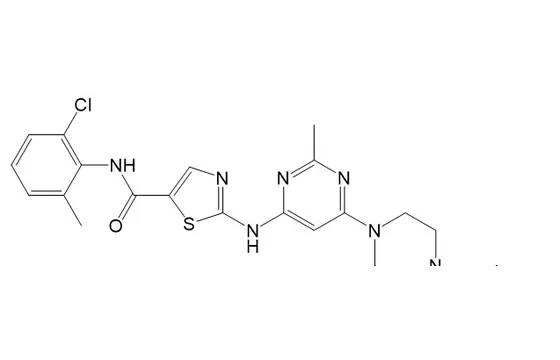
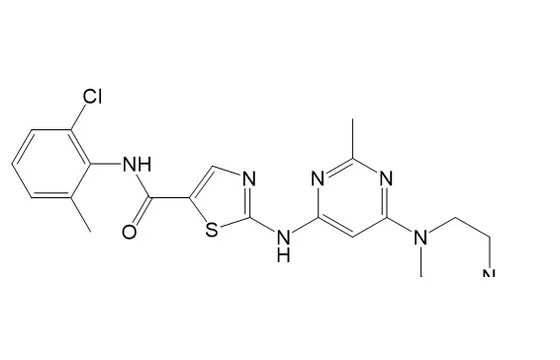
The same piperazine that makes dasatinib a weak base is the handle for the impurity story. The catalogue carries N-deshydroxyethyl dasatinib at C20H22ClN7OS, 444.0, the molecule with the hydroxyethyl group removed, leaving a secondary amine[5]. It is a process relative rather than a degradant: it appears when alkylation is incomplete, and it is also the intermediate carried forward if the purge is inadequate.
A secondary amine is a nitrosamine precursor, and the corresponding N-nitroso compound sits at C20H21ClN8O2S, 473.0, which is the 444.0 fragment plus NO minus H[6]. The arithmetic at the top dose is worth doing once: 1.5 micrograms per day divided by 140 mg is 10.7 parts per million, three orders of magnitude below the 0.2 per cent identification threshold for an ordinary impurity[7]. Two frameworks, two scales, one molecule.
The parent is not the risk. Its piperazine nitrogen is fully substituted and the aminopyrimidine nitrogens are not nitrosatable in the same sense, so the assessment is really about the deshydroxyethyl fragment and about nitrite sources in shared equipment.
Thresholds, catalogue, and a comparison that does not transfer
The dose range is narrow by the standards of this series, 20 to 140 mg per day, and every strength falls in the same identification band. Qualification does not: 20 mg sits below 100 mg and 140 mg above it[8].
| Daily dose | Identification | Qualification | Governing column |
|---|---|---|---|
| 20 mg | 0.2 per cent or 2 mg | 0.5 per cent or 200 micrograms | percentage for both: 0.5 per cent is 100 micrograms |
| 100 mg | 0.2 per cent or 2 mg | 0.5 per cent or 200 micrograms | absolute for qualification: 200 micrograms is 0.2 per cent |
| 140 mg | 0.2 per cent or 2 mg | 0.5 per cent or 200 micrograms | absolute for qualification: 200 micrograms is 0.14 per cent |
Table note: ICH Q3B(R2) Attachment 1, applied to the authorised daily doses of dasatinib[8]. Reporting is 0.1 per cent at every dose, since none exceeds 1 g per day.
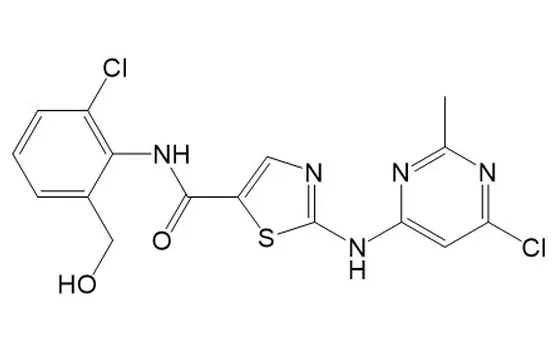
The dasatinib variety page lists 57 entries, and the pattern worth noticing is how many are small fragments rather than decorated versions of the whole molecule. That fits a synthesis built from a chloromethylaniline, a thiazole carboxylic acid and an aminopyrimidine: the catalogue mirrors the building blocks, and the entries cluster around the pieces.
Nilotinib is the obvious comparison and the wrong one to lean on. It is also a BCR-ABL inhibitor and also poorly soluble, but it is a capsule with a different salt form and its label does not carry a prohibition on acid-reducing agents of the same kind. Gefitinib is a better structural analogue for the impurity logic, since it shares the chloroaniline and the aminopyrimidine, and a worse one for dissolution, since its dose and solubility are both an order of magnitude away. Copying a method between them is how a project spends six months validating a test that cannot fail.
The impurity reference standards index is the practical starting point for the fragment set, and the variety index filters the kinase inhibitors by formula when numbered names stop being informative.
Four ways this method goes wrong in practice
Choosing 6.8 as the only medium. It is the pH where absorption happens and where a solubility-limited product looks fine. The discriminating condition is the one where solubility collapses.
Adding surfactant until dissolution is complete. Sink achieved by solubilisation removes the difference the method exists to detect.
Assuming the acid stage is a stability test. Dasatinib is chemically stable at pH 1.2 for two hours. The stage is measuring dissolution, and treating it as a degradation number wastes the information.
Forgetting the hydrate in the potency calculation. The monohydrate adds 18.02 to 488.01, and weighing against the anhydrous basis introduces a 3.6 per cent error no validation will reveal.
Frequently Asked Questions
Why does famotidine reduce dasatinib exposure more than omeprazole?
Should the dissolution medium be pH 1.2 or pH 4.5?
Is dasatinib a BCS class II compound?
Does the acid-reducing-agent effect mean the product is defective?
What is the nitrosamine risk in dasatinib?
Why is the monohydrate relevant to the assay?
Can a dissolution method be transferred from another kinase inhibitor?
Related Substances and Reference Standards
- Dasatinib (- impurity / derivative entries)
- Nilotinib (- impurity / derivative entries)
- Gefitinib (- impurity / derivative entries)
References and Sources
- DailyMed, US National Library of Medicine, SPRYCEL (dasatinib) tablets, prescribing information: 100 mg once daily in chronic phase CML and 140 mg once daily in advanced disease, drug substance insoluble in water, monohydrate with an anhydrous free base mass of 488.01, famotidine and omeprazole interaction data, antacid dosing window, accessed 2026-11-20
- Pharmaceutical Research, Springer, Moghrabi, Aburub and Fadda, Vitamin C Improves Dasatinib Concentrations Under Hypochlorhydric Conditions of the Simulated Stomach Duodenum Model, 39(9):2217-2226, 2022: about 90 per cent loss of duodenal AUC at pH 4.5 versus pH 2, restored by ascorbic acid, accessed 2026-11-20
- PubChem, National Center for Biotechnology Information, Dasatinib, C22H26ClN7O2S, 488.01, used here for the formula and the hydrate arithmetic, accessed 2026-11-20
- European Journal of Pharmaceutical Sciences, Elsevier, In vitro dissolution methodology, mini-Gastrointestinal Simulator (mGIS), predicts better in vivo dissolution of a weak base drug, 2015: transfer-based models outperform the compendial apparatus for weakly basic, poorly soluble compounds, accessed 2026-11-20
- PubChem, National Center for Biotechnology Information, N-Deshydroxyethyl dasatinib, CAS 910297-51-7, C20H22ClN7OS, 444.0: the piperazine secondary amine left by incomplete alkylation, accessed 2026-11-20
- PubChem, National Center for Biotechnology Information, N-Nitroso N-deshydroxyethyl dasatinib, CAS 2135905-86-9, C20H21ClN8O2S, 473.0: the nitrosamine of the fragment rather than of the drug substance, accessed 2026-11-20
- International Council for Harmonisation, ICH M7(R2), Assessment and control of DNA reactive impurities, used for the 1.5 microgram per day limit that converts to about 10.7 ppm at a 140 mg dose, accessed 2026-11-20
- International Council for Harmonisation, ICH Q3B(R2), Impurities in new drug products, Attachment 1: identification 0.2 per cent or 2 mg and qualification 0.5 per cent or 200 micrograms above 10 mg per day, accessed 2026-11-20
This article was prepared by the CATO technical team. Regulatory, pharmacopoeial and published literature content cited above is attributed in the reference list. It is provided for technical exchange and search reference only and does not constitute a quality specification or regulatory advice. For any specific substance, the applicable test methods, limits and filing requirements are governed by the current regulations, pharmacopoeial monographs and official publications.
Product information on this site is provided for research search and selection reference only and is not a quality specification; technical data, purity and structural confirmation are governed by the shipped COA and our written confirmation. All products mentioned are for research use only, not for human or animal diagnostic or therapeutic use.