Doxycycline Hyclate: A Two-by-Two Epimer Grid That the Assay Cannot See
Doxycycline↗ exists because a hydroxyl was removed from tetracycline. That change solved an absorption problem and created a stereocentre, and the entire impurity profile of the drug follows from it. Four of the six compendial impurities differ from the parent only in configuration, which is why a stability study that measures assay and total impurities can report a perfectly stable product while the molecule quietly rearranges.
Note: product names shown in red (marked with ↗) are links - click through to the product page for structure, CAS number, purity and lead time.
A salt form that is part of the molecule, and a dose that sets the limits
Key points
- Doxycycline base is C22H24N2O8, 444.4. The marketed hyclate is a hydrochloride hemiethanolate hemihydrate, CAS 24390-14-5, so ethanol and water are lattice components rather than residual solvents.
- At 200 mg a day, 1.0 mg corresponds to 0.5 percent, so the identification threshold stays at 0.10 percent and the percentage always governs[1].
- The pharmacopoeial impurity set is a two-by-two grid: 4-epi, 6-epi, both together, plus one dehydration product. All four epimers share the parent formula.
- Epimerisation changes the shape of the molecule, not its chromophore, so assay and total peak area can stay flat while the stereochemical profile drifts[2].
Doxycycline is what tetracycline becomes when the 6-hydroxyl is removed. That single change, made in the 1960s to improve absorption and half-life, is the reason the drug exists and also the reason its impurity profile looks nothing like the tetracyclines that came before it. Everything else follows from the crystal form and from one number in the dose.
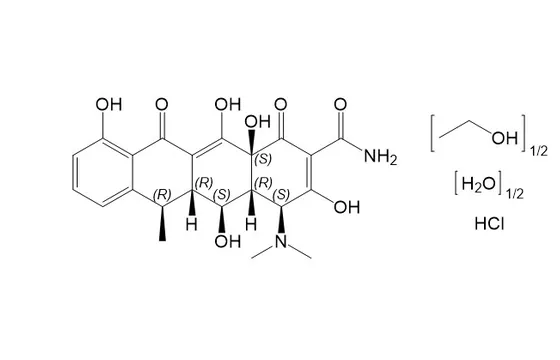
The hyclate deserves attention before any chromatogram is run. It is a hydrochloride salt of a molecule that already carries a dimethylamino group, and it crystallizes with half a molecule of ethanol and half a molecule of water per molecule of drug. The ethanol is not a manufacturing residue to be chased down with a residual solvent method; it is part of the lattice, and losing it changes the solid. That distinction matters in a stability programme, because a drying step intended to reduce residual solvents can convert the crystal form and change the dissolution profile without changing the assay by a single percent.
The dose sets the arithmetic. Doxycycline is given as 100 mg twice daily on the first day and then 100 mg daily, with 200 mg a day as the usual ceiling. At 200 mg, 1.0 mg/day corresponds to 0.5 percent, well above the 0.10 percent identification threshold, so the percentage governs throughout[1]. The practical consequence is that a 0.06 percent epimer is reportable and identifiable, and that the specification has to be justified on toxicological or batch grounds rather than derived from the threshold.
Removing the 6-hydroxyl changed the failure mode, not the failure rate
In tetracycline and oxytetracycline, C6 carries a methyl and a hydroxyl. Because that carbon has no hydrogen, it cannot epimerize; the hydroxyl can only leave. Under acid it is eliminated with the neighboring hydrogen, the C ring aromatizes, and the product is anhydrotetracycline. Tetracycline's own degradation literature has been built around that elimination for sixty years, and the reason it matters clinically is the next step: 4-epimerization of the anhydro product gives 4-epianhydrotetracycline, the species generally blamed for the Fanconi syndrome cases attributed to outdated tetracycline capsules.
Doxycycline replaced that hydroxyl with hydrogen. The elimination channel does not disappear, but it moves: water is now lost between the C5 hydroxyl and the C6 hydrogen to give an exocyclic methylene, and the product is metacycline, C22H22N2O8, catalogued here as EP impurity B at CAS 914-00-1. What does disappear is the barrier to epimerization. C6 now carries a hydrogen, a methyl and two ring bonds, which makes it a stereocentre, and a stereocentre next to a carbonyl in acid is a stereocentre that equilibrates.
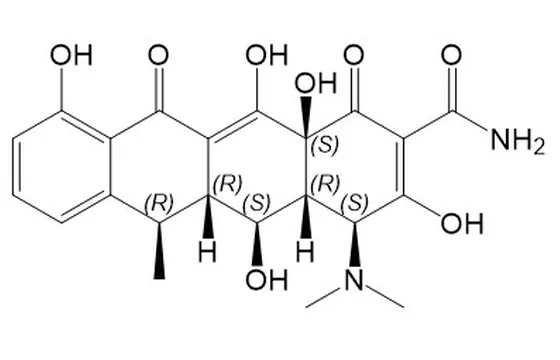
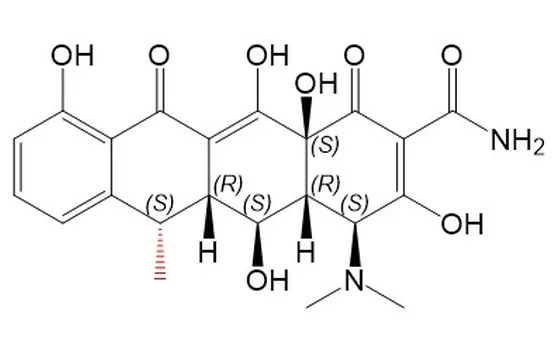
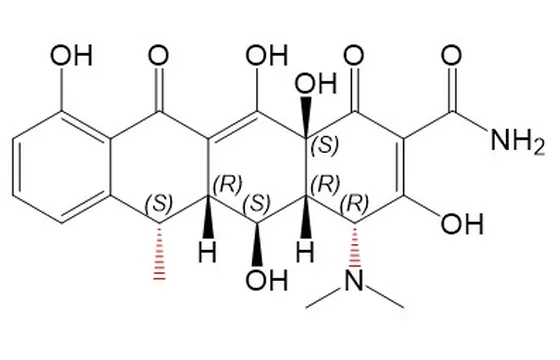
That is the whole structural argument, and it explains the impurity letters better than any list. 6-Epidoxycycline is EP impurity A, CAS 3219-99-6. 4-Epidoxycycline is EP impurity C, CAS 6543-77-7, and it is the epimer that every tetracycline can form, because C4 is labile in the whole family. 4-Epi-6-epidoxycycline is EP impurity D, CAS 97583-08-9, the double epimer that only exists once C6 has become labile. Oxytetracycline, the fermentation-derived starting material for the semi-synthetic step, is EP impurity E, CAS 79-57-2. The set is a grid: two centres, four combinations, one of which is the drug.
Where the grid is documented
The letters are worth laying out because the relationships are not obvious from the names, and because a laboratory that holds only the 4-epimer will not be able to assign the two peaks that appear after acid stress.
| EP letter | Compound | CAS | Formula | Relationship to the drug |
|---|---|---|---|---|
| A | 6-epidoxycycline | 3219-99-6 | C22H24N2O8 | C6 inverted, same formula |
| B | metacycline | 914-00-1 | C22H22N2O8 | dehydration, exocyclic methylene |
| C | 4-epidoxycycline | 6543-77-7 | C22H24N2O8 | C4 inverted, family-wide |
| D | 4-epi-6-epidoxycycline | 97583-08-9 | C22H24N2O8 | both centres inverted |
| E | oxytetracycline | 79-57-2 | C22H24N2O9 | semi-synthetic precursor |
| F | 2-acetyl-2-decarbamoyldoxycycline | 122861-53-4 | C23H25NO8 | N-acyl artefact of the amide |
Table note: assignments as catalogued; CAS and formula are the primary identifiers.
Why the assay stays flat while the profile moves
An epimer is a diastereomer, not a different molecule. It has the same formula, the same ultraviolet spectrum, the same molar absorptivity to within a few percent, and the same behavior in a total-impurity calculation. If a method reports assay at 99.2 percent and total impurities at 0.5 percent, and a third of the parent has converted to the 6-epimer over six months, neither number will show it. The chromatogram looks stable; the substance is not.
This is not a hypothetical. Acid-catalyzed epimerization of tetracyclines has been studied kinetically since the 1960s, with nuclear magnetic resonance used to follow the approach to equilibrium because the two species are otherwise hard to distinguish[3][4]. The kinetics are fast enough at pH 2 to 3 and 40 degrees to be visible in a two-week accelerated study, which is why acid stress belongs in the forced-degradation package for this molecule rather than being left out as uninformative. It is informative precisely because it is the failure mode that a conventional assay ignores.
Recent degradation mapping with high-resolution mass spectrometry adds a second layer: doxycycline in aqueous and semi-physiological media produces a family of hydrolysis and oxidation products beyond the epimers, and their kinetics differ from the epimerization kinetics[5]. A stability programme built only on the epimer cluster will still miss the oxidative branch, which is the one that produces the discoloration seen in aged capsules.
Designing the protocol around the failure mode
The standard ICH Q1A(R2) set is necessary and not sufficient here, because each of its conditions answers one question and leaves another open[2]. Accelerated conditions at 40 degrees and 75 percent relative humidity will drive both epimerization and hydrolysis, and they will also drive ethanol and water out of the lattice, so a form change and a chemical change arrive together and cannot be separated from a single chromatogram. Long-term conditions at 25 degrees and 60 percent relative humidity give the rate that matters for the shelf life, but only if the method resolves the epimers in the first place.
| Condition | What it probes | What it cannot show |
|---|---|---|
| 40 degrees, 75 percent RH | hydrolysis, epimerization rate, lattice water loss | which mechanism caused a given peak |
| 25 degrees, 60 percent RH | the shelf-life rate for a well-sealed pack | behavior of a pack with poor moisture barrier |
| 0.1 M hydrochloric acid, 60 degrees, 1 hour | the full epimer grid and the dehydration product | whether that rate applies at pH 6.8 |
| 25 degrees, 90 percent RH, open dish | hydrate and ethanolate stability, form conversion | anything without X-ray powder diffraction |
| ICH Q1B option 2 | photodegradation, discoloration, photo-epimerization | thermal epimerization over the shelf life |
Table note: conditions as defined in ICH Q1A(R2) and Q1B[2][6].
Two additions are specific to this molecule. Water content belongs in the protocol as a measured attribute at every pull, not as a release test, because the hyclate's lattice composition is the variable that couples chemistry to form. And X-ray powder diffraction at the long-term and accelerated points costs little and answers the question that a chromatogram cannot: whether the solid that is degrading is still the solid that was filed.
The five-peak cluster and how to keep it resolved
A method for doxycycline that resolves the parent from its 4-epimer and stops there is not fit for purpose. The cluster that has to be resolved contains the 4-epimer, the 6-epimer, the 4,6-diepimer and metacycline, and their elution order depends on the stationary phase and on the amount of metal in the system. Tetracyclines chelate divalent cations through the beta-diketone region, and trace iron or calcium in the mobile phase or on the frit produces tailing, fronting and occasionally a split peak that looks like an impurity.
The usual countermeasures are worth stating because they are not optional here: a mobile phase containing edetate or oxalic acid to sequester metals, a sample diluent at low pH to slow epimerization between injection and detection, and a column dedicated to tetracyclines rather than shared with other methods. The diluent point is the one most often missed. A sample prepared in neutral buffer will continue to epimerize in the autosampler, and the peak ratio at the end of a twelve-hour sequence will not match the ratio at the beginning, which produces the false conclusion that the batch is unstable.
What the filing has to demonstrate
Chinese registration activity for the hydrochloride is substantial, spread across formulations and applicants.
Three questions recur. The first is coverage: does the method resolve all four grid members, and is there a standard for each? Holding the 4-epimer alone is the most common gap, because it is the epimer that appears in every tetracycline and therefore the one every supplier stocks. The second is the acid-stress justification: reviewers ask why a degradation product seen under 0.1 M hydrochloric acid should not be expected at pH 6.8, and the answer is a rate comparison at the relevant pH rather than an assertion that gastric pH is irrelevant for an oral product that is swallowed in a capsule. The third is the solid form: what evidence shows that the ethanolate and the hydrate are unchanged at the end of the shelf life, and what happens to dissolution if they are not.
Water content and powder diffraction data belong in the answer to the third question, and they are cheap to generate. A filing that supplies them pre-empts a question that otherwise arrives late, after the stability package has already been compiled. The compendial baseline for the comparison is the current monograph, which specifies the lettered impurities and the chromatographic conditions to be reproduced[7].
Which tetracyclines can be compared, and which cannot
The C6 substituent sorts the family into three groups, and the grouping predicts the impurity profile better than any structural similarity score. Oxytetracycline and chlortetracycline both carry the 6-hydroxyl, so both have a quaternary C6, neither can form a 6-epimer, and both degrade mainly through dehydration; the oxytetracycline catalogue lists a dedicated dehydration entry, which is the anhydro channel made visible. Minocycline hydrochloride is 6-demethyl-6-deoxy, so C6 carries two hydrogens and is not a stereocentre at all: it has neither a 6-epimer nor a classical anhydro product, and its profile is dominated by 4-epimerization and by chemistry at the 7-dimethylamino group.
Two comparisons must be resisted. Metacycline is itself a marketed tetracycline in some markets, so treating it purely as an impurity of doxycycline understates what it is and can mislead a supplier conversation. And tigecycline is a glycylcycline built on a minocycline scaffold with a bulky substituent at C9; its degradation chemistry is dominated by that side chain, and none of the C6 reasoning transfers.
The doxycycline case is therefore narrow but sharp: one lost hydroxyl converts a dehydration problem into an epimerization problem, and the assay is blind to the difference. That is the sentence to keep in mind when a stability table shows a product that is behaving perfectly while the chromatogram quietly rearranges itself.
This catalogue carries 16 doxycycline entries, with the full EP set from 6-epidoxycycline to the 4,6-diepimer, plus metacycline and oxytetracycline as separate items: doxycycline hyclate reference standards.
Frequently Asked Questions
Is 6-epidoxycycline a degradation product or a process impurity?
Why does doxycycline not form anhydrotetracycline?
Can the four epimers be distinguished by mass spectrometry?
Does the ethanol in the hyclate need a residual solvent specification?
Which stress condition best reveals epimerization?
Why does the assay not fall when the epimer grows?
Is metacycline ever a legitimate API rather than an impurity?
Related Substances and Reference Standards
- Doxycycline Hyclate (16 impurity / derivative entries)
- Oxytetracycline (10 impurity / derivative entries)
- Minocycline Hydrochloride (38 impurity / derivative entries)
- Chlortetracycline (11 impurity / derivative entries)
References and Sources
- ICH, ICH Q3A(R2) Impurities in New Drug Substances: reporting threshold 0.05 percent, identification threshold 0.10 percent or 1.0 mg per day, qualification threshold 0.15 percent or 1.0 mg per day, whichever is lower, accessed 2026-11-04
- ICH, ICH Q1A(R2) Stability Testing of New Drug Substances and Products: long-term, intermediate and accelerated conditions, and the attributes to be tested at each pull, accessed 2026-11-04
- Journal of Pharmacy and Pharmacology (1968), Aspects of the epimerization of certain tetracycline derivatives (acid-catalyzed epimerization at C4 and at the C6 position in 6-deoxy derivatives), accessed 2026-11-04
- Journal of Pharmaceutical Sciences (1973), Tetracycline epimerization kinetics utilizing NMR spectrometry (approach to equilibrium followed by nuclear magnetic resonance because the epimers are otherwise difficult to distinguish), accessed 2026-11-04
- Talanta (2026), A dual QTOF-QTrap analytical platform for comprehensive tracking of doxycycline and its degradation byproducts (hydrolysis and oxidation products in aqueous and semi-physiological media, with kinetics distinct from epimerization), accessed 2026-11-04
- ICH, ICH Q1B Photostability Testing of New Drug Substances and Products: confirmatory studies on the finished product in its immediate packaging, accessed 2026-11-04
- Chinese Pharmacopoeia Commission, Pharmacopoeia of the People's Republic of China, doxycycline hyclate monograph and general chapters on related substances, accessed 2026-11-04
This article was prepared by the CATO technical team. Regulatory, pharmacopoeial and published literature content cited above is attributed in the reference list. It is provided for technical exchange and search reference only and does not constitute a quality specification or regulatory advice. For any specific substance, the applicable test methods, limits and filing requirements are governed by the current regulations, pharmacopoeial monographs and official publications.
Product information on this site is provided for research search and selection reference only and is not a quality specification; technical data, purity and structural confirmation are governed by the shipped COA and our written confirmation. All products mentioned are for research use only, not for human or animal diagnostic or therapeutic use.