Duloxetine: Two Entries Called Nitroso, One That Adds 29.00
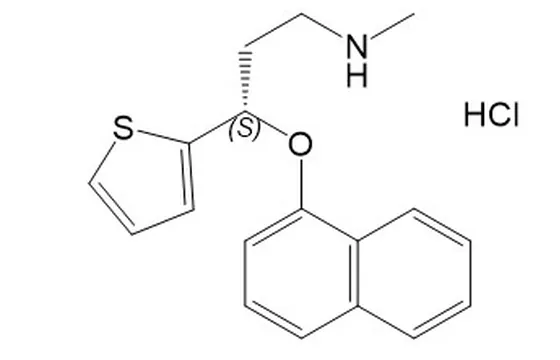
Nitrosation adds 29.00 mass units. Duloxetine↗ is 297.42 as the free base, so its NDSRI is 326.41. One catalogue entry sits there and one does not, and the difference decides whether a validated method ever looked at the right compound.
Note: product names shown in red (marked with ↗) are links - click through to the product page for structure, CAS number, purity and lead time.
Key points
Key points
- Duloxetine is C18H19NOS at 297.42 as the free base and 333.87 as the hydrochloride, and contains exactly one nitrosatable nitrogen: the methylamino group[1].
- N-Nitrosation adds 29.00 mass units, one NO less one H. Only one catalogue entry sits at the resulting 326.41. A second entry labelled as an N-nitroso compound sits at 172.19 and cannot be one[1].
- At 60 mg a day the M7 default of 1.5 micrograms per day is 25 ppm and at the maximum of 120 mg it is 12.5 ppm, against a Q3A identification threshold of 60 micrograms at 60 mg, forty times looser[2,3].
- Two naphthalene fragments in the catalogue carry halogens the drug does not contain. They are process markers, and a forced-degradation study that treats them as degradants chases chemistry that cannot happen[4].
The nitrosamine question for most small molecules is settled by looking at the structure and asking whether a nitrosatable nitrogen exists. Duloxetine makes that easy and then makes everything after it hard. There is one such nitrogen, so there is one N-nitroso structure to worry about, which sounds like a gift until you notice that the product also carries a stereocentre, an aryl ether and a thiophene, and that sixteen catalogue rows share one formula string.
The argument below rests on one operation: add 29.00 and see which entry moves.
One nitrosatable nitrogen, and it is the methylamine
Duloxetine is (S)-N-methyl-3-(naphthalen-1-yloxy)-3-(thiophen-2-yl)propan-1-amine. The nitrogen carries a methyl and a hydrogen, which makes it secondary and therefore directly nitrosatable. The other heteroatoms are an ether oxygen and a thiophene sulfur, neither of which gives a stable N-nitroso species with nitrous acid, and the aromatic rings are deactivated[1].
That favourable starting position is worth stating plainly, because it changes the shape of the risk assessment. Nobody has to enumerate a dozen possible NDSRIs. There is one structural question, and then a harder one: where does the nitrosating agent come from and can it reach that nitrogen. A secondary amine with no nitrosating partner in the process is a theoretical risk; the same amine in a route that uses nitrite salts, or shares equipment with one, is a real one.
It also means a generic screen with twenty analytes is the wrong purchase. What is needed is one transition measured well, with a calibration curve that survives matrix.
The arithmetic that separates the two nitroso entries
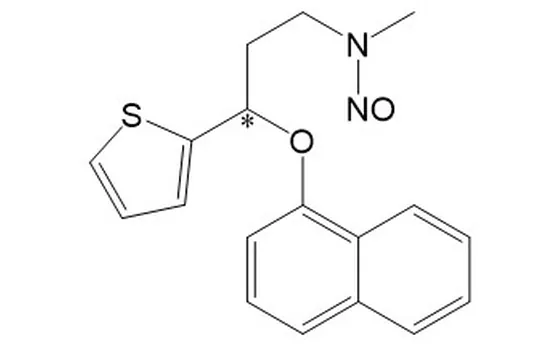
The catalogue lists two entries whose names contain the word nitroso. Entry 48 is described as the N-nitroso derivative of racemic duloxetine, CAS 2680527-91-5, formula C18H18N2O2S at 326.41. Entry 72, CAS 79602-99-6, is described as the N-nitroso derivative of entry 35, formula C10H8N2O at 172.19[1].
Nitrosation replaces N-H with N=O, so the mass change is plus 30.01 for NO and minus 1.01 for the departing hydrogen, a net 29.00. The free base is 297.42 and 297.42 plus 29.00 is 326.42. Entry 48 sits at 326.41, and the formula closes: C18H19NOS becomes C18H18N2O2S, one nitrogen and one oxygen in, one hydrogen out. That entry is what it says it is.
Entry 72 sits at 172.19, which is 125.23 below the free base. No nitrosation of duloxetine, or of any fragment still holding the naphthalene and the thiophene, lands there. Whatever that compound is, it does not carry the drug skeleton. A related problem: entry 35, which the name refers to, is not in the catalogue at all. The numbering runs to 73 with sixteen gaps, and 35 is one of them.
This is not pedantry. If the analytical target is taken from the name instead of the mass, a laboratory buys a 172.19 standard, builds a transition around it, validates against it, and then reports the product free of nitrosamine because that transition is clean. The compound at 326.41 was never in the method.
Two enantiomers of one NDSRI, and why the racemate still calibrates
Nitrosation does not touch C3, so the NDSRI inherits the chirality of the drug and the material formed in a real sample is a single enantiomer. The catalogue entry is explicitly the racemate, which means the two are not the same substance in a chiral environment[1].
For limit purposes the difference usually does not matter, and it is worth being precise about why. On an achiral column the two enantiomers have identical retention, ionisation and fragmentation; they co-elute and co-quantify, so a racemic standard calibrates the total correctly and is the right calibrant for a release method reporting one number against an acceptable intake.
It stops being right the moment the question changes from how much to which one. Establishing that nitrosation happened on the drug rather than on the enantiomeric impurity carried in from the route needs a chiral method and two single-enantiomer standards, one of which does not exist commercially and would have to be isolated.
Six rows at 297.42, and why sixteen share one formula string
Six rows sit at exactly 297.42: the free base, EP Impurities C, E and F in their monomer forms, entry 10 and entry 54. That is the drug plus five candidates a mass trace at m/z 298 reports as one peak when the chromatography is not doing its job. They are constitutional isomers or diastereomers rather than enantiomers, so an ordinary reversed-phase method separates them, but five is what makes the method worth validating rather than assuming[1].
The larger cluster is bookkeeping rather than chemistry. Sixteen rows carry the formula string C18H19NOS, which suggests sixteen isomeric compounds. They are not: seven sit at 297.42 and nine at 333.87, and 333.87 minus 297.42 is 36.45, which is HCl. The catalogue keeps the free-base formula beside the hydrochloride mass for every salt entry.
The consequence is small and sharp. An expected-mass calculation built from the formula field is 36.45 units low for every hydrochloride standard. On a high-resolution instrument that is enough to put the target outside the extraction window, which produces a clean chromatogram and a false negative.
Which fragments are degradants and which are route markers
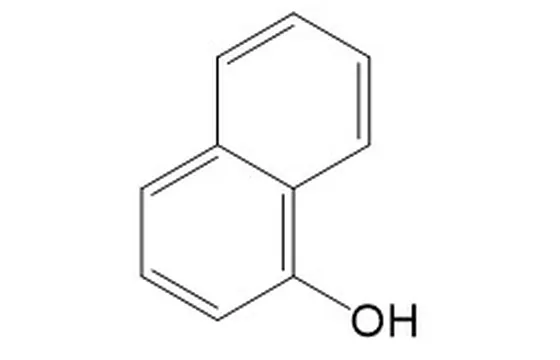
The catalogue contains 1-naphthol at C10H8O, 144.17, as EP Impurity D, 1-fluoronaphthalene at C10H7F, 146.16, as EP Impurity G, and two rows at C10H7BrO, 223.07, the bromonaphthols[5,4].
They are not one group. 1-Naphthol is both: it forms in the finished product by aryl ether hydrolysis, so it is a genuine degradant, and it remains if the route couples through a naphthol, so it is a process impurity at the same time. Its limit has to be argued twice, once from stability and once from carry-over.
1-Fluoronaphthalene cannot be a degradant. The drug contains no fluorine, so hydrolysis, oxidation and photolysis have no route to a fluorinated naphthalene; it can only be a residue of the naphthalene building block. Its presence in the catalogue is a statement about the route. The same holds for the bromonaphthols, and the fact that they appear in two isomeric forms says the halogenation is not regioselective and both isomers survive into the drug substance.
Sorting this list before writing a stability protocol avoids two errors at once: effort spent tracking a fluorinated compound through forced degradation, where it cannot appear, and an ether hydrolysis pathway buried among process markers that look similar.
Limits across a fourfold dose range
Duloxetine hydrochloride is licensed at 30 mg and 60 mg with a maximum of 120 mg a day, so the arithmetic spans a factor of four inside one product[6]. The M7 default becomes 50 ppm at 30 mg, 25 ppm at 60 mg and 12.5 ppm at 120 mg. The Q3A identification threshold of 0.10 per cent is 30, 60 and 120 micrograms, and the qualification threshold of 0.15 per cent is 45, 90 and 180 micrograms. The 1.0 mg absolute branch never applies, so every threshold in the specification is relative.
The gap between the two frameworks is the point. At 60 mg the Q3A identification threshold is 60 micrograms and the M7 default is 1.5 micrograms, a factor of forty. A nitrosamine limit set by generic Q3A logic would be forty times too loose, and that error is easy to make because one specification table usually holds both kinds of limit.
How the framework got here
| Year | Event | What it changed for a product like duloxetine |
|---|---|---|
| 2018 | NDMA found in valsartan; sartan products recalled across several markets | Established that a nitrosamine can form in a route with no deliberate nitrosating step |
| 2019 | Ranitidine↗ withdrawn in several markets after NDMA findings | Extended the problem from one API class to any secondary amine, and from drug substance to finished product |
| 2020 | CDE publishes its technical guideline for nitrosamine impurities in chemical drugs, trial version | Gave Chinese filings a risk-assessment and control framework with a defined route |
| 2021 | FDA publishes guidance on the control of nitrosamine impurities in human drugs | Made a documented risk assessment a condition of continued marketing rather than a response to an incident |
| 2023 | ICH M7(R2) reaches implementation | Moved N-nitrosamine drug substance related impurities onto compound-specific acceptable intakes instead of the 1.5 microgram default |
Table note: years of publication or withdrawal. Framework from M7(R2); Chinese implementation from the CDE guideline[2,7].
The consequence for a duloxetine filing is that 1.5 micrograms is now a starting point rather than an answer. A compound-specific acceptable intake read across from the closest structural analogue with carcinogenicity data will land well above or well below the default, and either direction changes the specification. The default is what you use when that work has not been done.
What transfers to other secondary-amine drugs
Paroxetine also carries a secondary amine and a stereocentre, so the logic transfers exactly: one nitrosatable nitrogen, one NDSRI, and a chiral centre that survives nitrosation. Fluoxetine is a secondary amine without a stereocentre, so its NDSRI is achiral and the racemate question disappears.
What does not transfer is the ether. Duloxetine is an aryl alkyl ether whose benzylic-type carbon hydrolyses under acid stress to give 1-naphthol. Paroxetine↗ has a methylenedioxyphenyl ether that behaves differently, and fluoxetine has a trifluoromethyl group that changes the electronics of the ring. A degradation pathway imported from one to another is a guess, and each catalogue shows it: the naphthol cluster in duloxetine has no counterpart in fluoxetine.
Standards for a one-target, many-isomer product
The catalogue holds 75 rows for duloxetine hydrochloride: 71 numbered entries, the free base and three deuterated standards, highest number 73, sixteen numbers missing. Two entries are labelled as nitroso compounds and only one of them is one, which is the single most useful thing to know before buying anything.
The working set is short: the drug, the racemic hydrochloride, the N-nitroso racemate at 326.41, 1-naphthol, and one diastereomer standard for the chiral test. Everything else can wait: [see all duloxetine entries](duloxetine hydrochloride).
Regulatory context: the CDE public database records 264 accepted filings for duloxetine hydrochloride from 71 applicants between 2003 and 2026, one of the more heavily filed antidepressants in the Chinese system[7].
Frequently Asked Questions
How many nitrosamine structures can duloxetine form?
How do I tell an N-nitroso entry from a mislabelled one?
Why does the catalogue show the same formula for a salt and its base?
Is 1-naphthol a degradant or a process impurity?
Can 1-fluoronaphthalene appear during stability testing?
What limit applies at 120 mg a day?
Is a racemic NDSRI standard acceptable for a release method?
Does the 1.5 microgram default still apply?
Related Substances and Reference Standards
- Duloxetine Hydrochloride (75 impurity / derivative entries)
- Paroxetine Hydrochloride (82 impurity / derivative entries)
- Fluoxetine Hydrochloride (46 impurity / derivative entries)
References and Sources
- PubChem, National Library of Medicine, Duloxetine hydrochloride, CAS 136434-34-9: free base C18H19NOS at 297.4 and the hydrochloride at 333.9, with a single stereogenic centre, accessed 2026-11-23
- International Council for Harmonisation, ICH M7(R2), Assessment and control of DNA reactive (mutagenic) impurities: hazard classes and the 1.5 microgram per day threshold of toxicological concern, accessed 2026-11-23
- International Council for Harmonisation, ICH Q3A(R2), Impurities in new drug substances: reporting, identification and qualification thresholds, including the 1.0 mg per day absolute branch, accessed 2026-11-23
- PubChem, National Library of Medicine, 1-Fluoronaphthalene, CAS 321-38-0: molecular formula C10H7F, molecular weight 146.2, a naphthalene carrying fluorine that the drug itself does not contain, accessed 2026-11-23
- PubChem, National Library of Medicine, 1-Naphthol, CAS 90-15-3: molecular formula C10H8O, molecular weight 144.2, the ether cleavage product of duloxetine, accessed 2026-11-23
- DailyMed, US National Library of Medicine, Duloxetine delayed-release capsules, prescribing information: 30 mg and 60 mg strengths and a maximum of 120 mg per day, accessed 2026-11-23
- Center for Drug Evaluation, National Medical Products Administration, Accepted marketing applications listed in the public drug registration database, queried by product name on 23 November 2026, accessed 2026-11-23
This article was prepared by the CATO technical team. Regulatory, pharmacopoeial and published literature content cited above is attributed in the reference list. It is provided for technical exchange and search reference only and does not constitute a quality specification or regulatory advice. For any specific substance, the applicable test methods, limits and filing requirements are governed by the current regulations, pharmacopoeial monographs and official publications.
Product information on this site is provided for research search and selection reference only and is not a quality specification; technical data, purity and structural confirmation are governed by the shipped COA and our written confirmation. All products mentioned are for research use only, not for human or animal diagnostic or therapeutic use.