Empagliflozin: Thirteen Catalog Entries, One Formula, and a Detector That Cannot Tell Them Apart
Empagliflozin↗ is 450.91 and nothing else in its impurity file is allowed to be. The problem is that thirteen entries in our own catalogue sit on exactly that mass, and three of them are the same molecule drawn with one bond pointing the other way. Reporting thresholds do not decide which of them a method found. Only a structure does.
Note: product names shown in red (marked with ↗) are links - click through to the product page for structure, CAS number, purity and lead time.
Key points
Key points
- Empagliflozin is C23H27ClO7 at 450.91, dosed at 10 or 25 mg once daily, and carries two fixed stereodescriptors: (1S) at the anomeric carbon and (3S) on the tetrahydrofuran ring[1].
- Thirteen entries in our catalogue, the API included, share that formula. A tandem mass spectrometer sees one precursor ion and one fragmentation pattern for all thirteen, because the differences are bond geometry, not composition[2,3].
- At 25 mg a day the ICH Q3A identification threshold is 0.10 percent, or 25 micrograms, and the qualification threshold is 0.15 percent. A mutagenic impurity would be capped at 60 ppm by the 1.5 microgram default[4,5].
- The same aryl skeleton appears in the catalogue with bromine, iodine and two chlorines in place of the API chlorine. Those are route markers carried by whatever building block a supplier bought, not degradants[2].
What the substance is, and what the label already fixes
Empagliflozin is a C-aryl glucoside. The label writes the name as a 1,5-anhydro-D-glucitol carrying a 4-chloro-3-(4-((3S)-tetrahydrofuran-3-yloxy)benzyl)phenyl group at C1, with the (1S) descriptor, formula C23H27ClO7 and molecular weight 450.91[1]. Two descriptors are worth noting before anything else in this article makes sense. The (1S) sits at the carbon that joins the sugar to the aromatic ring, the anomeric carbon. The (3S) sits on a tetrahydrofuran ring that hangs off a benzyl ether. Both are single, defined configurations, and both are reachable by a wrong bond.
The label also gives the physical profile that dictates diluent choice: very slightly soluble in water, sparingly soluble in methanol, slightly soluble in ethanol and acetonitrile, soluble in 50 percent acetonitrile/water, practically insoluble in toluene[1]. For a 25 mg tablet in 100 mL of diluent the nominal concentration is 250 micrograms per milliliter, which is comfortably inside the solubility envelope of a 50:50 acetonitrile/water diluent and outside a purely aqueous one. That single sentence from the label decides whether the 0.05 percent reporting limit is reachable without extraction losses.
The dose is 10 mg once daily, rising to 25 mg for additional glycemic control[1]. Almost every limit below keys off 25 mg, the worst case for a percentage threshold. Our index carries no EP, USP, BP, JP or ChP flag for empagliflozin, so the limits that govern a filing are the applicant's own, argued against ICH Q3A rather than copied from a monograph[4].
Thirteen rows at 450.91
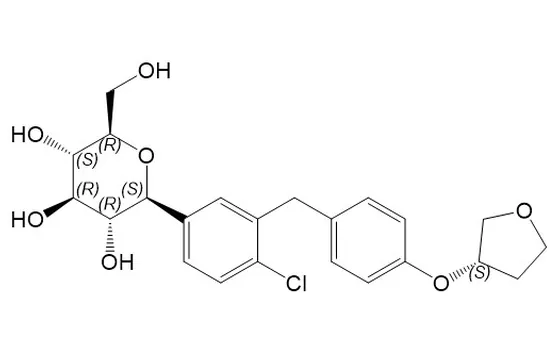
The variety page for Empagliflozin lists 135 rows: the API plus 134 numbered entries. Thirteen of those rows, the API included, carry the formula C23H27ClO7. That is not a rounding artifact. It is the direct consequence of a molecule whose complexity is stereochemical rather than functional: there is no second nitrogen to oxidize, no thiol to dimerize, no ester to hydrolyse. Change the molecule and you usually change the mass. Change the geometry and you change nothing.
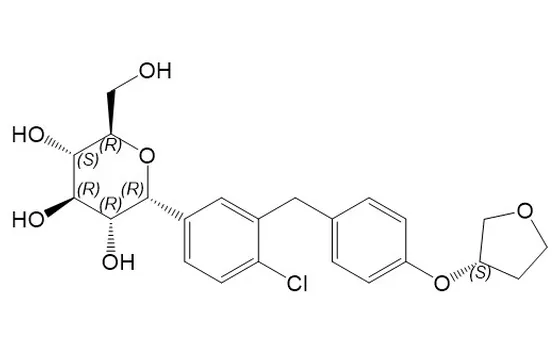
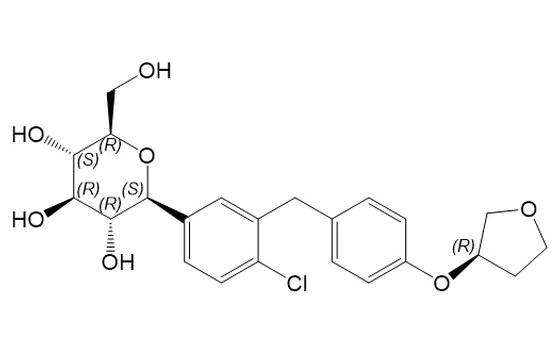
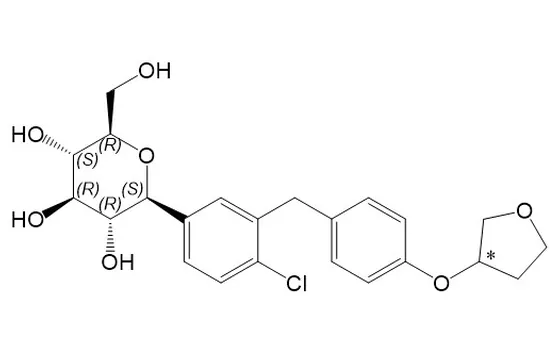
Three of the thirteen can be named from public indexing. CAS 1620758-33-9 is indexed as an anomer of empagliflozin, the same constitution with the C1 linkage inverted[3]. CAS 864070-43-9 is the (3R)-tetrahydrofuran-3-yloxy analogue, the epimer at the ether-linked ring[6]. CAS 2452301-21-0 is labelled in our catalogue as the racemate. The remaining ten carry numbers only, and a number is not a structure.
Practical consequence: a stability-indicating method, precise and still quantitate the wrong thing. When the standard on the bench is the anomer and the peak in the sample is the (3R) epimer, recovery is quantitative and the conclusion is false. That is the failure mode reference standards exist to prevent, and it is why thirteen rows matter more than 134.
The anomeric centre is the last bond made, so it is the first impurity
Almost every published route to empagliflozin converges on the same ending. A protected gluconolactone is treated with an aryl metal species to give a lactol, and the lactol is reduced to the C-aryl glucoside. The stereochemistry at C1 is set in that reduction, on the last carbon to be assembled. Nothing downstream can correct it. If the reduction runs with incomplete selectivity, the anomer is not a trace degradant that appears on storage; it is a product of the final step, formed in the same reactor, at the same time, in a ratio fixed by the reducing system.
Two consequences follow, and both are easy to get backwards. The anomer belongs in the specification as a process impurity with a limit justified by purge, not as a degradation product justified by stability data. And its level will be reproducible batch to batch, which is what makes it dangerous: a steady 0.2 percent looks like a baseline, and nobody investigates a baseline.
The third consequence is that anomers equilibrate. In water, and faster at low pH, the C1 centre can reopen and reclose, so a sample prepared in water and left overnight in an autosampler can show an anomer peak that was never in the solid. The diluent is part of the method, and a diluent that lets C1 move will manufacture the impurity it is trying to measure.
The tetrahydrofuran ring, and a purchase that is easy to get wrong
The second stereocentre arrives as a building block. Empagliflozin needs (3S)-3-hydroxytetrahydrofuran, and our catalogue carries both enantiomers as separate items: (S)-(+)-3-hydroxytetrahydrofuran, CAS 86087-23-2, and the (−) enantiomer, CAS 86087-24-3, both C4H8O2 at 88.11[7]. The names carry the descriptors. The trouble is that a purchase order written as "3-hydroxytetrahydrofuran" carries neither, and a racemic lot will install both configurations in equal measure.
The resulting impurity is not a mirror image of the drug, because the rest of the molecule is fixed; it is a diastereomer, and it will separate on an ordinary reversed-phase column if the method is built for it. The catch is that it is isobaric with the API, so nothing in a single-quadrupole trace says whether a 0.3 percent peak is the (3R) epimer or the anomer eluting nearby.
Here the certificate does more work than the chromatogram. A supplier who states the enantiomeric purity of the tetrahydrofuran block as a chiral assay rather than an optical rotation has told you what a forced-degradation study cannot. Rotation on a volatile, water-miscible alcohol is a weak control; chiral GC or SFC on the derivatized material is not.
Halogen swaps: when the route leaves a fingerprint on the API
The most useful thing in the catalogue is not the number of entries. It is the pattern of halogens. The same C17H16ClO2 skeleton appears six times with bromine and four times with iodine; the same C13H7ClFO benzyl fragment appears four times with bromine, twice with iodine, twice with a second chlorine, once with two bromines and once with two fluorines. Read as chemistry rather than as a list, that is a supplier map: different manufacturers assemble the same aglycone from whichever aryl halide was cheap that year, and the halide they started with stays in the impurity file.
Then the pattern escalates. Among the 134 entries sit C23H27BrO7, C23H27IO7 and C23H28O7: the API with bromine, with iodine, and with no halogen at all. These are not degradants. They are the drug assembled from the wrong building block, and they elute within tenths of a minute of the API, because a halogen swap moves lipophilicity far less than it moves mass.
| Catalogue formula | Mass | Rows | What it is |
|---|---|---|---|
| C23H27ClO7 | 450.91 | 13 | API, anomer, (3R)-THF epimer, racemate and nine numbered isomers |
| C23H27BrO7 | 495.36 | 1 | API with bromine substituted for chlorine |
| C23H27IO7 | 542.36 | 1 | API with iodine substituted for chlorine |
| C23H28O7 | 416.46 | 1 | Des-chloro analogue, 34.45 lighter than the API |
| C17H16BrClO2 | 333.61 | 6 | Bromo aglycone building block |
| C17H16ClIO2 | 381.61 | 4 | Iodo version of the same building block |
Table note: formulas counted on 25 November 2026; masses calculated from the stated formulas, not quoted from a pharmacopoeia[2].
The regulatory reading is blunt. A halogen-swapped analogue is a specified impurity only if someone specified it; otherwise it falls under the unspecified limit of 0.10 percent for identification and 0.15 percent for qualification at 25 mg a day[4]. A supplier who changed aryl halide mid-lifecycle can hold a dossier that is internally consistent, fully validated and silent about the one impurity the new route introduced.
Detection: a low-wavelength chromophore and no orthogonal mass
The only chromophore is the chlorophenyl ring: no adenine, no nitro group, no conjugated carbonyl to push absorbance into a roomy window. Useful signal sits at the low end of the ultraviolet range, where mobile-phase cutoffs and excipient peaks share the baseline. Published work on this molecule and its related substances uses diode-array detection, an admission that the spectrum carries little identifying power beyond a single band[8].
Mass spectrometry does not rescue it. Thirteen entries share 450.91; the anomer, the (3R) epimer and the racemate fragment identically because they are the same connectivity. A product-ion scan cannot distinguish a bond that points up from a bond that points down. Where the mass spectrometer does help is on the genuinely different things: the bromo and iodo analogues sit 44.45 and 91.45 above the API, and the des-chloro analogue sits 34.45 below, all of which are unmistakable in a high-resolution trace[2].
The workable combination is therefore two-dimensional: a reversed-phase method that resolves the isobaric set by shape, plus a high-resolution channel that catches halide variants. Validate one without the other and you either cannot see the impurity or cannot weigh it.
Limits at 25 mg a day
The arithmetic differs between substance and product, and reviewers notice when a dossier treats the two as interchangeable. At 25 mg the Q3A identification threshold of 0.10 percent is 25 micrograms a day, far below the 1.0 mg cap, so the percentage governs; qualification at 0.15 percent is 37.5 micrograms. For the tablet, Q3B applies to degradation products only, at looser bands[4,9].
| Threshold | Drug substance, Q3A | Drug product, Q3B | At 25 mg a day |
|---|---|---|---|
| Reporting | 0.05 percent | 0.1 percent | 12.5 and 25 micrograms |
| Identification | 0.10 percent | 0.2 percent | 25 and 50 micrograms |
| Qualification | 0.15 percent | 0.5 percent | 37.5 and 125 micrograms |
Table note: thresholds transcribed from the ICH tables and converted at 25 mg per day; where a percentage and an absolute cap both apply, the lower governs[4,9].
How crowded the field is matters, because reviewers compare. The CDE acceptance record, counted on 25 November 2026:
Those are acceptance records and applicants, not approvals, and they say nothing about impurity strategy.
Mutagenic impurities obey different arithmetic, and it is the one that catches people out. The M7 default of 1.5 micrograms per day divided by 25 mg gives 60 ppm[5], roughly one two-hundred-and-fiftieth of the qualification threshold. Any alerting structure must be argued there, not at 0.15 percent, and published work on genotoxic impurities in empagliflozin products already treats the two regimes as separate method scopes[10].
What transfers from dapagliflozin and what does not
The SGLT2 class invites analogy and then punishes it. Dapagliflozin and Canagliflozin are C-aryl glucosides with a halogen on the aglycone, and both share the anomeric problem, so the argument that C1 is a process-impurity position transfers intact. The ether side chain does not transfer: dapagliflozin's ethoxybenzyl group has no stereocentre, while empagliflozin's tetrahydrofuran adds a second, independent configuration.
The practical difference is the number of isobaric species you must be able to name. For a molecule with one stereocentre at C1, the isobaric set is small and the anomer plus its enantiomer covers most of it. For empagliflozin, the set multiplies: each C1 configuration can pair with each tetrahydrofuran configuration.
The class caution that does transfer is about excipients. All three products are formulated with lactose monohydrate and magnesium stearate[1], and lactose is a reducing sugar. Nothing here shows that either degrades empagliflozin, and this article does not claim it. The point is narrower: a lactose compatibility study on a C-glycoside has to say what it looked for, because an anomer and a lactulosyl conjugate both elute late and neither is visible on an extracted-ion trace at 450.91.
Common pitfalls
- Buying by number. A catalogue number is an index, not a structure. For this substance, ask for the CAS and the systematic name, and confirm the descriptor at C1 and at the tetrahydrofuran ring before the vial goes on the bench[3,6].
- Preparing samples in water. Very slightly soluble in water and soluble in 50 percent acetonitrile/water is the whole argument for the diluent[1]. An aqueous diluent both under-extracts and lets the anomeric centre equilibrate, and the second effect grows with time on the autosampler.
- Applying 0.15 percent to an alerting structure. The mutagenic limit is 60 ppm at this dose, two orders of magnitude tighter[5].
- Chasing route markers as degradants. The bromo and iodo analogues do not form on storage. A forced-degradation study that "finds" them has rediscovered the starting material.
Standards for a product whose impurities are shapes
Our catalogue carries 134 numbered entries beside the API for this substance, spanning the thirteen isobaric isomers, the halogen-swapped aglycone fragments, the sugar-derived chlorinated fragments and both enantiomers of the tetrahydrofuran building block — which is to say, the entries track the chemistry rather than the shelf. If the method has to name what it found, the starting point is the isobaric set: Empagliflozin for the full list, or the anomeric pair and the tetrahydrofuran epimer if the scope is limited to what the final step can make.
One closing caution. For an entry whose only distinguishing feature is a bond direction, the certificate is the primary evidence of identity and the chromatogram is not. Read the structure, not the retention time, and do not let a purity figure stand in for a structure when twelve other rows share the mass.
Frequently Asked Questions
Why does empagliflozin have so many impurities with the same molecular formula?
Can LC-MS distinguish the anomer from the active substance?
Does the anomer appear during storage or during manufacture?
Why is the tetrahydrofuran building block a stereochemical risk?
What limit applies to a halogen-swapped analogue of the API?
Where do the 60 ppm and 0.15 percent figures come from, and why do they differ so much?
Is there a pharmacopoeial monograph to fall back on?
Which single change would most improve a typical empagliflozin impurity method?
Related Substances and Reference Standards
- Empagliflozin (134 impurity / derivative entries)
- Dapagliflozin (153 impurity / derivative entries)
- Canagliflozin (67 impurity / derivative entries)
References and Sources
- DailyMed, U.S. National Library of Medicine, JARDIANCE (empagliflozin) tablets, prescribing information: chemistry, solubility profile, 10 mg and 25 mg strengths, inactive ingredients, accessed 2026-11-25
- PubChem, U.S. National Library of Medicine, Empagliflozin, CAS 864070-44-0: C23H27ClO7, molecular weight 450.91, with the (1S) and (3S) descriptors fixed in the systematic name, accessed 2026-11-25
- PubChem, U.S. National Library of Medicine, Empagliflozin anomer, CAS 1620758-33-9, indexed at the same formula and mass as the active substance, accessed 2026-11-25
- International Council for Harmonisation, ICH Q3A(R2), Impurities in new drug substances: reporting, identification and qualification thresholds, accessed 2026-11-25
- International Council for Harmonisation, ICH M7(R2), Assessment and control of DNA reactive (mutagenic) impurities: the 1.5 microgram per day threshold of toxicological concern, accessed 2026-11-25
- PubChem, U.S. National Library of Medicine, The (3R)-tetrahydrofuran-3-yloxy analogue of empagliflozin, CAS 864070-43-9, accessed 2026-11-25
- PubChem, U.S. National Library of Medicine, (S)-(+)-3-Hydroxytetrahydrofuran, CAS 86087-23-2, and its enantiomer CAS 86087-24-3: C4H8O2 at 88.11, accessed 2026-11-25
- BMC Chemistry, 2019, A UPLC/DAD method for simultaneous determination of empagliflozin and three related substances in spiked placebo, accessed 2026-11-25
- International Council for Harmonisation, ICH Q3B(R2), Impurities in new drug products: degradation product thresholds across daily dose bands, accessed 2026-11-25
- Journal of Pharmaceutical and Biomedical Analysis, 2024, Quantitative determination of potential genotoxic impurities in metformin hydrochloride and empagliflozin, accessed 2026-11-25
This article was prepared by the CATO technical team. Regulatory, pharmacopoeial and published literature content cited above is attributed in the reference list. It is provided for technical exchange and search reference only and does not constitute a quality specification or regulatory advice. For any specific substance, the applicable test methods, limits and filing requirements are governed by the current regulations, pharmacopoeial monographs and official publications.
Product information on this site is provided for research search and selection reference only and is not a quality specification; technical data, purity and structural confirmation are governed by the shipped COA and our written confirmation. All products mentioned are for research use only, not for human or animal diagnostic or therapeutic use.