Entacapone: One Isomer at Difference Zero and Ten Fragments at 197.15
A nitrocatechol acrylamide fails in four different ways and only one of them changes the mass. The rest of the method design follows from that asymmetry, including why the E to Z ratio needs a dark control to mean anything.
Note: product names shown in red (marked with ↗) are links - click through to the product page for structure, CAS number, purity and lead time.
Key points
Key points
- Entacapone↗ is C14H15N3O5 at 305.29 with four independent reactive handles: a catechol, a nitro group, an electron-poor acrylic double bond and a diethylamide[1].
- EP Impurity A is the geometric isomer: same formula, same mass, difference zero. Light converts one into the other, and no mass-based method tells them apart[1].
- Ten entries share C8H7NO5 at 197.15 and three share C7H5NO5 at 183.12. Those are positional isomers of one nitrated aromatic aldehyde, the product of oxidative cleavage of the double bond[1].
- At the maximum of 2000 mg a day the 1.0 mg absolute branch of Q3A pulls both the identification and the qualification thresholds down to 0.05 per cent, the only dose in this series where the two coincide[2].
Entacapone is a nitrocatechol attached to an acrylamide, and that sentence is nearly a list of everything that can go wrong: the catechol oxidises, the nitro group photoreduces, the double bond isomerises and adds nucleophiles, the amide hydrolyses. Four failure modes in one molecule is a hard subject for a stability programme and a harder one for a method, because they produce products that differ from the drug by almost nothing.
What makes it tractable is that the modes are separable in kind. Two change the mass. One changes only geometry, so the mass stays exactly the same. One produces a family of small aromatic fragments that differ only in where the substituents sit on the ring.
Four handles on one molecule
The catechol oxidises to an ortho-quinone at modest potential, and the quinone is a different chromophore, a different mass and a different reactivity. Carbidopa carries the same catechol and the same problem; Levodopa carries it without the nitro group and oxidises faster still, which is why the three are usually discussed together[1].
The nitro group photoreduces and photohydrolyses, and the nitrocatechol combination absorbs usefully in the near ultraviolet, which is exactly the region a photostability study exposes. The double bond carries a nitrile and an amide on the same carbon, making it strongly electron-poor and therefore both a Michael acceptor and a geometric isomer that isomerises under light.
Four handles, four mechanisms, and only one leaves the mass unchanged. That asymmetry is what the method design has to accommodate.
EP Impurity A: an isomer at difference zero
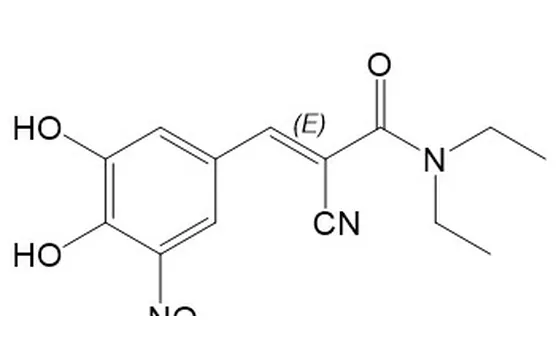
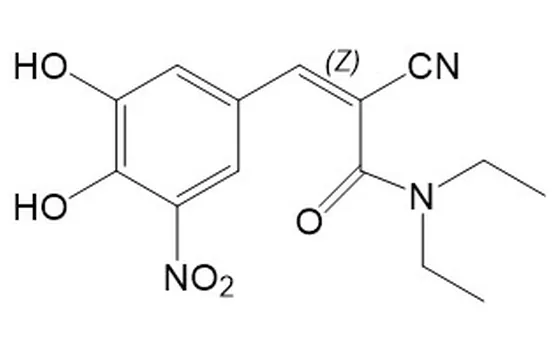
EP Impurity A, CAS 145195-63-7, is C14H15N3O5 at 305.29: the parent formula and the parent mass to the last digit[1]. The difference is the configuration of the acrylic double bond. The drug is E; the impurity is Z, in which the nitrile and the aromatic ring sit on the same side and the molecule folds back on itself.
Two consequences follow. The first is that no mass-based method distinguishes them, and an ultraviolet spectrum does not either, because the chromophore is the same nitrocatechol in both. Separation has to come from shape, and the folded Z isomer usually elutes earlier because it cannot interact with the stationary phase over its full length.
The second is that the Z isomer is not a degradant in the sense that hydrolysis or oxidation is. It is an equilibrium partner: light shifts the ratio, heat shifts it back, and the ratio in a sample records the light history rather than the damage. That makes it a good photostability marker and a bad stability-indicating parameter, and confusing the two roles is the most common error in entacapone method design.
Ten entries at 197.15 and three at 183.12
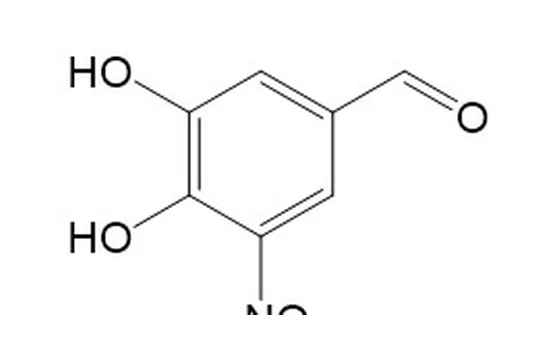
Ten entries share C8H7NO5 at 197.15 and three share C7H5NO5 at 183.12. The relationship between the families is one methyl: the 197.15 group is the 183.12 group with a methyl ether. The 183.12 member is recorded as EP Impurity C, CAS 116313-85-0, the nitro-substituted dihydroxybenzaldehyde[1].
These are positional isomers: the same atoms, the same mass, the same functional groups, differing only in where the substituents sit on the ring. They fragment identically and several have almost the same lipophilicity, so an octadecylsilane column will not always resolve all ten, and a mass detector reports whichever ones co-elute as one number.
The reason there are so many is the reason they exist: the aldehyde is the Knoevenagel partner, and the nitration and hydroxylation steps that decorate the ring are not fully regioselective. What survives into the drug substance is not one aldehyde but a set, and what appears in a stability sample is the same set produced again by oxidative cleavage. The two sources are chemically identical, so a peak at 183.12 cannot be assigned to either without more evidence.
The aldehyde is both the starting material and the degradant
In the route, 3,4-dihydroxy-5-nitrobenzaldehyde condenses with the diethylamide of cyanoacetic acid to give the double bond. In the finished product, oxidation cleaves that same bond and gives the same aldehyde back. So the compound is a starting material, a degradation product and a process impurity at one mass.
A limit on it therefore cannot be justified from one direction. As a starting material it is controlled by purge, an argument about what survives crystallisation. As a degradant it is controlled by stability data, an argument about what forms over the shelf life. Both end in the same specification line, and the line satisfies whichever is tighter.
The same logic applies one methyl higher at 197.15. With ten of them the specification cannot name each one, so it is written as a family limit, which is unusual in a pharmacopoeial context and normal in a development one.
Photostability: what the dark control has to prove
Entacapone absorbs in the near ultraviolet, so a photostability study is not optional and the design question is what to measure. The framework offers two options: expose to 1.2 million lux hours of visible light and 200 watt hours per square metre of near ultraviolet, or run a confirmatory study if the basic study shows sensitivity[3].
For entacapone the interesting measurement is the E to Z ratio, and the reason it is interesting is also why it is dangerous. A rise in the Z isomer under exposure is consistent with photoisomerisation and equally consistent with thermal equilibration, because the two interconvert in solution without any light. The only way to separate the explanations is a dark control held at the same temperature for the same time, and it has to show the ratio does not move on its own. If it does, the light effect is only part of the total and the study has to run cool enough to freeze the thermal pathway.
The second measurement is the quinone. Oxidation of the catechol removes two hydrogens, so the mass falls by 2.02 and the ultraviolet maximum shifts to longer wavelength. That product is a genuine degradant, not an equilibrium partner, and it accumulates. The two measurements answer different questions and both belong in the protocol[4].
The catechol chelates metals, and the method must allow for it
A nitrated 3,4-dihydroxyphenyl group is a strong bidentate ligand for transition metals, iron in particular, and that changes what happens inside the autosampler: stainless steel frits, metal-containing buffers and trace iron in the water all promote oxidation to the quinone while the sample waits in the tray.
The responses are unglamorous and effective: keep the sample solvent slightly acidic, add a chelating agent such as citrate or EDTA at low concentration, use amber glass, shorten the residence time, and validate autosampler stability explicitly. A method that shows a rising quinone across a run sequence is usually reporting the sampler rather than the sample. The same chelation has a formulation consequence: a transition metal at a level irrelevant for another drug is not irrelevant here, and the chemical argument is often tighter than the toxicological one[5].
Diethylamine is the nitrosamine question, not the API
Entacapone has no secondary amine. The amide nitrogen carries two ethyl groups and no hydrogen, so it cannot be nitrosated without losing an ethyl first, and the ring carries a nitro group rather than an amine. On a structural reading the drug is not a nitrosamine precursor.
The reagent is. The diethylamide is installed from diethylamine, a secondary amine whose N-nitroso derivative is N-nitrosodiethylamine at C4H10N2O, 102.14, one of the more potent members of the class[6]. Any nitrosating species in the plant, any nitrite carried in with a shared reagent, can convert it. The product is small, volatile and colourless with no useful chromophore, the same combination that hides the tadalafil chloride.
Fifty-six catalogue rows for entacapone contain no entry at 102.14. That absence is the point: the NDSRI this route can actually make is not in the impurity catalogue, so a risk assessment built from the catalogue concludes there is nothing to look for. The assessment has to start from the reagents.
Limits collapse at 2000 mg a day
| Daily exposure | 0.05 per cent | 0.10 per cent | 0.15 per cent | 1.0 mg absolute branch | Which governs |
|---|---|---|---|---|---|
| 200 mg, single dose | 100 micrograms | 200 micrograms | 300 micrograms | 0.50 per cent | the relative thresholds |
| 1000 mg | 500 micrograms | 1.0 mg | 1.5 mg | 0.10 per cent | both meet at 0.10 per cent |
| 2000 mg, ten doses | 1.0 mg | 2.0 mg | 3.0 mg | 0.05 per cent | the absolute branch, for both |
Table note: entacapone is taken as 200 mg with each levodopa dose, up to ten times a day, so daily exposure spans a factor of ten inside one product[7]. Q3A(R2) applies both branches and takes the lower[2].
The bottom row is the interesting one. At 2000 mg a day, 0.10 per cent is 2.0 mg and 0.15 per cent is 3.0 mg, both above the 1.0 mg cap, so the cap wins and both thresholds become 0.05 per cent. Identification and qualification become the same number, which means any impurity above it must be identified and qualified at once, with no band in which identification alone is enough.
That inverts the situation on most products, where the absolute branch never applies because the dose is too low. A template copied from a 10 mg product is therefore wrong here in a specific direction: it carries a 0.10 per cent identification threshold and lets through impurities that should have been qualified.
A unit error in the catalogue, and why it matters
Entry 12, the 3-O-glucuronide at C20H23N3O11, has a molecular weight field reading 48141. Entry 26 carries the same formula and reads 481.41[1]. The first is a factor of a hundred out: a transcription error, trivially obvious once the formula is checked, which is why it is worth mentioning. The catalogue is a purchasing aid, not a reference document, and a weighing calculation taken from it can be wrong by two orders of magnitude. The same caution applies to every salt entry, where the formula field records the free base and the mass field records the salt, so the two disagree by the counter-ion.
Standards for one isomer and ten fragments
The catalogue holds 56 rows for entacapone: the parent plus 55 numbered entries, highest number 75, twenty-one numbers missing. Nine pharmacopoeial letters cover the specified impurities, and the ten-row cluster at 197.15 is a family rather than a set of individually characterised compounds.
The working set is short: the drug, the Z isomer at 305.29, the aldehyde at 183.12, one representative of the 197.15 family and the quinone. The quinone is often missing from a purchased list because it is unstable and has to be prepared fresh: [see all entacapone entries](entacapone).
Regulatory context: the CDE public database records 81 accepted filings for entacapone from 35 applicants between 2000 and 2026, a thin field consistent with a drug almost always formulated with levodopa rather than alone[8].
Frequently Asked Questions
Is EP Impurity A a degradation product?
Why are there ten entries with the same formula at 197.15?
Which threshold governs at the maximum dose?
Where is the nitrosamine risk in entacapone?
Why does the quinone peak grow during a run sequence?
Can a photostability study rely on the E to Z ratio alone?
Is the aldehyde at 183.12 a starting material or a degradant?
Why does the catalogue show 48141 for one molecular weight?
Related Substances and Reference Standards
- Entacapone (55 impurity / derivative entries)
- Carbidopa (34 impurity / derivative entries)
- Levodopa (- impurity / derivative entries)
References and Sources
- PubChem, National Library of Medicine, Entacapone, CAS 130929-57-6: molecular formula C14H15N3O5, molecular weight 305.3, a nitrocatechol with an electron-poor acrylic double bond, accessed 2026-11-23
- International Council for Harmonisation, ICH Q3A(R2), Impurities in new drug substances: reporting, identification and qualification thresholds, including the 1.0 mg per day absolute branch, accessed 2026-11-23
- International Council for Harmonisation, ICH Q1B, Photostability testing of new drug substances and products: the two options, 1.2 million lux hours and 200 watt hours per square metre of near ultraviolet, accessed 2026-11-23
- International Council for Harmonisation, ICH Q1A(R2), Stability testing of new drug substances and products: long-term, intermediate and accelerated conditions, accessed 2026-11-23
- International Council for Harmonisation, ICH Q3D(R2), Guideline for elemental impurities: the twenty-four element list and permitted daily exposures, accessed 2026-11-23
- PubChem, National Library of Medicine, N-Nitrosodiethylamine, CAS 55-18-5: molecular formula C4H10N2O, molecular weight 102.1, the nitrosamine that a diethylamine reagent can form, accessed 2026-11-23
- DailyMed, US National Library of Medicine, Entacapone tablets, prescribing information: 200 mg taken with each levodopa and carbidopa dose, up to ten times a day, accessed 2026-11-23
- Center for Drug Evaluation, National Medical Products Administration, Accepted marketing applications listed in the public drug registration database, queried by product name on 23 November 2026, accessed 2026-11-23
This article was prepared by the CATO technical team. Regulatory, pharmacopoeial and published literature content cited above is attributed in the reference list. It is provided for technical exchange and search reference only and does not constitute a quality specification or regulatory advice. For any specific substance, the applicable test methods, limits and filing requirements are governed by the current regulations, pharmacopoeial monographs and official publications.
Product information on this site is provided for research search and selection reference only and is not a quality specification; technical data, purity and structural confirmation are governed by the shipped COA and our written confirmation. All products mentioned are for research use only, not for human or animal diagnostic or therapeutic use.