恩替卡韦的发补:三个手性中心,为什么不能塞进一张有关物质图谱Entecavir Deficiency Responses: Three Stereocentres That Will Not Fit on One Related-Substances Chromatogram
恩替卡韦↗的审评问询里,很少直接说「杂质研究不充分」,更常见的是一句很具体的话:请说明本品立体异构体的控制策略。这句话背后压着三层问题——方法能不能分离、限度按什么定、对照品覆盖到哪一步。把这三层拆开,发补的答复其实是有固定路径的。
Review questions on entecavir↗ rarely say outright that the impurity work is inadequate. They usually say something very specific: please describe the control strategy for the stereoisomers of this product. Three layers of questions sit behind that sentence — whether the method can separate them, what the limits rest on, and how far the reference standards reach. Unpack those three layers and the deficiency response turns out to have a fixed route.
Note: figures and pharmacopoeial references cited in this article are marked with superscript numbers; the full source list appears at the end.
一、品种定位:0.5 mg 的日剂量,把所有阈值推到百分比那一侧1. Where this product sits: a 0.5 mg daily dose that pushes every threshold onto the percentage side
关键要点Key points
- 恩替卡韦分子式 CEntecavir has the formula C12H15N5O3,相对分子质量 277.28,成人常规日剂量 0.5 mg,, a relative molecular mass of 277.28, and a standard adult daily dose of 0.5 mg, 拉米夫定lamivudine↗耐药者 1 mg。-resistant patients take 1 mg.
- ICH Q3A(R2) 的鉴定阈与界定阈都是「百分比或 1.0 mg/日,取低者」;日剂量 0.5 mg 时,1.0 mg 的绝对上限相当于 200%,实际起作用的只有百分比The identification and qualification thresholds in ICH Q3A(R2) both read "percentage or 1.0 mg/day, whichever is lower"; at a 0.5 mg daily dose the 1.0 mg absolute ceiling corresponds to 200 percent, so only the percentage actually operates[1]。
- 0.10% 的鉴定阈在 0.5 mg 日剂量下只对应 0.5 μg 绝对量,方法灵敏度与对照品纯度直接决定数据是否可信。At a 0.5 mg daily dose the 0.10 percent identification threshold corresponds to an absolute amount of just 0.5 μg, so method sensitivity and reference standard purity directly determine whether the data can be trusted.
- 本目录收录恩替卡韦相关条目 60 条(2026-11-03 实抓),覆盖 EP 杂质 A、B、D、E、F(缺 C、G),编号排到 82 以上,EP 字母杂质全部以「一水合物」命名。This catalogue holds 60 entries relating to entecavir (retrieved 2026-11-03), covering EP impurities A, B, D, E and F (C and G are not available), with numbered entries running past 82, and every EP lettered impurity named as the monohydrate.
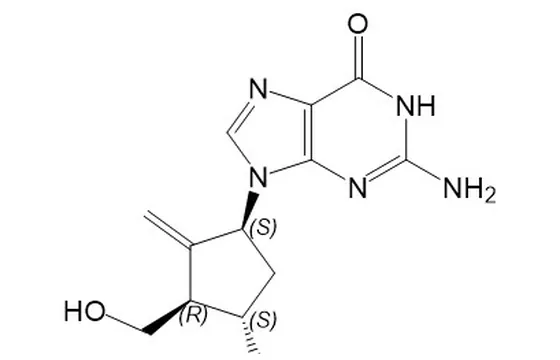
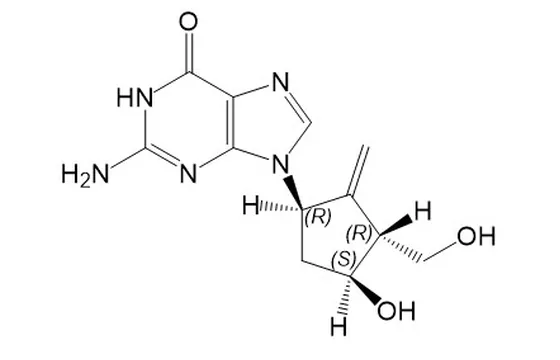
恩替卡韦的结构不复杂,麻烦在于密集。一个环戊烷骨架,2-位是环外亚甲基,3-位和 4-位各带一个取代基(羟甲基与羟基),1-位通过 N9 连到 2-氨基-6-羟基嘌呤上。三个手性中心挤在五元环上,任何一个翻转都得到一个独立的立体异构体。The structure of entecavir is not complicated; it is dense. A cyclopentane skeleton carries an exocyclic methylene at position 2, a substituent at each of positions 3 and 4 (a hydroxymethyl and a hydroxyl), and a bond from position 1 through N9 to 2-amino-6-hydroxypurine. Three stereocentres are crowded onto a five-membered ring, and inverting any one of them gives an independent stereoisomer.
日剂量低到这个程度,会改变整个杂质控制的思路。同样是 0.10% 的鉴定阈,A daily dose this low changes the whole approach to impurity control. Take the same 0.10 percent identification threshold: 二甲双胍metformin↗(2 g/日)对应 2 mg 绝对量,恩替卡韦(0.5 mg/日)只对应 0.5 μg。绝对量差了四千倍:前者一台普通 HPLC 就够,后者要求方法在 0.5 μg 级别上仍可靠,而这已接近常规紫外检测器的舒适区边缘。 at 2 g/day corresponds to 2 mg absolute, while entecavir at 0.5 mg/day corresponds to only 0.5 μg. A four-thousand-fold difference in absolute amount: an ordinary HPLC is enough for the first, whereas the second demands a method that stays reliable at the 0.5 μg level, which is already at the edge of the comfortable range for a conventional UV detector.
《中国药典》现行版收载恩替卡韦原料及其制剂The current edition of the Chinese Pharmacopoeia covers entecavir drug substance and its preparations[2]。药典给的是限度与方法,但立体异构体这一块,立体异构体这一块的覆盖程度与国际药典并不一致,双报要分别核对。. The pharmacopoeia supplies limits and methods, but on stereoisomers the extent of coverage does not match the international pharmacopoeias, and dual filings have to be checked against each separately.
二、三个手性中心:八种构型,一张 C18 装不下2. Three stereocentres: eight configurations, and one C18 column cannot hold them
三个手性中心对应 2Three stereocentres give 23=8 种绝对构型, = 8 absolute configurations, 恩替卡韦entecavir的目标构型只是其中之一,另有 7 个立体异构体。这 7 个里既有对映体(全部中心同时翻转),也有非对映体(部分翻转),色谱行为各不相同:对映体在普通 C18 上出峰位置几乎完全重合,非对映体则可能分得很开、也可能只差零点几个保留时间。's target configuration is only one of them, leaving seven stereoisomers. Those seven include both enantiomers, where every centre is inverted at once, and diastereomers, where only some are, and their chromatographic behaviour differs: enantiomers elute almost exactly on top of each other on an ordinary C18, while diastereomers may separate widely or differ by only a fraction of a minute in retention time.
所以「有关物质方法已包含立体异构体」这句话通常站不住。反相方法的分离基础是疏水性,对映体在非手性固定相上疏水性完全一样,物理上分不开。控制对映体只有三条路:手性固定相、手性流动相添加剂、非色谱手段。So the claim that the related substances method already covers stereoisomers usually does not hold. Reversed-phase separation rests on hydrophobicity, and enantiomers have identical hydrophobicity on an achiral stationary phase, so they cannot be separated physically. Controlling enantiomers leaves three routes: a chiral stationary phase, a chiral mobile-phase additive, or a non-chromatographic approach.
第三条路在文献里有现成例子。有研究用质谱动力学法,让恩替卡韦与手性参比物 R-besivance、二价锌离子形成三体络合物,通过碎片离子丰度比来区分构型——特征离子包括 m/z 733、849、394 和 278,其中 733 与 849 分别是含分析物与含两个参比物的络合离子The third route has a ready example in the literature. One study used a mass spectrometric kinetic method in which entecavir forms a ternary complex with the chiral reference compound R-besivance and divalent zinc, and the configuration is distinguished by fragment ion abundance ratios — characteristic ions include m/z 733, 849, 394 and 278, where 733 and 849 are the complex ions containing the analyte and containing two reference molecules respectively[3]。这个方法不需要手性柱,也不需要复杂前处理,适合做构型确认,但不适合放进常规放行检验。. The approach needs neither a chiral column nor elaborate sample preparation, which suits configuration confirmation but not routine release testing.
实际可执行的组合通常是:放行检验用手性柱方法控制对映体,用反相方法控制非对映体与一般杂质,构型确认用质谱或核磁做一次性论证。三套数据各司其职,缺一套就会在发补里被点名。The workable combination is usually: a chiral column method for enantiomers at release, a reversed-phase method for diastereomers and general impurities, and a one-off mass spectrometry or NMR argument for configuration confirmation. Three datasets each doing their own job; drop one and the deficiency letter will name it.
三、发补第一问:立体异构体到底有没有单独控制3. The first deficiency question: are stereoisomers actually controlled separately
这个问题的答案不能是「有」,必须是「有,且覆盖到哪些构型、用什么方法、限度依据是什么」。The answer cannot be yes; it has to be yes, covering these configurations, by this method, on this basis for the limit.
答复的结构建议按三段写。第一段给构型清单:7 个潜在立体异构体逐一列出,标注哪些有对照品、哪些只能靠 LC-MS 推断、哪些在工艺上不可能产生。这一段最能体现对路线的理解。The response should be structured in three parts. The first gives a configuration inventory: list the seven potential stereoisomers one by one, marking which have reference standards, which can only be inferred by LC-MS, and which cannot arise from the process. This part demonstrates most clearly how well the route is understood.
第二段给分离证据:确认手性方法能把目标构型与各非对映体分开,对映体有可辨认的保留时间。谱图要给空白、系统适用性、加标样、强制降解样四张。The second gives separation evidence: confirm the chiral method resolves the target configuration from each diastereomer and that the enantiomer has a distinguishable retention time. Supply four chromatograms — blank, system suitability, spiked sample and forced degradation sample.
第三段给限度依据。立体异构体的限度不能直接套 ICH Q3A 的 0.10%,要说明它是按「潜在致突变杂质」还是「普通有关物质」处理。恩替卡韦的立体异构体本身没有警示结构,按普通杂质处理是合理的;但如果某个异构体在毒理上有独立数据,限度就要单独论证。The third gives the basis for the limits. Stereoisomer limits cannot simply borrow the 0.10 percent of ICH Q3A; state whether they are handled as potential mutagenic impurities or as ordinary related substances. The entecavir stereoisomers carry no structural alert themselves, so treating them as ordinary impurities is reasonable — but if any one isomer has its own toxicology data, its limit needs a separate justification.
还有一个易忽略的口径问题:本目录里 EP 字母杂质全挂在「One easily overlooked basis issue: in this catalogue the EP lettered impurities all sit under the name 恩替卡韦一水合物entecavir monohydrate↗」名下。一水合物与无水物的分子量、含量折算、对照品称样量都不同,采购和计算时如果没对齐形态,0.10% 算出来会有系统性偏差。. The monohydrate and the anhydrate differ in molecular mass, in content conversion and in the weighing of reference standard; if the form is not aligned when purchasing and calculating, the 0.10 percent figure picks up a systematic bias.
四、发补第二问:氧化与酸水解为什么降解得那么彻底4. The second deficiency question: why oxidation and acid hydrolysis degrade it so completely
强制降解做得好不好,一眼能看出来:如果只有氧化和酸水解出峰,说明条件选对了;如果五项全都「稳定」,那不是分子稳定,是条件太温和。Whether forced degradation was done properly is visible at a glance: if only oxidation and acid hydrolysis produce peaks, the conditions were chosen correctly; if all five conditions come back stable, the molecule is not stable — the conditions were too mild.
有研究对恩替卡韦系统做过强制降解:水解(酸、碱、中性)、氧化、光照、热,五个方向都做,结果是在氧化与酸水解条件下显著降解,共检出 5 个降解产物;对热、中性水解和光照则相对稳定One study put entecavir through systematic forced degradation across five directions — hydrolysis (acid, base, neutral), oxidation, light and heat — and found significant degradation under oxidation and acid hydrolysis with five degradation products detected, while the molecule was comparatively stable to heat, neutral hydrolysis and light[4]。这组结果与结构完全吻合——环戊烷上的羟基与羟甲基是氧化位点,嘌呤的糖苷键是酸水解位点,而分子里没有共轭的发色团体系,光化学反应的通道本来就少。. The results match the structure exactly: the hydroxyl and hydroxymethyl on the cyclopentane are the oxidation sites, the glycosidic bond of the purine is the acid hydrolysis site, and with no conjugated chromophore system in the molecule there are few photochemical channels to begin with.
发补问这一点的目的,通常是确认两件事:降解产物有没有全部归属,以及方法有没有把这些产物分离出来。5 个降解产物是文献在一套特定条件下的结果,不代表你的样品只能出 5 个峰;图谱上多出来的每一个峰都必须能解释来源。The purpose of this question is usually to confirm two things: whether every degradation product has been assigned, and whether the method separates them. Five degradation products is what the literature found under one particular set of conditions; it does not mean your sample can only give five peaks, and every extra peak on the chromatogram must have an explained origin.
氧化降解还有处方层面的连带问题:若用了含过氧化物的辅料(某些型号聚维酮、聚乙二醇),或包材胶黏剂残留过氧化物,贮存期间都会推动氧化。发补问到氧化产物时,把辅料过氧化物价与稳定性数据一起给,比只给图谱有力。Oxidative degradation also drags in formulation questions: peroxide-containing excipients such as certain grades of povidone and polyethylene glycol, or peroxide residues from packaging adhesives, will drive oxidation during storage. When the deficiency letter asks about oxidation products, supplying excipient peroxide values alongside the stability data is stronger than supplying chromatograms alone.
五、发补第三问:糖苷键水解产物在方法里几乎不保留5. The third deficiency question: the glycosidic hydrolysis product barely retains in the method
嘌呤 N9 与环戊基之间的糖苷键在酸性条件下断裂,产物是一分子鸟嘌呤加一个环戊基碎片。鸟嘌呤极性极大,在常规反相柱上几乎不保留,往往在死体积附近出峰,甚至与溶剂峰重叠——这是核苷类药物有关物质方法的经典盲区。The glycosidic bond between purine N9 and the cyclopentyl group cleaves under acidic conditions, giving one molecule of guanine plus a cyclopentyl fragment. Guanine is extremely polar and barely retains on a conventional reversed-phase column, usually eluting near the dead volume and sometimes overlapping the solvent peak — the classic blind spot in related substances methods for nucleoside drugs.
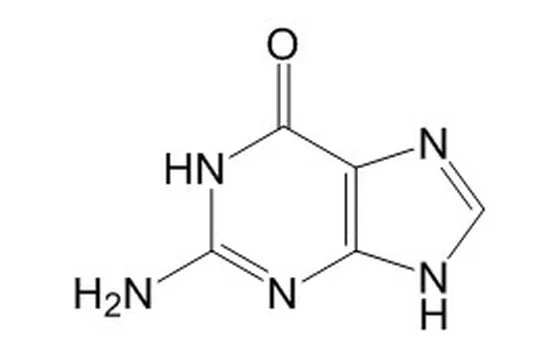
后果很具体:酸水解下主成分明显下降,图谱上却找不到对应降解峰,质量平衡对不上。把「未归属峰」写成「基线波动」,发补一定追问。The consequence is concrete: the main component falls markedly under acid hydrolysis yet no corresponding degradation peak appears, and the mass balance does not close. Writing an unassigned peak off as baseline fluctuation guarantees a follow-up question.
解决办法不在色谱柱上,而在方法组合上。一是加一个离子对或强极性条件的方法,专门看鸟嘌呤这类小分子碱基;二是用 LC-MS 做质量平衡的定性补充,把分子量对上;三是在强制降解设计里把酸水解强度控制住,别把主成分打到 50% 以下。The fix is not in the column but in the method set. First, add an ion-pair or strongly polar method aimed specifically at small bases like guanine; second, use LC-MS as a qualitative supplement to the mass balance so the molecular mass is accounted for; third, keep acid hydrolysis intensity under control in the forced degradation design and do not drive the main component below 50 percent.
工艺侧还有一类残留要交代:若嘌呤 N9 烷基化走 Mitsunobu 路线,会带入三苯基氧膦与肼类残留。三苯基氧膦在 254 nm 强吸收,是有关物质图谱上的常客,却没有字母编号与法定对照品,发补问到时要给「归属证据 + 清除数据」。若用到烷基卤或磺酸酯类试剂,还要按 ICH M7 做致突变性评估There is also a class of process residue to address: if purine N9 alkylation runs by a Mitsunobu route, triphenylphosphine oxide and hydrazine-type residues come with it. Triphenylphosphine oxide absorbs strongly at 254 nm and is a regular on related substances chromatograms, yet carries no letter designation and no compendial reference standard, so when asked you need assignment evidence plus clearance data. If alkyl halides or sulfonate esters are used, a mutagenicity assessment under ICH M7 is also required[5]。
六、把阈值换算成绝对量:一张表看清 0.10% 意味着什么6. Converting thresholds into absolute amounts: a table that shows what 0.10 percent actually means
ICH Q3A 的阈值体系有一个容易被忽略的细节:鉴定阈与界定阈都是「百分比或绝对量,取低者」。绝对量上限固定在 1.0 mg/日,所以日剂量越高,绝对量越早成为约束;日剂量越低,百分比越早成为约束。恩替卡韦站在最低的那一端。One easily missed detail in the ICH Q3A threshold system: both the identification and the qualification threshold read percentage or absolute amount, whichever is lower. The absolute ceiling is fixed at 1.0 mg/day, so the higher the daily dose the sooner the absolute amount binds, and the lower the dose the sooner the percentage binds. Entecavir stands at the very bottom end.
| 日剂量Daily dose | 0.05% 对应0.05 percent corresponds to | 0.10% 对应0.10 percent corresponds to | 0.15% 对应0.15 percent corresponds to | 1.0 mg/日 上限是否起作用Does the 1.0 mg/day ceiling operate |
|---|---|---|---|---|
| 0.5 mg | 0.25 μg | 0.50 μg | 0.75 μg | 不起作用No |
| 1 mg | 0.50 μg | 1.0 μg | 1.5 μg | 不起作用No |
| 50 mg | 25 μg | 50 μg | 75 μg | 不起作用No |
| 2 g | 1.0 mg | 2.0 mg | 3.0 mg | 起作用,阈值被压到 0.05%Yes, the threshold is pulled down to 0.05 percent |
表注:阈值体系依据 ICH Q3A(R2)Table note: the threshold system follows ICH Q3A(R2)[1];绝对量按日剂量乘百分比计算,仅用于说明量级。; absolute amounts are the daily dose multiplied by the percentage and indicate order of magnitude only.
这张表的用处,是让「限度合不合理」有共同语言。有人问为什么某杂质定在 0.10% 而不是 0.5%,答案是在 0.5 mg 日剂量下 0.5% 就是 2.5 μg,已超过界定阈三倍以上,没有毒理数据支撑的限度本身就不成立。The use of this table is to give a common language for whether a limit is justified. Someone asks why an impurity is set at 0.10 percent rather than 0.5 percent; the answer is that at a 0.5 mg daily dose, 0.5 percent is 2.5 μg, more than three times the qualification threshold, and a limit with no toxicology behind it does not stand up in the first place.
反过来也别把百分比当唯一尺度。0.5 μg 意味着对照品的一个小峰、溶剂杂质、进样瓶的一次污染都可能算进 0.10%。低剂量品种的数据可信度,取决于对照品纯度、空白控制与积分参数稳定性。The converse is not to treat the percentage as the only yardstick either. At 0.5 μg, a small peak in the reference standard, an impurity in the solvent, or a single contaminated vial can all land inside 0.10 percent. For low-dose products the credibility of the data rests on reference standard purity, blank control and stable integration parameters.
七、答复发补的四个动作7. Four actions for answering the deficiency letter
恩替卡韦在国内是典型的红海品种。截至 2026-11-03,CDE 公开受理记录里相关条目 421 条、申报单位 173 家,其中仿制 201 条、新药 115 条、补充申请 76 条、复审 20 条、进口 9 条Entecavir is a textbook crowded product in China. As of 2026-11-03 the CDE public acceptance records hold 421 related entries from 173 applicants: 201 generics, 115 new drugs, 76 supplemental applications, 20 re-reviews and 9 imports[6]。复审不少,说明这个品种在技术审评环节的争议点确实集中。. The re-review count is not small, which says the points of contention in technical review really do cluster on this product.
第一个动作是把杂质谱画全。以母体为中心,向上游列起始物料与中间体,向下游列降解产物,向左列立体异构体,向右列试剂残留。四类杂质落在四个象限里,缺哪一个象限,答复时就会被指出来。立体异构体这一象限最常空着。The first action is to draw the impurity profile complete. Put the parent at the centre, list starting materials and intermediates upstream, degradation products downstream, stereoisomers to the left and reagent residues to the right. Four classes fall into four quadrants, and whichever quadrant is empty is the one the response will be faulted on. The stereoisomer quadrant is most often left blank.
第二个动作是给方法配对。每一个象限都要有对应的分离手段:反相管一般杂质,手性柱管对映体,离子对或强极性条件管鸟嘌呤这类小分子,顶空 GC 管溶剂。方法之间要说明互补关系,而不是把一张图谱说成万能。The second is to pair each quadrant with a method. Reversed phase for general impurities, a chiral column for enantiomers, ion-pair or strongly polar conditions for small molecules like guanine, headspace GC for solvents. Explain the complementarity between methods rather than presenting one chromatogram as universal.
第三个动作是把数据落到对照品上:有法定对照品的用法定对照品,没有的用目录条目,再没有的用 LC-MS 加标推断。三级证据链写清楚,比一句「已按药典方法检验」有说服力。The third is to tie the data to reference standards: use a compendial standard where one exists, a catalogue entry where it does not, and LC-MS with spiking inference as the last resort. A clearly written three-tier chain of evidence persuades more than the sentence tested according to the pharmacopoeial method.
第四个动作是准备变更对比。补充申请 76 条说明工艺变更很常见,变更前后的杂质谱、立体异构体比例、元素杂质与溶剂数据都要对比,最好在首次申报就留好基线。The fourth is to prepare change comparisons. Seventy-six supplemental applications say process changes are common; impurity profile, stereoisomer ratios, elemental impurity and solvent data all need before-and-after comparison, and the baseline is best established at first filing.
八、四个常见误区8. Four common misconceptions
误区一:有关物质方法已经覆盖立体异构体。Misconception one: the related substances method already covers stereoisomers.非手性固定相分不开对映体,这是物理限制,不是方法优化能解决的。要在答复里明确区分「非对映体已被反相方法分离」与「对映体需手性方法控制」两件事。 An achiral stationary phase cannot resolve enantiomers; that is a physical limit, not something method optimisation can solve. The response must clearly separate two statements: diastereomers are resolved by the reversed-phase method, and enantiomers require chiral control.
误区二:日剂量低,杂质限度自然会宽。Misconception two: a low daily dose naturally means wider impurity limits.正好相反。0.5 mg 日剂量让阈值退化成纯百分比,绝对量小到 0.5 μg,方法灵敏度成了真正的门槛。 The opposite holds. A 0.5 mg daily dose reduces the threshold to a pure percentage, the absolute amount falls to 0.5 μg, and method sensitivity becomes the real gate.
误区三:强制降解五项都稳定,说明方法耐用。Misconception three: stability across all five forced degradation conditions shows the method is robust.全稳定通常意味着条件太温和。恩替卡韦在氧化与酸水解下明显降解,如果你的实验里这两项也稳定,先检查氧化剂浓度、酸浓度与加热时间。 Stability across the board usually means the conditions were too mild. Entecavir degrades markedly under oxidation and acid hydrolysis; if both came back stable in your study, check the oxidant concentration, the acid concentration and the heating time first.
误区四:鸟嘌呤不算杂质,因为它是人体内源物。Misconception four: guanine does not count as an impurity because it is endogenous to the human body.内源不等于可以不计。它在酸水解下生成、在方法里不保留、在质量平衡里留下缺口,这三件事任何一件都足以让发补追到底。 Endogenous does not mean excludable. It is formed under acid hydrolysis, it does not retain in the method, and it leaves a gap in the mass balance — any one of those three is enough for a deficiency letter to pursue it to the end.
九、对照品怎么搭:三层结构,与一处形态口径9. How to build the reference standard set: three tiers and one question of form
本目录收录恩替卡韦相关条目 This catalogue holds entecavir-related entries 60 条,覆盖 EP 杂质 A、B、D、E、F 与编号至 82 以上的条目,可用于从工艺开发到发补答复的对照品选型:[→ 查看恩替卡韦全部条目]( covering EP impurities A, B, D, E and F plus numbered entries up to and beyond 82, suitable for reference standard selection from process development through deficiency response: [→ view all entecavir entries](恩替卡韦条目一览Entecavir entries at a glance)。
选型按三层走:母体与 EP 字母杂质做杂质谱比对,编号杂质补强制降解里的未知峰,氘代内标用于 LC-MS 定量。第三层在低剂量品种上不是可选项——样品浓度低、响应弱,没有内标很难压住批间波动。同类核苷类品种的对照品清单也不能互相套用:Selection runs in three tiers: the parent and EP lettered impurities for profile comparison, numbered impurities for the unknown peaks in forced degradation, and deuterated internal standards for LC-MS quantitation. The third tier is not optional on a low-dose product — with low sample concentration and weak response, batch-to-batch scatter is hard to hold down without an internal standard. Nor can reference standard lists be carried across between nucleoside products: 拉米夫定lamivudine只有两个手性中心, has only two stereocentres, 阿德福韦adefovir没有手性中心, has none, 丙酚替诺福韦tenofovir alafenamide只有一个,异构体数量与恩替卡韦不在一个量级。 has just one, so the number of isomers is not on the same scale as entecavir.
常见问题(FAQ)Frequently asked questions
恩替卡韦的立体异构体,必须每个都买对照品吗?Do you have to buy a reference standard for every entecavir stereoisomer?
手性方法能不能替代反相方法做放行检验?Can a chiral method replace the reversed-phase method for release testing?
0.5 mg 日剂量下,0.10% 的杂质只有 0.5 μg,这个数据可信吗?At a 0.5 mg daily dose, 0.10 percent is only 0.5 μg — is that data credible?
糖苷键水解产物为什么在反相柱上不保留?Why does the glycosidic hydrolysis product not retain on a reversed-phase column?
强制降解要做到什么程度才算充分?How far does forced degradation have to go to count as adequate?
三苯基氧膦没有法定对照品,怎么做归属?Triphenylphosphine oxide has no compendial reference standard — how is it assigned?
EP 字母杂质以「一水合物」命名,对采购和计算有什么影响?EP lettered impurities are named as the monohydrate — how does that affect purchasing and calculation?
相关品种与对照品Related products and reference standards
- 恩替卡韦 / EntecavirEntecavir(共 60 个杂质/衍生物条目)(60 impurity and derivative entries)
- 拉米夫定 / LamivudineLamivudine(共 32 个杂质/衍生物条目)(32 impurity and derivative entries)
- 阿德福韦 / AdefovirAdefovir(共 48 个杂质/衍生物条目)(48 impurity and derivative entries)
- 富马酸丙酚替诺福韦 / Tenofovir Alafenamide FumarateTenofovir Alafenamide Fumarate(共 41 个杂质/衍生物条目)(41 impurity and derivative entries)
参考资料与来源References and sources
- ICH,ICH Q3A(R2)《新原料药中的杂质》:报告阈值 0.05%、鉴定阈值 0.10% 或 1.0 mg/日、界定阈值 0.15% 或 1.0 mg/日,均取低者ICH Q3A(R2) Impurities in New Drug Substances: reporting threshold 0.05 percent, identification threshold 0.10 percent or 1.0 mg/day, qualification threshold 0.15 percent or 1.0 mg/day, whichever is lower in each case,访问日期 2026-11-03, accessed 2026-11-03
- 中国药典委员会,Chinese Pharmacopoeia Commission, 《中华人民共和国药典》现行版收载恩替卡韦原料药及其制剂(各论条目与检验方法以现行版为准)The current edition of the Pharmacopoeia of the People's Republic of China covers entecavir drug substance and its preparations (monograph entries and test methods as given in the current edition),访问日期 2026-11-03, accessed 2026-11-03
- Journal of Mass Spectrometry(2018),Chiral detection of entecavir stereoisomeric impurities through coordination with R-besivance and Zn(II) using mass spectrometry(质谱动力学法,特征离子 m/z 733、849、394、278,可区分恩替卡韦与其手性异构体)Chiral detection of entecavir stereoisomeric impurities through coordination with R-besivance and Zn(II) using mass spectrometry (a mass spectrometric kinetic method with characteristic ions at m/z 733, 849, 394 and 278, able to distinguish entecavir from its chiral isomers),访问日期 2026-11-03, accessed 2026-11-03
- Journal of Separation Science(2014),LC-MS/MS method for the characterization of the forced degradation products of Entecavir(酸、碱、中性水解与氧化、光照、热五方向强制降解;氧化与酸水解下显著降解,共检出 5 个降解产物;对热、中性水解与光照稳定)LC-MS/MS method for the characterization of the forced degradation products of entecavir (five-direction forced degradation covering acid, base and neutral hydrolysis, oxidation, light and heat; marked degradation under oxidation and acid hydrolysis with five degradation products detected; stable to heat, neutral hydrolysis and light),访问日期 2026-11-03, accessed 2026-11-03
- ICH,ICH M7(R2)《评估和控制药物中 DNA 反应性(致突变)杂质以限制潜在致癌风险》:警示结构分类、TTC 1.5 μg/日与控制策略ICH M7(R2) Assessment and Control of DNA Reactive (Mutagenic) Impurities in Pharmaceuticals to Limit Potential Carcinogenic Risk: structural alert classification, the 1.5 μg/day TTC and control strategy,访问日期 2026-11-03, accessed 2026-11-03
- 国家药品监督管理局药品审评中心(CDE),Center for Drug Evaluation (CDE), NMPA, 受理品种信息检索:恩替卡韦相关受理记录 421 条、申报单位 173 家,其中仿制 201 条、新药 115 条、补充申请 76 条、复审 20 条、进口 9 条(抓取时间 2026-11-03;口径为公开受理记录,不等于获批家数)Acceptance information search: 421 acceptance records relating to entecavir from 173 applicants — 201 generics, 115 new drugs, 76 supplemental applications, 20 re-reviews and 9 imports (retrieved 2026-11-03; the count covers public acceptance records and is not the number of approved applicants),访问日期 2026-11-03, accessed 2026-11-03
说明:本文为 CATO 佳途技术团队原创整理,其中引用的法规、药典与公开文献内容已在上方标注来源,仅用于技术交流与检索参考,不构成质量标准或法规建议;具体品种的检测方法、限值与申报要求,请以现行法规、药典正文及官方发布为准。Note: this article was prepared by the CATO technical team. Regulatory, pharmacopoeial and published literature content cited here is sourced above and is provided for technical exchange and reference only; it does not constitute a quality standard or regulatory advice. For the test methods, limits and filing requirements of any specific product, the current regulations, pharmacopoeial texts and official publications govern.
本站产品信息仅供科研检索与选型参考,不作为质量标准依据;技术参数、纯度与结构确证以随货 COA 及我方书面确认为准。本文涉及的产品均为科研用途,不用于人体或动物诊断、治疗。Product information on this site is for research searching and selection reference only and is not a basis for quality standards; technical parameters, purity and structural confirmation are governed by the certificate of analysis supplied with the goods and by our written confirmation. All products discussed here are for research use and are not intended for human or animal diagnosis or treatment.