Esomeprazole Sodium: Two Forced-Degradation Esters That No Impurity Letter Covers
The impurity letters of esomeprazole sodium are inherited from omeprazole, and they describe a set of compounds that a development programme happened to find. Forced degradation keeps finding others. Two of them, isolated and characterised only in 2023, are esters formed by oxidative cleavage of the sulfoxide bridge; they are one dalton apart, they are absent from the letter set, and no reference standard for either exists. Meanwhile the largest acid-driven degradant is achiral and thirty-four units light, which means the chiral method that proves the enantiomeric purity cannot see it at all.
Note: product names shown in red (marked with ↗) are links - click through to the product page for structure, CAS number, purity and lead time.
Key points
Key points
- Esomeprazole↗ sodium is C17H18N3NaO3S at 367.4, the sodium salt of the S-enantiomer of omeprazole, whose free acid is 345.4[1].
- The sulfoxide sulphur is the only stereocentre. Anything that removes the oxygen removes the chirality with it, so the chiral method and the achiral method have different blind spots[1].
- Acid drives the sulfoxide into a cyclic sulfenamide and then into tetracyclic products at 311.4, thirty-four units below the drug, which arrive as two regioisomers of identical formula[6].
- Oxidation gives two compounds that share the formula C17H19N3O4S at 361.4: the sulfone, with the extra oxygen on sulphur, and the N-oxide, with it on the pyridine nitrogen. One mass, two structures[4,5].
- Two further degradants were isolated and characterised only in 2023: esters from oxidative cleavage of the bridge, at 312.3 and 313.3, one dalton apart and outside the EP letter set[2].
- The catalogue holds 184 rows, 178 of them numbered, 147 distinct numbers out to 228, letters A to I and 22 isotopically labelled rows. None of that coverage reaches the two esters[1].
The molecule is built to avoid the one reaction it is famous for
Esomeprazole is the S-enantiomer of omeprazole: a benzimidazole sulfoxide with a methoxybenzimidazole on one side of the sulfur and a 4-methoxy-3,5-dimethylpyridine on the other, with a methylene bridge between them. As the sodium salt the formula is C17H18N3NaO3S and the mass is 367.4; the free acid is 345.4[1].
The sulfoxide oxygen is the whole molecule's problem and its whole mechanism. In acid the benzimidazole nitrogen attacks the sulfoxide sulfur intramolecularly, the oxygen leaves, and the resulting sulfenamide is the species that binds the proton pump covalently. That is the pharmacology, and it is also the degradation pathway, which is why the oral product is enteric coated and why the intravenous product is a lyophilised powder reconstituted at alkaline pH rather than an acidic solution.
For a laboratory, the consequence is a shift of attention. The degradation that ruins the drug in a beaker of hydrochloric acid is not the degradation that limits its shelf life in a vial or a coated tablet. What limits those is the slower chemistry: oxidation of the sulfoxide, hydrolysis of the bridge under alkaline conditions, and the effect of residual water on a hygroscopic sodium salt.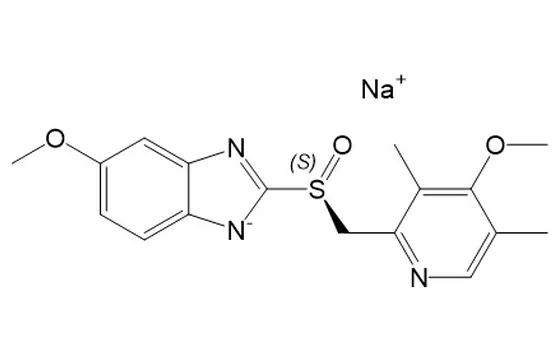
Five stress conditions and what each one actually proves
Forced degradation is often reported as a table of percentages with no statement of what the experiment was for. The useful version assigns each condition a question.
The table also explains why the acid cell of the matrix looks so different from the rest. Acid does not nibble at the molecule; it reorganises it, and the reorganisation is fast enough that the products dominate everything else in the chromatogram.
The acid products: achiral, thirty-four units light, and two of them
Protonation of the benzimidazole, intramolecular attack on the sulfoxide sulfur, loss of the oxygen: the immediate product is a cyclic sulfenamide. It does not stop there. Under continued acid exposure the sulfenamide closes further into a tetracyclic system, and the compound that comes out has the formula C16H13N3O2S at 311.4, thirty-four mass units below the drug[6].
Two things follow, and both matter more than the number.
The first is that the product is achiral. The stereocentre was the sulfoxide sulfur, and the sulfur no longer carries an oxygen, so there is nothing left to be R or S. A chiral method validated for the R-enantiomer will not see this compound at all, because it is not an enantiomer of anything: it is a different, symmetric compound. The largest acid-driven degradant in the file is therefore invisible to the method that the specification relies on for chiral purity.
The second is that it arrives as two regioisomers. The methoxy group can sit at the 8- or the 9-position of the tetracyclic system, and the two have the same formula, the same mass and different retention times. The catalogue holds them as two separate rows, which is honest, and a method that has not been shown to resolve them will report one peak and call it one impurity when it is two.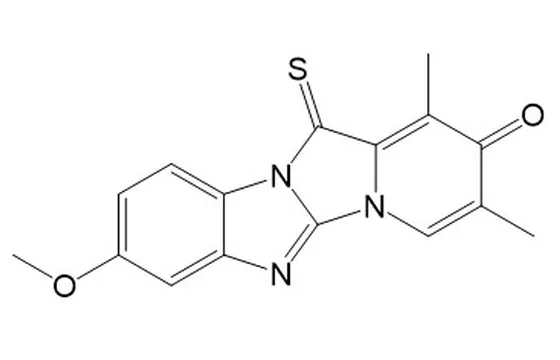
One formula, two structures, at 361.4
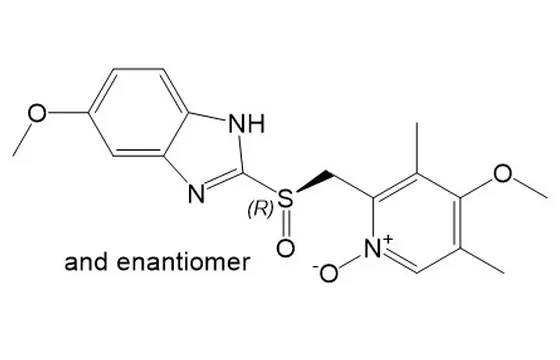
Oxidation is tidier to describe and no easier to analyse. Adding one oxygen to the sulfoxide gives the sulfone, C17H19N3O4S at 361.4, with the second oxygen on sulfur. Adding one oxygen to the pyridine gives the N-oxide, the same formula and the same mass, with the oxygen on the ring nitrogen[4,5].
These are not isomers in the trivial sense of a shared name. They differ in polarity, in retention, in UV spectrum and in what they do to the mass spectrometer, and they are indistinguishable by nominal mass. A single-quadrupole method with a UV detector can resolve them if the chromatography is good and cannot identify them if it is not; a method reporting impurity at 361.4 without a standard for each is reporting a number for two compounds at once.
This is the ordinary case in which a specification says 0.2 per cent for a named degradant, the chromatogram shows one peak at the right retention time, and the peak contains both. The cure is not exotic: run the two standards, prove the resolution, and where one is unavailable, use the photodiode array spectrum to show that the peak is a single species rather than a co-elution.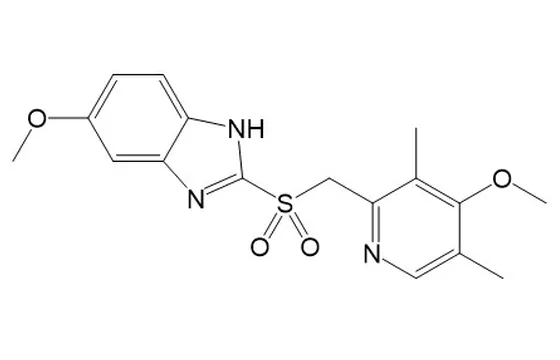
The pair nobody had characterised until 2023
The two degradants that matter most for a current forced-degradation study were isolated and structurally assigned only recently: an ester of 6-methoxybenzimidazol-2-ol with 4-amino-3,5-dimethylpyridine-2-carboxylic acid, and the corresponding 4-hydroxy compound, designated X and Y in the paper[2].
Chemically these come from oxidative cleavage of the methylene bridge that joins the two halves of the molecule. The sulfur leaves, the benzimidazole ends up as the alkoxy part of an ester, and the pyridine contributes the acyl part with either an amino or a hydroxyl at the 4-position. The two differ by a single hydrogen: NH2 in one, OH in the other, which is 0.98 daltons.
That difference is a specification problem and an analytical one. On the structures as published, X is C16H16N4O3 at 312.3 and Y is C16H15N3O4 at 313.3. A unit-resolution instrument reports two peaks one unit apart and an analyst reads the second as an isotope or as noise. An accurate-mass instrument separates them cleanly and immediately asks for standards that do not exist.
There is a further coincidence worth knowing before it causes a misassignment: the tetracyclic acid product at 311.4 and ester X at 312.3 are also about one unit apart. A sample stressed in acid and in peroxide, run on a method without enough resolution, can produce a peak cluster between 311 and 313 that contains three different compounds from two different mechanisms.
Attribution: esters are oxidative, not hydrolytic
The most consequential error in this file is not a missed peak, it is a wrong mechanism. An ester looks like a hydrolysis product, and the natural response is to tighten the water content and the packaging against moisture. But these esters are formed with incorporation of oxygen into the bridge, and the condition that produces them is peroxide or dissolved oxygen, not water alone[2].
The distinction changes what you control. If the mechanism is hydrolysis, the variables are water content, pH and temperature, and the controls are desiccation and a moisture barrier. If the mechanism is oxidation, the variables are dissolved oxygen, peroxide impurities in excipients, metal ion traces that catalyse radical chemistry, and the headspace of the vial, and the controls are nitrogen overlay, an antioxidant where compatible, and a specification for peroxide value in the solvents and excipients that touch the compound.
Attributing the ester to hydrolysis produces a stability programme that watches the wrong number and a specification that fails intermittently for reasons nobody can name. The 2023 paper is worth reading for the assignments alone, because an assignment is what makes the attribution possible.
Two methods, two blind spots, one mass balance
The chiral method exists to separate esomeprazole from its R-enantiomer, and it does that job. It cannot see the acid products, because they are achiral. The achiral method sees the acid products and cannot separate the enantiomer, because the enantiomer has the same retention time on an achiral column by definition.
Neither method alone can close a mass balance, and a validation package that presents them as alternatives is presenting two half-answers. The practical arrangement is a chiral method for the enantiomer and diastereomers, an achiral method for the degradants, and a mass balance that adds the two rather than choosing between them.
There is one further asymmetry that catches people out. The enantiomer of esomeprazole is a real impurity with a real limit, but it is also a degradation product of the drug under alkaline conditions, because the sulfoxide stereocentre racemises when the proton alpha to the sulfur is removed. So the chiral method is measuring something that can grow on stability, and the R-enantiomer limit has to be set with that in mind rather than as a fixed process-impurity number.
The salt, the water and the basis
Two masses belong to this product and they are 22 units apart: 367.4 for the sodium salt and 345.4 for the free acid. Every limit, every per cent and every assay value in the file depends on which one the calculation is written against.
A hygroscopic sodium salt holds water, and water moves the as-is result without moving the anhydrous result. A degradation limit expressed as a percentage of the labelled amount and computed on the as-is basis will drift with the water content of the batch, and the drift looks like a stability trend when it is a weighing artefact. The fix is unglamorous and almost always the right one: state the basis in the method, use the dried or anhydrous result for the limit comparison, and report water separately.
For the intravenous product there is a second layer. The reconstituted solution sits at alkaline pH, contains a chelating agent, and is exposed to oxygen during handling; the degradation chemistry of that solution is not the chemistry of the lyophilised powder and not the chemistry of the enteric-coated tablet either. A forced-degradation package built on the powder alone has not covered the product as it is used.
116 acceptance records, and a profile dominated by supplements
The filtered set is 116 acceptance records from 70 applicants, and the composition is the interesting part: 83 supplementary applications, 28 generics, 3 import re-registrations, 1 new drug and 1 unclassified. The supplement share is nearly three quarters of the file.
A profile like that says where the degradation questions come from. It is not a first-approval dossier problem; it is a change problem. A new excipient source, a change of vial, a scale-up of the lyophilisation cycle, a switch of the elastomer: each of those opens the degradation question again, and each has to be answered with data on the changed product rather than with the original dossier. The two esters at 312.3 and 313.3 are exactly the kind of finding that turns a supplement into a deficiency letter, because they appear when the oxygen exposure of a process changes and not when the molecule changes.
What the catalogue covers, and what it does not
184 rows, 178 of them numbered, 147 distinct numbers reaching out to 228 with 81 numbers missing, nine pharmacopoeial letters A to I, and 22 isotopically labelled rows for bioanalysis and for internal-standard work. The letters follow omeprazole's set rather than esomeprazole's degradants, which is why an ester found in 2023 cannot have a letter: the letters were assigned before anyone had characterised it.
Within that coverage, several rows are worth knowing by mass rather than by name. The thiol fragment at 180.2 is what remains of the benzimidazole half when the bridge is cut. The des-methoxy compound at 315.4 is thirty units light, one methoxy short. The sulfide at 329.4 is sixteen units light, the reduced form of the sulfoxide. Each of these appears in a stress study and none of them is the drug.
What the catalogue does not have is a standard for X or for Y. That is not an oversight, it is the normal lag between a published characterisation and a commercial reference material, and it defines what a laboratory can do in the meantime: isolate from a stressed sample, assign by NMR and high-resolution mass, and use the isolated material as a working standard with a documented purity.
What to write into the specification
Four items, each tied to a mechanism rather than to a template.
A limit for the tetracyclic acid products that names both regioisomers, or a single limit with a demonstrated resolution between them. A single limit without the resolution is a limit on whichever one elutes first.
A separate limit for the sulfone and the N-oxide, each with its own standard, because a combined limit at 361.4 cannot distinguish an oxidation at sulfur from an oxidation at nitrogen, and the two point at different root causes.
An oxidative-degradation statement rather than only a hydrolytic one: peroxide value specifications for the solvents and excipients that contact the compound, a nitrogen overlay where the process allows it, and a metal-ion control where a chelator is present.
An explicit basis for every percentage, with water reported separately and the chiral and achiral results combined in the mass balance rather than presented as alternatives.
Four questions before you buy a standard
Which 361.4 do you need? Ask for the structure, not the letter. Sulfone and N-oxide share a mass, a formula and a catalogue region, and they answer different questions.
Is the tetracyclic standard a single regioisomer? If the material is a mixture of the 8- and 9-methoxy compounds, the purity figure is a mixture figure and the retention time is a range.
Is the salt form stated? A sodium salt standard at 367.4 compared against a limit computed on the acid at 345.4 is a 6 per cent error before any other correction.
Can the supplier support the two esters? For X and Y the honest answer today is usually no, and the practical route is isolation from a stressed sample with full characterisation. A supplier who claims a catalogue number for a compound characterised in 2023 is worth asking for the certificate before the invoice.
Frequently Asked Questions
Why is the largest acid degradant invisible to the chiral method?
Are the sulfone and the N-oxide really the same mass?
What are the two degradants characterised in 2023?
Does that mean the specification is wrong?
Which condition produces the esters, acid or peroxide?
Why does the assay basis matter so much for this salt?
Do the EP letters A to I cover esomeprazole's degradants?
Why are there 22 isotopically labelled rows in the catalogue?
Related Substances and Reference Standards
- Esomeprazole Sodium (184 impurity / derivative entries)
- Lansoprazole (80 impurity / derivative entries)
- Ilaprazole (76 impurity / derivative entries)
References and Sources
- PubChem, National Library of Medicine, Esomeprazole sodium, CAS 161796-78-7: molecular formula C17H18N3NaO3S, molecular weight 367.4, the sodium salt of the S-enantiomer whose free acid is 345.4, accessed 2026-11-24
- Biomedical Chromatography, 2023, Separation and identification of degradation impurities of esomeprazole sodium: two previously unreported degradation products assigned as the 4-amino and 4-hydroxy pyridinecarboxylate esters of the benzimidazole, accessed 2026-11-24
- Journal of Pharmaceutical and Biomedical Analysis, 2026, Chemical stability of esomeprazole in biorelevant bicarbonate buffer, and the specification implications of the buffer-dependent degradation route, accessed 2026-11-24
- PubChem, National Library of Medicine, Omeprazole sulfone, CAS 88546-55-8: molecular formula C17H19N3O4S, molecular weight 361.4, the second oxygen on sulfur, accessed 2026-11-24
- PubChem, National Library of Medicine, Omeprazole N-oxide, CAS 176219-04-8: molecular formula C17H19N3O4S, molecular weight 361.4, the second oxygen on the pyridine nitrogen, accessed 2026-11-24
- PubChem, National Library of Medicine, 8-Methoxy tetracyclic acid rearrangement product, CAS 125656-82-8: molecular formula C16H13N3O2S, molecular weight 311.4, with the 9-methoxy regioisomer at CAS 125656-83-9, accessed 2026-11-24
- International Council for Harmonisation, ICH Q1A(R2), Stability testing of new drug substances and products: stress testing, batch selection and the evaluation of significant change, accessed 2026-11-24
- International Council for Harmonisation, ICH Q3B(R2), Impurities in new drug products: reporting, identification and qualification thresholds for degradation products, accessed 2026-11-24
- Center for Drug Evaluation, NMPA, Public drug acceptance records used for the acceptance counts cited in this article; counts are acceptance records, not approvals, accessed 2026-11-24
This article was prepared by the CATO technical team. Regulatory, pharmacopoeial and published literature content cited above is attributed in the reference list. It is provided for technical exchange and search reference only and does not constitute a quality specification or regulatory advice. For any specific substance, the applicable test methods, limits and filing requirements are governed by the current regulations, pharmacopoeial monographs and official publications.
Product information on this site is provided for research search and selection reference only and is not a quality specification; technical data, purity and structural confirmation are governed by the shipped COA and our written confirmation. All products mentioned are for research use only, not for human or animal diagnostic or therapeutic use.