Ethambutol Has Four Isobars and One Class 1 Solvent: What a Deficiency Letter Really Asks
Ethambutol hydrochloride is a small symmetric molecule with no chromophore, two secondary amines and two stereocentres, and almost every question a reviewer asks about it follows from those four facts. The isomeric impurity that matters most cannot be seen on the column most applicants use, the reagent that installs the linker is a Class 1 solvent, and the two nitrogen atoms that make the molecule a base are the two that can be nitrosated.
Four records, one formula, and only one of them is the drug
Key points
- Ethambutol is (S,S)-2,2′-(ethylenediimino)di-1-butanol, C10H24N2O2, 204.31, and this catalog holds four records with that formula: the drug as the dihydrochloride at CAS 1070-11-7, the (R,R) isomer at 10054-05-4, the meso form at 10054-06-5 and a positional isomer at 91135-20-5[1].
- Only the dextro isomer inhibits mycobacterial spermidine synthase; the levo form does not, so the configuration is a property of the substance rather than a purity metric[2].
- The (R,R) form is the enantiomer and needs a chiral selector, while the meso form is a diastereomer that separates on a C18 column, so one method cannot report both[1].
- The two nitrogen atoms are joined by a two-carbon linker installed with 1,2-dichloroethane, an ICH Q3C Class 1 solvent limited to 5 ppm, and the catalog carries both cis- and trans-1,2-dichloroethene as ethambutol impurities, which is the route fingerprint[3][1].
Ethambutol is a symmetric molecule: two 1-hydroxybutan-2-yl arms hanging from the two nitrogen atoms of ethane-1,2-diamine. The arms carry the stereocentres, and because the two halves are identical the molecule has a twofold axis. That symmetry does a great deal of work in the impurity strategy, and most of this article follows from it.
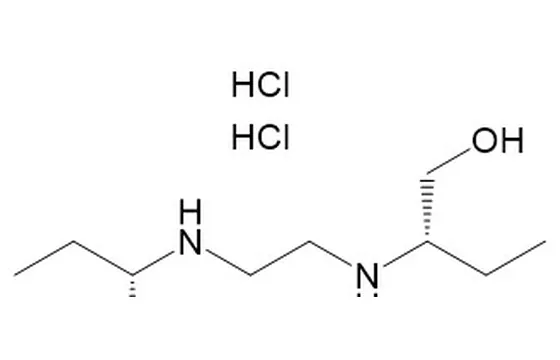
The catalog record for the drug is the dihydrochloride, C10H24N2O2·2HCl, 277.23, CAS 1070-11-7. Alongside it sit three records with the free-base formula C10H24N2O2 and the same nominal mass of 204.31: the (R,R) isomer at CAS 10054-05-4, the meso form at CAS 10054-06-5, and a constitutional isomer at CAS 91135-20-5 in which the hydroxyl sits at the far end of the butyl chain, so the arm is a 4-hydroxybutan-2-yl group rather than a 1-hydroxybutan-2-yl group[1].
Four substances, one formula, one nominal mass, and no chromophore anywhere in the molecule. A single quadrupole will not tell them apart and an ultraviolet detector will barely see them, so identity rests on retention time against a standard. That is why the four records exist as separate catalog items.
| Record | CAS | Relationship to the drug | Separable on C18 | Active |
|---|---|---|---|---|
| Ethambutol dihydrochloride | 1070-11-7 | the drug, (S,S) | reference peak | yes |
| (R,R)-ethambutol | 10054-05-4 | enantiomer | no | no |
| meso-ethambutol | 10054-06-5 | diastereomer | yes | no |
| Constitutional isomer | 91135-20-5 | hydroxyl at the far end of the arm | yes | not established |
Table 1. The four catalog records that share C10H24N2O2. The distinction between rows two and three is the whole analytical problem: one needs a chiral selector, the other does not. Data from the catalog entries and their PubChem records[1].
Why the enantiomer and the diastereomer need different columns
The (R,R) isomer is the mirror image of the drug. In an achiral environment it has the same retention time, spectrum and fragmentation, because it is the same molecule reflected. No amount of gradient optimisation on a C18 column will resolve it.
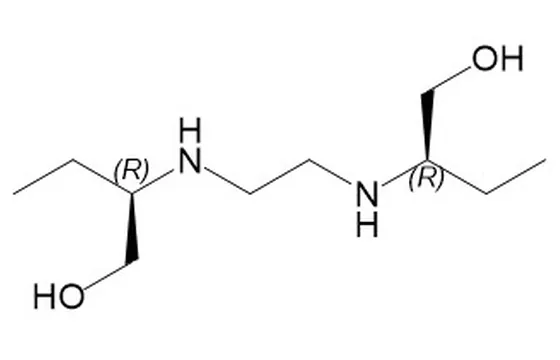
The options are a chiral stationary phase, a chiral mobile-phase additive, or derivatisation to a pair of diastereomers, and each of those is a separate method with its own validation package.
The meso form is a different problem. It carries one (S) and one (R) arm, so it is not a mirror image of the drug and it is not superimposable on it. It is a diastereomer, it has different physicochemical properties, and it separates on an ordinary reversed-phase column if the method has any retention at all.
That split is where deficiency responses usually go wrong. A method development report will show a clean chromatogram of a spiked sample, the spiked sample contains the meso form, the peak resolves, and the report concludes that isomeric impurities are controlled. The (R,R) enantiomer was never in the spike, because the standard was not purchased. The reviewer notices, because the impurity section claims coverage of an isomer that the method structurally cannot see.
A further wrinkle: the meso dihydrochloride is itself dimorphic, with two forms that transform enantiotropically and reversibly in a single-crystal-to-single-crystal manner, and the (S,S) diastereomer also has two known polymorphs[4]. An impurity standard weighed as a solid in an unstated form is a spike of unknown phase, and a slowly dissolving suspension gives a low recovery that reads as a purge.
The method begins with a detection problem, not a separation problem
Ethambutol has no aromatic ring, no carbonyl and no conjugated system. Its ultraviolet spectrum is end absorption, which means the useful signal sits at the wavelength where the mobile phase, the column and the sample solvent also absorb. There are three practical ways out, and they are not interchangeable.
The first is derivatisation. A chromophore is attached to the secondary amines or the hydroxyls, the derivative is separated on C18, and the method inherits a reaction that must be validated for reagent purity, reaction time, temperature and derivative stability in the autosampler. The second is a universal detector, charged aerosol or evaporative light scattering, which removes the chromophore requirement but makes the calibration quadratic and sensitive to the organic content of the mobile phase. The third is low-wavelength ultraviolet with heavy loading, which works only if the baseline is clean, and it rarely is.
Retention is the second half of the problem. The dihydrochloride is fully protonated in acidic mobile phases, and the free base is small and highly polar, so a plain C18 method with a formate buffer gives a peak at the solvent front. Ion pairing, or a stationary phase for polar bases, is what makes the injection volume meaningful. When a method shows the API at three minutes and nothing else for forty, the usual explanation is not that the sample is pure.
What the thresholds answer, and what they cannot
ICH Q3A sets the familiar three tiers for a new drug substance: a reporting threshold of 0.05 per cent, an identification threshold of 0.10 per cent or 1.0 mg per day whichever is lower, and a qualification threshold of 0.15 per cent or 1.0 mg per day[5]. The arithmetic for ethambutol is straightforward. The label dose is 15 mg/kg daily for initial treatment and 25 mg/kg daily for retreatment, falling back to 15 mg/kg after sixty days[6]. For a 70 kg adult that is 1050 mg and 1750 mg per day, so 1.0 mg corresponds to 0.095 per cent and 0.057 per cent respectively. Both are below 0.10 per cent, which means the percentage column governs and the absolute cap never binds.
That is worth stating in a filing because it removes an argument. It does not set a limit for the (R,R) isomer. The thresholds are mass fractions of a substance in a substance; two isomers have the same mass by construction, so the table has nothing to say about which of them is present. An isomeric limit has to be justified from the synthesis: what the stereochemical quality of the starting material is, which step sets the configuration, and what the purge factor is across the crystallisation.
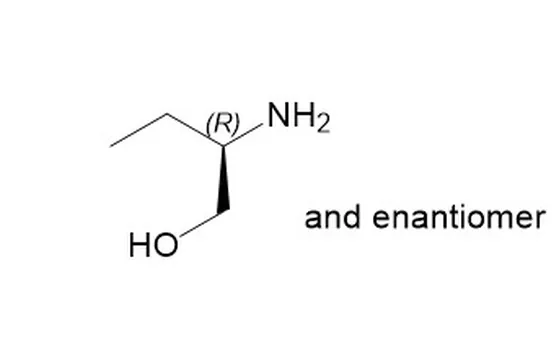
This is where the starting material becomes the centre of the discussion. The arms come from 2-amino-1-butanol, and the catalog holds both enantiomers of that material as separate items, (S) at CAS 5856-63-3 and (R) at CAS 5856-62-2[1]. If that material is not enantiopure, the diamine is a mixture before the linker is installed, and no downstream specification can restore a single stereoisomer. ICH Q11 asks for exactly this analysis: which starting materials are significant to the quality of the drug substance, and what controls are placed on them[7]. A response that answers an isomer question with a chromatogram of the final batch has answered a different question.
1,2-Dichloroethane is a reagent that behaves like a Class 1 solvent
The two arms are joined by alkylating the aminobutanol twice with 1,2-dichloroethane, so the linker carbon atoms and the alkylating agent are the same molecule, and its residue is a Class 1 item. ICH Q3C lists 1,2-dichloroethane among the five Class 1 solvents, with a concentration limit of 5 ppm; Class 1 substances have no permitted daily exposure and no option 2, because the limit is set on the basis of carcinogenicity rather than on a tolerable intake[3].
The catalog carries two further records that only make sense on that route: cis-1,2-dichloroethene at CAS 156-59-2 and trans-1,2-dichloroethene at CAS 156-60-5, both C2H2Cl2, 96.94[1]. They are the elimination products of the same two-carbon unit, a fingerprint of a dichloroethane alkylation step. If the route uses that reagent, both belong in the residual-solvent and genotoxic-impurity sections, and neither appears on a reversed-phase related-substances chromatogram. They are volatile, so the method is headspace gas chromatography, and the two dichloroethenes are isobaric, so the column has to resolve them rather than the detector.
Meeting 5 ppm does not close the mutagenic impurity question. 1,2-Dichloroethane alkylates DNA and is assessed under ICH M7 on its own terms, whether or not the residual level satisfies Q3C. Q3C asks how much is left; M7 asks what the substance does.
Two N-H bonds and a symmetry that deletes a category
Ethambutol is a bis-secondary amine. Each nitrogen carries one hydrogen, so each is a nitrosation site, and the catalog holds both products: the mono-nitroso compound at CAS 78213-39-5, C10H23N3O3, 233.31, and the di-nitroso compound at CAS 2792161-95-4, C10H22N4O4, 262.31, with the (R,R) di-nitroso analogue at CAS 52322-22-2[1].
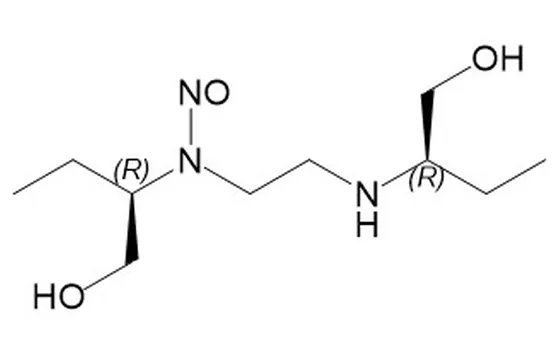
Here the symmetry pays off. Because the two halves are equivalent, N1-nitroso and N2-nitroso are the same compound, and there is no positional pair to separate. That is not true of every polyamine drug: azithromycin, with two inequivalent tertiary nitrogens, gives two distinct mono-nitroso products plus a di-nitroso one, and its impurity map is correspondingly wider. A method transferred from a macrolide to ethambutol without rethinking the species list will over-specify in one direction and under-specify in the other.
Ethambutol is never given alone: the label states that it is administered with at least one other drug, usually isoniazid[6]. The nitrosation is not hypothetical. A 1982 study reacted fifty micromolar drug with five hundred micromolar nitrite at pH 3.0 to 3.4 and 37 degrees for four hours and found considerable formation of nitroso compounds from ethambutol, alongside cinnarizine and pyridinol carbamate[8]. Those are gastric conditions, and nitrite is present in saliva and in cured food. The chemistry that makes the risk real is the same chemistry that makes the limit small.
How small: the ICH M7 threshold of concern is 1.5 micrograms per day[9]. At 1750 mg of ethambutol per day, that is 0.86 ppm. The compendial reporting threshold of 0.05 per cent is 500 ppm, roughly 580 times higher. A related-substances method built around a 0.05 per cent reporting threshold cannot see an impurity at 0.86 ppm, and no amount of method tuning will change that, because the limit and the method were designed against different numbers. The nitrosamine test has to be a separate method with its own standard and its own limit of quantification, typically by liquid chromatography with tandem mass spectrometry.
What the response should contain
The pattern in ethambutol filings is consistent enough to list. The reviewer is not asking whether the batch passed but whether the method could have failed it.
| Question as written | Evidence that closes it | What does not |
|---|---|---|
| Justify the limit for the (R,R) isomer | Stereochemical specification of the aminobutanol starting material, the step that sets configuration, spiked recovery on a chiral method at the limit, and batch data showing purge | A C18 chromatogram of a spiked sample that never contained the enantiomer |
| Where is the 1,2-dichloroethane control | Headspace GC with a limit at or below 5 ppm, plus a statement of whether the reagent is used at all and, if not, what replaced it | A Q3C option 2 calculation, which does not exist for a Class 1 solvent |
| Why no nitrosamine assessment | A species list built from the two secondary amines, a nitrite stress result, and a validated method at the ppm level with a limit derived from the daily dose | An assessment that stops at the observation that the drug is not a sartan |
| Is the method stability indicating | Forced degradation in acid, base, oxidation, heat and light, with mass balance and peak purity for each condition | A statement that the drug is stable, when the molecule has two secondary amines and two hydroxyls |
Table 2. The four questions that recur in ethambutol deficiency letters, mapped to the evidence that answers them.
The last row deserves a comment. Ethambutol is small and stable enough to invite the conclusion that there is nothing to degrade, but the di-nitroso compound is not an oxidation product: it comes from nitrosation, which has a different trigger. A forced-degradation package that treats oxidative stress as a proxy for nitrosation will miss the species that matters, because hydrogen peroxide does not deliver nitrous acid.
How many applicants sit in the same position:
Reference standards for a molecule with four isobars
The catalog lists 18 ethambutol entries. Three carry EP letters, with the meso form recorded as EP impurity B at CAS 10054-06-5 and the (R,R) form as EP impurity C at CAS 10054-05-4, and the two aminobutanol enantiomers appear as separate items, (S) at 5856-63-3 and (R) at 5856-62-2. The pair that a nitrosamine method actually needs is there as well, mono at 78213-39-5 and di at 2792161-95-4, and so is the dichloroethene pair at 156-59-2 and 156-60-5: [see all ethambutol entries](ethambutol hydrochloride impurity and isomer entries)
Because four records share C10H24N2O2, a laboratory that buys one of them and calls it the isomeric impurity will produce a method that passes system suitability and answers the wrong question. The spike has to contain the meso form for the C18 method and the (R,R) form for the chiral method, and the two experiments are separate.
Frequently Asked Questions
Which ethambutol isomer is the impurity?
Can one HPLC method cover the assay, the meso form and the (R,R) form?
Is 1,2-dichloroethane a residual solvent or a reagent in this route?
Does the 5 ppm limit apply if the manufacturer does not use 1,2-dichloroethane?
Why is the nitrosamine limit so far below the 0.05 per cent reporting threshold?
Do I need a chiral method if the drug substance is the dihydrochloride salt?
Is the meso form toxicologically relevant?
How should the meso standard be handled when preparing a spike?
Related Substances and Reference Standards
- Ethambutol Hydrochloride (- impurity / derivative entries)
- Isoniazid (- impurity / derivative entries)
- Azithromycin (- impurity / derivative entries)
References and Sources
- PubChem, National Center for Biotechnology Information, Ethambutol (CID 14052, C10H24N2O2, 204.31) and the records for CAS 1070-11-7, 10054-05-4, 10054-06-5, 91135-20-5, 5856-63-3, 5856-62-2, 78213-39-5 and 2792161-95-4, used here for formulas, masses and isomeric relationships, accessed 2026-11-18
- Antimicrobial Agents and Chemotherapy, American Society for Microbiology, Specific inhibition of spermidine synthesis in Mycobacteria spp. by the dextro isomer of ethambutol (1985), the source for the statement that only the dextro isomer is active, accessed 2026-11-18
- International Council for Harmonisation, ICH Q3C(R8), Impurities: guideline for residual solvents, Class 1 table with the 5 ppm concentration limit for 1,2-dichloroethane, accessed 2026-11-18
- Journal of Pharmaceutical Sciences, [R,S]-Ethambutol dihydrochloride: variable-temperature studies of a dimorphic system with very similar packing (2004), on the enantiotropic single-crystal transformation of the meso dihydrochloride, accessed 2026-11-18
- International Council for Harmonisation, ICH Q3A(R2), Impurities in new drug substances, reporting, identification and qualification thresholds, accessed 2026-11-18
- DailyMed, US National Library of Medicine, Ethambutol hydrochloride tablets, prescribing information: 15 mg/kg daily for initial treatment and 25 mg/kg daily for retreatment, reduced to 15 mg/kg after sixty days, accessed 2026-11-18
- International Council for Harmonisation, ICH Q11, Development and manufacture of drug substances, on the selection and control of starting materials, accessed 2026-11-18
- Cancer Letters, Formation of nitroso compounds and mutagens from cinnarizine, ethambutol, piromidic acid, pyridinol carbamate and tiaramide (1982), nitrite reaction at pH 3.0 to 3.4, accessed 2026-11-18
- International Council for Harmonisation, ICH M7(R2), Assessment and control of DNA reactive (mutagenic) impurities, threshold of toxicological concern of 1.5 micrograms per day, accessed 2026-11-18
This article was prepared by the CATO technical team. Regulatory, pharmacopoeial and published literature content cited above is attributed in the reference list. It is provided for technical exchange and search reference only and does not constitute a quality specification or regulatory advice. For any specific substance, the applicable test methods, limits and filing requirements are governed by the current regulations, pharmacopoeial monographs and official publications.
Product information on this site is provided for research search and selection reference only and is not a quality specification; technical data, purity and structural confirmation are governed by the shipped COA and our written confirmation. All products mentioned are for research use only, not for human or animal diagnostic or therapeutic use.