Ezetimibe: The Main Degradant Is an Isomer of the Drug
Ezetimibe↗ is a 10 mg drug built on a four-membered lactam, and that ring is where the analytical difficulty starts. Under heat, acid, base, peroxide or water the ring does not simply hydrolyse; it rearranges into a six-membered oxygen heterocycle of the same molecular formula, so the degradant reaches the detector at the parent mass. The second problem is quieter: in pure acetonitrile the molecule dimerises inside a glass vial, at a level that looks like a failed batch.
Note: product names shown in red (marked with ↗) are links - click through to the product page for structure, CAS number, purity and lead time.
A daily 10 mg tablet built on a four-membered ring
Key points
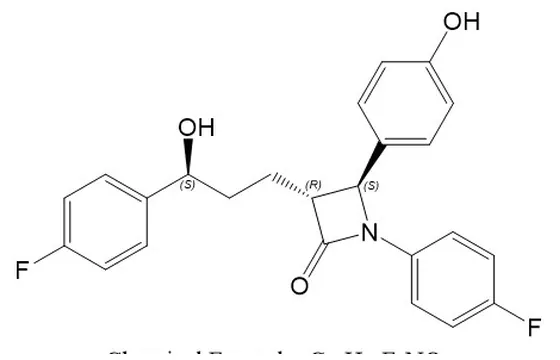
- Ezetimibe is C24H21F2NO3, 409.4, CAS 163222-33-1, dosed at 10 mg once a day, with three stereocenters on and beside a four-membered lactam.
- The principal degradant under thermal, acid, base, oxidative and hydrolytic stress is a tetrahydropyran carboxamide with the same molecular formula as the drug, so it reaches the detector at the same exact mass[1].
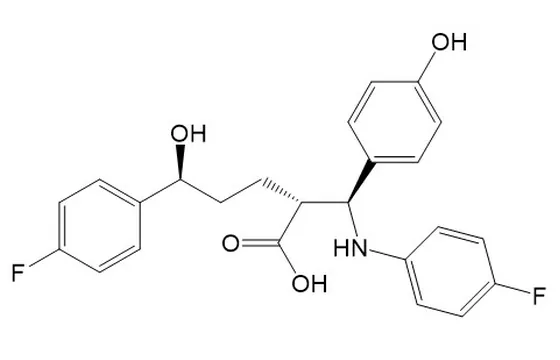
- Ring opening gives a hydroxy acid carrying a free anilino nitrogen. The drug contains no aromatic amine; the degradant does, and that changes how it has to be characterised[2].
- In pure acetonitrile held in glass vials, the molecule dimerises under base leached from the glass, reaching 4 to 5 percent in roughly one vial in seven[3].
Ezetimibe blocks cholesterol absorption at the brush border by inhibiting NPC1L1, and its skeleton is unusual for a drug taken by millions of people every day. The core is a β-lactam, the same four-membered heterocycle that defines penicillin. Around it sit a 4-fluorophenyl group on the lactam nitrogen, a 4-hydroxyphenyl group on the adjacent carbon, and a 3-(4-fluorophenyl)-3-hydroxypropyl chain on the third. The phenol invites glucuronidation, the two fluorines block para-hydroxylation, and the three stereocenters mean the molecule has to be resolved rather than sold as a racemate.
The dose sets the arithmetic before any chemistry does. Ten milligrams a day places ezetimibe in the band where absolute daily amounts run out before percentages, and it means a method has to find, inside a 10 mg tablet, an amount of substance measured in tens of micrograms.
Our catalogue holds 130 rows for ezetimibe, one of them the drug itself. The series is indexed by supplier sequence number rather than by compendial letter, and only a few rows carry a chemical descriptor. That indexing tells you the impurity vocabulary for this API was assembled by suppliers working backwards from routes, not inherited from a letter system.
Stress does not hydrolyse this ring, it rearranges it
A lactam is expected to hydrolyse. Amoxicillin↗ does, and loses its activity with the ring. Ezetimibe does something else. In a forced degradation study covering thermal, acid, base, oxidative, hydrolytic and photolytic conditions, the drug degraded extensively under five of the six, was stable to light, and in every one of those five the main product was an isomer rather than a fragment[1].
The assigned structure was (2R,3R,6S)-N,6-bis(4-fluorophenyl)-2-(4-hydroxyphenyl)-oxane-3-carboxamide, a tetrahydropyran. Count the atoms and nothing is missing: the lactam nitrogen has left the ring and reappeared outside it as the amide of the former carbonyl, the side-chain hydroxyl has taken its place and become the ring oxygen, and four members have become six. The formula is C24H21F2NO3 either way, and so is the exact mass of the protonated ion.
That reorders the analytical work. A high-resolution mass spectrometer will confirm that a peak is ezetimibe-related and will say nothing about whether it is the drug or its main degradant. Only retention against a characterised standard, or NMR on an isolated fraction, separates them.
Hydrolysis proper also occurs, and its product carries the more interesting liability. Opening the lactam gives (2R,5S)-2-[(S)-(4-fluoroanilino)-(4-hydroxyphenyl)methyl]-5-(4-fluorophenyl)-5-hydroxypentanoic acid, C24H23F2NO4, 427.4, CAS 1618657-29-6, one molecule of water added and nothing lost[2]. The acid is unremarkable; the nitrogen is not. In the intact drug it is a doubly acylated amide, chemically dull and not a mutagenicity alert. Once the ring opens it is a secondary aromatic amine, and aromatic amines appear on the alerting-structure lists used by every in-silico system in regulatory use.
So the ring-opened acid needs a characterised standard, a measured response factor and its own stability data, not a response factor of 1 and a line in a table. It also closes one shortcut in the nitrosamine assessment: the argument that ezetimibe has no secondary aliphatic amine is true of the drug and not of its degradant. The usual answer is still a documented negative, because N-nitroso aromatic amines are far less stable than the alkyl NDSRIs the guidance targets, but it has to be written rather than assumed.
Ghost peaks: degradation inside the autosampler
The second failure mode has nothing to do with the process. Dissolve ezetimibe in pure acetonitrile, put the solution in a glass HPLC vial, and in a fraction of vials two new peaks appear and then grow. A published investigation put the frequency near 15 percent of vials, with the peaks typically showing within 24 hours and growing until they accounted for 4 to 5 percent of total area[3].
The cause is alkali leached from the glass. The vials are not inert towards an unbuffered organic solvent sitting on a slightly basic surface, and the leached base catalyses two reactions: dimerisation to two dimeric impurities that had not previously been reported, and, to a lesser degree, isomerisation to a known isomeric impurity. The variability is the diagnostic: a real impurity is in the batch and appears in every injection, while a vial artefact appears in some vials, not others, and grows with residence time.
For a laboratory this is a false out-of-specification generator at a 4 percent magnitude, large enough to fail a specification and small enough to be believed. The controls follow from the mechanism: a buffered diluent instead of unbuffered acetonitrile, plastic or deactivated glass, and a validated hold time. Prepare a sample, leave it on the autosampler for the longest intended residence, and show the profile has not moved. A diluent blank injected after 24 hours belongs in the validation package, not in a footnote.
Seventeen rows, one molecular formula
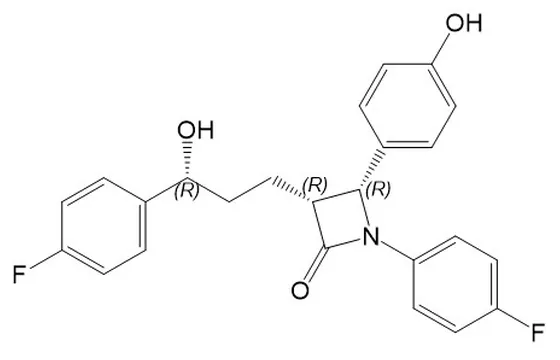
Of the 130 rows on the ezetimibe page, 17 share C24H21F2NO3 with the drug. Three are named for stereochemistry, including the S,S,S, R,R,S and R,R,R isomers; the rest are numbered. Any of the 17 could be the drug, a stereoisomer, a ring isomer of the kind described above, or a mixture of diastereomers a supplier has not resolved.
| Formula | Rows | What the group represents |
|---|---|---|
| C24H21F2NO3 | 17 | the drug, its stereoisomers and ring isomers, all 409.4 |
| C24H19F2NO3 | 2 | the ketone, two hydrogens short, from oxidation of the benzylic hydroxyl |
| C24H23F2NO4 | 1 | the ring-opened hydroxy acid, one molecule of water added |
| C30H29F2NO9 | 2 | two glucuronides of one formula, differing in which oxygen carries the sugar |
| C24H22FNO3 | 2 | mono-defluoro analogues, one fluorine replaced by hydrogen |
| C39H46F2N2O5Si2 | 6 | silyl-protected process species carrying two silicon atoms |
Counts from the ezetimibe page of our catalogue, read on 9 November 2026. Formulae are the catalogue's own; the interpretation of each group is ours.
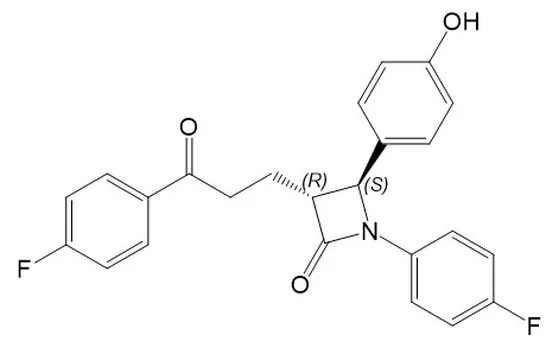
Two groups deserve a second look. The ketone, 407.4, is the oxidation product of the benzylic alcohol and the impurity most likely to grow on stability if the antioxidant or the packaging is inadequate; it is the one case here where two mass units help. The two glucuronides share C30H29F2NO9, 585.5, and only one is the circulating metabolite: ezetimibe is conjugated on the phenol, and that conjugate is pharmacologically active, while the aliphatic one is a characterisation tool rather than a purchase. The six two-silicon rows are route archaeology from silyl protection, useful if a supplier changes route, not useful on a stability programme.
How many species one method has to resolve
A method developed for ezetimibe separated 14 impurities, diastereomers and degradation products included, in a 45 minute run, with a limit of quantification at or below 0.04 percent and detection at or below 0.01 percent, recovery of 100 ± 6 percent and repeatability under 4 percent relative standard deviation[4]. The same paper compared it with the compendial approach and with earlier published alternatives and concluded that none of them resolved all the diastereomers and degradation products at once.
That conclusion is the useful part. It does not say the compendial method is wrong; it says one reversed-phase method cannot carry both jobs. Diastereomers differ in the relative configuration of two or three centres on a flexible molecule, and the tetrahydropyran differs from the drug in ring size alone. Selectivity for one class says nothing about the other.
Chiral stationary phases in reversed-phase mode give the orthogonal view. In a mechanistic modelling study a cyclodextrin column separated seven related substances from the drug and a cellulose column separated six, with better agreement between predicted and observed retention on the cyclodextrin phase, and the chosen operating points held their resolution over a two-year repeatability check[5]. A chiral method is not a replacement for the achiral one; it is the second dimension that shows the first is not blind.
Two details belong in the method description rather than in a development report. Detection at 210 nm sits at the practical edge of a UV detector, where mobile phase absorbance, dissolved oxygen and lamp ageing all contribute. And because two analytes differ only by ring size, column temperature is a selectivity parameter, not a robustness afterthought.
The arithmetic at 10 mg a day
For a degradation product in a finished product, ICH Q3B(R2) sets thresholds by maximum daily dose and offers a percentage and an absolute amount, whichever is lower[6]. At 10 mg the arithmetic lands somewhere awkward.
| Threshold | Guideline value at 10 mg per day | Which limb binds |
|---|---|---|
| Reporting | 0.1 percent | percentage only |
| Identification | 0.5 percent or 20 micrograms, whichever is lower | 20 micrograms is 0.2 percent, so the absolute limb binds |
| Qualification | 0.5 percent or 200 micrograms, whichever is lower | 200 micrograms is 2 percent, so 0.5 percent governs |
Thresholds from ICH Q3B(R2) Attachment 1; the conversions are ours.
The identification threshold is therefore 0.2 percent in practice, not the 0.5 percent a reader remembers. Twenty micrograms per day is the number the method must see, and it is a fifth of what the percentage column suggests. This is arithmetic a reviewer performs in half a minute and an applicant sometimes does not perform at all.
For the drug substance ICH Q3A(R2) applies instead, with reporting at 0.05 percent, identification at 0.10 percent or 1.0 mg per day and qualification at 0.15 percent or 1.0 mg per day[7]. At 10 mg the absolute limbs are unreachable, so percentages govern and the API specification is the stricter document. A tetrahydropyran degradant at 0.12 percent in the drug substance is above the identification threshold and needs a qualification or a structural argument, even though the same 0.12 percent in the tablet sits below the product threshold.
The commercial weight behind that arithmetic is visible in the filing record.
The block counts accepted filings and applicants, not approvals. It is also a reminder that a crowded generic field is running the same ring chemistry and the same isomer problem, so the differentiating work is degradant characterisation, not the price of the API.
Why the statins and the penicillins do not help
Three neighbouring classes contain a ring that opens, and none of them is a precedent.
Atorvastatin calcium and rosuvastatin calcium carry a six-membered lactone that equilibrates with the open hydroxy acid, and the open acid is the drug. The lactone is a specified impurity, but the two forms interconvert in solution, so the method measures a distribution rather than a decay. Ezetimibe has no equilibrium: the ring-opened acid is not the drug, and the drug does not re-form from it on storage.
Simvastatin is a closed lactone prodrug hydrolysed to the active acid in the body, so opening is activation. Ezetimibe is not a prodrug, and nothing about its four-membered ring is designed to break.
Amoxicillin carries a β-lactam that is the pharmacophore: it acylates the transpeptidase, hydrolysis is both mechanism and main degradation route, and polymerisation follows. Ezetimibe's β-lactam acylates nothing. It is a rigid scaffold holding two aryl groups at a fixed distance. The same heterocycle produces opposite control strategies, which is why a reviewer who has read a hundred penicillin dossiers still asks different questions here.
The analogy that does hold is about the amine. Any molecule that generates a free aromatic amine on degradation inherits the same three obligations: characterise the degradant, measure its response factor, and state whether the amine triggers a mutagenicity assessment. That obligation is independent of therapeutic class.
What to keep on the shelf
The routine set is small: drug substance for system suitability, the ketone, the ring-opened acid and the tetrahydropyran. The first three are available as characterised solids; the fourth has to be generated by stress and isolated, and its identity confirmed by NMR rather than by retention alone, precisely because mass spectrometry cannot place it.
Beyond the core, the useful purchases are the stereoisomer series and one glucuronide. The stereoisomers matter whenever the route involves a resolution, because the failure mode of a resolution is a stereoisomer that an achiral method reports as a single number. The phenolic glucuronide matters for a metabolite discussion; the aliphatic one rarely does.
The catalogue covers all of it: 17 rows at the drug's own formula, the ketone, the ring-opened acid, both glucuronides, the mono-defluoro analogues and six silyl-protected species. For a molecule whose main degradant is an isomer, owning the isomers is not a convenience, it is the only way to prove the method can tell them apart: Ezetimibe reference standards and related entries.
Frequently Asked Questions
Can LC-MS identify the tetrahydropyran degradant without a reference standard?
Why do ghost peaks appear in some vials and not others?
Does the ring-opened degradant trigger a nitrosamine assessment?
What limit of quantification does a 10 mg product need?
Is one achiral method enough for the diastereomers?
Is ezetimibe photolabile?
Do I need both glucuronides as standards?
What is the largest single method risk here?
Related Substances and Reference Standards
- Ezetimibe (129 impurity / derivative entries)
- Atorvastatin Calcium (96 impurity / derivative entries)
- Simvastatin (53 impurity / derivative entries)
- Amoxicillin (83 impurity / derivative entries)
References and Sources
- Talanta, 137 (2015) 203-212, Development and validation of a stability-indicating HPLC method for eleven related substances in ezetimibe drug substance and drug product, with characterisation of the tetrahydropyran degradation product formed under thermal, acid, oxidative, base and hydrolytic stress, accessed 2026-11-09
- National Library of Medicine, PubChem, Compound records for ezetimibe and its ring-opened degradation product, CAS 163222-33-1 and 1618657-29-6, with systematic names, molecular formulae and molecular weights, accessed 2026-11-09
- Journal of Pharmaceutical and Biomedical Analysis, 138 (2017) 213-220, Ghost peaks of ezetimibe: solution degradation products of ezetimibe in acetonitrile induced by alkaline impurities from glass HPLC vials, including dimerisation to two previously unreported dimeric impurities, accessed 2026-11-09
- Journal of Chromatographic Science, 57 (2019) 25-33, Development of a simple, highly selective reversed-phase liquid chromatography method for the quantification of diastereomers and other related substances of ezetimibe using multivariate analysis, accessed 2026-11-09
- International Journal of Molecular Sciences, 24 (2023) 16097, The applicability of chromatographic retention modelling on chiral stationary phases in reversed-phase mode: a case study for ezetimibe and its impurities, accessed 2026-11-09
- International Council for Harmonisation, ICH Q3B(R2) Impurities in New Drug Products: reporting, identification and qualification thresholds for degradation products as a function of maximum daily dose, accessed 2026-11-09
- International Council for Harmonisation, ICH Q3A(R2) Impurities in New Drug Substances: reporting, identification and qualification thresholds, including the absolute daily amount limb, accessed 2026-11-09
This article was prepared by the CATO technical team. Regulatory, pharmacopoeial and published literature content cited above is attributed in the reference list. It is provided for technical exchange and search reference only and does not constitute a quality specification or regulatory advice. For any specific substance, the applicable test methods, limits and filing requirements are governed by the current regulations, pharmacopoeial monographs and official publications.
Product information on this site is provided for research search and selection reference only and is not a quality specification; technical data, purity and structural confirmation are governed by the shipped COA and our written confirmation. All products mentioned are for research use only, not for human or animal diagnostic or therapeutic use.