Fluconazole Is a Mixture of Solid Forms, and One of Them Carries 6.7 Per Cent Ethyl Acetate
The fluconazole in the drum is not one crystal form, and the specification rarely says which one it is. Recrystallisation solvent decides the lattice, drying decides what is left of it, and one of the possible outcomes holds a quarter mole of ethyl acetate, which is a phase rather than a residue and cannot be released against a solvent limit.
Note: product names shown in red (marked with ↗) are links - click through to the product page for structure, CAS number, purity and lead time.
One molecule, five solid forms, and no single answer
Key points
- Fluconazole↗ is C13H12F2N6O, 306.27, and the substance in the drum is not necessarily one crystal form: a commercial drug substance examined in 2026 was a mixture of an anhydrous polymorph and the monohydrate[1].
- Recrystallisation from propan-2-ol gives Form III, water gives the monohydrate, ethyl acetate gives a solvate with a quarter mole of solvent, and desolvation of either solvate gives Form I[2].
- The quarter ethyl acetate solvate is 6.7 per cent solvent by mass, more than thirteen times the 5000 ppm concentration limit that applies to ethyl acetate as a Class 3 residual solvent, so a solvate cannot be released against a solvent limit[2][3].
- Equilibrium solubility is about 6.5 g per litre in water and in buffers from pH 4.5 to 7.2 and 3.85 times higher in 0.1 M hydrochloric acid, and the anhydrous form converts to the monohydrate during the measurement, so both forms dissolve to the same value[1].
Fluconazole is a small, symmetric molecule: a central tertiary alcohol bearing a 2,4-difluorophenyl group and two 1,2,4-triazol-1-ylmethyl arms. The alcohol is a strong hydrogen-bond donor and the triazoles are acceptors, so the molecule can build networks in more than one way, and it does. It is also small enough that the lattice energy difference between those networks is modest, which is the usual recipe for a polymorphic drug.
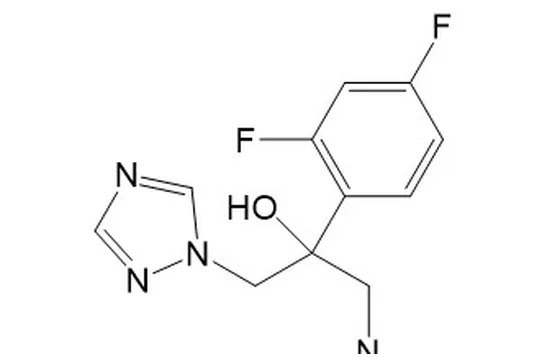
The record is not one form. Crystallisation from propan-2-ol yields a polymorph designated Form III; water yields a monohydrate; ethyl acetate yields a solvate that contains one molecule of solvent for every four of drug, written as fluconazole. (ethyl acetate)0.25. Dehydration of the monohydrate and desolvation of the ethyl acetate solvate both give Form I, and melting gives an amorphous solid[2]. A 2021 survey of finished products found that forms II and III are the ones actually in use in manufacture[4], and the 2026 study of a commercial substance found a mixture of an anhydrous form and the monohydrate[1].
| Solid form | How it is obtained | What it becomes on drying or heating | Solvent in the lattice |
|---|---|---|---|
| Form III | recrystallisation from propan-2-ol | not a desolvation product | none |
| Form I | dehydration of the monohydrate or desolvation of the ethyl acetate solvate | reference anhydrous form after drying | none |
| Forms II and III | the forms found in marketed products | anhydrous | none |
| Monohydrate | crystallisation from water | Form I on dehydration, anhydrous form on stronger drying | water, isolated sites |
| Ethyl acetate solvate | crystallisation from ethyl acetate | Form I on desolvation | 0.25 mol ethyl acetate in channels |
Table 1. The solid forms that appear in the fluconazole literature, with the solvent that produces each and the form left behind after drying. Data from the crystal characterisation and the dehydration and desolvation studies[2][5].
Two entries matter more than the others. Form I is reachable only by removing solvent, so it can be a product of drying rather than of crystallisation. The second is that the hydrate and the solvate are not the same kind of object, even though both lose solvent on heating.
The solvent you crystallise from decides the form you get
The three preparations above differ only in the recrystallisation solvent. That is a manufacturing fact with a regulatory consequence: the solid form is a function of a process parameter, so it belongs in the control strategy rather than in a footnote. A specification that names a form without naming the solvent and the drying condition has described a result, not a control.
The structural detail explains why the solvents behave so differently. In Form III the molecules sit as centrosymmetric hydrogen-bonded dimers, a motif built from the alcohol donor and a triazole acceptor[2]. Water enters that lattice at isolated sites, one molecule per drug molecule, and leaves it without collapsing the framework. Ethyl acetate does something else: it occupies constricted channels, which is why the stoichiometry is a quarter rather than one, and why the crystal has to be pried open to let it out.
For an applicant, the practical question is not which form is thermostable but which form the process can hold. A crystallisation in a water-miscible solvent that is never fully dried will deliver the monohydrate whatever the specification says, and a drying step that overshoots will deliver Form I. Neither outcome is a deviation from the process; both are the process.
The other triazoles sit elsewhere on this axis: itraconazole is practically insoluble and is formulated by amorphisation, while voriconazole brings a chiral centre into the same question. Fluconazole is soluble enough that its forms differ mainly in what is trapped inside the lattice.
A quarter mole of ethyl acetate is not a residual solvent
The arithmetic is short. Ethyl acetate is C4H8O2, 88.11. A quarter mole is 22.03 g per mole of drug, and the solvate unit is 306.27 plus 22.03, or 328.30. The solvent fraction is therefore 22.03 divided by 328.30, which is 6.71 per cent by mass.
Compare that with the limit that applies to ethyl acetate as a residual solvent. ICH Q3C places it in Class 3, the solvents with low toxic potential, and gives a concentration limit of 5000 ppm, which is 0.5 per cent[3]. A stoichiometric quarter-solvate carries 6.7 per cent, about thirteen times the limit. No drying optimisation will reconcile those two numbers, because they are not describing the same thing: Q3C limits a residue, and a solvate is a phase in which the solvent is part of the crystal.
This is where specifications go wrong in a recognisable way. A loss on drying test with a limit of half a per cent will reject every batch of the solvate, correctly, and a batch that passes the test has already lost the solvent and is no longer the solvate. A headspace gas chromatography test measures what is left, not what the crystal was. If the solvate is a legitimate intermediate form, the control is crystallisation and drying, verified by a solid-state method. If it is not wanted, the control is the choice of solvent.
A sample weighed as the solvate is 93.3 per cent drug by mass, so an assay on the dried basis and an assay as-is differ by the solvent. Neither is wrong, but a specification has to say which one it means.
Isolated water sites and constricted channels behave differently under vacuum
The two solvates lose their solvent by different mechanisms, and the kinetics were measured directly. Isothermal thermogravimetry on the monohydrate fitted a three-dimensional phase-boundary model, with an activation energy of 90 plus or minus 11 kilojoules per mole. The ethyl acetate solvate fitted a three-dimensional diffusion model, with an activation energy of 153 plus or minus 11 kilojoules per mole[5].
Phase-boundary control means the reaction front advances through the crystal, and the rate is set by the interface. Diffusion control means the solvent has to travel out through a channel that narrows as the framework closes, and the rate falls as the escape route shrinks. The 63 kilojoule difference is the price of the channel.
That has a direct bearing on drying. A monohydrate will give up its water at a moderate temperature and the drying curve will show a clean endpoint. An ethyl acetate solvate dried at the same temperature will keep releasing solvent for much longer, and the last fraction is the hardest, because it has the longest path. A drying study that reports one time point and one residual solvent value has measured an average, not a mechanism. It also explains why the same dryer can produce Form I from one batch and a partly desolvated solid from the next.
Why a dissolution difference between the forms will not show up
Solubility is where fluconazole refuses to cooperate with the usual polymorph story. Equilibrium solubility at 37 degrees was measured in water, in buffers from pH 4.5 to 7.2 and in 0.1 M hydrochloric acid. The anhydrous form and the monohydrate gave comparable values in water and in three buffered media, averaging about 6.5 g per litre, and equilibrium was reached within twelve hours. Solubility in 0.1 M hydrochloric acid was about 3.85 times higher[1].
The reason the two forms agree is that the anhydrous form converts to the monohydrate during the measurement. Powder diffraction of the residual solid after equilibration showed complete conversion, so both experiments ended with the same solid phase in contact with the same solution. The measured solubility is the solubility of the monohydrate, whatever was weighed at the start.
Scale that to a dissolution vessel. A 150 mg tablet in 900 mL is 0.17 g per litre, about 2.6 per cent of saturation. That is a sink condition by any definition, and the form in the tablet has time to convert before it has time to matter. Fluconazole sits in the high-solubility corner of the biopharmaceutics classification, and the risk that a form difference will produce a bioavailability difference is correspondingly small. What a form difference can still do is change compaction behaviour, flow, and the rate at which the tablet disintegrates, which is a manufacturing question rather than a thermodynamic one.
The dose arithmetic is worth doing at the same time. A single 150 mg oral dose is the regimen for vaginal candidiasis, and the label lists tablet strengths of 50, 100, 150 and 200 mg[6]. Under ICH Q3B the identification threshold is 0.10 per cent or 1.0 mg per day, whichever is lower, and 1.0 mg is 0.67 per cent of 150 mg, so the percentage governs[7]. The reporting threshold of 0.05 per cent is 75 micrograms, and the qualification threshold of 0.15 per cent is 225 micrograms. Those are the numbers an impurity method has to reach, and none of them depends on the crystal form.
The impurities that come with an azole
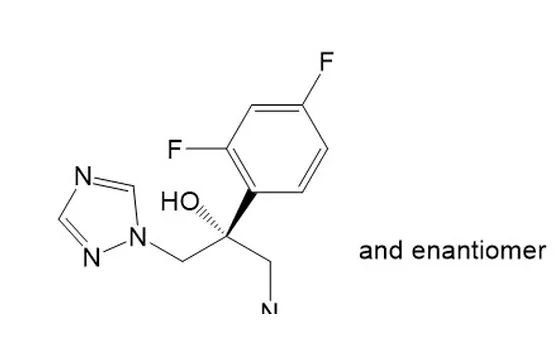
Fluconazole has no stereocentre, so the isomeric problem is constitutional rather than chiral, and the catalog shows it clearly. EP impurity A, iso-fluconazole at CAS 89429-59-4, carries the same formula, C13H12F2N6O, and the same mass, 306.27, as the drug[8]. Two records, one mass, and a difference a mass spectrometer cannot see, because nothing about the connectivity changes the formula. Identity rests on retention.
| Record | CAS | Formula | Mass | What changed |
|---|---|---|---|---|
| Fluconazole | 86386-73-4 | C13H12F2N6O | 306.27 | reference |
| EP impurity A, iso-fluconazole | 89429-59-4 | C13H12F2N6O | 306.27 | constitutional isomer, same mass |
| EP impurity D | 81886-51-3 | C13H13FN6O | 288.28 | one fluorine lost, minus 18.00 |
| Fluconazole N-oxide | 1997296-62-4 | C13H12F2N6O2 | 322.27 | plus one oxygen |
| 4-amino fluconazole bromide | 150168-54-0 | C13H14BrF2N7O | 402.20 | quaternary triazolium salt |
Table 2. Five catalog records that bracket the fluconazole impurity map. The first pair is the one that matters analytically: identical formula, identical nominal mass, different retention. Data from the catalog entries and their PubChem records[8].
The last row is the one to think about.
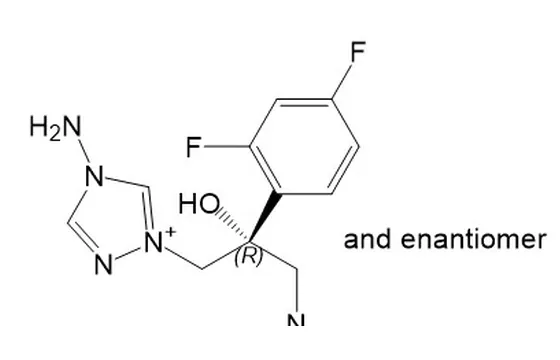
A triazolium salt is what you get when a triazole nitrogen is alkylated, and the record exists because that reaction is reachable in the chemistry, not because the compound was found in a batch. Quaternary azolium species are assessed for mutagenic potential on structural grounds rather than against a threshold table, and the assessment turns on what sits on the nitrogen. For an applicant the practical question is which alkylating reagent the route uses and whether that reagent can reach a triazole at all.
Between those two ends sit the ordinary ones.
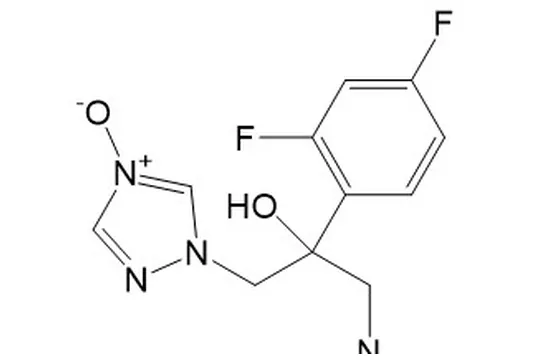
Loss of a fluorine gives 288.28, a difference of 18.00 that corresponds to replacing fluorine with hydrogen. Oxidation of a triazole nitrogen gives the N-oxide at 322.27, plus 16.00. Both are the kind of change that a stability-indicating method is expected to find, and both are the kind of change that a method developed only against the compendial impurity set will miss if the set does not include them.
What the specification should actually say
Three controls cover the ground, and none of them is a polymorph limit in the usual sense. The first is a solid-state identity test at release and at the end of shelf life, by powder diffraction against a stated reference pattern, or by a spectroscopic method cross-validated against diffraction. Naming a form without a pattern is not a specification; it is a description.
The second is a solvent test that distinguishes a residue from a stoichiometric component. Headspace gas chromatography answers the residue question. It does not answer the phase question, and a passing result on a partly desolvated solid says nothing about which form is in the drum.
The third is a phase-conversion check after storage, because the monohydrate is the phase that water activity pushes towards. ICH Q6A treats polymorphism as a decision to be justified rather than a box to be ticked: the question is whether the form can change under the conditions of manufacture and storage, and whether that change matters for performance[9]. For fluconazole the honest answer is that the form can change, that solubility barely notices, and that the properties which do notice are the mechanical ones.
Applicant volume for the substance in the Chinese system:
Reference standards for a drug with more than one lattice
The catalog lists 32 fluconazole entries, nine of them carrying EP letters A through I, and the set covers the constitutional isomer at 89429-59-4, the des-fluoro compound at 81886-51-3, the N-oxide at 1997296-62-4 and the quaternary triazolium salt at 150168-54-0: [see all fluconazole entries](fluconazole impurity and derivative entries)
What the catalog cannot supply is the solid form, and that is the point of the article. A reference standard defines a chemical identity; a form defines a lattice. The two are bought, tested and specified separately, and a filing that treats the second as a property of the first will be asked to explain how the form was controlled.
Frequently Asked Questions
Is fluconazole polymorphic or is it a hydrate former?
Which form is in marketed fluconazole?
Can a batch of the ethyl acetate solvate pass a 5000 ppm residual solvent limit?
Why is the dehydration activation energy lower than the desolvation energy?
Does the solid form affect fluconazole dissolution?
Why is solubility higher in 0.1 M hydrochloric acid?
Is iso-fluconazole separable from fluconazole by mass spectrometry?
What should a polymorph specification contain?
Related Substances and Reference Standards
- Fluconazole (- impurity / derivative entries)
- Voriconazole (- impurity / derivative entries)
- Itraconazole (- impurity / derivative entries)
References and Sources
- Journal of Pharmaceutical Sciences, Solid state convergence to fluconazole monohydrate: mechanochemical hydration, phase transitions, and solvent-mediated conversion driving solubility (2026), including the composition of a commercial drug substance and equilibrium solubility at 37 degrees, accessed 2026-11-18
- Journal of Pharmaceutical Sciences, Preparation and crystal characterization of a polymorph, a monohydrate, and an ethyl acetate solvate of the antifungal fluconazole (2004), the source for Form III from propan-2-ol, the 0.25 ethyl acetate solvate, and Form I from desolvation, accessed 2026-11-18
- International Council for Harmonisation, ICH Q3C(R8), Impurities: guideline for residual solvents, Class 3 concentration limit of 5000 ppm for ethyl acetate, accessed 2026-11-18
- Journal of Pharmaceutical and Biomedical Analysis, Classification of polymorphic forms of fluconazole in pharmaceuticals by FT-IR and FT-NIR spectroscopy (2021), noting that products are mostly manufactured with forms II and III, accessed 2026-11-18
- Journal of Pharmaceutical Sciences, Comparison between dehydration and desolvation kinetics of fluconazole monohydrate and fluconazole ethyl acetate solvate using three different methods (2006), activation energies of 90 and 153 kilojoules per mole, accessed 2026-11-18
- DailyMed, US National Library of Medicine, Fluconazole tablets, prescribing information: strengths of 50, 100, 150 and 200 mg, the 150 mg single oral dose for vaginal candidiasis, and the statement that the substance is slightly soluble in water, accessed 2026-11-18
- International Council for Harmonisation, ICH Q3B(R2), Impurities in new drug products, reporting, identification and qualification thresholds, accessed 2026-11-18
- PubChem, National Center for Biotechnology Information, Fluconazole (CID 3365, C13H12F2N6O, 306.27) and the records for CAS 89429-59-4, 81886-51-3, 1997296-62-4 and 150168-54-0, used for formulas, masses and constitutional relationships, accessed 2026-11-18
- International Council for Harmonisation, ICH Q6A, Specifications: test procedures and acceptance criteria, on polymorphism and the need to justify the choice and control of the solid form, accessed 2026-11-18
This article was prepared by the CATO technical team. Regulatory, pharmacopoeial and published literature content cited above is attributed in the reference list. It is provided for technical exchange and search reference only and does not constitute a quality specification or regulatory advice. For any specific substance, the applicable test methods, limits and filing requirements are governed by the current regulations, pharmacopoeial monographs and official publications.
Product information on this site is provided for research search and selection reference only and is not a quality specification; technical data, purity and structural confirmation are governed by the shipped COA and our written confirmation. All products mentioned are for research use only, not for human or animal diagnostic or therapeutic use.