Fluoxetine: The N-Methyl That Carries Both the Pharmacology and the Nitroso Group
Fluoxetine owes its selectivity to a single methyl group on the amine nitrogen. That methyl makes the amine secondary, weakly basic and lipophilic, which is also the profile of an efficient nitrosation substrate. The consequence is not theoretical: N-nitroso-fluoxetine was found above its acceptable intake in a marketed product in Belgium, and the product was temporarily withdrawn.
Note: product names shown in red (marked with ↗) are links - click through to the product page for structure, CAS number, purity and lead time.
A selectivity that sits on one methyl group
Key points
- Fluoxetine hydrochloride is C17H18F3NO·HCl, 345.8, CAS 56296-78-7, usually 20 mg a day, and the amine nitrogen carries a methyl group rather than a hydrogen-free tertiary centre.
- That methyl makes the amine secondary and nitrosatable. The product is N-nitroso-fluoxetine, C17H17F3N2O2, 370.3, CAS 150494-06-7[1].
- A marketed fluoxetine product was temporarily withdrawn in Belgium after the nitrosamine was found above an acceptable intake of 100 ng per day[2].
- At the 60 mg daily dose used in that calculation, 100 ng per day is 1.67 ppm; a reformulated product measured 0.58 ppm at release and 1.15 ppm after 21 months at 25 degrees Celsius and 60 percent relative humidity[2].
Fluoxetine is N-methyl-3-phenyl-3-[4-(trifluoromethyl)phenoxy]propan-1-amine, a molecule with one stereocenter at the benzylic carbon and a second aryl ring that carries three fluorines on a single carbon. It is marketed as the racemate, and both enantiomers are active at the serotonin transporter. The trifluoromethyl group blocks metabolic hydroxylation of that ring, which is part of why the half-life is measured in days rather than hours.
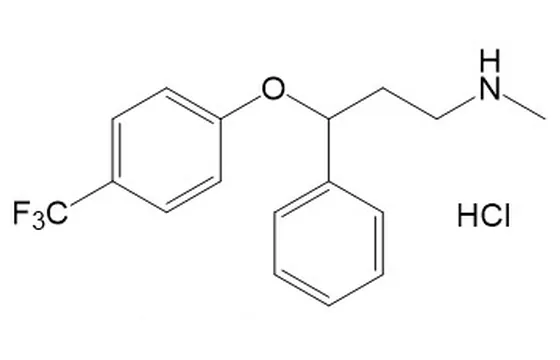
The methyl on the nitrogen is not decoration. Demethylation by CYP2D6 gives norfluoxetine, C16H16F3NO, 295.3, a metabolite with a longer half-life and a broader pharmacological footprint than the parent, including noradrenergic activity that the parent does not show to the same degree. The methyl therefore separates the serotonin-selective parent from its less selective metabolite, and it is the one structural feature a medicinal chemist would not remove.
It is also the feature that makes the molecule an NDSRI substrate. A secondary amine has the hydrogen that nitrosation requires; a tertiary amine does not, and needs to lose an alkyl group first. Fluoxetine arrives at the nitrosation step with the leaving group already absent and the hydrogen already present. Our catalogue holds 46 rows for the hydrochloride, indexed with European Pharmacopoeia letters, and exactly one of them is a nitroso compound.
The regulatory machinery does not treat nitrosamines as a separate universe. ICH M7(R2) applies its hazard and control logic to any DNA-reactive impurity, and the class-specific acceptable intakes for nitrosamines sit on top of that framework rather than replacing it[3]. What changes with a secondary amine is not the framework but the arithmetic: the general thresholds run at 0.05 percent reporting and 0.10 percent identification, which are 500 ppm and 1000 ppm, while a category-2 nitrosamine limit at a 20 mg dose is 5 ppm[4]. The dedicated method is not a precaution; it is the only way to see a number below the general thresholds.
Why this particular nitrogen nitrosates so readily
Nitrosation of a secondary amine needs three things at once: nitrite, an acidic environment that converts it into the reactive carriers, and a meaningful fraction of amine in the free base form. The first two are the ones people audit. The third is the one that decides the rate.
Only the unprotonated amine reacts. Anything that lowers the basicity of the nitrogen, or raises the pH towards its pKa, increases the free fraction and therefore the rate at the same nitrite concentration. Fluoxetine is a weaker base than a simple alkylamine, because the benzylic carbon and the aryloxypropyl chain both pull electron density away from the nitrogen. A weak base is a good nitrosation substrate, which is the same arithmetic that dominates the aromatic amine case, where the pKa is low enough that a substantial free fraction survives even in acidic solutionthe methotrexate NDSRI case.
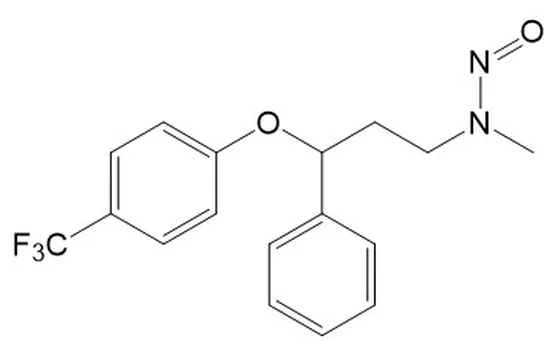
The hydrochloride salt adds a wrinkle that matters for the product rather than the API. Dissolved in a small amount of water, fluoxetine hydrochloride gives an acidic solution, and an acidic solution containing nitrite is precisely the condition under which nitrous acid and its anhydride exist. A wet granulate, a film coat with acidic residues, or simply moisture equilibrating in a blister can create a microscopic reaction volume where the pH sits in the window of maximum nitrosation rate and the amine is partly free. Nothing exotic is required: water, an acidic counterion and a few parts per million of nitrite.
Nitrite is a lot property, not a compendial name. Two batches of the same excipient grade can differ by an order of magnitude, and the number is rarely on the certificate of analysis unless it is asked for. The same is true of purified water and of the adhesives and inks in a printed blister.
Belgium, and what 1.67 ppm actually means
The regulatory event is documented. N-nitroso-fluoxetine was detected above an acceptable intake of 100 ng per day in a marketed product, and the product was temporarily withdrawn in Belgium[2]. The 100 ng per day figure is the second potency category of the carcinogenic potency categorization approach, well below the 1500 ng per day applied to the least potent nitrosamines[5].
Converting an acceptable intake into a specification is division, and the divisor is the maximum daily dose. At 60 mg, 100 ng per day is 1.67 ppm, which is the ceiling reported in the reformulation work.
| Maximum daily dose | Limit at 100 ng per day | Limit at 400 ng per day |
|---|---|---|
| 10 mg | 10 ppm | 40 ppm |
| 20 mg | 5 ppm | 20 ppm |
| 40 mg | 2.5 ppm | 10 ppm |
| 60 mg | 1.67 ppm | 6.7 ppm |
Arithmetic from the acceptable intakes in the carcinogenic potency categorization approach; the dose column spans the labelled range for fluoxetine.
Two numbers from the same study are worth keeping together. The reformulated product contained 0.58 ppm at release and 1.15 ppm after 21 months at 25 degrees Celsius and 60 percent relative humidity, against a limit of 1.67 ppm[2]. The formation continued in the pack, roughly doubling over the shelf life, which means a release result is not a stability result. A nitrosamine method that appears only in the release specification, and not at every long-term timepoint, answers a question nobody asked.
The three levers were low-nitrite excipients, an aluminium-aluminium blister with an integrated desiccant, and a shortened shelf life. That combination is diagnostic: the first removes the reagent, the second removes the water that makes the reagent mobile, and the third limits the time available. An applicant who proposes only one of the three should expect a question about why the other two were unnecessary.
Fluoxetine is not a niche molecule, and the filing record behind it is correspondingly dense.
This is not a borderline mutagen
NDSRI risk assessments often end with a read-across argument, and read-across is easier when the compound in hand shows no signal in a standard battery. N-nitroso-fluoxetine does not offer that comfort. In metabolically competent HepaRG cells, cultured both as monolayers and as three-dimensional spheroids, it was cytotoxic, produced DNA damage in the comet assay and increased mutation frequency measured by high-fidelity sequencing; a micronucleus response appeared only at the highest concentration in the spheroid model after 14 days of exposure[6].
The duration dependence is the part that changes experimental design. For N-nitroso-fluoxetine, 14-day treatments produced higher mutagenesis than 3-day treatments, while the comparison compound in the same study, N-nitroso-varenicline, gave similar responses at both durations[6]. A short exposure therefore underestimates this particular nitrosamine, and benchmark concentrations derived from 3-day experiments sit higher than those from 14-day experiments, more so in the spheroid model.
The study closes two doors. A negative micronucleus result at low concentration does not make the compound non-clastogenic, because the response needed 14 days to appear. And read-across on structural similarity alone is weakened, since two nitrosamines tested side by side behaved differently with exposure time.
The method: 22 minutes and a pH knob
The published method is a reversed-phase liquid chromatography tandem mass spectrometry assay with positive electrospray, on a trifunctional C18 phase, with a 22 minute run time. It quantifies N-nitroso-fluoxetine from 0.09 to 4.75 ppm in both drug substance and finished product and was validated under ICH Q2(R2) using a total error approach[7]; the design of experiments identified the pH of the aqueous mobile phase as the critical parameter for detection and quantification limits, and gradient time as the critical parameter for separation[2].
The pH sensitivity is not an artefact of the method. A nitrosamine has no acidic or basic centre that gives a strong retention handle, so its retention sits close to the solvent front and moves with the ionization state of the stationary phase and of any residual silanols. A method transferred without controlling the aqueous pH will drift in both retention and response, and it will drift silently, because the analyte peak is small and the integration window is wide.
Sample preparation carries the other risk, and it is the one that produces false positives. Nitrite plus acid plus time is the same chemistry the product undergoes, so a diluent prepared with nitrite-containing water and acidified, then heated or left standing, can generate the analyte in the vial. Use nitrite-free water, keep the extraction at ambient temperature, and inject a reagent blank carried through the whole procedure. The blank is not a formality here; it is the only control that separates formation in the product from formation in the laboratory.
There is also a stoichiometry problem. Twenty milligrams of API against 0.1 ppm of nitrosamine is five orders of magnitude, so the drug is simultaneously a column overload and an ion-suppression source. Dilution after extraction, or a clean-up step, is not optional. And because the drug is a racemate, the nitrosamine inherits the stereocenter: a chiral method would see two peaks where the regulatory method integrates one. For a racemate that is the right choice, but it should be a stated one.
Read the impurity list as a list of amines
The 46 catalogue rows for fluoxetine hydrochloride describe a route as much as a set of specifications. Impurity B is N-methyl-3-phenylpropan-1-amine, the side-chain amine without the benzylic hydroxyl, C10H15N, 149.2, CAS 23580-89-4. Impurity C is the meta-trifluoromethyl regioisomer, C17H18F3NO, 309.3, CAS 56161-72-9, identical in formula and mass to the drug and separable only by chromatography. A separate row carries the S enantiomer, and one carries N-nitroso-fluoxetine itself.
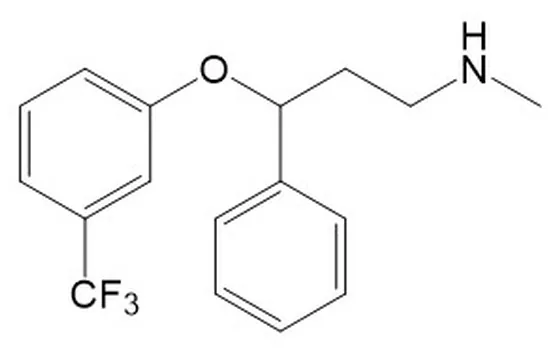
Two observations follow. First, impurity B is a secondary amine in its own right. Nitrosation does not care that a molecule is an impurity rather than the API, so N-nitroso-N-methyl-3-phenylpropan-1-amine is a chemically plausible species in any sample where impurity B and nitrite coexist. Whether it deserves a limit is a risk question, and the defensible answer is usually a documented ranking: an impurity at a fraction of the API level yields a nitrosamine two orders of magnitude lower again, below any achievable quantification limit. That is a sentence to write, not a gap to leave.
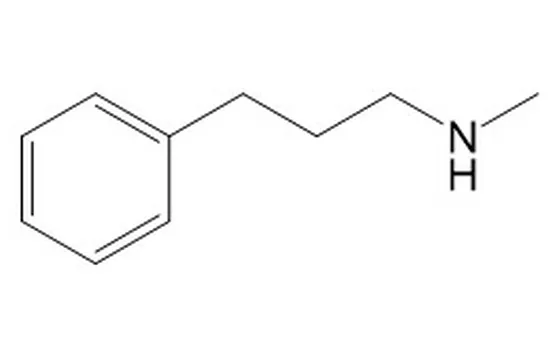
Second, a specification built only around N-nitroso-fluoxetine assumes the API is the only nitrosatable species in the product. The impurity list says otherwise, and the assumption should be stated so that a reviewer can test it. The same logic covers degradation products: any secondary amine formed on storage joins the list.
Which SSRIs belong in the same conversation
Nitrosamine risk in this class follows the substitution pattern of the nitrogen, not the mechanism of action.
Sertraline carries an N-methyl group on a benzylic amine, the same motif as fluoxetine, and is a secondary amine. Duloxetine also carries an N-methyl secondary amine on a benzylic carbon, this time next to a thiophene. Paroxetine has a secondary piperidine nitrogen, which is a different geometry but the same hydrogen on the nitrogen. All three are NDSRI substrates for the same reason, and all three are in this catalogue with European Pharmacopoeia letters.
The tertiary amines behave differently. Citalopram↗ and escitalopram have no hydrogen on the nitrogen, so direct nitrosation is not available; the risk appears only through a dealkylated impurity or degradant, and the assessment therefore starts with the impurity profile rather than the API. Fluvoxamine, with a primary amine on its aminoethoxy chain, is not a classical NDSRI substrate either, because the product of nitrosation on a primary amine is not a stable N-nitrosamine.
Metformin and ranitidine are the counter-examples that keep appearing in the same conversations. In both, the nitrosamine is a small dialkyl species assembled from fragments rather than the drug minus one hydrogen plus NO. That is a different formation chemistry, a different set of control points, and often a different analytical method. Grouping them with fluoxetine because both are called nitrosamine cases will produce a control strategy that fits neither.
What to buy and what to test
The working set for a fluoxetine nitrosamine programme is four solids: the drug substance for system suitability, N-nitroso-fluoxetine as the quantified analyte, impurity B because it is the second nitrosatable amine in the profile, and impurity C because it is the one same-formula species a mass spectrometer cannot place. The S enantiomer belongs in the set if the route includes a resolution rather than a racemate synthesis.
On testing, three decisions carry most of the value. Put the nitrosamine in the stability protocol at every long-term timepoint rather than at release only, because the published data show formation continuing in the pack. Audit nitrite in the excipients actually used, lot by lot, rather than accepting a compendial name as evidence. And state in the dossier which nitrosatable amines were considered and which were dismissed, with the arithmetic, so that the assessment ends with a numbered list rather than an assurance.
The catalogue covers the set, including the nitroso compound at CAS 150494-06-7, impurity B in free base and hydrochloride forms, impurity C in both forms, the S enantiomer, and three rows at the norfluoxetine formula for metabolite work: Fluoxetine hydrochloride reference standards and related entries.
Frequently Asked Questions
Is N-nitroso-fluoxetine a nitrosamine impurity or an NDSRI?
What limit applies to it?
Can the risk be removed by changing the salt?
Does the capsule or an oral solution carry the higher risk?
Does a negative micronucleus assay support a higher acceptable intake?
Do I need a dedicated method if the level is well below the limit?
Which excipients need a nitrite specification?
Does the S enantiomer change the nitrosamine question?
Related Substances and Reference Standards
- Fluoxetine Hydrochloride (46 impurity / derivative entries)
- Sertraline Hydrochloride (66 impurity / derivative entries)
- Paroxetine Hydrochloride (82 impurity / derivative entries)
- Duloxetine Hydrochloride (75 impurity / derivative entries)
References and Sources
- National Library of Medicine, PubChem, Compound records for fluoxetine hydrochloride, fluoxetine base and N-nitroso-fluoxetine, CAS 56296-78-7, 54910-89-3 and 150494-06-7, with systematic names and molecular formulae, accessed 2026-11-09
- Journal of Pharmaceutical and Biomedical Analysis, 2026, An analytical quality by design guided method development for the quantification of N-nitroso-fluoxetine, including the temporary Belgian withdrawal, the 100 ng per day acceptable intake, and release and 21-month stability results for the reformulated product, accessed 2026-11-09
- International Council for Harmonisation, ICH M7(R2) Assessment and Control of DNA Reactive Impurities in Pharmaceuticals: hazard assessment, the threshold of toxicological concern and control strategies, accessed 2026-11-09
- International Council for Harmonisation, ICH Q3A(R2) Impurities in New Drug Substances: reporting, identification and qualification thresholds, accessed 2026-11-09
- United States Food and Drug AdministrationRecommended acceptable intake limits for nitrosamine drug substance related impurities: carcinogenic potency categorization approach with potency categories and their ng per day limits
- Mutagenesis, 2026, Mutagenicity of N-nitroso-fluoxetine and N-nitroso-varenicline in human HepaRG cell models: comet, micronucleus and high-fidelity sequencing endpoints in two-dimensional and spheroid culture, accessed 2026-11-09
- International Council for Harmonisation, ICH Q2(R2) Validation of Analytical Procedures, including the total error approach used for the nitrosamine assay, accessed 2026-11-09
This article was prepared by the CATO technical team. Regulatory, pharmacopoeial and published literature content cited above is attributed in the reference list. It is provided for technical exchange and search reference only and does not constitute a quality specification or regulatory advice. For any specific substance, the applicable test methods, limits and filing requirements are governed by the current regulations, pharmacopoeial monographs and official publications.
Product information on this site is provided for research search and selection reference only and is not a quality specification; technical data, purity and structural confirmation are governed by the shipped COA and our written confirmation. All products mentioned are for research use only, not for human or animal diagnostic or therapeutic use.