Furosemide: The Starting Material Is Also the Degradant, So Release Testing Proves Nothing
Furosemide↗ is a chlorosulfamoyl anthranilic acid carrying a furanylmethyl group on the aromatic amine. That single benzylic C-N bond is where acid hydrolysis, photolysis and oxidative stress all converge, and the product they leave is the last intermediate of the synthesis. A batch that passes release therefore carries no information about what will happen to it in a blister pack on a window sill.
Note: product names shown in red (marked with ↗) are links - click through to the product page for structure, CAS number, purity and lead time.
A sulfonamide diuretic built on an anthranilic acid
Key points
- Furosemide is C12H11ClN2O5S, 330.74, CAS 54-31-9, dosed at 20 to 80 mg in routine use and at several hundred milligrams in resistant oedema.
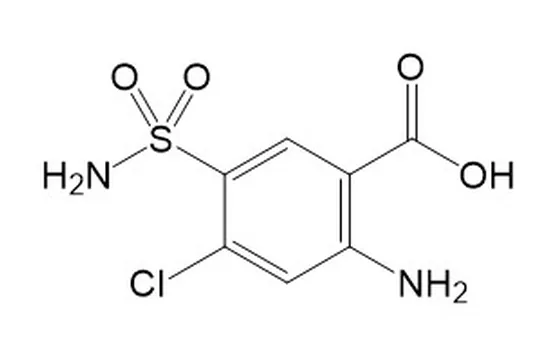
- Acid hydrolysis and photolysis both cleave the furanylmethyl group, giving 4-chloro-5-sulfamoylanthranilic acid, C7H7ClN2O4S, 250.66, CAS 3086-91-7[1].
- That same anthranilic acid is EP impurity C and the last intermediate of the synthesis, so it is a process impurity and a degradant with one identity.
- At 80 mg a day, the Q3B identification and qualification thresholds are governed by the percentage limbs, not the 1.0 mg absolute limb[2].
The molecule is a benzoic acid with three substituents that each do something different. At C1 sits the carboxylate that gives the drug its pH-dependent solubility. At C4 sits a chlorine. At C5 sits a primary sulfonamide, the group that produces the diuresis. At C2 sits a secondary aromatic amine bearing a furan-2-ylmethyl group, and that substituent is the only part of the molecule that is not doing pharmacological work.
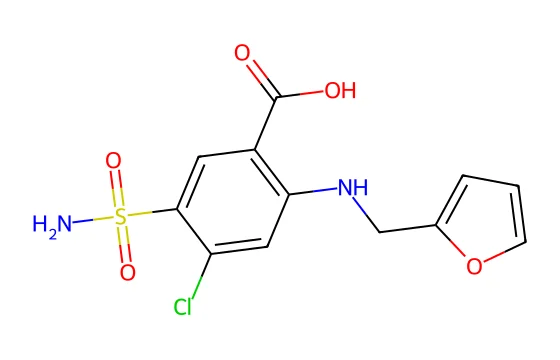
The catalogue holds 43 furosemide entries and the substance is monographed in the European Pharmacopoeia, so the impurity letters are fixed. What is not fixed, and what this article is about, is the relationship between those letters and the chemistry.
One bond, three ways to break it
The C-N bond between the aromatic ring and the furanylmethyl carbon is benzylic on one side and arylamine on the other. That combination is unusually fragile for a bond that is not part of a leaving-group strategy: it is activated toward both acid-catalysed hydrolysis and radical or excited-state cleavage, and the fragment it releases is a stable furan species.
Hydrolysis is the straightforward case. In aqueous acid, furosemide loses the furanylmethyl group and gives 4-chloro-5-sulfamoylanthranilic acid, routinely abbreviated CSA. The mass balance is clean: furosemide plus water gives CSA plus furfuryl alcohol, and no other small molecule is needed. Published stability work on extemporaneous oral suspensions states the pathway directly, and notes that the drug is stable in alkaline media and unstable in acid[1].
Photolysis is more interesting, because the same bond breaks and several others do too. In a xenon-lamp experiment on river water, furosemide gave five transformation products, and the mass-to-charge values map onto a clear set of reactions: cleavage of the furanylmethyl group to CSA at m/z 248.975 as the deprotonated ion, replacement of the aromatic chlorine by hydroxyl at m/z 311.033, dehalogenation at m/z 295.041, and a combined loss of the furanylmethyl group with chlorine-to-hydroxyl substitution at m/z 231.009[3].
Two conclusions follow. First, the C-N bond is the primary photolabile site, which is why the same degradant appears whether the stress is acid or light. Second, the C-Cl bond is the secondary site, and the dehalogenated and hydroxylated products are isobaric with nothing else in the panel, so they are easy to detect once you look for them and easy to miss if the method stops the gradient early.
The impurity panel is the synthesis, in order
Furosemide is assembled from 2,4-dichlorobenzoic acid by chlorosulfonation, amination and then alkylation of the resulting anthranilic acid with a furfuryl equivalent. Read the European Pharmacopoeia impurities in that order and the panel stops looking arbitrary.
| Entry | Structure | Formula, mass | Role |
|---|---|---|---|
| EP impurity E, CAS 50-84-0 | 2,4-dichlorobenzoic acid | C7H4Cl2O2, 191.01 | starting acid |
| EP impurity B, CAS 2736-23-4 | 5-sulfamoyl-2,4-dichlorobenzoic acid | C7H5Cl2NO4S, 270.09 | after chlorosulfonation |
| EP impurity C, CAS 3086-91-7 | 4-chloro-5-sulfamoylanthranilic acid | C7H7ClN2O4S, 250.66 | after amination, and the main degradant |
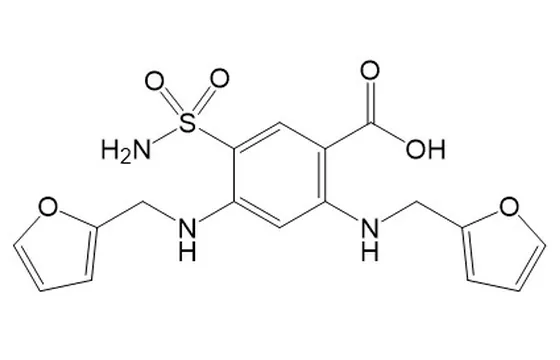
| EP impurity D, CAS 5046-19-5 | 2,4-bis(furan-2-ylmethylamino)-5-sulfamoylbenzoic acid | C17H17N3O6S, 391.40 | double alkylation |
| EP impurity A, CAS 4818-59-1 | isofurosemide | C12H11ClN2O5S, 330.74 | ring regioisomer, same mass as the drug |
Table note: formulas and masses from PubChem records for each CAS number; the sequence is the one implied by the substitution pattern of each structure.
Three things in that table deserve attention. EP impurity E is a starting material that any commercial supplier buys by the tonne, so its presence at a low level is a purification question rather than a chemistry question. EP impurity B sits between the acid and the amine and is the species that accumulates when the amination is incomplete or when the chlorosulfonation over-runs. EP impurity D carries a furanylmethylamino group at both C2 and C4, which means two secondary amines and two potential nitrosation sites instead of one.
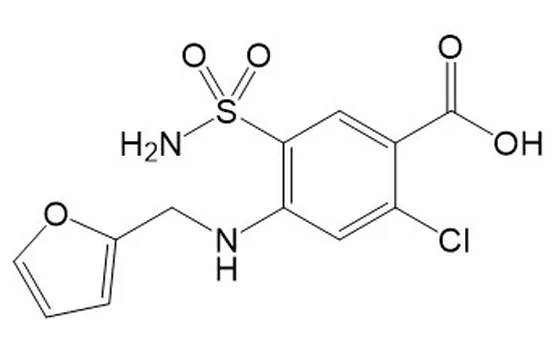
EP impurity A is the awkward one analytically. It has the same formula and the same nominal mass as furosemide, so no mass spectrometric experiment distinguishes them, and the only handle is chromatographic selectivity. A method that resolves the pair has to be developed with both solids in hand; a method developed against the drug alone will happily co-elute them and report a clean result.
Dual identity, and why the release result is silent
Here is the consequence that matters most in a stability package. CSA is EP impurity C, the last intermediate before the furanylmethyl group is installed. It is also what the drug becomes when the C-N bond breaks. One substance, two origins, and the release chromatogram cannot tell them apart.
Consider two batches that both report CSA at 0.10 percent. In the first, the alkylation ran to completion and the crystallization removed the residual anthranilic acid efficiently, so 0.10 percent is what is left. In the second, the alkylation ran to 99.0 percent and the workup left the unreacted intermediate in place. Analytically identical, and the second batch has a head start on degradation because its impurity is dissolved in the same crystal lattice environment as the parent. Nothing in the certificate of analysis separates the two cases.
The discriminating experiment is not a better assay, it is a light and acid stress study. ICH Q1B requires photostability testing of the drug substance and the product, and for a molecule with an absorption band overlapping the emission of a xenon or metal halide source the outcome is predictable: loss of parent, formation of CSA, and a set of secondary photoproducts that appear only when the exposure is long enough[4]. A 1.2 million lux hour exposure will not reproduce a warehouse, but it will rank two formulations or two crystal habits against each other, which is the decision a formulator actually has to make.
| Question | Release testing answers it? | What does |
|---|---|---|
| Is CSA present, and how much | yes | related substances |
| Did the CSA come from the route or from storage | no | none, and it does not matter for the specification |
| How fast will it form on storage | no | photostability and accelerated studies |
| Is the packaging adequate | no | Q1B option 2 testing in the proposed container |
The third and fourth rows are where filings are won or lost. A specification that sets CSA at 0.3 percent and a protocol that never opens the blister is not a control strategy, it is a description of the batch that was tested.
The list above counts accepted filings and applicants, not approvals, and it shows how many suppliers run this sequence.
Light, pH and the formulation
Three formulation variables dominate, and they act on the same bond.
pH is the first. The hydrolysis is acid-catalysed, so any vehicle buffered below about pH 5 shortens the shelf life in proportion to the hydrogen ion activity. That is why extemporaneous suspension work in different commercial vehicles produces such different results: the ones with a higher and more stable pH keep the parent, and the dextrose-based ones drift acid and lose it[1]. The comparison is worth reading even if you never compound a suspension, because it isolates pH from every other variable.
Light is the second, and it is not optional. Amber glass is used for the injection and for oral liquids precisely because the parent absorbs in the near ultraviolet, and the photostability data on the product rather than the substance is what supports the container claim[4]. A clear blister is a formulation decision with a photochemical consequence.
Water activity is the third and the least discussed. Hydrolysis needs water, so a tablet with a high equilibrium moisture content hydrolyses faster than the same tablet dried harder at identical storage humidity. That is a drying question, and it is why CSA sometimes rises in one presentation and not another from the same API lot.
The secondary amine that most reviews leave out
The aromatic amine in furosemide is secondary: it carries the furanylmethyl group and one hydrogen. Secondary amines are the classical nitrosatable motif, and the catalogue reflects it with an N-nitroso furosemide entry, C12H10ClN3O6S, 359.74, CAS 2708280-93-5, which is the parent plus NO minus H.
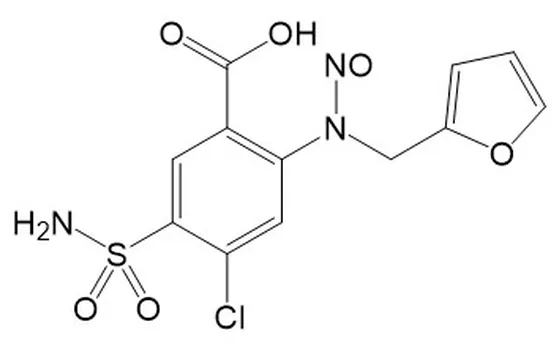
The honest assessment is that the risk is low and the documentation burden is not. Furosemide is made without any nitrosating reagent, there is no dimethylamine or diethylamine in the route, and the amine is sterically crowded by the furanylmethyl group. What remains is nitrite from excipients or from water, and that is a formulation question rather than a route question. ICH M7(R2) expects the risk to be assessed and either controlled or justified, not assumed away[5]; for furosemide the defensible position is a documented negative risk assessment plus a limit test if nitrite-bearing excipients are used.
The reference standard still belongs on the shelf. An N-nitroso entry is the only way to prove that a peak at the expected retention time is not the nitrosamine, and the argument is much cheaper to make with a spiked injection than with a mass spectrometric identification during an investigation.
Method design for a molecule that degrades while you run it
Furosemide is not a difficult molecule to chromatograph, and that is the trap. The parent is well retained on a C18 column at low pH, the sulfonamide gives good peak shape, and a simple isocratic method looks adequate until the degradant is considered.
CSA is smaller and more polar, and it carries a free amino group and a carboxylic acid. On a low-pH reversed-phase system it elutes near the injection front, where the solvent disturbance is largest and integration least reliable. The method needs a shallow gradient or a high-aqueous start, and the degradant should be injected as a standard rather than located by relative retention[6].
The second trap is the autosampler. Aqueous samples of furosemide left in a clear vial on a bench, or in a tray under laboratory lighting for a long sequence, will form CSA between injection one and injection forty. The symptom is a drift in the degradant peak that correlates with run order and looks like column equilibration. Amber vials, a covered tray and a validated bench-top hold time solve it, and the hold time belongs in the method, not in a notebook.
The third trap is the wavelength. CSA and the hydroxylated photoproducts lack the furan chromophore and their spectra differ from the parent, so a single-wavelength method at the parent maximum will under-report them. A photodiode array with a confirmatory second wavelength is cheap insurance, and it is the only way to notice a peak that has no reference standard yet.
Where furosemide cannot be compared
Three comparisons get made and only one of them holds.
Hydrochlorothiazide is the tempting one, because both are sulfonamide diuretics with a chlorine and a sulfonamide on an aromatic ring. The chemistry is different in the place that matters: hydrochlorothiazide is built on a methylene bridge that hydrolyses to formaldehyde, and its signature impurity is a formaldehyde adduct rather than an anthranilic acid. Sharing a functional group is not sharing a degradation pathway.
Bumetanide and Torasemide are closer in use and further in structure. Bumetanide↗ is a phenoxybenzoic acid with a butylamino group and no furan, so its photochemistry follows the phenoxy ether rather than a benzylic amine. Torasemide is a pyridine sulfonylurea, and its labile bond is the urea, which hydrolyses to a sulfonamide and an amine. Neither produces CSA, and neither can be used to justify a furosemide specification.
The one comparison that does hold is with Indapamide, not because the structures are similar but because the analytical lesson is the same: a small, polar, early-eluting degradant that is also a process intermediate will be under-reported by any method that was optimized on the parent alone.
Reference standards for this file
The set that earns its shelf space is small: the drug substance for system suitability, CSA as EP impurity C because it is both the degradant and the intermediate, isofurosemide as EP impurity A because it is isobaric with the drug, and EP impurity D because the disubstituted species shows whether the amination and alkylation are being pushed too hard.
The catalogue carries the full furosemide series including EP A to F, the bis-alkylated species and the N-nitroso entry, so a forced-degradation package can be built on characterized solids rather than on relative retention times: Furosemide reference standards and related entries.
Frequently Asked Questions
Is 4-chloro-5-sulfamoylanthranilic acid a process impurity or a degradant?
Why does furosemide degrade in acid but not in alkali?
How many photoproducts should a forced degradation study look for?
Does the aromatic chlorine matter analytically?
Is an N-nitroso impurity a real concern for furosemide?
Why is isofurosemide harder to control than the other impurities?
Should the degradant be quantified against its own standard?
What is the single most useful stability experiment for this molecule?
Related Substances and Reference Standards
- Furosemide (43 impurity / derivative entries)
- Bumetanide (53 impurity / derivative entries)
- Torasemide (36 impurity / derivative entries)
- Hydrochlorothiazide (58 impurity / derivative entries)
References and Sources
- Pharmaceuticals, 18 (2025) 937, Stability assessment of furosemide oral suspension in hospital extemporaneous preparations: acid-catalysed hydrolysis to 4-chloro-5-sulfamoylanthranilic acid and stability in alkaline media, accessed 2026-11-06
- ICH, ICH Q3B(R2) Impurities in New Drug Products: reporting, identification and qualification thresholds expressed as a percentage and as an absolute daily amount, whichever is lower, accessed 2026-11-06
- Analytical and Bioanalytical Chemistry, 406 (2014) 3667, Elucidation of transformation pathway of ketoprofen, ibuprofen and furosemide in surface water using UHPLC-QTOF-MS: five furosemide transformation products including furanylmethyl cleavage, chlorine-to-hydroxyl substitution and dehalogenation, accessed 2026-11-06
- ICH, ICH Q1B Photostability Testing of New Drug Substances and Products, including the option 1 and option 2 testing designs and the 1.2 million lux hour exposure, accessed 2026-11-06
- ICH, ICH M7(R2) Assessment and Control of DNA Reactive (Mutagenic) Impurities in Pharmaceuticals, including the requirement for a nitrosamine risk assessment, accessed 2026-11-06
- Molecules, 30 (2025) 4031, Simultaneous development and validation of an HPLC method for the determination of furosemide and its degraded compound in pediatric extemporaneous furosemide oral solution, accessed 2026-11-06
This article was prepared by the CATO technical team. Regulatory, pharmacopoeial and published literature content cited above is attributed in the reference list. It is provided for technical exchange and search reference only and does not constitute a quality specification or regulatory advice. For any specific substance, the applicable test methods, limits and filing requirements are governed by the current regulations, pharmacopoeial monographs and official publications.
Product information on this site is provided for research search and selection reference only and is not a quality specification; technical data, purity and structural confirmation are governed by the shipped COA and our written confirmation. All products mentioned are for research use only, not for human or animal diagnostic or therapeutic use.