Gefitinib Has Three Genotoxic Liabilities and Only One Is a Nitrosamine
A genotoxic impurity assessment is usually written as if a molecule had one liability. Gefitinib↗ has three, sitting in three different positions in the route, which means the assessment has to be split by position before any limit can be justified.
Note: product names shown in red (marked with ↗) are links - click through to the product page for structure, CAS number, purity and lead time.
One molecule, three different kinds of genotoxicity
Key points
- Gefitinib is C22H24ClFN4O3, 446.9, built from a quinazoline core, a 3-chloro-4-fluoroaniline and a 3-morpholinopropoxy side chain[1].
- The aniline is the starting material, so its control is a purge question: the later steps either remove it or they do not, and that has to be shown with spiked lots rather than assumed.
- The side chain carries a terminal chloride before the morpholine is installed, which makes the chloropropoxy relative an alkylating impurity rather than an aromatic amine problem[2].
- The nitrogen that links the quinazoline to the aryl ring is a secondary amine, so nitrosation is possible in principle; the catalog carries an N-nitroso entry at C22H23ClFN5O4.
Most genotoxic impurity assessments are written as if a molecule had one liability. Gefitinib has three, and they sit in three different places in the route, which means they cannot be handled with a single control strategy or a single analytical method. That is what makes this molecule a useful case: the assessment has to be split by position before any limit can be justified.
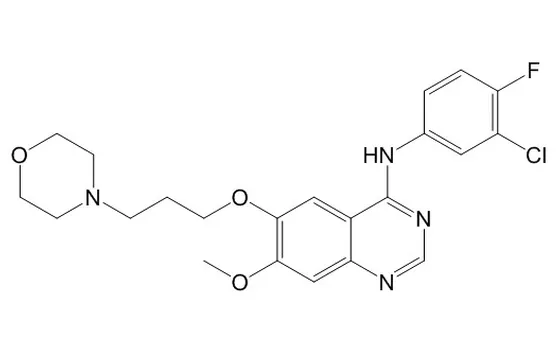
The catalog reflects that split. The gefitinib variety page lists 60 entries, and they are not a flat list of numbered impurities: some are route intermediates, some are side-chain relatives, and at least one is a nitrosamine. Reading the page as a single impurity profile is the mistake to avoid.
The aniline is a purge question, not a limit question
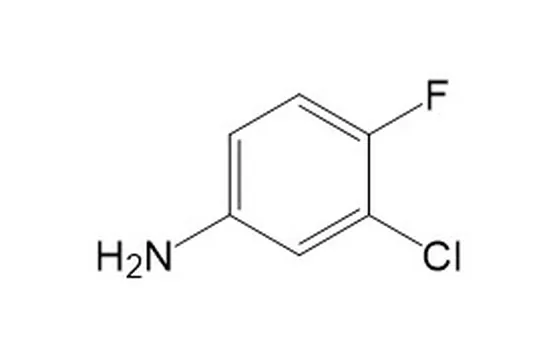
3-chloro-4-fluoroaniline, C6H5ClFN, 145.56, is the nucleophile that installs the aryl ring at C4 of the quinazoline[2]. It is an aromatic amine with a structural alert, so ICH M7 applies, and the default approach is to demonstrate that the material is purged downstream rather than to measure it in the final API at a limit derived from the TTC.
Purge is a property of the process, not of the molecule. The relevant evidence is a spiking study: add the aniline to a batch at a known level before the last crystallisation, carry it through, and measure how much survives. If the answer is two orders of magnitude below the TTC-derived limit, the argument is closed with one experiment. If the answer is that it survives at a level near the limit, the argument has to move to routine testing, and the analytical method becomes part of the control strategy.
The distinction matters for cost and for timelines. A purge argument needs one campaign and one validated method for the intermediate; a routine limit needs a method in the release specification for the life of the product. For an aniline that is fed early in a multi-step route, the purge argument is almost always the correct one, and the mistake is to skip the study because the chemistry looks clean.
The chloropropoxy chain is an alkylating agent in waiting
Before the morpholine is attached, the side chain ends in a propyl chloride. The catalog lists the intermediate as 6-(3-chloropropoxy) gefitinib, C18H16Cl2FN3O2, which is the molecule with the quinazoline core and the chloride still present and the morpholine missing[4]. A primary alkyl chloride is a soft electrophile, and the structural alert is real even though the molecule is an intermediate rather than a reagent.
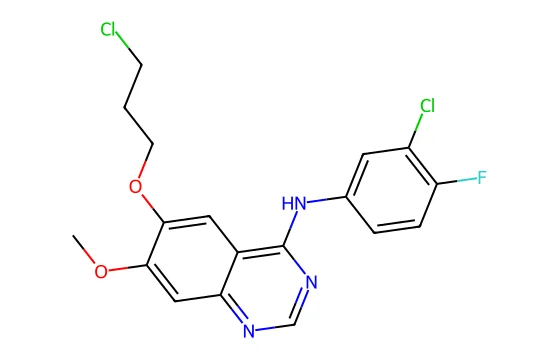
Two things make this liability easier to handle than the aniline. First, it is late in the route: the morpholine displacement happens after the chloride is installed, so the intermediate is consumed by design and the purge is mechanistic rather than accidental. Second, it is a large, hydrophobic molecule that crystallises well, so it partitions into the mother liquor rather than following the API.
The trap is the reverse of the aniline trap. A late-stage alkylating intermediate is easy to purge and easy to forget, because everyone assumes the displacement is quantitative. Displacement reactions on primary chlorides are clean, but they are not always complete, and an under-charged morpholine step leaves the chloride behind in a position where it is one bond away from the API. That is why the chloropropoxy relative usually appears in the specification as a specified impurity with a limit, even when the purge argument is strong.
The bridging nitrogen can be nitrosated
The nitrogen at C4 of the quinazoline is a secondary amine: it carries the aryl ring on one side and the heterocycle on the other. Secondary amines are the classical nitrosamine precursor, and the catalog carries an N-nitroso gefitinib entry at C22H23ClFN5O4, one NO short of a full substitution on that nitrogen.
Whether nitrosation is a real risk in manufacturing depends on sources of nitrosating species: nitrite in water, in excipients, in the environment of a drying oven, or carried in from a previous step. For an API made in a dedicated train with nitrite-free water and no nitrosating reagents in the route, the risk is small but not zero, and the usual outcome is a risk assessment that documents the absence of nitrosating agents plus a control on the raw materials that could carry nitrite.
The analytical side has its own trap. Nitrosamines are volatile, they ionise poorly, and they fragment in a way that makes them easy to confuse with the parent amine in a generic screening method. A method that is not built for the nitrosamine will report zero and be believed. If a nitrosamine assessment says the risk is low, the assessment should name the method that was used to confirm it, and that method should be specific enough to detect the compound at the relevant level.
The three liabilities side by side
Putting them in one table is the fastest way to see why one strategy cannot cover all three: the position in the route decides whether the answer is purge, limit or avoidance.
| Liability | Where it comes from | ICH M7 reading | Control route |
|---|---|---|---|
| 3-chloro-4-fluoroaniline | starting material, aromatic amine | class 3 with a structural alert | purge by route position; spiked-lot clearance study |
| 6-(3-chloropropoxy) gefitinib | alkyl chloride on the side chain | class 3, alkylating | control as a specified impurity with a limit justified by purge |
| N-nitroso gefitinib | bridging secondary amine, nitrosated | cohort of concern | nitrite-free process and excipients; limit at the nitrosamine level |
Classes follow the ICH M7(R2) scheme; the control route is the practical consequence of where the liability sits in the route[3].
The right-hand column is the part that gets lost in a written assessment. Two liabilities land on the same control route, purge, for different reasons; the third lands on avoidance because a limit alone cannot be defended for a cohort-of-concern impurity at a low TTC.
Where the thresholds land
ICH M7(R2) sets a default acceptable intake of 1.5 micrograms per day for a compound with a structural alert and no compound-specific data, and the limit in the API is that intake divided by the maximum daily dose[3]. Gefitinib is dosed at 250 mg per day, so 1.5 micrograms per day corresponds to 6 parts per million in the drug substance. That is a low number, and it is the reason the aniline argument rests on purge rather than on testing.
ICH Q3A sits in a different framework and does not apply to genotoxic impurities at all: its 0.05 per cent reporting, 0.10 per cent identification and 0.15 per cent qualification thresholds are for ordinary impurities[5]. Mixing the two frameworks is a common error in assessment documents. A 0.10 per cent peak in a chromatogram is 1000 parts per million, which is three orders of magnitude above the M7 limit for the same compound, and quoting the Q3A number for a genotoxic impurity is a finding waiting to happen.
What the catalog shows, and how to read it
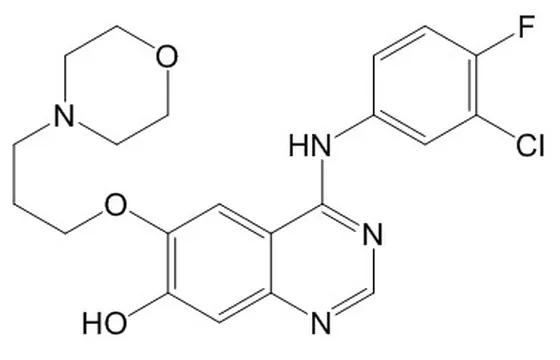
The gefitinib entries fall into the three groups the table describes, plus a fourth that is easy to miss: the numbered impurity series. A catalog that numbers impurities from 1 upwards does not tell you which of them carry a structural alert, and the numbering does not follow the route. The only reliable way to use such a page is to look at the structure of each entry and classify it, which is what a genotoxic assessment is for.
For practical work, three entries anchor the classification: the API itself at gefitinib, the aniline at 3-chloro-4-fluoroaniline when a purge study needs a spiked standard, and the chloropropoxy intermediate at 6-(3-chloropropoxy) gefitinib. The rest can be sorted by structure once those three are placed.
The same quinazoline-aniline linkage appears across the kinase inhibitor class, and the classification does not transfer automatically. Osimertinib mesylate shares the aniline-derived aryl amine but has a different side chain and a different nitrosation geometry, so its assessment is not a template for gefitinib. What transfers is the method: split the molecule by position, then decide purge, limit or avoidance for each position separately.
Frequently Asked Questions
Is the aniline controlled in the gefitinib specification?
Does a 0.10 per cent unspecified impurity limit cover the aniline?
Why is the chloropropoxy intermediate a specified impurity rather than an unspecified one?
Is N-nitroso gefitinib a cohort-of-concern impurity?
Can one chromatographic method cover all three liabilities?
Does the 250 mg dose change the limits compared with a 500 mg regimen?
What does a purge factor actually mean in a filing?
Is the quinazoline core itself a mutagenic alert?
Related Substances and Reference Standards
- Gefitinib (- impurity / derivative entries)
- Osimertinib Mesylate (- impurity / derivative entries)
- Gefitinib (CAS 184475-35-2)
References and Sources
- PubChem, National Center for Biotechnology Information, Gefitinib, C22H24ClFN4O3, 446.9, used here for the formula, the mass and the substitution pattern of the quinazoline core, accessed 2026-11-19
- PubChem, National Center for Biotechnology Information, 3-chloro-4-fluoroaniline, C6H5ClFN, 145.56, the aromatic amine used to install the aryl ring at C4, accessed 2026-11-19
- International Council for Harmonisation, ICH M7(R2), Assessment and control of DNA reactive (mutagenic) impurities: default acceptable intake of 1.5 micrograms per day and the class scheme, accessed 2026-11-19
- PubChem, National Center for Biotechnology Information, 4-(3-chloropropyl)morpholine, C7H14ClNO, 163.64, the reagent that installs the morpholinopropoxy chain and carries the same terminal chloride as the side-chain intermediate, accessed 2026-11-19
- International Council for Harmonisation, ICH Q3A(R2), Impurities in new drug substances: reporting 0.05 per cent, identification 0.10 per cent, qualification 0.15 per cent for ordinary impurities, accessed 2026-11-19
This article was prepared by the CATO technical team. Regulatory, pharmacopoeial and published literature content cited above is attributed in the reference list. It is provided for technical exchange and search reference only and does not constitute a quality specification or regulatory advice. For any specific substance, the applicable test methods, limits and filing requirements are governed by the current regulations, pharmacopoeial monographs and official publications.
Product information on this site is provided for research search and selection reference only and is not a quality specification; technical data, purity and structural confirmation are governed by the shipped COA and our written confirmation. All products mentioned are for research use only, not for human or animal diagnostic or therapeutic use.