Glimepiride Has No Chiral Centre, and That Is Exactly Why Its Isomer Problem Is Hard
Every chirality chapter in impurity control starts with a stereocentre and a chiral column. Glimepiride↗ does not have one. It has a 1,4-disubstituted cyclohexane, which means cis and trans, not R and S, and four catalogue entries that a mass spectrometer cannot separate from the drug.
Note: product names shown in red (marked with ↗) are links - click through to the product page for structure, CAS number, purity and lead time.
Key points
Key points
- Glimepiride is C24H34N4O5S at 490.62, and the official name fixes the cyclohexane as trans, which is a geometric descriptor rather than a stereochemical one[1].
- The molecule has no stereocentre. There is no enantiomer to separate, so a chiral column answers a question this substance never asks[2].
- Four catalogue entries, the API included, share the molecular formula, and the differences between them are cis/trans geometry, ring substitution position and the hydrogenation state of the pyrrolinone[2].
- The sulfonylurea bridge hydrolyses to a sulfonamide and 4-methylcyclohexylamine, and the amine has no chromophore, so an ultraviolet method reports zero while the sample degrades[3,4].
What the name already tells you
Glimepiride is a sulfonylurea with a pyrrolinone carboxamide on one side and a cyclohexane on the other, formula C24H34N4O5S, molecular weight 490.62. The label writes the chemical name out in full and includes the phrase trans-4-methylcyclohexyl[1]. That single word is the subject of this article. Trans and cis are not interchangeable decorations; they are different compounds with different melting points, different solubilities and, in a few documented cases, different potency per milligram of powder weighed onto the balance.
The physical profile is unhelpful in a specific way: a white to yellowish crystalline powder, practically insoluble in water[1]. Maximum recommended dose is 8 mg once daily, titrated from 1 or 2 mg[1]. Eight milligrams is a small dose, and small doses have a quiet consequence for impurity limits: the absolute caps in the ICH tables sit far above the percentage caps, so the percentages govern everything. A 0.10 percent impurity at 8 mg is 8 micrograms. Nobody qualifies an impurity at 8 micrograms; they qualify it by argument.
Our index flags an EP monograph for this substance, which changes the shape of the work. Where a monograph exists, the named impurities and their limits are given, and the applicant's freedom sits in the unspecified region. That region is where a lifecycle change hides, and it is where the four isobaric entries below become relevant.
No stereocentre, no enantiomer
Count the carbons that could carry four different substituents. The pyrrolinone ring has a carbon-carbon double bond, so two of its carbons are planar and the remaining ring carbon carries two hydrogens. The ethyl and methyl groups are terminal. The ethylene linker carries two hydrogens on each carbon. The benzene ring is planar. The cyclohexane is 1,4-disubstituted, and the two ring paths from C1 to C4 are identical, which is precisely why C1 and C4 are not stereocentres. The urea nitrogens are not stereogenic.
There is no stereocentre anywhere in glimepiride. The consequence is not a technicality. It means the molecule has no enantiomer, no optical rotation worth measuring, and no racemate to control. A chiral method developed for this substance is measuring nothing, and a specification that includes an enantiomeric purity limit is copying a template rather than describing a risk.
What glimepiride does have is cis/trans isomerism on the cyclohexane: the methyl group and the urea nitrogen can sit on the same face or on opposite faces. The drug is the trans isomer, as the official name states[1]. The cis isomer is a real, separable compound of identical mass, and it is the stereochemical impurity that matters here. The published identification work on this pair uses tandem mass spectrometry rather than a chiral separation, which tells you what the authors thought the problem was[5].
Four rows at 490.62
Our catalogue holds 44 numbered entries for glimepiride beside the API. Four of them, the API included, carry C24H34N4O5S[2]. That is a small enough set to examine one at a time, and doing so is more instructive than any general discussion of isomerism.
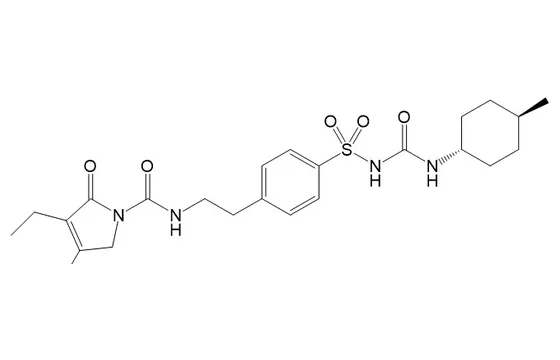
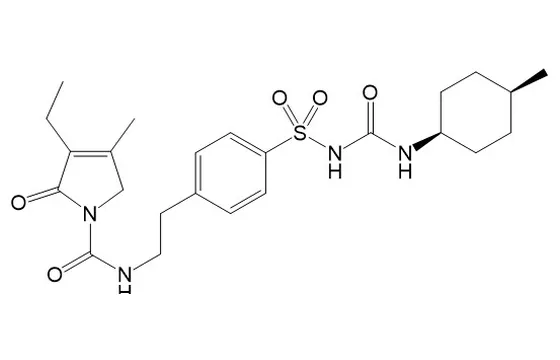
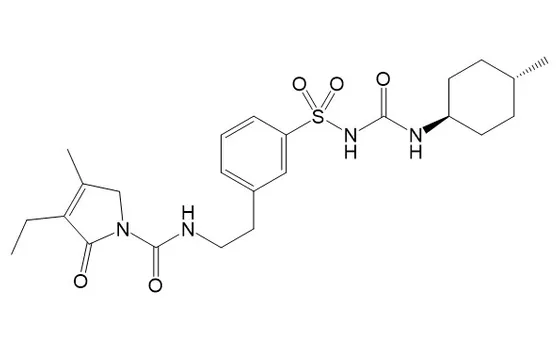
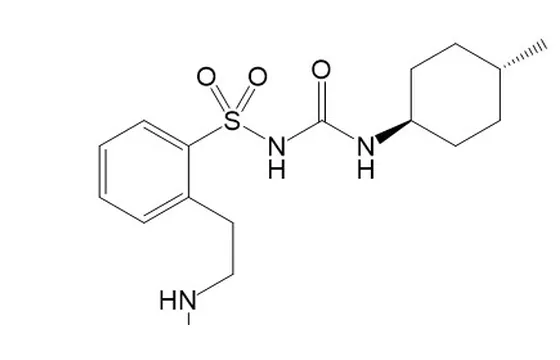
| Entry | CAS | Formula and mass | What differs |
|---|---|---|---|
| Glimepiride | 93479-97-1 | C24H34N4O5S, 490.62 | Reference: trans cyclohexane, para-substituted ring |
| EP impurity A | 684286-46-2 | C24H34N4O5S, 490.62 | Same formula; indexed under the same trans-cyclohexyl name |
| EP impurity D | 791104-62-6 | C24H34N4O5S, 490.62 | Pyrrolinone written as 2,3-dihydro; ring attachment at position 3 |
| EP impurity I | 878480-70-7 | C24H34N4O5S, 490.62 | Pyrrolinone written as 2,3-dihydro; ring attachment at position 2 |
Table note: the third column is measured against the API; the fourth is read from the systematic names indexed for each CAS number, not from a chromatogram[2].
Read the fourth column carefully. Despite the shared formula, the four entries are not four copies of one defect. They differ in three unrelated ways: whether the cyclohexane methyl sits cis or trans, where the aminoethyl arm attaches to the benzenesulfonamide ring, and whether the pyrrolinone double bond sits at the position the name calls 2,5-dihydro or the one it calls 2,3-dihydro. Three defect classes, one nominal mass.
The amine that no ultraviolet method will see
The sulfonylurea bridge is the weakest bond in the molecule, and its hydrolysis is simple to write: the urea splits into a benzenesulfonamide, an amine and carbon dioxide. The sulfonamide half is well represented in the catalogue. EP impurity B, CAS 119018-29-0, is the 4-substituted benzenesulfonamide at C16H21N3O4S and 351.42[3]. EP impurity C is the same sulfonamide carrying an extra C2H2O. Each of those two has a second entry at the same formula elsewhere in the numbering, which is the catalogue telling you that the sulfonamide fragment itself comes in more than one form.
The other half of the hydrolysis is the part that gets missed. Cleaving the bridge releases 4-methylcyclohexylamine, C7H15N at 113.20. It has no chromophore at all: no aromatic ring, no carbonyl, no nitrogen lone pair conjugated to anything. On a conventional reversed-phase method with ultraviolet detection it is invisible at any wavelength, and it is volatile enough that a drying step removes it before the vial is capped[4].
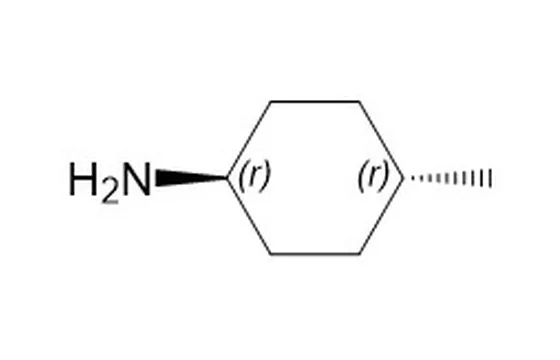
The catalogue carries that amine twice, under CAS 2523-55-9 and 6321-23-9, both named 4-methylcyclohexylamine, both C7H15N[4]. Two CAS numbers for one name is the same geometric ambiguity as the drug itself, one level down the synthesis. If the starting amine is bought as a mixture, the cis form enters the route and can be carried through to the API. The name on the purchase order does not distinguish them, and neither does the molecular formula.
What a method has to resolve, and what it has to confirm
Three requirements for gliclazide-style aromatic sulfonamides do not map onto this molecule, and the method has to be built for the three that do, in order of difficulty. First, the API must be separated from its cis isomer and from the two ring-substitution isomers, all at 490.62. Second, the sulfonamide fragments must be quantitated, which is straightforward because they carry the benzenesulfonamide chromophore and behave like small aromatic acids. Third, the amine must be measured by something other than ultraviolet absorbance, or the degradation pathway is monitored on one side only.
The published answer to the first requirement is tandem mass spectrometry rather than chromatography: the cis isomer and glimepiride give distinguishable product ions under collision, which allows identification without baseline resolution[5]. That is a pragmatic solution and it carries a limitation worth stating. Identification is not quantitation. A method that can tell you which isomer a peak is, but cannot resolve it from the API, cannot report a percentage for it, and the specification needs a percentage.
For the amine, the honest options are gas chromatography with a nitrogen-specific detector, ion chromatography after trapping, or derivatization to something ultraviolet-active. Each has a cost. The derivatization route introduces a reagent that must itself be shown not to form the analyte, which is the same trap that catches formaldehyde methods. Whichever route is chosen, the validation package has to demonstrate recovery of a compound that is volatile, basic and water-miscible, which is a different validation problem from the one in the rest of the method.
Limits at 8 mg a day
At the maximum dose the percentage caps govern, because the absolute caps are far away. Reporting at 0.05 percent is 4 micrograms a day, identification at 0.10 percent is 8 micrograms, and qualification at 0.15 percent is 12 micrograms[6]. For the tablet, Q3B applies its own bands to degradation products: at a daily intake between 1 and 10 mg, identification is 0.5 percent or 20 micrograms and qualification is 1.0 percent or 50 micrograms, and at 8 mg the 20 microgram cap governs because it is the tighter of the two[7]. The substance and product thresholds therefore differ by an order of magnitude, which is normal and frequently forgotten.
| Threshold | Percentage | Mass per day at 8 mg | Practical reading |
|---|---|---|---|
| Reporting | 0.05 percent | 4 micrograms | Below the quantification floor of most UV methods |
| Identification | 0.10 percent | 8 micrograms | Structure elucidation on a peak this size needs MS |
| Qualification | 0.15 percent | 12 micrograms | Argument, not an animal study, at this exposure |
Table note: percentages from Q3A for the substance, converted at the maximum recommended daily dose of 8 mg[6,1].
Registration volume for a mature sulfonylurea is a useful sanity check on how much impurity strategy has already been published. CDE acceptance data for this substance, counted on 25 November 2026:
Acceptance records and applicants again, not approvals.
The mutagenic framework is separate and, for this molecule, easy. Glimepiride contains no aromatic amine, no nitrosatable secondary amine on the drug itself and no alkylating electrophile. The 4-methylcyclohexylamine is an aliphatic primary amine and carries no M7 alert as an impurity at that size. Where M7 does come in is upstream: any aromatic amine or alkyl halide in the route needs its own assessment at 1.5 micrograms a day, which at 8 mg is 187.5 ppm, a limit loose enough that most routes pass without argument[8].
What transfers from the rest of the sulfonylureas
Glipizide and gliclazide are the nearest neighbours and the comparison is instructive in both directions. Both have the sulfonylurea bridge, so the hydrolysis logic transfers unchanged: sulfonamide plus amine plus carbon dioxide. Neither has a cyclohexane, so neither has the cis/trans problem, and a method written for gliclazide will not have a slot for it.
Repaglinide is the mirror case. It has a genuine stereocentre on the carbon bearing the 3-methylbutyl chain, so it has an enantiomer, and enantiomeric purity there is a real specification item. Copying repaglinide's chiral method onto glimepiride would produce a validated separation of nothing at all. The two molecules are both meglitinide-adjacent secretagogues and both are dosed in milligrams, and that is where the similarity ends.
The class lesson is that "sulfonylurea impurity profile" is not a template. The bridge is shared, the chromophore is shared, and almost nothing else is. A reviewer who has seen ten sulfonylurea dossiers will look first at whether the applicant noticed which kind of isomerism their own molecule actually has.
Common pitfalls
- Developing a chiral method. There is no stereocentre and no enantiomer. The separation you validate will be a very expensive way of measuring baseline.
- Assuming the cis isomer is the only isobaric risk. Two of the four rows at 490.62 are ring-substitution isomers with the pyrrolinone drawn differently, not geometric isomers of the drug[2].
- Monitoring hydrolysis on one side only. Ultraviolet detection sees the sulfonamide and is blind to the amine. A stability study that reports no degradation because the chromatogram is clean has measured half a reaction.
- Buying the starting amine without a geometry. Two CAS numbers share the name 4-methylcyclohexylamine. The formula does not distinguish them and neither will your certificate review if you only read the formula[4].
- Quoting substance thresholds for the tablet. Q3B bands for a product dosed below 10 mg are far looser than Q3A bands for the substance, and mixing them invites a deficiency question[6,7].
Standards for a molecule whose impurity is a shape
Our catalogue carries 44 numbered entries beside the API for this substance, spanning the four isobaric C24H34N4O5S rows, the sulfonamide fragments from bridge hydrolysis, the pyrrolinone building blocks and both CAS numbers for the cyclohexylamine. The practical starting set for a method is small: the cis isomer, the two ring-substitution isomers, and the sulfonamide. Begin with Glimepiride if the scope is the full map rather than a particular method.
A last note on certificates. When two entries share a formula, the systematic name is the only thing on the certificate that carries the difference. Read it, and if the name does not state the geometry, treat the standard as unspecified until the supplier says otherwise in writing.
Frequently Asked Questions
Does glimepiride have an enantiomer?
Then why does the literature talk about a glimepiride cis-isomer?
How many catalogue entries share the glimepiride formula?
What does the sulfonylurea bridge actually degrade into?
Why does the catalogue list 4-methylcyclohexylamine twice?
Should the reporting limit really be 0.05 percent at this dose?
Is there a nitrosamine question for glimepiride?
What single experiment would most improve a glimepiride impurity method?
Related Substances and Reference Standards
- Glimepiride (44 impurity / derivative entries)
- Glipizide (47 impurity / derivative entries)
- Repaglinide (33 impurity / derivative entries)
References and Sources
- DailyMed, U.S. National Library of Medicine, Glimepiride tablets, prescribing information: chemical name, molecular weight 490.62, aqueous solubility, maximum recommended dose of 8 mg daily, accessed 2026-11-25
- PubChem, U.S. National Library of Medicine, Glimepiride, CAS 93479-97-1: C24H34N4O5S at 490.62, named as the trans-4-methylcyclohexyl urea with no stereodescriptor, accessed 2026-11-25
- PubChem, U.S. National Library of Medicine, 4-[2-[(3-Ethyl-4-methyl-2-oxo-pyrrolin-1-yl)carboxamido]ethyl]benzenesulfonamide, CAS 119018-29-0, the sulfonamide fragment of the sulfonylurea bridge, accessed 2026-11-25
- PubChem, U.S. National Library of Medicine, 4-Methylcyclohexylamine, C7H15N at 113.20, carried in the catalogue under two CAS numbers 2523-55-9 and 6321-23-9, accessed 2026-11-25
- Talanta, 2018, A rapid assay of identification for glimepiride and its cis-isomer by tandem mass spectrometry, accessed 2026-11-25
- International Council for Harmonisation, ICH Q3A(R2), Impurities in new drug substances: reporting, identification and qualification thresholds, accessed 2026-11-25
- International Council for Harmonisation, ICH Q3B(R2), Impurities in new drug products: degradation product thresholds across daily dose bands, accessed 2026-11-25
- International Council for Harmonisation, ICH M7(R2), Assessment and control of DNA reactive (mutagenic) impurities: hazard classes and the 1.5 microgram per day default, accessed 2026-11-25
This article was prepared by the CATO technical team. Regulatory, pharmacopoeial and published literature content cited above is attributed in the reference list. It is provided for technical exchange and search reference only and does not constitute a quality specification or regulatory advice. For any specific substance, the applicable test methods, limits and filing requirements are governed by the current regulations, pharmacopoeial monographs and official publications.
Product information on this site is provided for research search and selection reference only and is not a quality specification; technical data, purity and structural confirmation are governed by the shipped COA and our written confirmation. All products mentioned are for research use only, not for human or animal diagnostic or therapeutic use.