Hydrochlorothiazide: One Methylene Carbon Explains the Whole Impurity Profile
Hydrochlorothiazide↗ is a three-ring-looking molecule built on a single methylene carbon, and almost every impurity it forms is a different decision about where that carbon goes. It can leave with water as formaldehyde, it can stay and hold two molecules together, or it can be oxidized away and leave an aromatic ring behind. Once the carbon is placed, the rest of the profile stops looking like a list.
Note: product names shown in red (marked with ↗) are links - click through to the product page for structure, CAS number, purity and lead time.
A benzothiadiazine with one carbon doing all the work
Key points
- Hydrochlorothiazide is C7H8ClN3O4S2, 297.74, CAS 58-93-5, dosed at 12.5 to 50 mg a day alone or in combination.
- Hydrolysis opens the ring and releases formaldehyde, leaving 4-amino-6-chloro-1,3-benzenedisulfonamide, C6H8ClN3O4S2, 285.7, CAS 121-30-2.
- Two molecules plus one formaldehyde, minus one water, give a 2:1 methylene-bridged adduct of 607.5 that has been isolated from drug substance and found above the 0.1 percent threshold in 16 of 19 lots[1].
- At 50 mg a day, 0.10 percent is 50 micrograms, so the percentage limbs of Q3B govern and the 1.0 mg absolute limb never binds[2].
The molecule is a benzene ring carrying a chlorine, a sulfonamide, and a fused thiadiazine ring that itself carries a second sulfonamide. The fused ring is the part that matters: it is formed by a methylene bridge between a sulfonamide nitrogen and an aryl nitrogen, and that single CH2 is the only aliphatic carbon in the molecule.
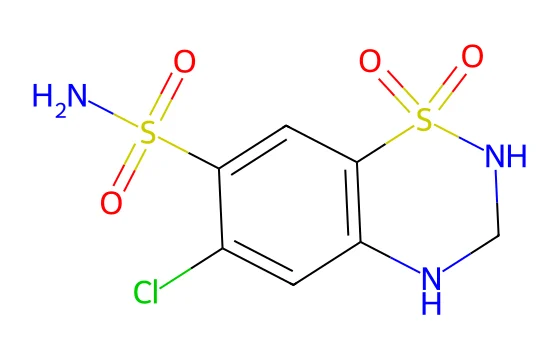
Every impurity discussed below is a statement about that carbon. This is why the profile is small, coherent and predictable, and why a laboratory that understands one member of the set can usually assign the others without a full structure elucidation.
Four destinations for one carbon
The relationships are easiest to see as a table, because the mass differences are arithmetic rather than approximate.
| Species | Formula | Mass | What happened to the carbon |
|---|---|---|---|
| hydrochlorothiazide | C7H8ClN3O4S2 | 297.74 | in the ring, as CH2 |
| chlorothiazide | C7H6ClN3O4S2 | 295.72 | still there, dehydrogenated to CH |
| ring-opened disulfonamide | C6H8ClN3O4S2 | 285.72 | gone, as formaldehyde |
| 2:1 methylene adduct | C15H16Cl2N6O8S4 | 607.5 | shared between two molecules |
Table note: formulas and masses computed from the structures; the adduct identity and its observed levels are reported in [1].
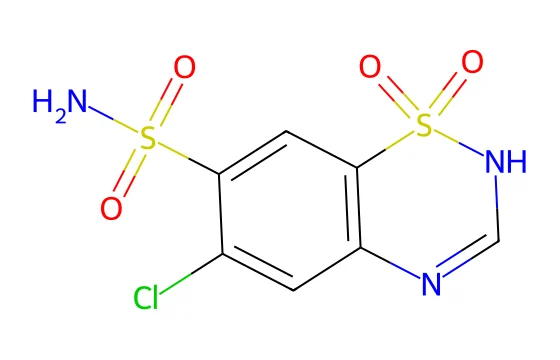
The first two rows are the compendial pair. Chlorothiazide↗, C7H6ClN3O4S2, 295.7, CAS 58-94-6, is the dehydrogenated analogue: the methylene becomes a methine, the thiadiazine ring becomes aromatic, and the molecule loses two hydrogens. It is the European Pharmacopoeia impurity A of hydrochlorothiazide, and it is also a diuretic in its own right, which creates a small commercial ambiguity when a supplier quotes it. The ring-opened disulfonamide, CAS 121-30-2, is impurity B and the product of hydrolysis.
Formaldehyde is a raw material before it is a degradant
The ring is assembled by condensing the disulfonamide with formaldehyde, which means the same aldehyde that later appears as a degradation product is present, in excess, during synthesis. That explains why the 2:1 adduct is found in drug substance rather than only in aged tablets: it is a process impurity formed by a second condensation when formaldehyde is not fully consumed.
The published survey is unusually direct about scale. Nineteen lots of hydrochlorothiazide drug substance from five manufacturers in four countries were analysed on a gradient system; the disulfonamide and chlorothiazide separated cleanly, and a late-eluting unknown appeared in every chromatogram. It was isolated by preparative liquid chromatography and preparative thin-layer chromatography and characterized by electrospray mass spectrometry as a 2:1 hydrochlorothiazide-formaldehyde adduct. Its level ranged from 0.02 to 1.1 area percent, and it exceeded the 0.1 percent threshold for other impurities in 16 of the 19 lots[1].
Sixteen of nineteen is not a process excursion. It is the normal output of a synthesis that uses formaldehyde as a reagent and does not remove the condensation product, and it sets the baseline against which any new manufacturer has to be judged.
The bridge is unsymmetrical, and that matters for the method
The adduct is not a symmetrical dimer. The methylene links the ring nitrogen of one molecule to the sulfonamide nitrogen of the other, which is why the systematic name is long and why the two halves are chemically distinct. The ring nitrogen is a secondary aromatic amine; the sulfonamide nitrogen is a much weaker nucleophile. The first condensation is easy, the second is not, and the product is the one that the stronger nucleophile wins.
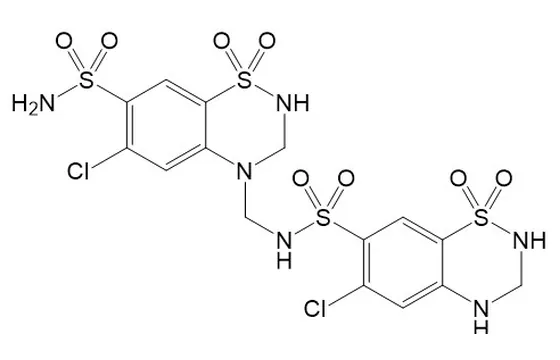
This has two consequences. Analytically, the molecule has two different environments for the same bridge, so it behaves as a single late-eluting peak with a distinctive mass and a fragmentation pattern that shows both halves. Practically, it means the adduct cannot be made cleanly by mixing the drug with formalin in the laboratory: the ratio of the two possible regioisomers depends on the conditions, and a laboratory-made standard may not match the peak in the sample. This catalogue lists two entries with C15H16Cl2N6O8S4, which is consistent with that regiochemistry problem rather than with an error.
Hydrolysis in the tablet, and what happens to the formaldehyde afterwards
In aqueous solution the ring opens, the disulfonamide is released and formaldehyde is produced in equimolar amount. The rate depends on pH and temperature, and the pH dependence is not monotonic: the ring is opened by both acid and base, with a minimum somewhere in the middle of the range that a tablet granulation passes through.
What makes this more than a textbook hydrolysis is that the formaldehyde does not leave. In a solution it can evaporate or react with water; in a tablet it stays within a few hundred micrometres of where it was formed, surrounded by the drug, by excipients and by residual water. Some of it re-condenses with unreacted drug to form more of the 2:1 adduct; some reacts with excipient hydroxyls; some escapes into the headspace of the pack. The distribution is a formulation property, not a chemical constant.
Excipients can also be a source in their own right. Polyethylene glycols, polysorbates and povidone carry trace hydroperoxides and can generate formaldehyde through oxidative degradation, and the general problem of reactive impurities in excipients has been reviewed in detail[3]. For a drug whose main degradation pathway produces formaldehyde, an excipient that generates it is not a neutral choice.
Two ends of the polarity scale, one gradient
The analytical difficulty is not resolution. It is that the species of interest sit at opposite ends of the polarity range and one of them is invisible.
The disulfonamide is small, polar, and elutes near the solvent front on a conventional C18 gradient, where the injection solvent and the buffer also elute. The 2:1 adduct is roughly twice the size, has no ionizable group left, and elutes at the far end of the gradient, sometimes after the column wash. A 20-minute method that resolves the middle well will typically under-resolve both ends.
Formaldehyde itself is the invisible one. It has no chromophore, it elutes in the void, and it will not be seen by the ultraviolet detector that the assay uses. Measuring it requires either derivatization with a reagent that adds a chromophore, or headspace chromatography after a suitable conversion. Neither is difficult; both are usually absent from a related-substances method developed by transferring a compendial procedure.
The assay deserves a separate note. Hydrochlorothiazide is quantified by ultraviolet absorption, and the ring-opened disulfonamide absorbs at a similar wavelength with a similar intensity, because the chromophore is the substituted benzene ring and that ring is intact in both. A sample that has lost two percent of the drug to hydrolysis can therefore assay within one percent of label while the impurity grows unchecked. The mass balance does not close unless the hydrolysis product is measured separately.
Why the percentage always governs the limit
Hydrochlorothiazide is dosed at 12.5 to 50 mg, and that range settles the threshold question before any toxicology is discussed. The absolute limb of the identification threshold is 1.0 mg a day; at 50 mg that would be 2 percent of the dose, which is twenty times the percentage limb. The percentage wins at every strength.
| Threshold | Percentage limb | At 12.5 mg | At 50 mg |
|---|---|---|---|
| reporting | 0.05 percent | 6.3 micrograms | 25 micrograms |
| identification | 0.10 percent | 12.5 micrograms | 50 micrograms |
| qualification | 0.15 percent | 18.75 micrograms | 75 micrograms |
Table note: thresholds from ICH Q3B(R2)[2]; the absolute-amount limb of 1.0 mg a day is not reached at either strength, so the percentage limb applies.
The number that matters in practice is the qualification threshold, because the 2:1 adduct has been reported at up to 1.1 percent, which is seven times that threshold[1]. An impurity at that level has to be qualified, and the qualification package has to cover the impurity as it actually occurs, not a laboratory surrogate. That is the argument for isolating the adduct from drug substance rather than synthesizing it: the qualification study should use the material that is in the product.
The ring nitrogen is also the nitrosation site
The ring nitrogen that carries the methylene bridge is a secondary aromatic amine, which puts hydrochlorothiazide on the list of molecules that have to be considered in a nitrosamine risk assessment even though it is a sulfonamide. This catalogue carries the N-nitroso derivative, C7H7ClN4O5S2, 326.7, CAS 63779-86-2, which means the reference standard exists for the risk-assessment step rather than for a routine test[4].
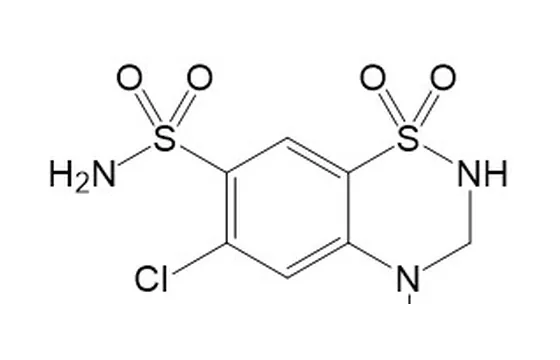
Chemically, the site is a poor substrate. The nitrogen is conjugated with the aromatic ring, the adjacent sulfonyl group withdraws electron density, and the ring constrains the geometry. Nitrosation will happen under forcing conditions and slowly under realistic ones, which is why the risk assessment usually concludes that the risk is low and the control strategy is a nitrite limit on raw materials rather than a specification limit on the nitrosamine. That conclusion is defensible, but it has to be written, and it has to name the site.
The combination products make the question sharper. Hydrochlorothiazide is frequently formulated with an angiotensin receptor blocker, and those molecules have their own nitrosamine history and their own tetrazole chemistry. The two risks are separate, they have different root causes, and a single control strategy cannot cover both. A risk assessment that treats the combination as one nitrosamine question will be incomplete in one direction or the other.
What the filing has to defend
Chinese registration activity for hydrochlorothiazide is dominated by combination products, which is why the filing count is large relative to the number of stand-alone tablets.
The general chapters of the Chinese Pharmacopoeia apply in parallel and set the monograph baseline[5].
Three questions recur. The first is whether the 2:1 adduct is controlled at all: a specification that lists the disulfonamide and chlorothiazide but not the adduct has a gap, and the gap is documented in the literature. The second is the formaldehyde: is it measured, and if not, what is the argument that the hydrolysis product is a sufficient marker for it. The third is the combination: which impurity belongs to which active, and how the method assigns a peak that could plausibly come from either.
Stability adds a fourth. Because the hydrolysis produces a volatile species that can leave the pack, the impurity profile of a tablet at the end of shelf life depends on the moisture barrier of the container, not only on the formulation. A stability programme run in aluminium blisters does not describe a product sold in high-density polyethylene bottles, and the difference is exactly the water activity that drives the ring opening[6].
Which thiazides compare, and which do not
Chlorothiazide is the closest relative and the least useful comparison, because it is also impurity A of the drug. The two molecules differ by two hydrogens, and a laboratory that holds both has a standard for the dehydrogenated species without buying anything extra. What does not transfer is the degradation chemistry: chlorothiazide has an aromatic thiadiazine ring and no methylene to lose, so it cannot hydrolyse the way hydrochlorothiazide does.
Bendroflumethiazide shares the benzothiadiazine core but carries a benzyl group at C3 and a trifluoromethyl in place of the chlorine. With the methylene carbon substituted, neither the dehydrogenation nor the formaldehyde chemistry runs the same way, and the benzylic position becomes the labile one instead. Metolazone is a quinazoline rather than a benzothiadiazine, so nothing about the methylene chemistry applies. Indapamide is not a thiazide at all in the structural sense: it is a chlorosulfamoyl benzamide, its ring is different, and its degradation chemistry is dominated by the indoline and the amide instead. Furosemide is an anthranilic acid derivative with no thiadiazine ring to open, and its photochemistry rather than its hydrolysis is the interesting part.
What the group shares is the sulfonamide group, and that is the one place where a comparison does hold: all of them can lose sulfur as sulfate under forcing conditions, and all of them require the same care with the sulfonamide nitrogen in a nitrosamine assessment. That is a family-level statement, and it is the only one worth making.
This catalogue carries 58 hydrochlorothiazide entries, including chlorothiazide, the ring-opened disulfonamide, both methylene-bridged adducts and the N-nitroso derivative: hydrochlorothiazide reference standards. For combination work, the valsartan and losartan potassium pages carry the tetrazole-side impurities that share the tablet.
Frequently Asked Questions
Why is the 2:1 adduct not seen in every hydrochlorothiazide method?
Does the assay fall when the ring opens?
Is chlorothiazide an impurity or a different drug?
How should formaldehyde be measured in a tablet?
Is N-nitroso hydrochlorothiazide a specification impurity?
Why does the container matter for this drug?
Can the adduct be prepared in the laboratory by mixing the drug with formalin?
Related Substances and Reference Standards
- Hydrochlorothiazide (58 impurity / derivative entries)
- Valsartan (71 impurity / derivative entries)
- Losartan Potassium (74 impurity / derivative entries)
- Indapamide (60 impurity / derivative entries)
References and Sources
- Journal of Pharmaceutical and Biomedical Analysis, 26 (2001), Isolation of a 2:1 hydrochlorothiazide-formaldehyde adduct impurity in hydrochlorothiazide drug substance by preparative chromatography and characterization by electrospray ionization LC-MS: 19 lots from five manufacturers, adduct at 0.02 to 1.1 area percent, above the 0.1 percent threshold in 16 lots, accessed 2026-11-05
- ICH, ICH Q3B(R2) Impurities in New Drug Products: reporting, identification and qualification thresholds as percentage and as absolute daily amount, whichever is lower, accessed 2026-11-05
- AAPS PharmSciTech (2011), Reactive impurities in excipients: profiling, identification and mitigation of drug-excipient incompatibility, including formaldehyde generation from polyethylene glycols and povidone, accessed 2026-11-05
- ICH, ICH M7(R2) Assessment and Control of DNA Reactive (Mutagenic) Impurities in Pharmaceuticals, including the TTC of 1.5 micrograms per day and the nitrosamine-specific limits, accessed 2026-11-05
- Chinese Pharmacopoeia Commission, Pharmacopoeia of the People's Republic of China, hydrochlorothiazide monograph and general chapters on related substances, accessed 2026-11-05
- ICH, ICH Q1A(R2) Stability Testing of New Drug Substances and Products: long-term, intermediate and accelerated conditions, and the influence of container closure on the stability profile, accessed 2026-11-05
This article was prepared by the CATO technical team. Regulatory, pharmacopoeial and published literature content cited above is attributed in the reference list. It is provided for technical exchange and search reference only and does not constitute a quality specification or regulatory advice. For any specific substance, the applicable test methods, limits and filing requirements are governed by the current regulations, pharmacopoeial monographs and official publications.
Product information on this site is provided for research search and selection reference only and is not a quality specification; technical data, purity and structural confirmation are governed by the shipped COA and our written confirmation. All products mentioned are for research use only, not for human or animal diagnostic or therapeutic use.