Ibuprofen: In a Racemate the Enantiomer Is the Drug, So What Is the Chiral Test For?
Ibuprofen↗ has one stereocenter and is sold as a 50:50 mixture of both configurations, which means the enantiomer cannot be an impurity: it is half the substance. That single decision removes the chiral test from the specification and hands the analytical problem to a different set of species, four of which share the same molecular formula and cannot be separated by mass.
Note: product names shown in red (marked with ↗) are links - click through to the product page for structure, CAS number, purity and lead time.
One stereocenter, deliberately unresolved
Key points
- Ibuprofen is C13H18O2, 206.28, CAS 15687-27-1, dosed at 200 to 400 mg for analgesia and up to 3200 mg a day in rheumatoid arthritis.
- It is a racemic 2-arylpropanoic acid with one stereocenter, so the enantiomer is 50 percent of the substance and cannot be treated as an impurity.
- Four catalogue entries share C13H18O2, including the parent, so mass spectrometry cannot distinguish them and only chromatographic selectivity can.
- At 3200 mg a day the 1.0 mg absolute limb of the Q3A identification threshold works out to about 0.03 percent, well below the 0.10 percent percentage limb[1].
Ibuprofen is 2-(4-isobutylphenyl)propanoic acid: a benzene ring carrying an isobutyl group at the para position, a propanoic acid side chain at position one, and a methyl branch on the alpha carbon. That alpha carbon is the only stereocenter in the molecule, and it is the reason the compound behaves differently from every other profen in the catalogue.
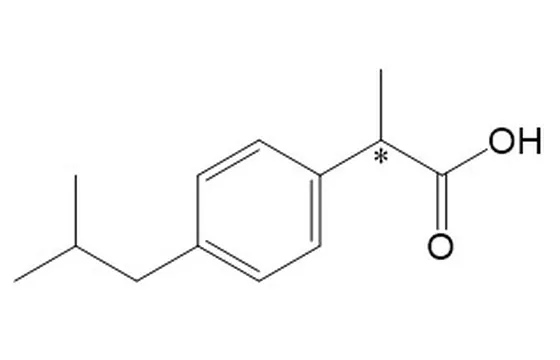
The catalogue holds 85 ibuprofen entries and the substance is monographed in the European Pharmacopoeia. Of those entries, a dozen carry the annotation that they are supplied as mixtures of enantiomers. That annotation is not a supplier convenience. It is a statement about what the molecule is.
A limit on the enantiomer would be a limit on the drug
In a single-enantiomer API the unwanted configuration is an impurity by definition: it is structurally identical, it is pharmacologically different, and it has no therapeutic purpose. Ibuprofen is the opposite case. Both configurations are present by design, the specification describes the racemate, and the related-substances test runs on an achiral column where the two configurations co-elute as one peak.
This has a consequence that surprises people new to the molecule. On an achiral method, every chiral impurity also appears as a single peak regardless of its own enantiomeric composition. A batch containing EP impurity A as the racemate and a batch containing it as a single enantiomer give identical chromatograms. For a racemic API that is acceptable, because the same is true of the parent. For a single-enantiomer API it is not, and the method has to change accordingly.
That is exactly what happened commercially. S-(+)-ibuprofen, marketed as dexibuprofen, is a separate active substance with its own specification, and once the parent is a single enantiomer the R configuration becomes a specified impurity with a chiral limit. The molecule did not change; the regulatory category of one of its components did. Ibuprofen and dexibuprofen are two products built on one structure, and the entire chiral testing question turns on which one is on the label[2].
The isobaric quartet is the real analytical problem
Set the chirality aside and the panel becomes a mass-spectrometry problem. Four of the compendial impurities have the same formula as the drug, and three of them differ only in where a substituent sits or how long a chain is.
| Entry | Structure | Formula, mass | Difference from the drug |
|---|---|---|---|
| ibuprofen | 2-(4-isobutylphenyl)propanoic acid | C13H18O2, 206.28 | reference |
| EP impurity A, CAS 66622-47-7 | 2-(3-isobutylphenyl)propanoic acid | C13H18O2, 206.28 | meta instead of para |
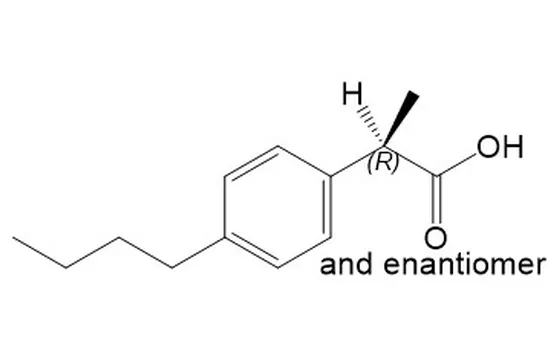
| EP impurity B, CAS 3585-49-7 | 2-(4-butylphenyl)propanoic acid | C13H18O2, 206.28 | linear butyl instead of isobutyl |
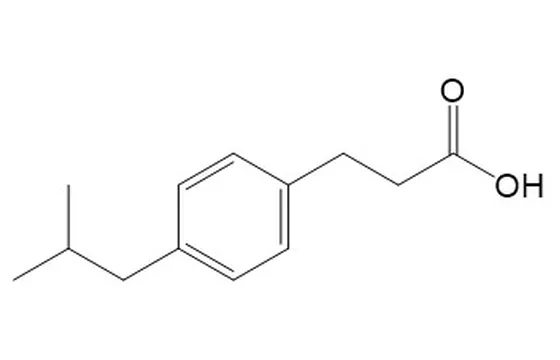
| EP impurity F, CAS 65322-85-2 | 3-(4-isobutylphenyl)propanoic acid | C13H18O2, 206.28 | acid on the beta carbon, no methyl branch |
Table note: formulas and masses from PubChem records for each CAS number; the structural differences are read from the systematic names.
All four give the same protonated molecule at m/z 207 and the same fragment at m/z 161, because the fragment is the isobutylphenyl cation and it survives every one of the rearrangements. Tandem mass spectrometry therefore cannot tell you which of the four you are looking at, and no amount of high resolution helps when the elemental composition is identical.
What does help is the shape of the molecule. The meta isomer in EP impurity A is more compact than the para isomer and elutes differently on a C18 column, but the separation is small and it collapses if the method runs a steep gradient. EP impurity F, with the acid one carbon further from the ring, loses the alpha-methyl and behaves more like a linear fatty acid than like a 2-arylpropanoic acid. EP impurity B differs only by branching of the alkyl chain, which is the hardest of the three to resolve from the parent.
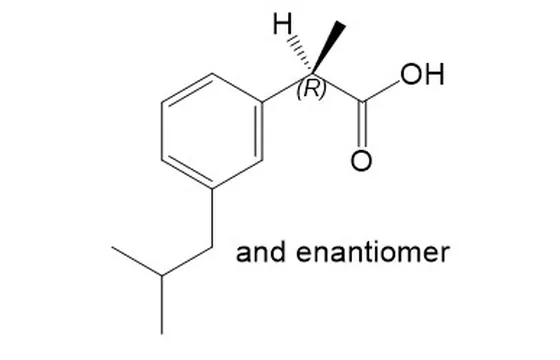
The practical instruction follows directly: a related-substances method for ibuprofen has to be developed with EP impurity A and EP impurity B in hand, on a column and gradient chosen for the pair, not inherited from a method written for the assay.
The rest of the panel reads the route
The three remaining compendial entries are not isobaric, and each one is a fingerprint of a specific step.
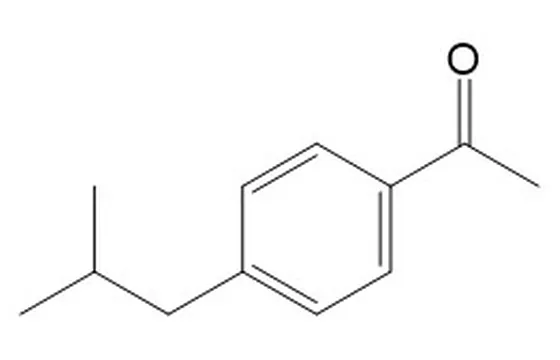
EP impurity E is 4-isobutylacetophenone, C12H16O, 176.25, CAS 38861-78-8. It is the ketone from which the propanoic acid side chain is built, and its presence at release means the ketone was not fully consumed or not fully removed. It is also the smallest and most volatile of the panel, so it is the one a drying step can remove and a poor drying step will not.
EP impurity C is the amide, C13H19NO, 205.30, CAS 59512-17-3, one nitrogen in place of the acid hydroxyl and one mass unit lighter than the drug. Amide impurities in a carboxylic acid API usually come from the nitrile route or from ammonia in a workup, and they matter because they co-elute with the parent on many systems and because they hydrolyse back to the acid under stress.
EP impurity D is 2-(4-tolyl)propanoic acid, C10H12O2, 164.20, CAS 938-94-3, which is 42 mass units lighter than ibuprofen. That difference is C3H6, exactly what is lost when an isobutyl group is replaced by a methyl. An impurity of that shape does not arise from a reaction of ibuprofen; it comes in with the starting ketone, as a 4-methylacetophenone contaminant that is carried through the same chemistry. It is a supplier qualification finding, not a process development finding, and it is worth running the calculation before assuming otherwise.
Why the standards come as racemates, and when that stops working
Most of the ibuprofen impurity entries in this catalogue are supplied as mixtures of enantiomers, and for a racemic API that is the right purchase. A racemic standard has the same formula and the same ultraviolet response as the single enantiomer, it elutes at the same time on an achiral column, and it costs less because nobody had to resolve it.
The logic breaks in three places, and each one is easy to walk into.
The first is dexibuprofen development. Once the API is the S enantiomer, EP impurity A as a racemate is only half relevant: the R form of the impurity is a different species chromatographically and, depending on the specification, a different impurity. Single-enantiomer standards become mandatory, not optional.
The second is a chiral method validation. If the method separates the two configurations, a racemic standard will produce two peaks, and that is the correct result rather than a method failure. Analysts who expect one peak spend a day chasing a ghost. The system suitability criterion should be written as a resolution between the two peaks of the standard, not as a single-peak purity.
The third is any investigation involving a peak that appears only on the chiral column. A racemic standard tells you where both configurations elute, which is useful, but it cannot tell you which one is in the sample. For that you need the single enantiomer, and for ibuprofen impurities those are special-order items in most catalogues.
In vivo inversion is pharmacology, not an impurity argument
There is a well-known pharmacokinetic fact that gets borrowed to justify things it cannot justify. Racemic ibuprofen undergoes rapid and extensive unidirectional chiral inversion from R to S, with roughly 60 percent of the R dose converted, so the circulating drug is mostly the S enantiomer whichever configuration was swallowed[2]. The S enantiomer is also reported to be more than 100-fold more potent as a COX-2 inhibitor, which is what motivated the chiral switch in the first place[2].
Both statements are true and neither one belongs in an impurity justification. Inversion happens in the body, after absorption, through acyl-coenzyme A intermediates; it says nothing about what is in the tablet, nothing about the stability of the configuration in the solid state, and nothing about the specification. A filing that argues the enantiomer is harmless because it inverts is answering a pharmacological question with a pharmacological answer to a chemical question nobody asked.
Where the inversion does matter is comparability. If a sponsor switches from the racemate to dexibuprofen and claims almost-bioequivalence on the basis of the inversion data, that is a legitimate argument, but it is a BE argument supported by plasma concentration data, not a specification argument. The two files should not be allowed to merge.
Two analytical problems that need two methods
The related-substances method and the chiral method answer different questions, and trying to serve both with one system produces a method that does neither well.
For related substances, the requirements are selectivity against the isobaric set and a gradient shallow enough to keep EP impurity A and EP impurity B off the parent peak. Detection is at a low ultraviolet wavelength because the arylpropanoic acid chromophore is weak and the impurities have no additional conjugation; that also means the mobile phase absorbance and the injection solvent are part of the method, not details to be settled later.
For the chiral method, the chemistry changes completely. Profens are separated on polysaccharide or cyclodextrin stationary phases in normal-phase or polar organic mode, and the carboxylic acid needs either a low pH modifier to suppress ionization or an additive to compete for the chiral recognition sites. A published review of capillary electrophoretic enantioseparation of profens makes the broader point well: the selector determines the separation, and the same selector class behaves very differently across the profen set, so screening by substrate type beats screening by brand[3].
Where the two methods meet is the specification. ICH Q6A treats chirality as a specification decision to be justified rather than a default test, and for a racemic API the justification for not testing the enantiomer is straightforward, provided it is written down[4]. A specification with no chiral test and no explanation is a deficiency waiting to happen; the same specification with two paragraphs explaining that the substance is a racemate by definition is not.
Where ibuprofen cannot be compared
Three comparisons are made routinely and only the first is safe.
Naproxen is the same 2-arylpropanoic acid framework marketed as the single S enantiomer, with the R form excluded on toxicological grounds. That is the mirror image of the ibuprofen decision: same acid, same chromophore, opposite specification logic. Anything learned about naproxen chiral testing transfers to dexibuprofen, not to ibuprofen.
Ketoprofen and Flurbiprofen are racemates like ibuprofen, so the specification logic does transfer, but the substitutions do not. Ketoprofen↗ carries a benzoyl group that opens a photochemical pathway ibuprofen does not have, and flurbiprofen carries a fluorine that changes the chromatography. The shared decision is the absence of a chiral limit, not the impurity panel.
The genuinely different case is Dexketoprofen, where the same molecular framework is marketed as a single enantiomer and the R configuration becomes a specified impurity with a chiral limit. Reading the ibuprofen monograph and the dexketoprofen monograph side by side is the fastest way to see how much of a specification is chemistry and how much is a regulatory choice about which substance is on the label.
Reference standards for a racemic API
For routine work the set is four solids: the drug substance, EP impurity A because it is isobaric and the most likely to be missed, EP impurity F because it is the second isobaric trap, and EP impurity E because it is the only entry that tells you about the ketone step. EP impurities B, C and D belong in an investigation kit rather than on the bench.
All of them are available as racemic mixtures here, which matches a racemic API, together with single-enantiomer material for chiral work: Ibuprofen reference standards and related entries. For a dexibuprofen project the buying list changes, and the single enantiomers become the starting point rather than an upgrade.
The block above counts accepted filings and applicants, not approvals, and it explains why the specification argument is worth having in writing: a crowded field is a field where someone will read the dossier closely. The substance is also monographed in the Chinese Pharmacopoeia, whose related-substances system is the one a domestic generic is measured against[5].
Frequently Asked Questions
Does a racemic API need an enantiomeric purity test?
Why can mass spectrometry not resolve the ibuprofen impurities?
Which impurity is the hardest to separate from ibuprofen?
Where does EP impurity D come from if it is not a reaction product?
Why are the impurity standards supplied as racemates?
Does the R to S inversion mean the enantiomer is safe?
At 3200 mg a day, which threshold binds?
Should the chiral method be validated on the racemate or on the single enantiomer?
Related Substances and Reference Standards
- Ibuprofen (85 impurity / derivative entries)
- Naproxen (84 impurity / derivative entries)
- Ketoprofen (98 impurity / derivative entries)
- Flurbiprofen (108 impurity / derivative entries)
References and Sources
- ICH, ICH Q3A(R2) Impurities in New Drug Substances: reporting, identification and qualification thresholds as a percentage or as an absolute daily amount, whichever is lower, accessed 2026-11-06
- Pharmaceuticals, 15 (2022) 240, Chiral switch: between therapeutical benefit and marketing strategy, including the greater than 100-fold COX-2 potency difference between S-ibuprofen and R-ibuprofen and the approximately 60 percent unidirectional inversion of the R enantiomer, accessed 2026-11-06
- Molecules, 31 (2026) 3256, Capillary electrophoretic enantioseparation of profens: advances in chiral selectors, separation strategies and analytical applications, accessed 2026-11-06
- ICH, ICH Q6A Specifications: test procedures and acceptance criteria for new drug substances and new drug products, including the decision tree on chirality, accessed 2026-11-06
- Chinese Pharmacopoeia Commission, Pharmacopoeia of the People's Republic of China, ibuprofen monograph and the general chapters on related substances, accessed 2026-11-06
This article was prepared by the CATO technical team. Regulatory, pharmacopoeial and published literature content cited above is attributed in the reference list. It is provided for technical exchange and search reference only and does not constitute a quality specification or regulatory advice. For any specific substance, the applicable test methods, limits and filing requirements are governed by the current regulations, pharmacopoeial monographs and official publications.
Product information on this site is provided for research search and selection reference only and is not a quality specification; technical data, purity and structural confirmation are governed by the shipped COA and our written confirmation. All products mentioned are for research use only, not for human or animal diagnostic or therapeutic use.