碘克沙醇的卤代丙醇类基因毒性杂质:65 克一次的注射剂,TTC 折下来只剩 0.02 ppmHalopropanol Genotoxic Impurities in Iodixanol: A 65-Gram Injection Where the TTC Converts to Just 0.02 ppm
碘克沙醇↗是二聚体碘造影剂,两个单体单元靠一条三碳桥连起来。这条桥既是它的结构标志,也是它最大的风险入口——桥的化学来自卤代丙醇类烷基化试剂,而一次 100 mL 的检查用量会把 ICH M7 的 TTC 折算到 0.02 ppm 量级。这两个事实叠在一起,决定了这个品种的基因毒性杂质策略不能走「成品检验」这条路。
Iodixanol↗ is a dimeric iodinated contrast agent whose two monomer units are joined by a three-carbon bridge. That bridge is both its structural signature and its largest risk entry point: the chemistry of the bridge comes from halopropanol alkylating reagents, and a single 100 mL examination converts the ICH M7 TTC to the 0.02 ppm level. Those two facts together mean the genotoxic impurity strategy for this substance cannot run through finished-product testing.
Note: product names shown in red (marked with ↗) are clickable. Click to open the product page for structure, CAS number, purity and lead time.
一、二聚体结构:一条三碳桥,划出了它与单体造影剂的分界线1. The dimer structure: one three-carbon bridge separates it from monomeric contrast agents
关键要点Key points
- 碘克沙醇是二聚体造影剂,CIodixanol is a dimeric contrast agent, C35H44I6N6O15,分子量约 1550,含碘 49.1%;两个单体单元靠一条三碳桥连起来,这条桥是它区别于碘海醇的结构标志。, molecular weight about 1550, iodine content 49.1%; two monomer units are joined by a three-carbon bridge, and that bridge is the structural feature that distinguishes it from iohexol.
- 三碳桥来自卤代丙醇类烷基化试剂(The three-carbon bridge comes from halopropanol alkylating reagents (环氧氯丙烷epichlorohydrin↗及其水解、二氯代副产物)。这三个物种分子量只有 92–129、无紫外吸收,常规有关物质 HPLC 一个也看不见 together with its hydrolysis and dichloro by-products). These three species have molecular weights of only 92–129 and no UV absorption, so a conventional related-substances HPLC method sees none of them[3]。
- 一次 320 mgI/mL × 100 mL 的检查用量约 65 g 碘克沙醇。把 ICH M7 的 TTC 1.5 μg/天 除下来,限度落在 One examination at 320 mgI/mL × 100 mL corresponds to about 65 g of iodixanol. Dividing the ICH M7 TTC of 1.5 μg/day by that gives a limit in the 0.023 ppm 量级——这不是成品检验能承担的尺度 range, a scale finished-product testing cannot carry[1]。
- 本目录该品种 13 条里,EP 杂质 A 的 CAS 就是碘海醇(66108-95-0);EP 杂质 G 与母体的元素差恰好是「一个碘换成一个氢」。裂解与脱碘是两条必须分开建的通道。Among the 13 entries for this substance in the catalogue, the CAS of EP Impurity A is that of iohexol (66108-95-0), and the elemental difference between EP Impurity G and the parent is exactly one iodine replaced by one hydrogen. Cleavage and deiodination are two channels that must be built separately.
碘克沙醇(CAS 92339-11-2,CIodixanol (CAS 92339-11-2, C35H44I6N6O15,分子量 1550.2,含碘 49.1%)是非离子型二聚体碘造影剂,主打等渗。它的结构与碘海醇的关系可以一句话说清:两个碘海醇单元各让出一个氮上的氢,用一条 2-羟基丙烷-1,3-二基的链连起来。整分子 6 个碘、6 个氮、15 个氧,在水中不解离,渗透压靠的是分子本身而不是离子。, molecular weight 1550.2, iodine content 49.1%) is a non-ionic dimeric iodinated contrast agent marketed as iso-osmolar. Its relationship to iohexol can be stated in one sentence: two iohexol units each give up a hydrogen on a nitrogen and are joined by a 2-hydroxypropane-1,3-diyl chain. The whole molecule has six iodines, six nitrogens and fifteen oxygens, does not ionise in water, and draws its osmolality from the molecule itself rather than from ions.
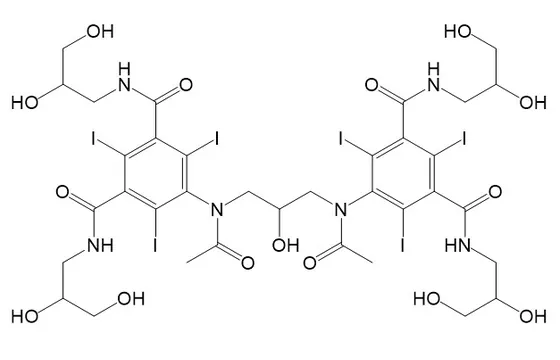
这个结构决定了它的杂质谱和单体造影剂不是一回事。单体品种的杂质主要围绕「侧链烷基化不完全」和「脱碘」;二聚体多了一条最要紧的通道——桥断了就变回单体,而断下来的那个单体是另一个已上市药品。本目录收录This structure means its impurity profile is not the same as a monomer's. In monomeric products the impurities centre on incomplete side-chain alkylation and deiodination; the dimer adds the most important channel of all, since breaking the bridge returns it to a monomer, and that monomer is another marketed drug. This catalogue holds 碘克沙醇Iodixanol相关条目 related entries 13 条(含母体),EP 与 USP 均有收载 entries (including the parent), and both the EP and USP monograph it[5],中国药典亦有对应各论, as does the Chinese Pharmacopoeia[6],条目覆盖 EP 杂质 A、B、C、E、F、G、I 与 USP 相关化合物 D,另有 4 条只有编号没有药典字母。. The entries cover EP Impurity A, B, C, E, F, G and I plus USP Related Compound D, with 4 further entries carrying only numbers and no pharmacopoeial letter.
二、13 条条目按元素差拆开,只剩裂解、烷基化不完全、脱碘三条线2. Subtract the formulas across the 13 entries and only three lines remain: cleavage, incomplete alkylation and deiodination
把 13 条的分子式逐个和母体相减,会得到三条互不重叠的线索。Subtract the parent formula from each of the 13 in turn and three non-overlapping threads appear.
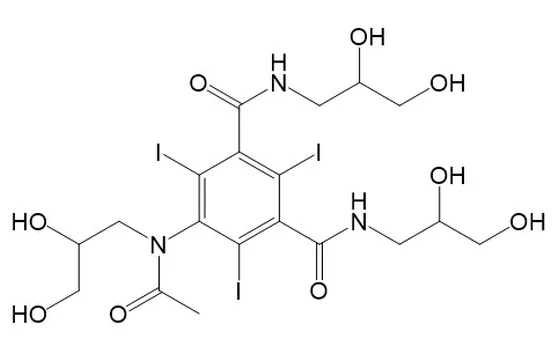
第一条是裂解。The first is cleavage.EP 杂质 A 的 CAS 是 66108-95-0,分子式 C The CAS of EP Impurity A is 66108-95-0, formula C19H26I3N3O9——这就是碘海醇。也就是说,二聚体的桥一断,掉下来的那一半是一个独立上市的造影剂。这件事在方法开发上有个直接后果:验证裂解通道时,手上必须有碘海醇对照品,否则那个峰只能记成未知。: this is iohexol. In other words, break the dimer's bridge and the half that falls away is an independently marketed contrast agent. The direct consequence for method development is that validating the cleavage channel requires an iohexol reference standard in hand, otherwise that peak can only be recorded as unknown.
第二条是烷基化不完全。The second is incomplete alkylation.EP 杂质 B 的分子式是 C The formula of EP Impurity B is C16H20I3N3O7,恰好等于碘海醇减去一个 C, exactly iohexol minus one C3H6O2——少接了一个 2,3-二羟基丙基。少接一个羟丙基,分子上就留了一个 N–H。酰胺氮上的氢同样能被亚硝化,所以这条杂质不只是「纯度不够」,它同时是一个潜在的亚硝化位点。: one 2,3-dihydroxypropyl group is missing. Missing one hydroxypropyl leaves an N–H on the molecule. The hydrogen on an amide nitrogen can also be nitrosated, so this impurity is not merely a purity shortfall but a potential nitrosation site as well.
第三条是脱碘。The third is deiodination.EP 杂质 G 的分子式 C The formula of EP Impurity G is C35H43I5N6O15 与母体相比,差值正好是「一个 I 换成一个 H」,这是最干净的还原脱碘证据。EP 杂质 F 同为五碘物种,但还少了 C , and against the parent the difference is exactly one iodine replaced by one hydrogen, the cleanest evidence of reductive deiodination. EP Impurity F is likewise a pentaiodo species but additionally lacks C2H2O,说明脱碘之外侧链也断了一截。脱碘的后果不在安全性,而在效价:碘密度掉了,同样体积的 X 射线衰减就不够了。O, showing that a stretch of side chain is lost as well as iodine. The consequence of deiodination is not safety but potency: with iodine density down, the same volume no longer attenuates X-rays sufficiently.
还有一条容易被忽略:EP 杂质 C 的分子式是 COne more is easily overlooked: the formula of EP Impurity C is C33H42I6N6O14,正好是母体减一分子水。分子上有多个仲羟基,酸与热同时在场时脱水成醚是常规反应,而注射剂的终端灭菌(121 ℃)恰好提供了这个条件。它不改变碘密度,也不改变电荷,色谱上却会明显后移,最容易在稳定性样品里被当成「新出现的未知峰」。, exactly the parent minus one molecule of water. The molecule carries several secondary hydroxyls, and acid plus heat makes dehydration to an ether a routine reaction, conditions that terminal sterilisation of an injection (121 °C) supplies precisely. It changes neither iodine density nor charge, yet shifts markedly later on chromatography, and is the peak most likely to be written off as a newly appearing unknown in stability samples.
三、卤代丙醇从哪来:桥链试剂、位置异构体与「测不到」的三种存在3. Where the halopropanols come from: bridge reagent, regioisomers and three species that cannot be measured
| 条目Entry | 分子式Formula | 与母体或碘海醇的关系Relationship to the parent or to iohexol | 归属Category |
|---|---|---|---|
| EP 杂质 AEP Impurity A | C19H26I3N3O9 | 即碘海醇,二聚体裂解为单体Iohexol itself; the dimer cleaved to a monomer | 降解Degradation |
| EP 杂质 BEP Impurity B | C16H20I3N3O7 | 碘海醇减 CIohexol minus C3H6O2,少一个羟丙基, one hydroxypropyl short | 工艺Process |
| EP 杂质 GEP Impurity G | C35H43I5N6O15 | 母体 − I + H,单脱碘Parent − I + H, single deiodination | 降解Degradation |
| EP 杂质 FEP Impurity F | C33H41I5N6O14 | 五碘,且少 CPentaiodo, and C short2H2O,脱碘兼侧链断裂O; deiodination plus side-chain cleavage | 降解Degradation |
| 杂质 10–13(4 条)Impurity 10–13 (4 entries) | C22H32I3N3O11 | 碘海醇加 CIohexol plus C3H6O2,多接一个羟丙基的四种异构体, four isomers carrying one extra hydroxypropyl | 工艺Process |
表注:分子式取自本目录条目数据(2026-10-25 抓取);元素差为按分子式相减所得,属推导结论。Table note: formulas are from the catalogue entry data (retrieved 2026-10-25); elemental differences are obtained by subtracting formulas and are derived conclusions.
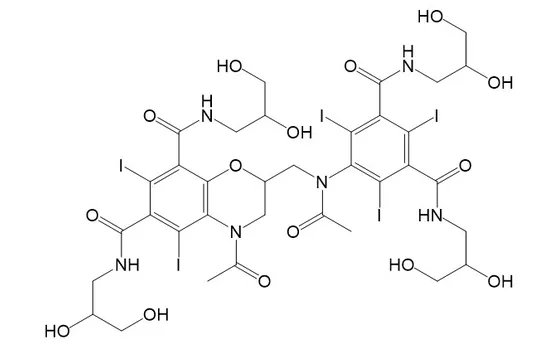
表里最后一行值得单独拎出来。四条同分子式的 CThe last row deserves separate attention. Four entries of the same formula C22H32I3N3O11,说明「多接一个羟丙基」这件事不是单一反应:羟基可以接在不同的氧上,也可以接在氮上,构型还会跟着变。这类位置异构体在紫外上几乎一样、在质谱上完全一样,只有色谱保留时间能把它们分开。方法开发时如果只用一个对照品,很容易把另外三个当成系统峰。, showing that attaching one extra hydroxypropyl is not a single reaction: the hydroxyl can land on different oxygens or on a nitrogen, and configuration changes follow. Such regioisomers are nearly identical in UV and completely identical in mass spectrometry, and only chromatographic retention separates them. Develop the method with a single standard and the other three are easily dismissed as system peaks.
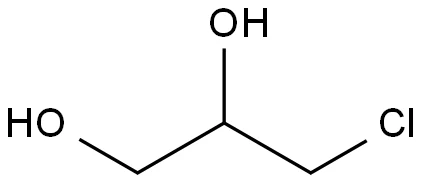
那条三碳桥是从哪来的?工业上用卤代丙醇类烷基化试剂把两个单元的氮连起来,最典型的是环氧氯丙烷(CAS 106-89-8)。环氧氯丙烷遇水水解成 3-氯-1,2-丙二醇(CAS 96-24-2),二氯代副产物是 1,3-二氯-2-丙醇(CAS 96-23-1)。这三个物种分子量分别只有 92.5、110.5、129.0,沸点低、无紫外吸收、极性大,在常规有关物质色谱里既没有保留也没有响应。它们不会以「杂质峰」的形式出现,只会以「测不到」的形式存在。Where does that three-carbon bridge come from? Industry joins the nitrogens of the two units with halopropanol alkylating reagents, most typically epichlorohydrin (CAS 106-89-8). Epichlorohydrin hydrolyses in water to 3-chloro-1,2-propanediol (CAS 96-24-2), and the dichloro by-product is 1,3-dichloro-2-propanol (CAS 96-23-1). These three species have molecular weights of only 92.5, 110.5 and 129.0, low boiling points, no UV absorption and high polarity, so in a conventional related-substances chromatogram they have neither retention nor response. They do not appear as impurity peaks; they exist as things that cannot be measured.
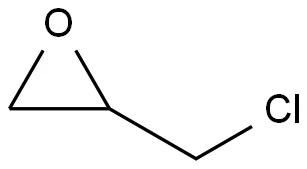
这三个物种在 ICH M7 框架下按 class 2 处理(致突变性已知、致癌性数据不足),走 TTC 1.5 μg/天。它们还有一个共同点:都是亲电试剂,直接与 DNA 反应,不需要代谢活化。这意味着 Ames 试验阳性的可能性很高,也意味着不能用「成品中未检出」来结案——必须证明工艺能清除。Under the ICH M7 framework these three are handled as class 2 (known mutagenicity, insufficient carcinogenicity data) and run against a TTC of 1.5 μg/day. They share another property: all are electrophiles that react with DNA directly without metabolic activation. That means a high likelihood of Ames positivity, and it means the case cannot be closed with not detected in the finished product; the process must be shown to clear them.
四、剂量是分母:65 克一次,把限度压到 ppb 级4. Dose is the denominator: 65 grams per examination drives the limit to ppb level
造影剂的杂质限度之所以难谈,是因为分母太大。口服药一天几百毫克,注射造影剂一次几十克,同样的 TTC 除下来能差三到四个数量级。Impurity limits for contrast agents are hard to discuss because the denominator is so large. An oral drug runs to a few hundred milligrams a day while an injected contrast agent runs to tens of grams per examination, so dividing the same TTC differs by three to four orders of magnitude.
| 给药方案Dosing regimen | 碘量Iodine amount | 折算碘克沙醇Iodixanol equivalent | TTC 折算限TTC-derived limit |
|---|---|---|---|
| 320 mgI/mL × 100 mL | 32 g | 约 65 gAbout 65 g | 约 0.023 ppmAbout 0.023 ppm |
| 320 mgI/mL × 50 mL | 16 g | 约 33 gAbout 33 g | 约 0.046 ppmAbout 0.046 ppm |
| 270 mgI/mL × 50 mL | 13.5 g | 约 27 gAbout 27 g | 约 0.055 ppmAbout 0.055 ppm |
| 270 mgI/mL × 20 mL | 5.4 g | 约 11 gAbout 11 g | 约 0.14 ppmAbout 0.14 ppm |
表注:按含碘 49.1%、TTC 1.5 μg/天 折算;用量取常见成人单次检查范围,实际以说明书与临床方案为准。Table note: converted at 49.1% iodine and TTC 1.5 μg/day; the amounts span common adult single-examination ranges and the label and clinical protocol prevail.
0.023 ppm 这个数字的现实含义是:任何以「成品检验」为核心的策略都走不通。三重四极杆在纯水里的检出限或许能做到这个量级,但造影剂基质是 65% 左右的碘化合物水溶液,黏度高、离子强度大、还含 EDTA 类稳定剂,进样量一大就污染源;同一方法在纯水与成品基质里的检出限不是一个数。即便方法做出来,每批都测也不现实。所以正确路径只有一条:The practical meaning of 0.023 ppm is that any strategy centred on finished-product testing is a dead end. A triple quadrupole might reach that order of magnitude in pure water, but the matrix here is roughly 65% aqueous iodinated compound with high viscosity, high ionic strength and EDTA-type stabilisers, and large injection volumes foul the source; the detection limit in pure water and in the product matrix are not the same number. Even with a workable method, testing every batch is unrealistic. So there is only one correct path: 用工艺清除能力论证,而不是用成品数据论证。argue from process clearance capability, not from finished-product data.
具体怎么做:在烷基化步骤前加标(spike)到远高于实际残留的水平,走完整条下游工艺,测各步中间体与成品中的残留,算出清除因子(clearance factor)。清除因子足够大,就能论证「无论投料波动如何,成品都远低于限度」。这套做法在 ICH M7 的框架里是被明确接受的替代路径How this works in practice: spike before the alkylation step at a level far above actual carry-over, run the entire downstream process, measure residues in intermediates at each step and in the finished product, and calculate the clearance factor. A sufficiently large clearance factor supports the argument that the finished product stays far below the limit whatever the charge variation. This approach is explicitly accepted as an alternative in the ICH M7 framework[1],比硬做 0.02 ppm 的成品方法省力得多,也更经得起审评追问。, which is far less onerous than forcing a 0.02 ppm finished-product method and withstands review questions far better.
五、方法要按物种分开设计,一个方法管不了三类杂质5. Methods must be designed per species; one method cannot cover three classes
方法要按物种分开设计,没有一个方法能同时管住三类杂质。Methods must be designed per species; no single method covers all three classes of impurity.
卤代丙醇类Halopropanols走气相。环氧氯丙烷沸点 116 ℃,顶空进样足够;3-氯-1,2-丙二醇沸点 213 ℃、极性大、易溶于水,直接顶空响应差,通常要衍生化(全氟酰化)后进 GC-MS,或改用液相;衍生化对这类小分子亲电试剂的灵敏度提升,公开综述里有系统总结 go by gas chromatography. Epichlorohydrin boils at 116 °C and headspace injection suffices; 3-chloro-1,2-propanediol boils at 213 °C, is highly polar and freely water-soluble, so direct headspace response is poor and derivatisation (perfluoroacylation) followed by GC-MS, or a switch to liquid chromatography, is usual. The sensitivity gain from derivatisation of such small-molecule electrophiles is systematically reviewed in the published literature[4]。同类思路在司维拉姆的环氧氯丙烷残留测定上已有公开做法,用静态顶空 GC-FID 就能做到残留级别. The same thinking is already published for epichlorohydrin residue in sevelamer, where static headspace GC-FID reaches residue levels[3]。这条经验可以直接迁移:基质不同,但「顶空 + 卤代物选择性检测」的逻辑一样。. That experience transfers directly: the matrix differs, but the logic of headspace plus halide-selective detection is the same.
脱碘与裂解产物Deiodination and cleavage products走反相 LC。碘克沙醇与碘海醇都是极性很大的多羟基化合物,C18 上保留很弱,需要高水相起始或改用亲水作用色谱;检测波长只能取 245 nm 附近(碘代苯环的吸收),灵敏度天生不如有共轭的品种。这也解释了为什么脱碘杂质在 EP 各论里是靠 TLC 或 HPLC 定性比较,而不是靠痕量定量。 go by reversed-phase LC. Iodixanol and iohexol are both highly polar polyhydroxy compounds with very weak C18 retention, requiring a high-aqueous start or a switch to hydrophilic interaction chromatography; detection can only sit near 245 nm, the absorption of the iodinated benzene ring, so sensitivity is inherently lower than for conjugated substances. This also explains why deiodinated impurities are compared qualitatively by TLC or HPLC in the EP monograph rather than quantified at trace level.
元素杂质Elemental impurities走 ICP-MS。上游硝基还原步骤会用到金属催化剂,Pd 属 ICH Q3D 的 2B 类,注射途径的 PDE 是 10 μg/天,比口服严十倍 go by ICP-MS. The upstream nitro-reduction step uses metal catalysts, and Pd is ICH Q3D class 2B with a parenteral PDE of 10 μg/day, ten times stricter than oral[2]。造影剂一次几十克,这条限度实际很紧,催化剂选型与去除步骤要在工艺里就定下来,不能留到成品端解决。. With tens of grams per examination this limit is genuinely tight, so catalyst selection and removal steps must be settled within the process rather than left for the finished product to solve.
亚硝酸盐Nitrite走离子色谱。它不是造影剂本身的杂质,但决定了「烷基化不完全留下的 N–H」会不会被亚硝化。这一项常被漏掉,因为品种本身不在亚硝胺高风险名单里。 goes by ion chromatography. It is not an impurity of the contrast agent itself, but it determines whether the N–H left by incomplete alkylation gets nitrosated. This item is routinely omitted because the substance is not on the high-risk nitrosamine list.
六、申报策略:审评看的是清除因子,不是「未检出」6. Filing strategy: review looks at clearance factors, not at not detected
造影剂的基因毒性杂质资料,审评看的不是「测了多少批」,而是三件事:风险识别是否完整、清除是否有数据、限度是否按注射途径算。In genotoxic impurity dossiers for contrast agents, review does not ask how many batches were tested but three things: whether risk identification is complete, whether clearance is supported by data, and whether limits were derived for the parenteral route.
风险识别上,起始物料与试剂清单必须把卤代丙醇类列进去。这一步最常见的疏漏是把环氧氯丙烷写成「工艺助剂」而不入清单,于是整份评估里没有它,后面所有清除数据也就无从谈起。正确做法是从路线倒推:凡是能引入亲电碳的试剂,都要单独列一行。On risk identification, the starting material and reagent list must include the halopropanols. The most common omission is writing epichlorohydrin down as a processing aid and leaving it off the list, so the whole assessment lacks it and every downstream clearance datum becomes moot. Work backwards from the route: any reagent that can introduce an electrophilic carbon gets its own line.
限度上,注射途径不能用口服 PDE 套。造影剂还有一层特殊性:它的「日剂量」不是按体重算的常规剂量,而是一次检查的实际用量,且不同适应症差别很大(血管造影与脊髓造影用量差数倍)。实务上按「最大单次用量」作为分母是保守且可辩护的口径,但必须在文件里写清取的是哪个临床方案。On limits, oral PDEs cannot be applied to the parenteral route. Contrast agents add a further twist: the daily dose is not a body-weight-scaled routine dose but the actual amount used in one examination, and it varies widely by indication, with angiography and myelography differing several-fold. Using the maximum single dose as the denominator is conservative and defensible, but the file must state which clinical regimen was used.
发补最常见四问:氯丙醇类未列入风险评估;只用 HPLC-UV 说「未检出」——方法能力与 0.02 ppm 不匹配;脱碘杂质未单独定限;桥链位置异构体(同类 4 条)没做归属。前两条是硬伤,后两条看资料深度Four questions dominate deficiency letters: chloropropanols omitted from risk assessment; not detected claimed from HPLC-UV alone, where method capability does not match 0.02 ppm; deiodinated impurities not limited separately; and the four bridge regioisomers not assigned. The first two are fatal flaws, the latter two test the depth of the dossier[7]。
七、五个误区,前两个会直接导致资料被退7. Five misconceptions, the first two of which get a dossier rejected outright
误区一:造影剂「化学惰性」,所以没有基因毒性风险。Misconception 1: a contrast agent is chemically inert, so there is no genotoxic risk.惰性说的是主成分,不是试剂。风险恰恰在把两个单元连起来的那一步,主成分越稳定,越说明问题不在它身上。 Inert describes the active ingredient, not the reagents. The risk sits precisely in the step that joins the two units, and the more stable the active ingredient the clearer it is that the problem is not with it.
误区二:把碘海醇当普通降解物,不单独备对照品。Misconception 2: treat iohexol as an ordinary degradant and stock no standard for it.它就是 EP 杂质 A,是裂解通道的定量基准,缺了它这条通道等于没建。 It is EP Impurity A, the quantitative anchor of the cleavage channel; without it the channel is not built at all.
误区三:用口服 PDE 套注射剂。Misconception 3: apply oral PDEs to an injection.同一元素、同一试剂,注射途径的限度普遍比口服严一个数量级,套错会高估可接受水平。 For the same element or reagent the parenteral limit is generally an order of magnitude stricter than oral, and applying the wrong one overstates the acceptable level.
误区四:认为「成品未检出」就是结论。Misconception 4: treat not detected in the finished product as the conclusion.在 0.02 ppm 量级,未检出更多反映方法能力,而不是产品安全性。审评要的是清除因子,不是一句未检出。 At the 0.02 ppm level, not detected reflects method capability more than product safety. Review wants a clearance factor, not a phrase.
误区五:只盯脱碘,不盯烷基化不完全。Misconception 5: watch deiodination but not incomplete alkylation.脱碘影响效价、容易被发现;烷基化不完全留下的 N–H 没有明显信号,但它是亚硝化的入口,属于「看不见的风险」。 Deiodination affects potency and is easily spotted; the N–H left by incomplete alkylation gives no obvious signal yet is the gateway to nitrosation, an invisible risk.
八、与四个单体碘造影剂横向对比:能借一半,不能借一半8. Comparison with four monomeric iodinated contrast agents: half transfers, half does not
同为碘造影剂,能类比的部分其实只有一半。For all that they are all iodinated contrast agents, only half of the analogy holds.
碘海醇Iohexol是单体,没有桥链,因此不存在卤代丙醇桥链引入的问题;但它同样有烷基化不完全与脱碘两条线,而且它就是碘克沙醇的裂解产物,两个品种的杂质谱在这里重叠。 is a monomer without a bridge, so there is no halopropanol bridge introduction to worry about; but it has the same two lines of incomplete alkylation and deiodination, and it is the cleavage product of iodixanol, so the two impurity profiles overlap here. 碘帕醇Iopamidol、碘普罗胺Iopromide、碘佛醇Ioversol都是单体,侧链结构各不相同:碘帕醇是 2-羟基丙酰基侧链, are all monomers with different side chains: iopamidol has a 2-hydroxypropionyl side chain, 碘普罗胺Iopromide↗带甲氧基乙酰基与两个羟丙基,碘佛醇的羟丙基位置又不一样。这些差异决定了各自的烷基化副产物不同,但「脱碘 + 烷基化不完全」这两个共性问题可以横向借用方法思路。 carries a methoxyacetyl group and two hydroxypropyls, and ioversol has its hydroxypropyls in yet another arrangement. Those differences make the alkylation by-products different in each case, but for the two shared problems of deiodination and incomplete alkylation, method thinking can be borrowed across.
不能借的是桥链那一层。二聚体才有的裂解通道、才有的三碳桥试剂残留,单体品种一概没有。反过来,把单体的杂质谱直接套到碘克沙醇上,会漏掉整条裂解线。What does not transfer is the bridge layer. The cleavage channel and the three-carbon bridge reagent residue exist only in the dimer and in no monomer. Conversely, applying a monomer's impurity profile to iodixanol misses the entire cleavage line.
对照品选型上,本目录可提供 13 条覆盖,从母体到 EP 杂质 A/B/C/E/F/G/I 与 USP 相关化合物 D 都在其中;做裂解通道要把碘海醇一起配,做脱碘通道则要盯住五碘的那两条:[→ 查看碘克沙醇全部条目](For reference standard selection this catalogue offers 13 entries covering everything from the parent through EP Impurity A/B/C/E/F/G/I and USP Related Compound D; the cleavage channel requires iohexol as well, while the deiodination channel needs the two pentaiodo entries: [→ View all iodixanol entries](碘克沙醇 13 条Iodixanol, 13 entries)。
常见问题(FAQ)Frequently asked questions (FAQ)
碘克沙醇里为什么会有环氧氯丙烷这类杂质?Why does iodixanol contain impurities such as epichlorohydrin?
0.023 ppm 是怎么算出来的?How is 0.023 ppm calculated?
成品里测不到,是不是就不用管了?If it cannot be measured in the product, can it be ignored?
EP 杂质 A 为什么要用碘海醇做对照品?Why is iohexol used as the reference standard for EP Impurity A?
脱碘杂质为什么要单独定限?Why do deiodinated impurities need their own limits?
同类 4 条 C22H32I3N3O11 是什么?What are the four entries of C22H32I3N3O11?
注射途径的元素杂质限度真的更严吗?Are elemental impurity limits really stricter for the parenteral route?
亚硝酸盐为什么要查?这个品种又不在亚硝胺名单里。Why test nitrite when this substance is not on the nitrosamine list?
相关品种与对照品Related drug substances and reference standards
- 碘克沙醇 / IodixanolIodixanol(共 12 个杂质/衍生物条目)(12 impurity and derivative entries in total)
- 碘海醇 / IohexolIohexol(共 33 个杂质/衍生物条目)(33 impurity and derivative entries in total)
- 碘帕醇 / IopamidolIopamidol(共 25 个杂质/衍生物条目)(25 impurity and derivative entries in total)
- 碘普罗胺 / IopromideIopromide(共 33 个杂质/衍生物条目)(33 impurity and derivative entries in total)
- 碘佛醇 / IoversolIoversol(共 24 个杂质/衍生物条目)(24 impurity and derivative entries in total)
参考资料与来源References and sources
- ICH,ICH M7(R2)《评估和控制药物中 DNA 反应性(致突变)杂质以限制潜在致癌风险》(TTC 1.5 μg/天、class 1–5 分类与工艺清除论证路径)ICH M7(R2) Assessment and Control of DNA Reactive (Mutagenic) Impurities in Pharmaceuticals to Limit Potential Carcinogenic Risk (TTC 1.5 μg/day, class 1–5 classification and the process-clearance argument),访问日期 2026-10-25, accessed 2026-10-25
- ICH,ICH Q3D(R2)《元素杂质指导原则》(元素分类与口服、注射、吸入三种途径的 PDE)ICH Q3D(R2) Guideline for Elemental Impurities (element classification and PDEs for the oral, parenteral and inhalation routes),访问日期 2026-10-25, accessed 2026-10-25
- Scientia Pharmaceutica,Determination of residual epichlorohydrin in sevelamer hydrochloride by static headspace gas chromatography with flame ionization detection(顶空 GC 测定环氧氯丙烷残留的公开方法范式)Determination of residual epichlorohydrin in sevelamer hydrochloride by static headspace gas chromatography with flame ionization detection (a published method paradigm for epichlorohydrin residue by headspace GC),访问日期 2026-10-25, accessed 2026-10-25
- Molecules(MDPI),From Undetectable to Sensitive Detection: Advances in Derivatization Techniques for LC-MS Analysis of Genotoxic Impurities(衍生化提升基因毒性杂质灵敏度的综述)From Undetectable to Sensitive Detection: Advances in Derivatization Techniques for LC-MS Analysis of Genotoxic Impurities (a review of derivatisation for sensitivity in genotoxic impurity analysis),访问日期 2026-10-25, accessed 2026-10-25
- 欧洲药品质量管理局(EDQM),European Directorate for the Quality of Medicines (EDQM), 欧洲药典(Ph. Eur.)碘克沙醇各论:有关物质项下 EP 杂质 A–I 的命名与限度体系European Pharmacopoeia monograph on Iodixanol: naming and limits of EP Impurity A–I under related substances,访问日期 2026-10-25, accessed 2026-10-25
- 国家药典委员会,Chinese Pharmacopoeia Commission, 中国药典品种正文数据库(碘克沙醇及其注射液各论)Chinese Pharmacopoeia monograph database (iodixanol and iodixanol injection),访问日期 2026-10-25, accessed 2026-10-25
- 国家药品监督管理局药品审评中心(CDE),Center for Drug Evaluation (CDE), NMPA, CDE 受理品种信息(信息公开):碘克沙醇相关受理记录与申报单位统计CDE acceptance information (public): iodixanol acceptance records and applicant statistics,访问日期 2026-10-25, accessed 2026-10-25
说明:本文为 CATO 佳途技术团队原创整理,其中引用的法规、药典与公开文献内容已在上方标注来源,仅用于技术交流与检索参考,不构成质量标准或法规建议;具体品种的检测方法、限值与申报要求,请以现行法规、药典正文及官方发布为准。Note: this article was compiled by the CATO technical team. Regulatory, pharmacopoeial and public literature content cited has been sourced above and is provided for technical exchange and search reference only; it does not constitute a quality specification or regulatory advice. For the test methods, limits and filing requirements of any specific product, the current regulations, pharmacopoeial monographs and official publications prevail.
本站产品信息仅供科研检索与选型参考,不作为质量标准依据;技术参数、纯度与结构确证以随货 COA 及我方书面确认为准。本文涉及的产品均为科研用途,不用于人体或动物诊断、治疗。Product information on this site is for scientific search and selection reference only and is not a quality specification; technical data, purity and structural confirmation are governed by the shipped COA and our written confirmation. All products mentioned are for research use only and are not intended for human or animal diagnosis or treatment.