Iopamidol: One Lactate Stereocenter, Three Isobars, and a Formula That Proves Nothing
Iopamidol↗ is a monomeric, non-ionic iodinated contrast medium: C17H22I3N3O8, 777.1, three iodines on a benzene ring, two serinol amide arms, one 2-hydroxypropanoylamino group. Iohexol, iopromide, ioversol and iodixanol all carry an acetyl, a glycolyl or a methoxyacetyl on that nitrogen and are therefore achiral. Iopamidol carries a lactate, so its acyl carbon is a stereocenter, and the impurity map of this one product is different in kind from its neighbours.
Note: product names shown in red (marked with ↗) are links - click through to the product page for structure, CAS number, purity and lead time.
One stereocenter, on an acyl group that no other agent in the class has
Key points
- Iopamidol is C17H22I3N3O8, 777.1, CAS 60166-93-0, with a (2S)-2-hydroxypropanoyl group on the 5-amino position. Of the five non-ionic agents in this catalog it is the only one with a defined stereocenter[1].
- Three entries besides the parent share C17H22I3N3O8 exactly: an amide-arm regioisomer, a record with no configuration at the lactate carbon, and one with no public structure at all[2].
- Four entries share C16H20I3N3O7, and they arise at opposite ends of the molecule, two at the acid terminus and two at the amine terminus[2].
- Above 2 g per day ICH Q3A(R2) drops the milligram branches and sets identification and qualification both at 0.05%; at 75 g that is 37.5 mg of one impurity per administration[3].
Iopamidol is a monomeric, non-ionic iodinated contrast medium. The record gives C17H22I3N3O8, molecular weight 777.1, and a systematic name that places the (2S)-2-hydroxypropanoyl group on the aromatic nitrogen of a 2,4,6-triiodobenzene-1,3-dicarboxamide[1]. Three iodines sit at positions 2, 4 and 6. Two amide arms carry 1,3-dihydroxypropan-2-yl groups. The fifth substituent, on the aromatic nitrogen, is a lactyl group, and it is the only part of the molecule that is not symmetric.
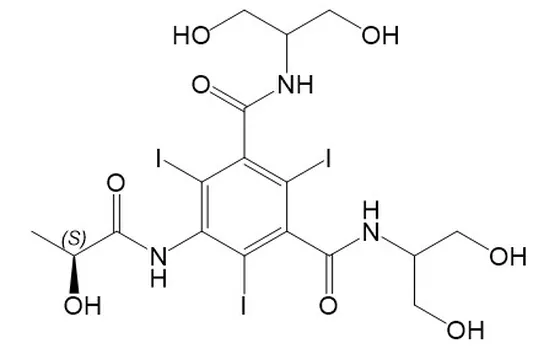
That lactyl group is what makes the molecule chiral. Its alpha carbon holds a hydroxyl, a methyl, the amide carbonyl and a hydrogen, so the acyl fragment exists as two enantiomers and the drug is the S one. Nothing else in iopamidol qualifies: the ring is planar, each serinol arm is symmetric within itself, and the iodines are identical. One stereocenter, on a side chain that exists to keep the molecule in solution.
Iodine also sets the dose arithmetic. Three iodines are 380.7 of the 777.1 molecular weight, 49.0% by mass, so the 370 mg iodine per mL presentation holds about 755 mg of iopamidol per mL and a 100 mL administration is roughly 75 g in one sitting[1]. That one number governs what a specification can defensibly say.
Where the lactate enters, and what one intermediate proves
The molecule is assembled from 5-amino-2,4,6-triiodoisophthalic acid through an activated, acetyl-protected lactate: the aromatic amine is acylated with (S)-2-acetoxypropanoyl chloride, the two acids become acid chlorides, those are amidated with 2-amino-1,3-propanediol, and the acetyl comes off at the end[4]. Four operations, and each leaves its own residue.
The catalog holds the intermediate that fixes the order of the first two. CAS 60166-91-8 is a 2,4,6-triiodo-1,3-benzenedicarbonyl dichloride, C13H8Cl2I3NO5, 709.8, that already carries the acetylated lactyl on its ring nitrogen[2]. A compound of that shape can only exist if acylation preceded the acid chlorides. Reverse the order and the intermediate has no reason to form.
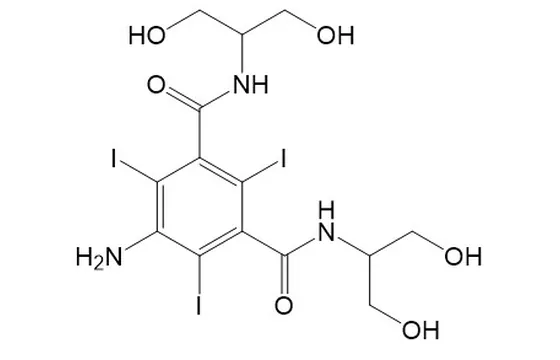
EP impurity A is the same skeleton one step earlier, C14H18I3N3O6, 705.0[2]. The letters used here are the pharmacopoeial ones, running from A to K with no I[5]. EP impurity A is both the acylation substrate and the product of lactyl amide hydrolysis, and that double identity weakens every release result for it: a batch at 0.05% may have been under-acylated, or purified well and then begun to hydrolyse in the dryer.
Three entries carry the parent's formula
Four records in this catalog share C17H22I3N3O8 exactly. One is the drug. The other three are why a formula match is not an identity check.
| Catalog entry | CAS | What differs from the drug | Origin |
|---|---|---|---|
| Iopamidol | 60166-93-0 | nothing | the drug |
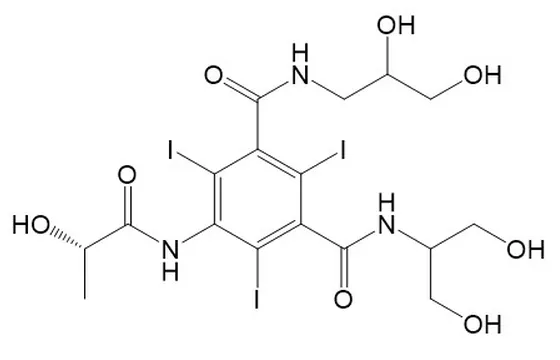
| EP impurity G | 1869069-72-6 | one arm is a 2,3-dihydroxypropyl group instead of 1,3-dihydroxypropan-2-yl | wrong amino-diol regioisomer in the amidation |
| Impurity 27 | 62883-00-5 | same skeleton, no configuration stated at the lactate carbon | the stereochemical position: epimer, racemate or unassigned |
| Impurity 45 | 77868-45-2 | nothing assignable from public data | undetermined |
Table 1. The four C17H22I3N3O8 records. Structures and formulas from the public compound records [2].
The first of the three is chemically the most interesting. 2-amino-1,3-propanediol is symmetric, so the nitrogen can only attach at one place and the two product arms are identical. 3-amino-1,2-propanediol is not. When that isomer is in the amidation feed, one arm becomes 2,3-dihydroxypropyl while the other stays 1,3-dihydroxypropan-2-yl. The formula does not move, and neither does the exact mass, the fragmentation or the number of hydroxyls available for derivatisation. What changes is the shape of one arm.
The second entry differs only in a configurational assignment. Its systematic name carries no descriptor at the lactate carbon, and the CAS number reads as an originator code rather than a descriptive name. Whether it is the R enantiomer or the racemate cannot be settled from the name, only that its skeleton is the drug's and its free variable is one carbon[2]. Either way the specification needs the same chiral method and limit.
The acid end: a glycolyl, an acetyl, and an acetyl that stayed behind
Two entries are one carbon short of the drug, and they are short in different places. EP impurity B, CAS 77868-41-8, C16H20I3N3O8, 763.1, carries a 2-hydroxyacetyl group where the drug carries 2-hydroxypropanoyl[2]: glycolic acid in the acyl position, either charged by mistake or present in the lactic acid. One methylene missing at the far end of the side chain, and the hydroxyl the chiral argument depends on still there.
EP impurity C, CAS 87932-07-8, C16H20I3N3O7, 747.1, is the acetanilide, 5-acetamido in place of 5-lactamido[2]. Two carbons short and no hydroxyl. Chemically it is the least interesting impurity in the group; practically it is the most diagnostic, because an acetyl in a product whose acyl chemistry is a lactate means acetic acid or anhydride was present where it had no business being.
EP impurity E is the one to watch. CAS 60166-92-9, C19H24I3N3O9, 819.1, is the drug with the protecting acetyl still on the lactate hydroxyl[2]. Its existence is independent proof that the acetyl strategy above is the real one, and its presence in a batch is a statement about the last operation rather than about storage: deprotection did not finish.
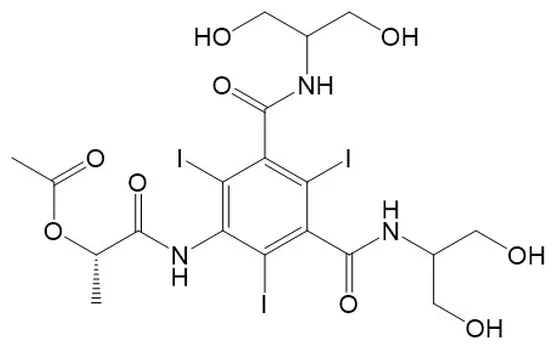
The distinction is worth money in a deviation. A degradant follows time and temperature; an unremoved protecting group follows the quench, the hydrolysis pH, the residence time in the last reactor and the number of washes. Whether the level tracks batch age or reactor campaign is the fastest way to tell a poor deprotection from a slow hydrolysis.
The amine end: under-amidation, ethanolamine, and dimethylamine
The other terminus fails in three ways, and one lands on exactly the formula of EP impurity C.
EP impurity D, CAS 87932-11-4, C14H15I3N2O7, 704.0, has one arm amidated and the other still a carboxylic acid[2]. One of the two acid chlorides met water before it met the amine. EP impurity J, CAS 77868-44-1, C16H20I3N3O7, 747.1, has one arm built from ethanolamine, so that arm is 2-hydroxyethyl rather than 1,3-dihydroxypropan-2-yl[2]. EP impurity F, CAS 1869069-71-5, C16H20I3N3O6, 731.1, carries a dimethylamide on one arm[2]. Dimethylamine is what dimethylformamide becomes with thionyl chloride, so EP impurity F points at the acid chloride step, not the amidation.
| Formula | What changed | Operation | Entries |
|---|---|---|---|
| C17H23I2N3O8 | one iodine replaced by hydrogen | deiodination | impurity K |
| C17H24IN3O8 | two iodines replaced by hydrogen | deiodination | des-diiodo iopamidol |
| C17H22ClI2N3O8 | chlorine in place of iodine | chlorination, not deiodination | EP impurity H |
| C17H22I3N3O8 | amine-arm regioisomer | amidation | EP impurity G |
| C19H24I3N3O9 | protecting acetyl retained | deprotection | EP impurity E |
| C16H20I3N3O8 | glycolyl in place of lactyl | acylation | EP impurity B |
| C16H20I3N3O7 | acetyl in place of lactyl | acylation | EP impurity C |
| C16H20I3N3O7 | ethanolamine in place of serinol | amidation | EP impurity J, impurities 26 and 41 |
| C16H20I3N3O6 | dimethylamide on one arm | acid chloride step | EP impurity F |
| C14H18I3N3O6 | lactyl absent | acylation, or amide hydrolysis | EP impurity A |
| C14H15I3N2O7 | one arm never amidated | amidation | EP impurity D |
Table 2. Iopamidol impurities grouped by the operation that produced them. Formulas and names from the public compound records [2].
One row deserves a second look. C16H20I3N3O7 appears four times: EP impurity C, EP impurity J, impurity 26 and impurity 41[2]. Two lost atoms at the acid terminus and two at the amine terminus, yet all four arrive at one formula because a methylene and a hydroxyl swap places arithmetically. On a nominal mass screen they are one peak group; on a formula-based suspect list they are four candidates with the same molecular ion.
Deiodination runs down a ladder; a chlorine is not a rung on it
Iodine leaves these rings. The catalog carries the first two rungs: impurity K, CAS 1788899-70-6, C17H23I2N3O8, 651.2, and the des-diiodo entry, CAS 1798830-49-5, C17H24IN3O8, 525.3[2]. Each rung replaces iodine with hydrogen for 125.9 mass units, and nothing else common lands on that spacing. Spotting either is easy; deciding whether it happened in the reactor or in the vial is not.
EP impurity H is not on that ladder. CAS 2996862-55-4, C17H22ClI2N3O8, 685.6, is 4-chloro-2,6-diiodo, with chlorine at the 4-position instead of iodine or hydrogen[2]. Deiodination removes iodine; it does not install chlorine. A batch containing EP impurity H has met a chlorine source, and the candidates are chlorinated process water, an upstream chlorinating reagent, or cleaning chemistry that was not rinsed out. Reading it as a deiodination product sends the investigation to the filling line when the answer is in the reactor.
Radiation moves these molecules too: a 2024 study of iomeprol and iopamidol formulations exposed to X-ray found measurable change after irradiation[6]. Contrast media therefore belong with the photolabile injections, with amber glass where possible and a light-exposure arm in the stability protocol rather than an assumption that a sealed vial is inert.
The other end of the process closes the loop. Two entries, CAS 127324-02-1 and 127324-03-2, are both C8H5I2NO4, 432.9: 5-amino-2,4-diiodoisophthalic acid and a position isomer of it[2]. Iodination can leave a position empty or fill the wrong one, and either outcome is inherited downstream. No recrystallisation removes a compound that differs from its parent by one iodine on the same ring.
What the mass spectrometer settles, and what it only appears to settle
Iodine is monoisotopic. That single fact decides how these compounds behave in a mass spectrometer, and it is routinely got wrong in method notes written by analogy with brominated compounds. The [M+H]+ envelope of iopamidol is not a wide halogen cluster; it is the ordinary carbon envelope of a C17 molecule, with M+1 at roughly 18% of the base peak and M+2 at about 1.5%. What iodine contributes is mass, not pattern. Three of them put the molecule at 777, far from anything an excipient or a leachant can supply.
Formula confirmation is therefore easy and structure confirmation is not. Every same-formula entry in the two tables gives the same exact mass and the same product ions, because the bonds that break in the collision cell are the bonds that were always there. What differs is where an atom sits and which way a bond points.
The consequence is that an unknown-peak investigation on this product cannot be closed by accurate mass alone; it needs a standard, and the right one of four. Method development belongs in two tiers: a high-resolution survey for the deiodination and chlorination series, where mass is decisive, and a chromatographic separation with single-compound standards for the isobaric families, where it is not.
Which neighbours can be reasoned from, and which cannot
The comparison is worth making precisely because four of the five non-ionic agents in this catalog are achiral. Iohexol carries an acetyl and, on the same nitrogen, a 2,3-dihydroxypropyl group, which makes that nitrogen a tertiary amide and leaves no stereocenter. Iopromide carries a methoxyacetyl and an N-methyl. Ioversol carries a hydroxyacetyl and a 2-hydroxyethyl group. Iodixanol is a dimer in which both halves are acetylated and the linker is symmetric by construction[1]. None can produce an epimer, because none has a configuration to invert.
That is the boundary of transferability. What is learned about the iopamidol epimer does not apply to iohexol or iopromide, and the axes that dominate those two have no counterpart here. Within the monomeric group the amine chemistry does transfer: all four are bis-amides of 2-amino-1,3-propanediol, so under-amidation and the 3-amino-1,2-propanediol regioisomer are shared risks. What does not transfer is anything keyed to the acyl group, because only this molecule's acyl chemistry is a chiral hydroxy acid with a protecting group.
The Chinese filing record shows how much of this work has already been done elsewhere[7]:
Five questions to settle before a batch is released
- Is the lactic acid single-enantiomer at the supplier? If not, the epimer is a process impurity needing a chiral method, not a degradant a stability study will reveal.
- Does the certificate name EP impurity G, or only quote C17H22I3N3O8? A supplier who cannot say which of the four records was used to assign the peak has not assigned the peak.
- Is EP impurity E reported? It is the only direct measure of deprotection completeness, and it is invisible to any specification that stops at unspecified impurities.
- Are EP impurity C and EP impurity J resolved? Same formula, opposite ends of the molecule; a method that resolves one may miss the other.
- Is EP impurity H on the panel? If not, a chlorine source can sit in the process for years without appearing in a review.
The limit arithmetic is blunt. At 75 g per administration the above-2-gram row of ICH Q3A(R2) applies, with identification and qualification both at 0.05% and no milligram alternative[3]; a 0.05% impurity is 37.5 mg in one sitting, and there is no separate qualification stage. For a mutagenic impurity the arithmetic runs the other way: M7(R2) allows 120 micrograms per day for a month or less, and 120 micrograms against 75 g is 1.6 ppm[8], thirty times below the Q3A row.
The catalog carries 25 numbered iopamidol impurities between 1 and 45 alongside the ten EP letters: the full iopamidol listing covers the deiodination ladder, the amide-arm regioisomers and the retained acetyl.
Frequently Asked Questions
Does iopamidol actually have a chiral center?
Why does the catalog carry four different records with the formula C17H22I3N3O8?
Can a deiodination product be mistaken for a chlorination product?
Is EP impurity A an intermediate or a degradant?
Why does EP impurity E matter more than its size suggests?
Does iodine make these compounds easy or hard to detect by mass spectrometry?
Is a chiral method needed for every iopamidol batch?
What limit is realistic for a mutagenic impurity at a 75 g dose?
Related Substances and Reference Standards
- Iopamidol (25 impurity / derivative entries)
- Iohexol (33 impurity / derivative entries)
- Iodixanol (12 impurity / derivative entries)
- Ioversol (24 impurity / derivative entries)
- Iopromide (33 impurity / derivative entries)
References and Sources
- U.S. National Library of Medicine, PubChem, Iopamidol: C17H22I3N3O8, molecular weight 777.1, systematic name describing a 2,4,6-triiodobenzene-1,3-dicarboxamide with two 1,3-dihydroxypropan-2-yl amide arms and a (2S)-2-hydroxypropanoyl group on the aromatic nitrogen, accessed 2026-11-11
- U.S. National Library of Medicine, PubChem, Compound records for the iopamidol impurity series: EP impurities A to K, the deiodo and des-diiodo entries, the diiodo isophthalic acid pair, and the four C17H22I3N3O8 records, with systematic names used to assign each structure, accessed 2026-11-11
- International Council for Harmonisation, ICH Q3A(R2), Impurities in New Drug Substances: Attachment 1 thresholds, including the above-2-gram row at 0.03% reporting and 0.05% identification and qualification, accessed 2026-11-11
- RSC Advances, 2024, Enabling amidation in water: micellar catalysis approach for sustainable synthesis of iopamidol, describing the acylation and amidation sequence for the triiodo isophthalamide core, accessed 2026-11-11
- Council of Europe, European Directorate for the Quality of Medicines and HealthCareEuropean Pharmacopoeia, iopamidol monograph and its specified impurities A to K, which fix the lettering used in this article
- Radiography, 2024, Stability testing of iomeprol and iopamidol formulations subjected to X-ray radiation, accessed 2026-11-11
- Center for Drug Evaluation, National Medical Products Administration of China, Public accepted-filing records for iopamidol counted by application type and applicant: 226 accepted filings from 33 applicants as retrieved on 2 November 2026, accessed 2026-11-11
- International Council for Harmonisation, ICH M7(R2), Assessment and Control of DNA Reactive Mutagenic Impurities: the 120 micrograms per day limit for a treatment duration of one month or less, accessed 2026-11-11
This article was prepared by the CATO technical team. Regulatory, pharmacopoeial and published literature content cited above is attributed in the reference list. It is provided for technical exchange and search reference only and does not constitute a quality specification or regulatory advice. For any specific substance, the applicable test methods, limits and filing requirements are governed by the current regulations, pharmacopoeial monographs and official publications.
Product information on this site is provided for research search and selection reference only and is not a quality specification; technical data, purity and structural confirmation are governed by the shipped COA and our written confirmation. All products mentioned are for research use only, not for human or animal diagnostic or therapeutic use.