Irinotecan Hydrochloride: The Lactone Ring Is Not an Impurity, and the Assay Cannot Tell You It Opened
Irinotecan↗ hydrochloride is formulated at pH 3.5 for a reason that has nothing to do with solubility. The camptothecin E-ring is a six-membered lactone, and opening it costs the molecule its activity without changing what the molecule is. That single fact reorganises the stability programme: what the assay reports, what a related-substances method can and cannot see, and why a diluted infusion has a 24-hour window while the concentrate has two years.
Note: product names shown in red (marked with ↗) are links - click through to the product page for structure, CAS number, purity and lead time.
Two hydrolysable bonds, and only one of them is a defect
Key points
- Irinotecan hydrochloride trihydrate is C33H38N4O6·HCl·3H2O, 677.19; the marketed concentrate is 20 mg/mL at pH 3.5, range 3.0 to 3.8, with 0.9 mg/mL lactic acid and 45 mg/mL sorbitol[1].
- Irinotecan and SN-38 each exist as an active lactone and an inactive hydroxy acid anion; acid pH favours the closed ring and basic pH favours the open one[1].
- Opening the E-ring adds one water molecule: C33H38N4O6 becomes C33H40N4O7, 586.68 becomes 604.70. This catalogue carries that open acid as impurity 35, together with its sodium salt.
- The carbamate at C10 hydrolyses to SN-38, which is EP impurity E, is 2- to 2000-fold more potent than the parent and is 95 per cent protein bound against roughly 50 per cent for irinotecan[1].
Irinotecan is a camptothecin. Five rings are fused into a planar core, an ethyl group sits at C7, and a carbamate at C10 links the core to 4-(piperidin-1-yl)piperidine. The E-ring is a six-membered lactone closed on a tertiary hydroxyl at C20. That last detail defines the molecule: the ring is the cyclic ester of a tertiary alcohol and a carboxylic acid, so opening it does not require a reagent. Water will do.
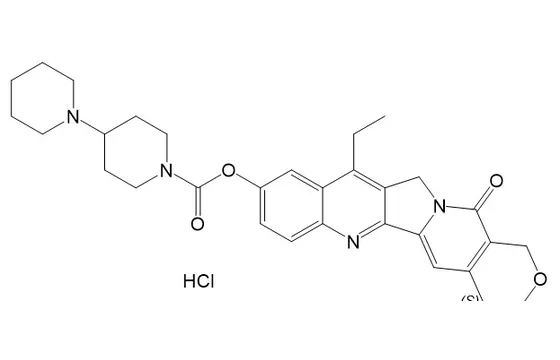
Two bonds in this structure hydrolyse, and they behave nothing alike. The lactone opens reversibly. The carbamate opens irreversibly, and when it does the molecule splits: the C10 oxygen stays with the camptothecin, and the product is 7-ethyl-10-hydroxycamptothecin, SN-38. One of these events changes the molecule's shape and its activity without changing what the molecule is. The other destroys it.
Every stability question about irinotecan reduces to keeping those two apart. A test that reports a single number for loss of parent cannot, because the two losses have different causes, different reversibility and different consequences.
Ring opening adds eighteen daltons that the detector does not see
The open form is not a fragment. It is the same skeleton with the E-ring hydrolysed: C33H40N4O7, 604.70, against 586.68 for the closed lactone[2]. The quinoline chromophore that carries the ultraviolet absorbance is untouched, so the two species have almost the same spectrum, the same molar response within a few per cent, and no distinguishing feature in a photodiode array.
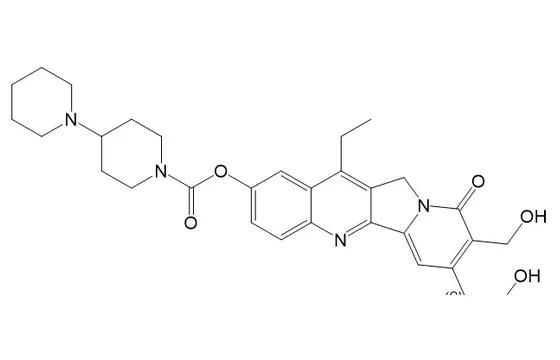
Once open, the molecule also carries a carboxylate. Above pH 4 it is anionic, it elutes early on a C18 column, and its peak shape depends on the ionic strength of the mobile phase rather than on the chemistry of the analyte. This catalogue holds the species twice: as the free acid at 142706-06-7, C33H40N4O7, and as a sodium salt at 1329502-92-2, C33H39N4NaO7. The salt is the giveaway. The species exists as an anion, and any method that does not account for that will either lose it in the solvent front or fail to integrate it.
The equilibrium itself is fast. In neutral buffer the two forms interconvert within minutes, which is why a sample's ring state is decided by the last buffer it touched, not by the sample it came from.
A pH 3 mobile phase closes the ring inside the column
Here is the consequence that catches people. Almost every published irinotecan assay runs an acidic mobile phase, usually with a phosphate or formate buffer near pH 3, because that is what gives a sharp peak for the lactone. The same acidity drives the equilibrium back towards the closed form. The column is not an inert separator; for this analyte it is a reactor with a residence time of several minutes. The underlying chemistry is not in dispute: irinotecan exists as a lactone, a carboxylate or both depending on pH, and only the closed form inhibits topoisomerase I[3].
The result is a method that measures covalent impurities very well and ring state not at all. Inject a sample that is 40 per cent open and the chromatogram shows one peak. Nothing is wrong with the integration, the system suitability passes, and the assay returns close to 100 per cent of label claim while the product has lost a large part of its activity.
Two ways out, and they answer different questions. If the question is how much covalent impurity is present, keep the acidic method and accept that it reports the sum of both ring states as irinotecan. If the question is how much active lactone remains, the ring state has to be measured as a ratio, on a method whose mobile phase does not force the equilibrium, with the sample quenched at the pH it actually occupies. The second measurement belongs in the stability protocol and, for an aqueous injection, in the specification.
The concentrate is formulated for the ring, not for solubility
The commercial concentrate is 20 mg/mL irinotecan hydrochloride in water with 45 mg/mL sorbitol and 0.9 mg/mL lactic acid, adjusted to pH 3.5 with sodium hydroxide or hydrochloric acid, range 3.0 to 3.8[1]. Sorbitol at 45 mg/mL carries tonicity, and since the labelling describes the salt as only slightly soluble in water it is probably doing some solvent work as well. Lactic acid at 0.9 mg/mL is roughly 10 mM, a weak buffer but enough to hold pH 3.5 in a vial.
Dilution destroys that. The label directs dilution to 0.12 to 2.8 mg/mL in 5 per cent dextrose or 0.9 per cent sodium chloride, and permits storage for up to 24 hours at 2 to 8 degrees Celsius if the infusion is not used immediately[1]. At 1 mg/mL the lactate is diluted twenty-fold; the dextrose solution contributes no buffer capacity of its own. The diluted solution therefore sits wherever its own concentration and the bag's starting pH put it, and that number moves during the hold.
| State | Irinotecan | pH and buffer | What limits the hold time |
|---|---|---|---|
| Concentrate in vial | 20 mg/mL | 3.5, about 10 mM lactate | carbamate hydrolysis, slow at this pH |
| Infusion in D5W | 0.12 to 2.8 mg/mL | unbuffered, drifts upward | ring opening, then carbamate hydrolysis |
| Infusion in saline | 0.12 to 2.8 mg/mL | unbuffered, chloride present | same, with a higher ionic strength |
Table note: product attributes from the approved labelling[1]; the hold-time column is a mechanistic reading of those attributes, not a labelled limit.
The 24 hours at 2 to 8 degrees is doing more work than the 24 hours suggests. Cooling slows both the ring opening and the carbamate hydrolysis, and it is the reason a refrigerated bag is acceptable while the same bag at room temperature is not.
SN-38 is a starting material, a degradant and the active drug at once
The carbamate is the second liability and the more interesting one. Carbamates are acid-stable and base-labile, which is why the concentrate at pH 3.5 survives two years while a neutral infusion does not. Hydrolysis cleaves the C10 oxygen to carbonyl bond, releasing SN-38, carbon dioxide and 4-(piperidin-1-yl)piperidine.
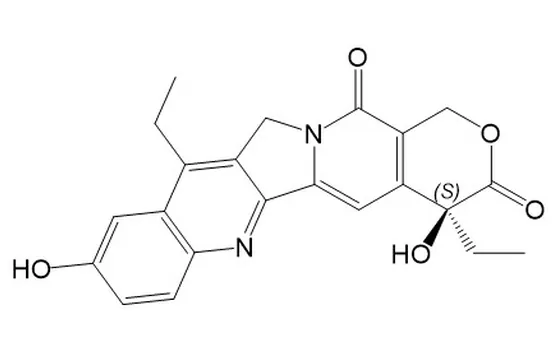
SN-38 is not a dead end. It is the topoisomerase I poison the prodrug was built to deliver, its potency relative to irinotecan spans 2- to 2000-fold depending on the system, and it is about 95 per cent bound to plasma protein against 30 to 68 per cent for the parent[1]. In this catalogue it is EP impurity E, filed between the desethyl impurity and the dimer.
That creates a specification problem with no clean answer. A limit on SN-38 expressed as a percentage of irinotecan is a limit on a compound that is more active than the parent, is also a synthesis starting material, and is also the metabolite a clinician expects to see. If the number is set for safety, it is set far above the level at which potency begins to shift. If it is set for potency, it will be tight enough that the synthesis route, not the stability programme, becomes the binding constraint. Both statements are true and a reviewer will ask which one the specification is for.
Acid stress is the least informative experiment available
Forced degradation on irinotecan routinely reports a large acid-driven loss and a chromatogram with almost nothing new in it. That is not a contradiction; it is the ring opening again. Acid opens the lactone, the assay by area counts the open form as parent on an acidic method, and the mass balance appears to fail by exactly the amount that opened.
| Condition | Dominant event | Reversible | What a related-substances method shows |
|---|---|---|---|
| Acid, 0.1 M, 60 C | E-ring opening to the hydroxy acid | yes, on pH reversal | little or nothing, because the column re-closes it |
| Base, 0.1 M, room temperature | carbamate hydrolysis to SN-38 | no | SN-38 plus ring-opened material |
| Peroxide, 3 per cent | piperidine nitrogen oxidation | no | polar N-oxide, poorly retained |
| Light, ICH Q1B option 1 | core photochemistry plus ring effects | partly | discolouration before peaks appear |
Table note: assignments follow the labelled lactone and carbamate chemistry[1] and are stated as mechanism rather than as measured recovery; the light exposure follows ICH Q1B option 1[4].
The base experiment is the one that pays. It produces SN-38 in quantities a method can see, it distinguishes a product that hydrolyses from one that does not, and it gives the only number that matters for an aqueous injection: how fast the carbamate goes at the pH the product actually holds. Acid stress should still be run, but as a ring-state experiment with a ratio measurement, not as a purity experiment.
What a specification can carry, and what it cannot
ICH Q3B(R2) sets the thresholds for degradation products in a finished product by maximum daily dose[5]:
| Maximum daily dose | Reporting | Identification | Qualification |
|---|---|---|---|
| 1 g or less | 0.1 per cent | 0.5 per cent or 1.0 mg per day | 1.0 per cent or 1.0 mg per day |
| More than 1 g | 0.05 per cent | 0.2 per cent or 2.0 mg per day | 0.5 per cent or 2.0 mg per day |
ICH Q3A(R2) applies the same three thresholds to the drug substance, at 0.05 per cent reporting and 0.10 per cent identification for 2 g per day or less[6], so a supplier and a finished-product manufacturer are working to different numbers for the same molecule.
For an intravenous product the daily dose needs a definition before the table can be read. A 350 mg per square metre dose in an adult of 1.7 square metres is close to 600 mg in a single infusion, so the upper row does not apply and the identification threshold is 0.5 per cent, or 3 mg. A weekly 125 mg per square metre regimen gives a smaller number and a tighter percentage. Two products with the same strength can therefore sit in different rows, which is a filing decision, not a laboratory one.
None of this reaches the ring. Q3B governs degradation products, and the open form is the same molecule in a different state, with an acceptance criterion that belongs to efficacy. The defensible structure is a specification with two arms: related substances against the Q3B thresholds, and a lactone content or lactone-to-acid ratio with a limit justified by the dose-response of the lactone, not by a toxicological threshold.
give a sense of how many applicants are answering the same question.Where the camptothecin analogy holds and where it collapses
Topotecan shares the E-ring lactone and shares the problem: its open form is inactive, and an acidic method hides it the same way. It does not share the carbamate, so it has no SN-38 equivalent and no base-labile ester. A stability protocol copied from irinotecan will over-test topotecan for hydrolysis and under-test it for ring state, because the ratio, not the impurity, is the whole story there.
Belotecan and camptothecin sit on the same scaffold with different substitution, and the same rule applies: the lactone is the pharmacophore and the open acid is not, so any comparison of impurity profiles across the family has to state which ring state was measured. Etoposide is the trap. It is a topoisomerase II poison with a glycoside and a pendent ring, no lactone of this kind, and an entirely different degradation route through the aglycone. Nothing about irinotecan's ring chemistry transfers to it.
Liposomal irinotecan is the case where the analogy fails in the other direction. The bilayer holds the drug in a environment where the ring stays closed, so the 24 hour refrigerated window for a compounded infusion is not the relevant limit; the liposome brings its own degradation chemistry, lysolipid formation and phospholipid hydrolysis among it[7], and the assay has to release the drug from the vesicle before it can say anything about the ring.
Reference standards for the two liabilities
This catalogue holds 76 irinotecan hydrochloride entries, which is what a molecule with a two-year shelf life and a dozen rearrangements accumulates. The set that matters for stability work is small: the trihydrate at 136572-09-3 for the labelled form, the open acid at 142706-06-7 and its sodium salt at 1329502-92-2 for the ring, SN-38 at 86639-52-3 for the carbamate, and the desethyl impurity at 103816-16-6 as the control that separates a route artefact from a degradant. [See every irinotecan entry](Irinotecan Hydrochloride)
Two practical notes. The open acid standard should be weighed and dissolved at the pH of use, not at neutral pH where it will partly re-close before the flask is capped. And because the equilibrium is temperature sensitive, a standard prepared cold and injected warm is a different solution by the time it reaches the detector.
Frequently Asked Questions
Is the ring-opened form of irinotecan an impurity or a degradant?
Why does the assay not fall when the ring opens?
Does the same thing happen with SN-38?
How long can a diluted infusion actually be held?
Should acid stress be removed from the forced degradation package?
Is the trihydrate form relevant to stability?
What does the 2- to 2000-fold potency range for SN-38 mean for limits?
Where does ICH M7 come in for this molecule?
Related Substances and Reference Standards
- Irinotecan Hydrochloride (76 impurity / derivative entries)
- Topotecan (7 impurity / derivative entries)
- Belotecan (59 impurity / derivative entries)
- Camptothecin (18 impurity / derivative entries)
References and Sources
- U.S. National Library of Medicine, DailyMed, CAMPTOSAR (irinotecan hydrochloride) injection, solution: prescribing information, including 20 mg/mL strength, pH 3.5 with range 3.0 to 3.8, lactic acid 0.9 mg/mL, sorbitol 45 mg/mL, dilution to 0.12 to 2.8 mg/mL, 24 hour hold at 2 to 8 C, the lactone and hydroxy acid equilibrium, and protein binding, accessed 2026-11-12
- U.S. National Library of Medicine, PubChem, Irinotecan, CAS 97682-44-5, C33H38N4O6, 586.7; irinotecan hydrochloride trihydrate, CAS 136572-09-3, C33H45ClN4O9, 677.2; SN-38, CAS 86639-52-3, C22H20N2O5, 392.4; 11-desethyl irinotecan, CAS 103816-16-6, C31H34N4O6, 558.6, accessed 2026-11-12
- AAPS PharmSciTech, Evaluating the potential for delivery of irinotecan via the buccal route: physicochemical characterization, recording that CPT-11 exists as a lactone, a carboxylate or both depending on pH, accessed 2026-11-12
- International Council for Harmonisation, ICH Q1B, Photostability testing of new drug substances and products: option 1 exposure of 1.2 million lux hours and 200 W h per square metre, accessed 2026-11-12
- International Council for Harmonisation, ICH Q3B(R2), Impurities in new drug products: reporting, identification and qualification thresholds by maximum daily dose, accessed 2026-11-12
- International Council for Harmonisation, ICH Q3A(R2), Impurities in new drug substances: reporting, identification and qualification thresholds, including 0.05 per cent reporting and 0.10 per cent identification at 2 g per day or less, accessed 2026-11-12
- Journal of Pharmaceutical Sciences, Drug stability and minimized acid- and drug-catalyzed phospholipid degradation in liposomal irinotecan, accessed 2026-11-12
This article was prepared by the CATO technical team. Regulatory, pharmacopoeial and published literature content cited above is attributed in the reference list. It is provided for technical exchange and search reference only and does not constitute a quality specification or regulatory advice. For any specific substance, the applicable test methods, limits and filing requirements are governed by the current regulations, pharmacopoeial monographs and official publications.
Product information on this site is provided for research search and selection reference only and is not a quality specification; technical data, purity and structural confirmation are governed by the shipped COA and our written confirmation. All products mentioned are for research use only, not for human or animal diagnostic or therapeutic use.