Four Substances, One Formula: Why Latanoprost Eye Drops Fail on Content, Not on Impurity Limits
Latanoprost↗ is dosed in micrograms, and that single fact dismantles the usual impurity argument. In a 500 mg tablet the specification is built around parts per million of a genotoxic degradant; in a 0.005 percent ophthalmic solution the identification threshold is 1.0 percent, no plausible degradant can approach a toxicological threshold, and the product still fails. Bottles returned after six weeks of ordinary patient use averaged 88.1 percent of label. What follows concerns the four substances that share the formula C26H40O5, why only chromatography separates them, and why the assay rather than the impurity list is the specification line that decides.
Note: product names shown in red (marked with ↗) are links - click through to the product page for structure, CAS number, purity and lead time.
A prodrug assembled from four stereochemical decisions
Key points
- Latanoprost is C26H40O5, 432.6, CAS 130209-82-4, the isopropyl ester of a prostaglandin F2alpha analogue with four stereocenters. The ester exists to cross the cornea and is not designed to survive storage, which the label concedes by requiring 2 to 8 Celsius until the bottle is opened[1].
- One 30 microlitre drop of the 0.005 percent solution carries about 1.5 micrograms, placing the product in the lowest dose band of ICH Q3B(R2), where identification and qualification both sit at 1.0 percent[2].
- Content loss has been measured: bottles collected after a mean of 43.9 days of patient use held 88.1 percent of label, against 103.7 percent for the amide analogue bimatoprost[3].
- Four catalogue entries share C26H40O5 — the drug, its C15 epimer, its 5-trans isomer and the isomer wrong at both positions — and no ultraviolet or mass detector distinguishes them[4].
The molecule is an isopropyl ester, and almost everything about its impurity profile follows from that: the ester must be present at instillation and gone by the time the drug reaches the aqueous humour, so the same bond is a delivery feature and the weakest point in the structure[1].
Latanoprost is C26H40O5, 432.6, CAS 130209-82-4, and its systematic name is propan-2-yl (Z)-7-[(1R,2R,3R,5S)-3,5-dihydroxy-2-[(3R)-3-hydroxy-5-phenylpentyl]cyclopentyl]hept-5-enoate[4]. Four stereocenters are written into that name: the two ring carbons carrying hydroxyls, the ring carbon bearing the upper chain, and the carbon carrying the C15 hydroxyl. Sixteen stereoisomers are possible and one of them is the drug.
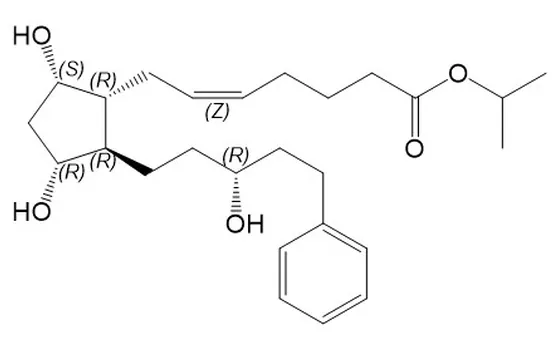
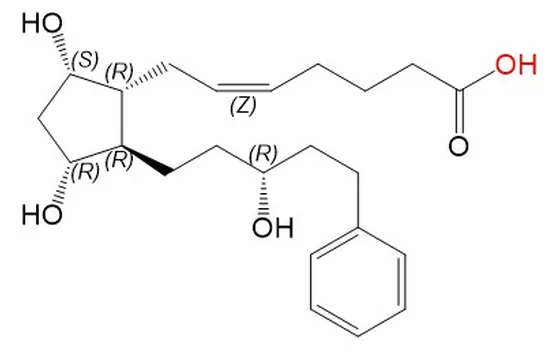
The pharmacophore is not the ring. Affinity at the FP receptor depends on the C15 hydroxyl and on a carboxylic acid at C1, and the isopropyl group esterifies exactly that acid. Latanoprost crosses the cornea as an ester and is hydrolysed to latanoprost acid behind it, so the acid is the active species and the ester is the transport form. A degradant in the bottle is therefore a loss of the transport form, which is worse than it sounds, because the acid crosses the cornea poorly.
A specification written in percent is, at this scale, a specification written in nanograms: the whole 2.5 millilitre bottle holds 125 micrograms.
The dose band that changes the threshold
The ICH Q3B(R2) thresholds are five bands rather than one table, and the band is chosen by maximum daily dose, not by therapeutic class[2]. Most programmes work in the middle rows, where identification sits at 0.2 percent. Latanoprost works in the first row.
| Maximum daily dose | Identification threshold | Qualification threshold |
|---|---|---|
| Below 1 mg | 1.0 percent or 5 micrograms per day | 1.0 percent or 50 micrograms per day |
| 1 to 10 mg | 0.5 percent or 20 micrograms per day | 1.0 percent or 50 micrograms per day |
| 10 to 100 mg | 0.2 percent or 2 mg per day | 0.5 percent or 200 micrograms per day |
| 100 mg to 2 g | 0.2 percent or 2 mg per day | 0.2 percent or 3 mg per day |
| Above 2 g | 0.10 percent | 0.15 percent |
Table: degradation-product thresholds for new drug products, from ICH Q3B(R2) Attachment 1. At 1.5 micrograms a day the absolute-mass limb of the first row is unreachable, so the percentage governs[2].
At 1.5 micrograms a day, 5 micrograms of degradant would be 333 percent of the drug and 50 micrograms would be 3,333 percent. The percentage decides, and the deciding number is 1.0 percent for identification and qualification alike. A degradant at 0.9 percent is 13.5 nanograms a day. No toxicological question survives that arithmetic.
The asymmetry with the drug substance confuses people who move between specifications. ICH Q3A(R2) governs latanoprost as a raw material and sets identification at 0.10 percent and qualification at 0.15 percent for any dose below 2 g, with no low-dose band at all[5]. The same molecule therefore carries a ten-fold tighter identification threshold as an API than as a product. Both numbers are correct, and neither says what to do about a 0.6 percent epimer the method cannot see.
The ester breaks, and the break has been measured
Ester hydrolysis is the dominant chemical event in an aqueous formulation, and it has been measured in three directions that bracket the problem.
Clinically: bottles returned by 34 patients after a mean of 43.9 days of ordinary use contained 88.1 percent of label, against 103.7 percent for bimatoprost, an amide with no ester to lose[3]. That is a mean over real handling, and the number a generic developer must match.
Thermally: bottles held at 27, 37 and 50 Celsius for up to 30 days, uncapped for a minute daily, lost latanoprost at 0.15 and 0.29 micrograms per millilitre per day at the two higher temperatures and not measurably at 27[6]. That 27 Celsius result is why the label can permit six weeks at room temperature once the bottle is opened.
In formulation terms: an emulsion held at 60 Celsius for four weeks recovered 100.4, 100.7 and 99.2 percent at pH 5.0, 6.0 and 7.0[7]. The trend is small but not accidental — ester hydrolysis is base-catalysed. The commercial solution sits at pH 6.7 in a phosphate buffer, a compromise between stability, comfort and preservative performance[1].
The label follows from this: unopened bottles at 2 to 8 Celsius, protected from light, tolerated at 40 Celsius for eight days in shipment, and six weeks at up to 25 Celsius once opened[1].
Four substances, one formula
Here is what makes the assay difficult. The catalogue carries three isomers of latanoprost that share its formula exactly: the C15 epimer at CAS 145773-22-4, the 5-trans isomer at CAS 913258-34-1, and the isomer wrong at both positions at CAS 1235141-39-5. All four are C26H40O5, all four are 432.6, and all four fragment the same way.
| Entry | CAS | Formula | Difference from the drug |
|---|---|---|---|
| Latanoprost | 130209-82-4 | C26H40O5 | none |
| C15 epimer | 145773-22-4 | C26H40O5 | configuration of the hydroxyl eight bonds from the ring |
| 5-trans isomer | 913258-34-1 | C26H40O5 | geometry of the 5,6 double bond |
| 15-epi-5-trans | 1235141-39-5 | C26H40O5 | both of the above |
| Latanoprost acid | 41639-83-2 | C23H34O5 | isopropyl ester removed |
| 15-ketone | 135646-98-9 | C26H38O5 | C15 alcohol oxidised, two hydrogens fewer |
Table: species that share a formula with latanoprost or sit one ester or one oxidation state away from it. CAS numbers and structures verified against PubChem[4].
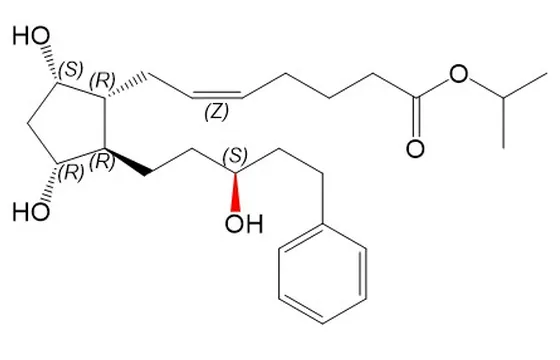
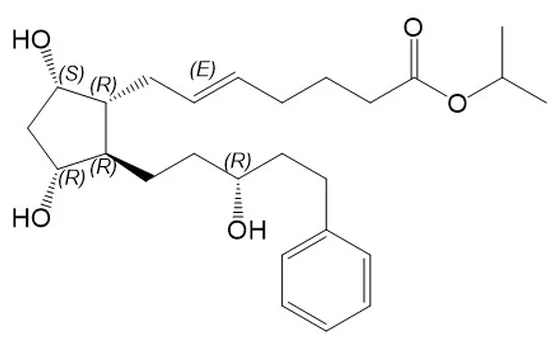
The 15-epimer is the hard one. It differs only in the configuration of a hydroxyl hanging off a saturated chain, with no change in shape near the ring or in ionization. On a C18 column the two peaks are neighbours, and the selectivity between them is a property of the mobile phase more than of the column. The 5-trans isomer redirects a chain and separates more comfortably; the doubly substituted isomer more comfortably still.
This matters because the assay and the impurity method are usually the same injection. An unresolved 15-epimer is counted as latanoprost: content reads 100 percent while part of the label claim is a diastereomer the FP receptor does not read as latanoprost. The failure mode is not an out-of-specification impurity result. It is a passing assay on a product that under-delivers.
What the published methods actually do
The assay used in the patient-use study shows where the difficulty sits. Detection was at 205 nanometres — the phenyl ring is the only chromophore and it absorbs weakly — with water, tetrahydrofuran and methanol at 6:1:13 containing 0.05 percent trifluoroacetic acid, and samples diluted one hundred fold to 0.45 to 0.55 micrograms per millilitre[3]. Tetrahydrofuran is not casual: it changes selectivity between ester and acid more than methanol or acetonitrile does.
The standard set is equally informative. That method ran a free acid standard, a mixed standard at the limit of quantitation, and a bracketing standard after every six injections. A frequency of six concedes that the baseline at 205 nanometres drifts, and drift matters because the acid elutes near the solvent front, where a drifting baseline is worst.
A later controlled-degradation study moved to tandem mass spectrometry with multiple reaction monitoring, for the reason this article keeps returning to: the ultraviolet response is a poor discriminator between species that differ only in stereochemistry[8]. Mass spectrometry is no better on that point, but it removes the baseline problem and tolerates the dilution a 50 microgram per millilitre formulation demands.
Where the isomers come from, and why stress testing will not make them
The two stereochemical features are installed in different steps, which is why the isomers behave differently under stress.
The 5,6 geometry is set during chain assembly. The upper chain is installed by a Wadsworth-Horner-Emmons condensation between a cyclopentane aldehyde and a phosphonate carbanion, and that reaction is Z-selective rather than Z-specific: the E isomer is a normal by-product that survives chromatography and is carried through deprotection. The C15 alcohol is set later, by reduction of the corresponding ketone, and a reduction that is not fully stereoselective leaves the 15-epimer.
The consequence is uncomfortable. Forced degradation will produce the acid and, with a strong enough oxidative condition, the 15-ketone, but it will not generate the 15-epimer or the 5-trans isomer in useful amounts. Selectivity for those has to be shown with spiked standards at the specification level, in the formulation matrix, at the wavelength the method uses. An HPLC-UV method validated only against acid-stressed and peroxide-stressed samples has proved nothing about the two impurities most likely to be present.
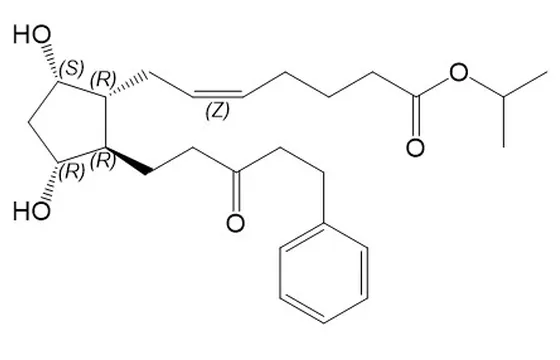
The 15-ketone repays a closer look. The catalogue holds four entries under C26H38O5, and only one is the ketone; the others are isobaric species with different skeletons, including a 17-phenyl trinor analogue whose extra double bond sits in the chain rather than the ring[4]. Isobaric is not isomeric, and a method that assigns by mass alone will merge them.
Reading the rest of the catalogue
Process intermediates come first. A tris(triethylsilyl) ether, C44H82O5Si3, 775.4, CAS 477884-78-9, is the fully protected precursor with three silyl groups still on. A phosphine oxide, C20H25O3P, 344.4, CAS 2088449-88-9, is what the ylide becomes after the condensation. Neither can form in a bottle; both are legitimate purge markers.
A different molecule. Three entries carry C27H41NO8, 507.6, the formula of latanoprostene bunod — the same cyclopentane nucleus with a nitro-oxybutyl ester in place of the isopropyl ester. That compound is an approved active substance in its own right. Its related substances are not latanoprost degradants, and putting them in a latanoprost specification creates a limit with no toxicological basis.
The acid family. C23H34O5, 390.5, covers latanoprost acid at CAS 41639-83-2 and two of its isomers. This is the group that grows on storage, and the only group a stability programme captures without spiking.
In China this is not niche. CDE's public acceptance records list 84 filings from 49 applicants for latanoprost, with the ophthalmic solution the form most of them target (retrieved 10 November 2026).
Read that block as acceptance records, not approvals, and it still says something useful: enough applicants are working against the same 1.0 percent threshold that method selectivity, not limit setting, is where filings will be won.
Adjacent molecules that do not transfer
Three comparisons get made routinely and each fails differently.
Bimatoprost↗ is the ethyl amide rather than the isopropyl ester, C25H37NO4, 415.6. It has no ester, which is why the patient-use study found no measurable loss, but it does have an amide that hydrolyses slowly. The acid is still the degradant, later and in smaller amount. Transferring a bimatoprost method to latanoprost imports the wrong kinetics and none of the epimer problem.
Travoprost↗ is an isopropyl ester of a different prostaglandin F2alpha analogue and shares the hydrolysis problem almost exactly. A method written for travoprost will find the acid in latanoprost and miss the epimers, because the epimer pattern belongs to each molecule's own stereocenters rather than to the class.
Tafluprost↗ is the instructive negative. Its upper chain carries a 15,15-difluoro group in place of the C15 hydroxyl, C25H34F2O5, 452.5, which removes the secondary alcohol and with it the whole 15-ketone pathway. The intent was metabolic — blocking oxidation by 15-hydroxyprostaglandin dehydrogenase — but the stability consequence is identical: there is no C15 epimer to control because there is no C15 alcohol to epimerise. Reasoning from tafluprost's impurity profile back to latanoprost's is backwards.
All four sit in the catalogue; the useful comparison is not the structure but which bond each molecule leaves unprotected. See latanoprost, bimatoprost, travoprost and tafluprost, and timolol maleate for the other preservative-and-pH problem that dominates ophthalmic formulation work.
What to keep on the shelf
The working set is small and specific: the drug substance, the acid at CAS 41639-83-2, the C15 epimer at CAS 145773-22-4, the 5-trans isomer at CAS 913258-34-1 and the doubly substituted isomer at CAS 1235141-39-5. Add the 15-ketone at CAS 135646-98-9 when the oxidative pathway is being argued rather than excluded, and keep one protected intermediate on hand when the purge argument is being built. All of them sit in the same entry set, alongside the isobaric trinor analogue that a mass-only assignment will confuse with the ketone: latanoprost reference standards and related entries.
Frequently Asked Questions
Does ICH Q3B really allow 1.0 percent for latanoprost?
Why is the same molecule held to 0.10 percent as an API and 1.0 percent in the product?
Is latanoprost acid an impurity or the active drug?
Can a 205 nanometre ultraviolet method resolve the C15 epimer?
Why require 2 to 8 Celsius if six weeks at 25 Celsius is allowed?
Does the 5-trans isomer form on storage?
What is the 15-ketone, and why does it appear four times in the catalogue?
Is the preservative a stability variable?
Related Substances and Reference Standards
- Latanoprost (23 impurity / derivative entries)
- Bimatoprost (19 impurity / derivative entries)
- Travoprost (37 impurity / derivative entries)
- Tafluprost (15 impurity / derivative entries)
References and Sources
- U.S. National Library of Medicine, DailyMed, XALATAN (latanoprost ophthalmic solution) 0.005 percent prescribing information: 50 micrograms per millilitre, pH approximately 6.7, benzalkonium chloride 0.02 percent, storage at 2 to 8 Celsius and six weeks at up to 25 Celsius once opened, accessed 2026-11-10
- International Council for Harmonisation, ICH Q3B(R2) Impurities in New Drug Products, Attachment 1: reporting, identification and qualification thresholds for degradation products by maximum daily dose, accessed 2026-11-10
- BMC Ophthalmology, 2008;8:11, Paolera MD, Kasahara N, Umbelino CC, Walt JG. Comparative study of the stability of bimatoprost 0.03 percent and latanoprost 0.005 percent: a patient-use study, including the 205 nm assay and the free acid standard, accessed 2026-11-10
- U.S. National Library of Medicine, PubChem, Compound records for latanoprost and its related substances, including the C15 epimer, 5-trans-latanoprost, latanoprost acid, 15-ketolatanoprost, the tris(triethylsilyl) ether and latanoprostene bunod, accessed 2026-11-10
- International Council for Harmonisation, ICH Q3A(R2) Impurities in New Drug Substances: reporting, identification and qualification thresholds, accessed 2026-11-10
- Journal of Ocular Pharmacology and Therapeutics, 2011;27:51-59, Johnson TV, Gupta PK, Vudathala DK, Blair IA, Tanna AP. Thermal stability of bimatoprost, latanoprost and travoprost under simulated daily use, accessed 2026-11-10
- International Journal of Pharmaceutics, 2005, Stability of latanoprost in an ophthalmic lipid emulsion using polyvinyl alcohol: ester hydrolysis under heat stress and recovery at pH 5.0, 6.0 and 7.0, accessed 2026-11-10
- Current Eye Research, 2015Stability of latanoprost in generic formulations using controlled degradation and patient usage simulation studies, with tandem mass spectrometry and multiple reaction monitoring
This article was prepared by the CATO technical team. Regulatory, pharmacopoeial and published literature content cited above is attributed in the reference list. It is provided for technical exchange and search reference only and does not constitute a quality specification or regulatory advice. For any specific substance, the applicable test methods, limits and filing requirements are governed by the current regulations, pharmacopoeial monographs and official publications.
Product information on this site is provided for research search and selection reference only and is not a quality specification; technical data, purity and structural confirmation are governed by the shipped COA and our written confirmation. All products mentioned are for research use only, not for human or animal diagnostic or therapeutic use.