Levofloxacin Impurity A at Fifty Per Cent Is Ofloxacin: Choosing a Standard for a Chiral Boundary
A reference standard is normally the easy part of an impurity method: buy the lettered item, weigh it, correct for potency. Levofloxacin↗ breaks that habit in three places at once. The impurity that matters most is the enantiomer of a molecule that is already a marketed drug, the substance is a hemihydrate in one pharmacopoeia and an anhydrate elsewhere, and the same impurity is sold as free base, hydrochloride, lactate and mesylate.
Note: product names shown in red (marked with ↗) are links - click through to the product page for structure, CAS number, purity and lead time.
Five records with one formula
Key points
- Levofloxacin is the (S) enantiomer, C18H20FN3O4, 361.4, and EP impurity A is the (R) enantiomer with the same formula and the same mass[1][3].
- The racemate of those two enantiomers is ofloxacin, CAS 82419-36-1, a separately marketed antibacterial, so the limit on EP impurity A is a boundary between two products rather than a toxicity threshold[2].
- This catalog holds five entries with the C18H20FN3O4 formula, so mass spectrometry cannot distinguish the API from its enantiomer or from two further isomers[1].
- The hemihydrate, CAS 138199-71-0, is 370.4 per molecule against 361.4 for the anhydrate, a 2.4 per cent difference that is larger than most impurity limits in the same specification[5].
Levofloxacin is (S)-9-fluoro-2,3-dihydro-3-methyl-10-(4-methylpiperazin-1-yl)-7-oxo-7H-pyrido[1,2,3-de][1,4]benzoxazine-6-carboxylic acid, C18H20FN3O4, 361.4[1]. The stereocentre is the methyl-bearing carbon of the fused oxazine ring, not the piperazine and not the quinolone core. That single detail determines which analytical questions exist and which do not.
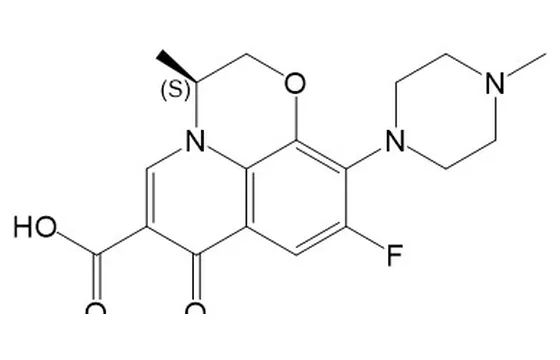
EP impurity A is the (R) enantiomer, CAS 100986-86-5, and it is the same molecule with one bond drawn the other way[3]. It is also, by definition, one half of ofloxacin, the racemate that has been on the market since the 1980s and is still dosed at 200 to 400 mg[2]. That is the fact worth holding on to: levofloxacin and ofloxacin share a molecular formula, a mass, a UV spectrum and most of a pharmacopoeial text, and the difference between them is the configuration of one carbon.
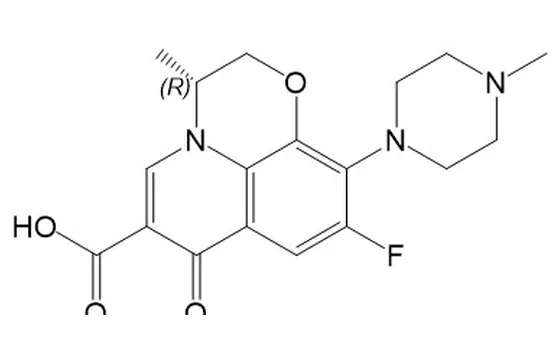
This catalog lists five entries at C18H20FN3O4: the API, EP impurity A, EP impurity I, and two supplier-numbered items. A high-resolution mass measurement returns the same value for all five, and a photodiode array spectrum returns the same shape. Identity, in this molecule, is retention, and for the enantiomer pair retention on an achiral column is identical by construction.
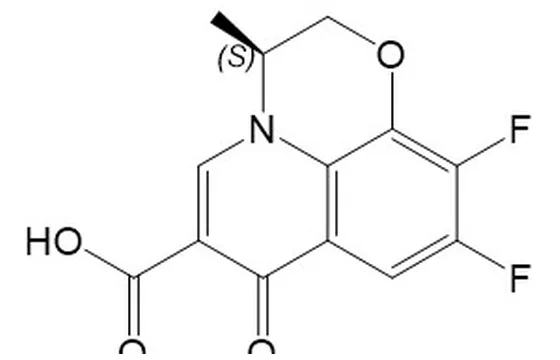
The route explains why the enantiomer is a residue rather than a degradant. EP impurity F is the difluoro acid, C13H9F2NO4, 281.2, the substrate that has not yet been attacked by N-methylpiperazine, and it already carries the methyl on the oxazine ring[1]. The stereocentre is therefore fixed before the last substituent is installed, which means chiral purity is set by the chiral pool or by a resolution step, and is not something a stability programme can improve.
Half a molecule of water, and a 2.4 per cent error that never announces itself
Water is the second trap and it is easier to miss than the first. The catalog lists the hemihydrate as a separate entry, CAS 138199-71-0, and PubChem records that entry as C36H42F2N6O9, 740.7, which is two molecules of the API plus one molecule of water, or 370.4 per molecule[5]. The anhydrous substance is 361.4. The difference is 9.0, or 2.43 per cent.
That number is larger than almost every impurity limit in the same specification. A laboratory that weighs a hemihydrate standard and calculates against an anhydrous basis will report an assay roughly 2.4 per cent low and an impurity content roughly 2.4 per cent high, on every injection, with no chromatographic fault to find. The error is silent because it is consistent: the system suitability passes, the retention times are stable, and the numbers are simply on the wrong basis.
The naming convention makes the trap worse rather than better. The EP lettered impurities in this catalog are recorded under names of the form levofloxacin hemihydrate EP impurity A, which says that the monograph describes the hydrate. A specification written for the anhydrous substance and a certificate written for the hydrate can both be internally consistent and still disagree by 2.4 per cent. The certificate has to state the basis, and the method has to state which basis the calculation uses.
Water in this substance is not residual moisture. A loss-on-drying limit of 1.0 per cent, copied from a template, will fail every legitimate hemihydrate batch, because the crystal contains 2.4 per cent water by definition. Karl Fischer will find it, and the specification has to expect it. The solid form also changes with the water: the anhydrate and the hemihydrate are different solids with different dissolution behaviour, which is a biopharmaceutical question rather than an impurity question, and one that does not appear on a related-substances chromatogram at all.
The same impurity in four forms, and four different weighing factors
The third trap is the one that produces the largest numerical errors, and it is entirely a documentation problem. The same impurity is supplied in several forms, and the form changes the weighing factor. This catalog carries EP impurity A as the free base and as the lactate, EP impurity B as the free base and as the hydrochloride, EP impurity G as the hydrochloride, and the API itself as a mesylate, which is a salt of an active substance appearing in an impurity catalog.
| Item as supplied | Formula | M | Correction to the free acid |
|---|---|---|---|
| EP impurity A, free base | C18H20FN3O4 | 361.4 | no correction |
| EP impurity A, lactate | C18H20FN3O4 with C3H6O3 | 451.5 | divide by 1.249 |
| EP impurity B, hydrochloride | C17H18FN3O4 with HCl | 383.8 | divide by 1.105 |
| EP impurity G, hydrochloride | C16H18FN3O4 with HCl | 371.8 | divide by 1.109 |
| API impurity 48, mesylate | C18H20FN3O4 with CH4O3S | 457.5 | divide by 1.266 |
| API as the hemihydrate | C18H20FN3O4 with half H2O | 370.4 | divide by 1.025 |
Table note: formula weights from the catalog records and PubChem; the correction factor is the formula weight of the supplied form divided by the formula weight of the analyte as reported, so a standard weighed as the lactate must be divided by 1.249 before it is used as free base[1][5].
Assume free base and weigh the lactate, and every reported level is 25 per cent too high before any chromatography is considered. That is not a small correction; it is the difference between passing and failing a 0.2 per cent limit, and it is the sort of discrepancy that survives review because the chromatogram looks perfect.
Two habits prevent it. The certificate of analysis has to name the form and the formula weight used for the assignment, not only a purity value. And the correction has to be written into the method as a formula rather than applied by hand, because the analyst who weighs the standard is rarely the analyst who wrote the specification. For the enantiomer specifically, the certificate also has to state chiral purity: a standard at 99 per cent HPLC purity can still contain several per cent of the opposite enantiomer, and for EP impurity A that impurity is the API itself.
The piperazine end: demethylation, ring opening and one nitrosamine
The piperazine end of the molecule carries its own set of entries, and they behave differently from the chiral end.
EP impurity B is N-desmethyl levofloxacin, C17H18FN3O4, 347.3, and it is both an oxidative process impurity and the principal human metabolite[4]. This catalog carries three entries at that formula, so the demethylation position or the ring conformation is not fixed by the mass, and a supplier number is not an identification. The practical consequence is that a level of EP impurity B in a batch cannot be read as evidence of a metabolic or a toxicological problem; the metabolite status cuts the other way, and the limit is a purity limit.
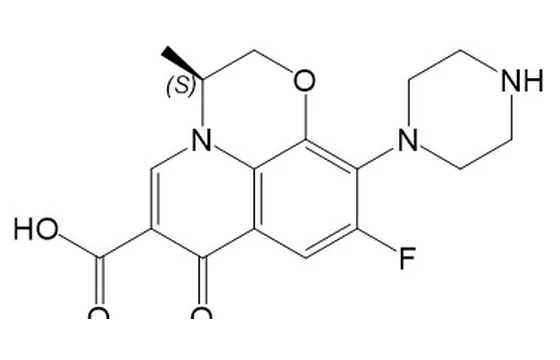
EP impurity G is the opened piperazine, C16H18FN3O4, 335.3, which is the API minus C2H2: the ring has been cleaved to a 2-(methylamino)ethylamino chain while the tricyclic core remains intact[6]. EP impurity H is the ethyl ester, C20H24FN3O4, 389.4, the unhydrolysed intermediate of the last step[7]. One is an oxidative degradation product of the finished molecule and the other is a process residue that should have been hydrolysed, and they sit next to each other in the same letter sequence with nothing in the naming to distinguish them.
The nitrosamine question sits on the same nitrogen as the demethylation. Levofloxacin itself has no nitrogen-hydrogen bond: the piperazine nitrogen carries a methyl and the quinolone nitrogen is part of the ring system. Nitrosation therefore requires EP impurity B first, and the product is N-nitroso desmethyl levofloxacin, C17H17FN4O5, 376.3[8]. At a 750 mg daily dose, the default 1.5 micrograms per day corresponds to 2 ppm, which is two orders of magnitude below the 0.05 per cent reporting threshold and therefore invisible to the general related-substances method. A control strategy that relies on the compendial method to catch this species is not a control strategy.
Three methods for one molecule, and only one of them is compendial
The catalog carries nine EP letters for levofloxacin, A through I, against 68 entries in total. The letters follow the history of the monograph rather than a ranking of risk, and reading them as a priority list is a mistake that shows up in method development plans.
Three of the nine need different analytical capability from the rest. EP impurity A needs a chiral method, because no achiral separation will resolve an enantiomer pair. The remaining eight are achiral and separable on a reversed-phase column, although EP impurity F, at 281.2, is small and polar enough to elute near the solvent front and to be lost if the gradient starts too late. The nitrosamine needs a third method entirely, because a UV method at 2 ppm on a 750 mg dose is not a measurement.
That is three methods for one molecule, and the compendial requirement is not the reason. The reason is that levofloxacin has three independent impurity mechanisms: a chiral centre that is fixed at synthesis, a piperazine that oxidises, and a carboxylic acid that can be left esterified. Each produces species with different chemistry, different detection requirements and different origins, and no single method covers all three well.
What 750 mg per day does to the thresholds
Dose arithmetic decides how much of this matters. At 750 mg per day, the ICH Q3A identification threshold of 0.10 per cent is 0.75 mg per day, which is below the 1.0 mg cap, so the percentage governs and the absolute limit never binds[9]. Reporting at 0.05 per cent is 0.375 mg. Those are generous numbers for an organic impurity and impossible numbers for a genotoxic one, and the gap between them is where most of the analytical effort belongs.
For ordinary process and degradation impurities the arithmetic is comfortable: a peak at 0.1 per cent is 0.75 mg per day, well inside a qualification package that any generic file will already contain. For the nitrosamine the same 0.1 per cent would be 750 micrograms per day, five hundred times the default acceptable intake. The two species live in the same chromatogram and are governed by frameworks that differ by three orders of magnitude, which is why a single specification line cannot cover both.
Ofloxacin is the mirror case, and moxifloxacin is not
Two comparisons clarify what is specific to levofloxacin and what is a property of the class.
Moxifloxacin has no methyl on a fused oxazine ring, so it has no equivalent of EP impurity A and no enantiomer on the market. Its stereochemistry lives in the bicyclic amine side chain, and its impurity questions are about that amine and about the 8-methoxy group. The chiral-boundary argument does not transfer, even though both molecules are fluoroquinolones and both are 8-substituted.
Ofloxacin is the mirror case, and it is the one worth putting in front of a review team. For ofloxacin, the (S) enantiomer is the impurity; for levofloxacin, the (R) enantiomer is the impurity; the two monographs point at each other and specify the same molecule from opposite directions. A specification copied between the two products will be wrong in a way that no analytical validation can detect, because the method will pass and the limit will be inverted.
Ciprofloxacin, which has no stereocentre at all, sits outside the argument entirely. A racemate, an enantiopure drug and an achiral analogue are three different regulatory situations, and only the first two share a formula.
What the filing record changes, and what it does not
Levofloxacin has one of the largest acceptance records of any single antibacterial in China, which changes the evidentiary burden rather than the chemistry: with that many prior assessments, an argument that is merely plausible has already been made and answered.
Reference standards at the chiral boundary
The catalog carries 68 levofloxacin entries with nine EP letters, A through I, and it lists the separate forms a method actually has to distinguish: EP impurity A as free base at CAS 100986-86-5 and as the lactate at CAS 294662-18-3, the hemihydrate at CAS 138199-71-0, and ofloxacin at CAS 82419-36-1 for the racemate comparison: [see all levofloxacin entries](levofloxacin impurity and derivative entries)
Frequently Asked Questions
Is levofloxacin EP impurity A really the (R) enantiomer?
Can EP impurity A be quantified on a C18 column?
Why does my assay read about 2.4 per cent low?
Is the water in levofloxacin a residual solvent?
Which salt form should the impurity standard be?
Is N-desmethyl levofloxacin an impurity or a metabolite?
Where does the nitrosamine risk sit?
How many EP-lettered impurities are there?
Related Substances and Reference Standards
- Levofloxacin (68 impurity / derivative entries)
- Moxifloxacin Hydrochloride (177 impurity / derivative entries)
References and Sources
- PubChem, National Center for Biotechnology Information, Levofloxacin, CID 149096: C18H20FN3O4, 361.4; the IUPAC name places the single stereocentre on the methyl-bearing carbon of the oxazine ring, accessed 2026-11-17
- PubChem, National Center for Biotechnology Information, Ofloxacin, CID 4583: C18H20FN3O4, 361.4, the racemate of the two enantiomers, marketed as a separate antibacterial, accessed 2026-11-17
- PubChem, National Center for Biotechnology Information, Ofloxacin, D- (the (R) enantiomer), CID 452723: C18H20FN3O4, 361.4, EP impurity A of levofloxacin, accessed 2026-11-17
- PubChem, National Center for Biotechnology Information, N-Desmethyl levofloxacin, CID 10958963: C17H18FN3O4, 347.3, EP impurity B and the principal human metabolite, accessed 2026-11-17
- PubChem, National Center for Biotechnology Information, Levofloxacin hydrate, CID 3033924: recorded as C36H42F2N6O9, 740.7 for two molecules of API plus one water, that is 370.4 per molecule, against 361.4 for the anhydrate, accessed 2026-11-17
- PubChem, National Center for Biotechnology Information, Levofloxacin impurity 5 monomer (EP impurity G), CID 71315635: C16H18FN3O4, 335.3, the opened piperazine with an intact tricyclic core, accessed 2026-11-17
- PubChem, National Center for Biotechnology Information, Ethyl levofloxacin carboxylate (EP impurity H), CID 13677362: C20H24FN3O4, 389.4, the unhydrolysed ethyl ester, accessed 2026-11-17
- PubChem, National Center for Biotechnology Information, N-Nitroso-N-desmethyl levofloxacin, CID 59548969: C17H17FN4O5, 376.3, the nitrosation product of EP impurity B, accessed 2026-11-17
- International Council for Harmonisation, ICH Quality Guidelines: Q3A(R2) Impurities in New Drug Substances (0.05 per cent reporting, 0.10 per cent or 1.0 mg per day identification), Q6A Specifications, M7(R2) Assessment and Control of DNA Reactive Impurities (1.5 micrograms per day default intake), accessed 2026-11-17
This article was prepared by the CATO technical team. Regulatory, pharmacopoeial and published literature content cited above is attributed in the reference list. It is provided for technical exchange and search reference only and does not constitute a quality specification or regulatory advice. For any specific substance, the applicable test methods, limits and filing requirements are governed by the current regulations, pharmacopoeial monographs and official publications.
Product information on this site is provided for research search and selection reference only and is not a quality specification; technical data, purity and structural confirmation are governed by the shipped COA and our written confirmation. All products mentioned are for research use only, not for human or animal diagnostic or therapeutic use.