Lisinopril Closes a Ring It Was Not Supposed to Close, and It Does So Twice
Lisinopril↗ has no ester, no amide side chain and no readily oxidised group, which is why its impurity profile is often described as unremarkable. That description misses the one reaction the molecule is built to undergo. The free proline carboxyl and the lysine alpha-nitrogen sit three atoms apart in a dipeptide, and on heating the nitrogen closes onto the acid to give a fused diketopiperazine. The pharmacopoeia lists two of them — same formula, same mass, opposite configuration at a single ring junction — and the pair, not either one alone, is what an analyst has to resolve.
Note: product names shown in red (marked with ↗) are links - click through to the product page for structure, CAS number, purity and lead time.
A dipeptide with three stereocenters and one weak joint
Key points
- Lisinopril is supplied as the dihydrate, C21H31N3O5 with two waters, 441.53, CAS 76547-98-3, and carries three stereocenters: the 1-carboxy-3-phenylpropyl carbon, the lysine alpha-carbon and the proline alpha-carbon[1].
- Cyclisation removes one water from C21H31N3O5 to give C21H29N3O4, 387.5 — a fused pyrrolo-pyrazine diketopiperazine formed by the lysine alpha-nitrogen attacking the free proline carboxyl[2].
- The catalog carries two such diketopiperazines, differing only at the ring junction: (3S,8aS) at CAS 328385-86-0 and (3S,8aR) at CAS 219677-82-4. The second exists because the proline alpha-carbon epimerises while its carbonyl is activated[2].
- In the solid state the cyclisation follows dehydration: the dihydrate loses water at 76 Celsius and again at 99 to 101 Celsius, and the ring closes after the lattice is gone[3].
Lisinopril is (S)-1-[N2-(1-carboxy-3-phenylpropyl)-L-lysyl]-L-proline, supplied as the dihydrate. The label gives C21H31N3O5 with two molecules of water and a molecular weight of 441.53, describes it as soluble in water, sparingly soluble in methanol and practically insoluble in ethanol, and lists mannitol, calcium phosphate and starch among the tablet excipients[1]. Three facts in that list matter later: there is no sugar in the formulation, so browning chemistry is not on the table; the molecule is a zwitterion, so it retains poorly on a reversed phase column; and the storage instruction is to protect from moisture rather than from light.
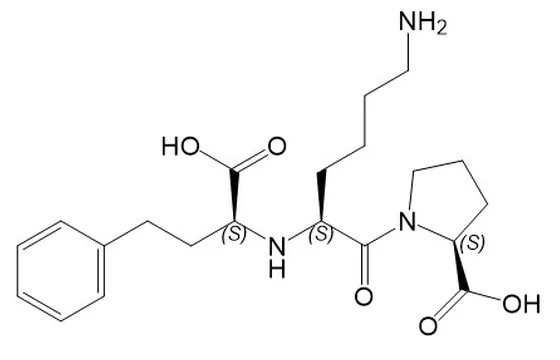
The three stereocenters each have a standard in the catalogue. The phenpropyl carbon is set by reductive amination and can end up R instead of S; the lysine alpha-carbon arrives intact; the proline alpha-carbon is the one that moves during degradation.
Which nitrogen closes the ring
The cyclisation has one plausible geometry. The proline carboxyl is free, the lysine alpha-nitrogen is secondary — alkylated by the phenylpropyl chain — and the two are held close by the peptide backbone. Attack of that nitrogen on that carbonyl closes a six-membered ring fused to the pyrrolidine, expelling water. The product is a pyrrolo[1,2-a]pyrazine-1,4-dione: a diketopiperazine.
Two details in the structure are worth reading carefully. The 4-aminobutyl group is still there, which means the epsilon-amino group took no part in the reaction; only the alpha-nitrogen did. And the phenylpropyl chain is on the ring nitrogen rather than hanging free, which fixes the regiochemistry without a labelling experiment. The mass balance is correspondingly simple: C21H31N3O5 loses H2O and becomes C21H29N3O4, 387.5, eighteen mass units lighter than the drug.
The reaction needs no enzyme, no metal and no harsh reagent, only proximity, which a dipeptide provides. How fast it goes depends almost entirely on whether the molecule is in solution, in a hydrated crystal or in a dried solid.
Two diketopiperazines, one inverted ring junction
The two diketopiperazines in the catalogue are not tautomers or conformers. They differ at C-8a, the ring junction that was the proline alpha-carbon, and the difference is a matter of absolute configuration: (3S,8aS) for CAS 328385-86-0 and (3S,8aR) for CAS 219677-82-4. Both are C21H29N3O4, both are 387.5, and both fragment identically.
| Species | CAS | Formula | Relationship to lisinopril |
|---|---|---|---|
| Lisinopril | 76547-98-3 | C21H31N3O5 | the drug, S at all three centers |
| Diketopiperazine C | 328385-86-0 | C21H29N3O4 | ring closed, proline center still S |
| Diketopiperazine D | 219677-82-4 | C21H29N3O4 | ring closed, proline center inverted to R |
| Impurity E | 85955-59-5 | C21H31N3O5 | phenylpropyl center inverted to R, no ring closure |
| Impurity G | 1356839-89-8 | C42H60N6O9 | two molecules joined by one amide bond, less one water |
| Impurity A | 1012-05-1 | C10H13NO2 | 2-amino-4-phenylbutanoic acid, the side chain without the lysine |
Table: the same-formula and derived species that give lisinopril its impurity profile. CAS numbers and configurations verified against PubChem records, which name the two diketopiperazines by their ring-junction descriptors[2].
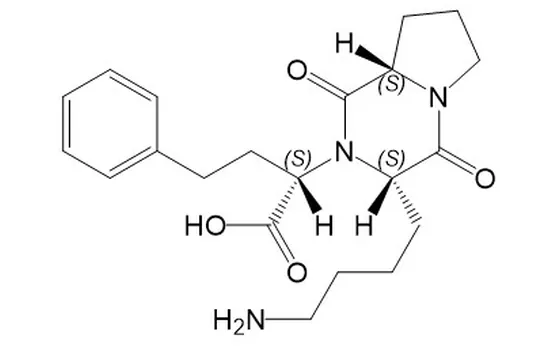
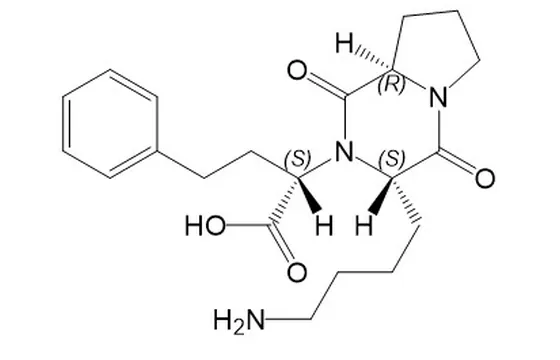
The existence of the second one is the interesting part. A cyclisation that simply joined the two ends would preserve every stereocenter; the fact that a second diketopiperazine exists with the proline center inverted means that the reaction proceeds through an activated carbonyl whose alpha-carbon can enolise, and that the enol is trapped by ring closure on both faces. In practical terms, a cyclisation that has gone 60 percent to completion does not give one peak at 60 percent — it gives two peaks whose ratio depends on pH, temperature and time.
For a specification this is decisive. A limit written against a single diketopiperazine standard will under-report the degradation by the fraction that went to the epimer. If the pair is co-eluting, which is the default on a short column with a high organic modifier, the number that appears in the report is a sum that nobody declared.
Water leaves first, then the ring closes
The solid-state story runs in a direction that surprises anyone who assumes a hydrate must be safer than an anhydrate. Thermal analysis of lisinopril dihydrate shows a two-step dehydration: dihydrate to monohydrate at 76 Celsius, then monohydrate to anhydrate at 99 to 101 Celsius, with the intramolecular cyclisation following the loss of the lattice water[3].
Isothermal work on the same reaction puts the kinetics on firmer ground. Between 147.5 and 157.5 Celsius the conversion to diketopiperazine can be followed directly by infrared microscopy, and the time-dependent spectra separate cleanly into two components, drug and ring[4]. The temperatures are too high to extrapolate to a warehouse floor; what transfers is the mechanism and the ordering, not the rate.
The practical reading is that the dihydrate is part of the control strategy rather than an inconvenience. A lattice that holds water between molecules holds the carboxyl and the nitrogen apart, and the reaction waits. Anything that removes that water — over-drying a granule, a high-shear step that heats locally, a package that lets moisture out rather than in — shortens the induction period. This is why the label says protect from moisture and why a stability programme for lisinopril tablets is really a study of water activity.
Three stereocenters, three different failure modes
Three stereocenters give three distinct failure modes.
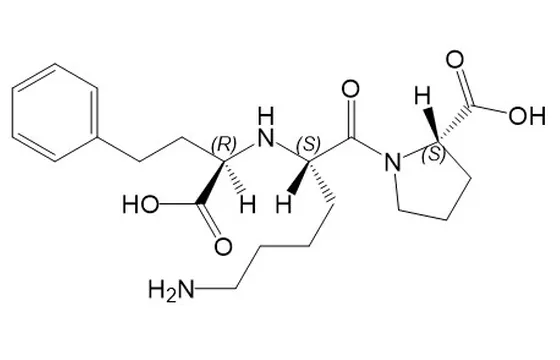
The phenylpropyl center is set by reductive amination of 2-oxo-4-phenylbutanoic acid with the lysine derivative. That step is diastereoselective rather than diastereospecific, and its epimer is a diastereomer of the drug, not a ring-closed product: C21H31N3O5, 405.5, CAS 85955-59-5, catalogued as the R,S,S isomer. Because it has the same formula and the same nominal mass as the drug, it is invisible to any detector that is not a chromatographic one, and it will co-elute with the parent on a low-selectivity method.
The same reductive amination explains a smaller impurity that is easy to overlook. If the keto acid condenses with ammonia rather than with the lysine derivative, reduction gives 2-amino-4-phenylbutanoic acid — C10H13NO2, 179.22, CAS 1012-05-1. The catalogue lists it as a mixture of enantiomers, which is what a non-stereoselective background reaction should give; that racemic annotation is the tell.
The third mode is the ring junction, already described, and it is the one that matters most because it grows during storage rather than during manufacture.
The dimer and the nitrosamine
Two further entries matter even if they never appear in a batch.
The dimer is C42H60N6O9, CAS 1356839-89-8, which is exactly two molecules of lisinopril less one water. Only one combination of functional groups can do that: an amide between a free carboxyl of one molecule and a free amine of the next. Lisinopril has two carboxyls and exactly one free amine, the epsilon-amino group of the lysine side chain, so the linkage has to involve that amine. Which of the two acids forms the bond is not fixed by the formula, and a claim about the regiochemistry needs NMR rather than arithmetic. What the formula does fix is the concentration dependence: a second-order reaction scales with the square of the local concentration, which is why dimers appear in concentrated process streams and in wet granulations rather than in release testing.
The nitrosamine is the other entry worth naming. N-nitrosolisinopril is C21H30N4O6, 434.5, CAS 519175-80-5, and the nitrogen that carries the nitroso group can only be the secondary one — the lysine alpha-nitrogen already bearing the phenylpropyl chain. The epsilon-amino group is primary and would give a diazonium species, not a stable N-nitrosamine, and the proline nitrogen is a tertiary amide. Both alpha-carbons flanking the nitrosatable nitrogen are substituted, which is the structural pattern the carcinogenic potency categorisation treats as deactivating, so this is a nitrosamine with a comparatively generous acceptable intake rather than a marginal one. The calculation is still worth doing: at 1500 nanograms a day and a 40 mg dose the limit is 37.5 parts per million, which is below the 0.05 percent reporting threshold of the related-substances method and therefore invisible to it.
Where a lisinopril method actually breaks
Lisinopril has no chromophore beyond the phenyl ring, so detection sits at the edge of the ultraviolet range. A published stability-indicating method for lisinopril with hydrochlorothiazide used 210 nanometres, a phosphate buffer at pH 7.1 and a mobile phase of methanol, acetonitrile and buffer at 15:15:70, at 0.8 millilitres per minute[5]. The buffer pH is not decoration: at 210 nanometres the response of a zwitterion depends on its ionization state, and the retention of a diacid changes sharply over half a pH unit.
The second trap is conformational rather than chemical. Lisinopril contains a tertiary proline amide, and such amides rotate slowly enough to give two chromatographic species. A study of column temperature and mobile phase pH on lisinopril and enalapril found that the rate of this isomerisation increases with temperature and that it distorts peak shape or splits the peak, with all species collapsing into a single narrow band only at 80 Celsius and pH 2[6]. Temperature therefore buys speed and costs the ability to tell a rotamer from a degradant.
Third, the limit of detection has to be low enough to see a 0.1 percent specification line on a 405.5 molecular weight. One validated method for an extemporaneous formulation reported a detection limit of 0.0075 micrograms per millilitre, which was 0.03 percent of the method concentration, and used that sensitivity specifically to quantify the diketopiperazine in a matrix containing two parabens[7].
Limits at 40 mg, and the questions a reviewer asks
At a maximum daily dose of 40 mg, and 80 mg in the doses that are used but not recommended, the ICH Q3A(R2) thresholds for a drug substance below 2 g a day apply without modification: reporting at 0.05 percent, identification at 0.10 percent and qualification at 0.15 percent[8]. In absolute terms 0.10 percent of 40 mg is 40 micrograms a day, and the 1.0 mg a day limb never binds. Percentage governs throughout.
What a reviewer will ask is not the arithmetic but the completeness of the profile. Two questions recur. First, whether the diketopiperazine limit is supported by a standard that covers both ring-junction epimers, since a single-standard calibration assumes a response factor for a diastereomer nobody injected. Second, whether the toxicological qualification of the diketopiperazines has been addressed at all — the same ring system appears across the ACE inhibitor class, and a published structure-activity screen of nine of those drugs and their diketopiperazine degradants exists precisely because the question was raised[9]. Neither question is answered by a batch release certificate.
The third question is Chinese-specific and practical. CDE's public acceptance records list 108 filings from 52 applicants for lisinopril (retrieved 10 November 2026), most of them for the tablet and many of them for fixed combinations with hydrochlorothiazide, where the two active substances compete for the same chromatographic space at the same wavelength.
Which neighbouring dipeptides can be reasoned from
The dipeptide ACE inhibitors share a skeleton, not a degradation pathway.
Enalapril, ramipril, perindopril and benazepril are all ester prodrugs. Their diketopiperazine forms at the ester stage, where the carbonyl is more electrophilic and the reaction is faster, and their acid metabolites hydrolyse on storage. A lisinopril method transferred to enalapril will find the ring closure and will misjudge its rate.
Captopril↗ is the instructive negative. It is a single amino acid with a thiol, not a dipeptide, so it has no ring to close; its characteristic degradation is oxidation to the disulfide dimer. The word dimer appears in both molecules' impurity vocabularies and means two entirely different bonds.
See lisinopril, enalapril maleate, ramipril, perindopril arginine, benazepril and captopril for the six entry sets; the useful comparison is which bond each molecule leaves available, not which class it belongs to.
What to keep on the shelf
The indispensable pair is the two diketopiperazines at CAS 328385-86-0 and CAS 219677-82-4, ordered together rather than singly, because a limit calibrated on one of them describes half a reaction. Add the R,S,S isomer at CAS 85955-59-5 for the reductive amination, the dimer at CAS 1356839-89-8 when the process includes a concentrated aqueous step, and N-nitrosolisinopril at CAS 519175-80-5 if the risk assessment needs a limit rather than a documented negative. All of them sit in the same entry set: lisinopril reference standards and related entries.
Frequently Asked Questions
Why does lisinopril form a diketopiperazine when it has no ester?
Why are there two diketopiperazines in the catalogue?
Is the dihydrate more or less stable than the anhydrate?
At 210 nanometres, what is the main interference?
Does the dimer form during storage?
Where is the nitrosamine in lisinopril?
Why is the identification threshold 0.10 percent rather than something dose-scaled?
Which standard is most often missing from a lisinopril file?
Related Substances and Reference Standards
- Lisinopril (97 impurity / derivative entries)
- Enalapril Maleate (16 impurity / derivative entries)
- Ramipril (34 impurity / derivative entries)
- Captopril (34 impurity / derivative entries)
References and Sources
- U.S. National Library of Medicine, DailyMed, Zestril (lisinopril) tablets prescribing information: lisinopril dihydrate C21H31N3O5 with two waters, molecular weight 441.53, solubility, mannitol and starch excipients, storage with protection from moisture, accessed 2026-11-10
- U.S. National Library of Medicine, PubChem, Compound records for lisinopril and its related substances, including the (3S,8aS) and (3S,8aR) diketopiperazines, the R,S,S diastereomer and 2-amino-4-phenylbutanoic acid, accessed 2026-11-10
- Chemical and Pharmaceutical Bulletin, 2000;48:1890, Thermal-dependent dehydration process and intramolecular cyclization of lisinopril dihydrate in the solid state: dihydrate to monohydrate at 76 Celsius, monohydrate to anhydrate at 99 to 101 Celsius, accessed 2026-11-10
- Applied Spectroscopy, 2008Kinetics of lisinopril intramolecular cyclization in the solid phase monitored by Fourier transform infrared microscopy between 147.5 and 157.5 Celsius
- Journal of Chromatographic Science, 2014Stability-indicating LC method for the simultaneous determination of lisinopril and hydrochlorothiazide: 210 nm detection, phosphate buffer pH 7.1, methanol acetonitrile buffer 15:15:70
- Journal of Chromatography B, 2001, Effect of column temperature on the behaviour of some angiotensin converting enzyme inhibitors during high-performance liquid chromatographic analysis: isomerisation, peak shape and peak splitting for lisinopril and enalapril, accessed 2026-11-10
- Journal of Pharmaceutical and Biomedical Analysis, 2005, Development and validation of a stability indicating HPLC method for determination of lisinopril, lisinopril degradation product and parabens in the lisinopril extemporaneous formulation, with a detection limit of 0.0075 micrograms per millilitre, accessed 2026-11-10
- International Council for Harmonisation, ICH Q3A(R2) Impurities in New Drug Substances: reporting, identification and qualification thresholds, accessed 2026-11-10
- Toxicology and Applied Pharmacology, 2023, In silico and in vitro screening for carcinogenic potential of angiotensin-converting enzyme inhibitors and their diketopiperazine degradation impurities, accessed 2026-11-10
This article was prepared by the CATO technical team. Regulatory, pharmacopoeial and published literature content cited above is attributed in the reference list. It is provided for technical exchange and search reference only and does not constitute a quality specification or regulatory advice. For any specific substance, the applicable test methods, limits and filing requirements are governed by the current regulations, pharmacopoeial monographs and official publications.
Product information on this site is provided for research search and selection reference only and is not a quality specification; technical data, purity and structural confirmation are governed by the shipped COA and our written confirmation. All products mentioned are for research use only, not for human or animal diagnostic or therapeutic use.