氯沙坦钾的元素杂质与残留溶剂:四氮唑环合把锡、钯和叠氮一起带进了路线Elemental Impurities and Residual Solvents in Losartan Potassium: How the Tetrazole Cyclisation Brings Tin, Palladium and Azide Into the Route
元素杂质风险评估最常见的写法,是把 ICH Q3D 的三类元素表抄一遍,再补一句「本品工艺未使用金属催化剂」。这句话在氯沙坦钾↗上很容易站不住:联苯要靠偶联做起来,四氮唑要靠叠氮化物环合,两步都自带金属或类金属来源。难的不是测,是说清哪一步带进来、带进来的是什么形态、限度为什么定在这里。
The commonest way to write an elemental impurity risk assessment is to copy the ICH Q3D three-class table and add one sentence saying no metal catalyst is used in this process. On losartan potassium↗ that sentence does not hold up: the biphenyl has to be built by coupling and the tetrazole has to be closed with an azide, and both steps bring their own metal or metalloid source. The difficulty is not measuring; it is explaining which step introduced what, in which form, and why the limit sits where it does.
Note: figures and pharmacopoeial references cited in this article are marked with superscript numbers; the full source list appears at the end.
一、品种定位:一个分子上同时挂着四氮唑、咪唑和钾1. Where this molecule sits: a tetrazole, an imidazole and a potassium on the same skeleton
关键要点Key points
- 氯沙坦钾分子式 CLosartan potassium has the formula C22H22ClKN6O2,相对分子质量 461.01,日剂量 50–100 mg,属于日剂量偏低的口服品种, a relative molecular mass of 461.01, and a daily dose of 50–100 mg, which places it among the low-dose oral products[1]。
- ICH Q3D(R2) 把 24 个元素分成三类并给出口服 PDE,元素限度由 PDE 除以日剂量换算;日剂量越低,换算出的浓度限度越宽ICH Q3D(R2) sorts 24 elements into three classes and assigns an oral PDE to each; the element limit is obtained by dividing the PDE by the daily dose, so the lower the dose, the wider the resulting concentration limit[1]。
- 结构风险集中在两处:联苯四氮唑环(偶联与环合两步引入金属与叠氮)与咪唑 5-位羟甲基(氧化成醛、再氧化成羧酸即活性代谢物)。The structural risk concentrates in two places: the biphenyltetrazole ring, where the coupling and cyclisation steps introduce metals and azide, and the hydroxymethyl group at imidazole position 5, which oxidises to an aldehyde and then to a carboxylic acid, the active metabolite.
- 本目录收录氯沙坦钾相关条目 74 条(2026-11-03 实抓),覆盖 EP 杂质 A–D、F、H–M(缺 E、G),杂质 12 与 13 各有游离酸和钾盐两种形态,另有 6 条氘代内标。This catalogue holds 74 entries relating to losartan potassium (retrieved 2026-11-03), covering EP impurities A–D, F and H–M (E and G are not available), with impurities 12 and 13 each present in both the free-acid and potassium-salt forms, plus six deuterated internal standards.
结构拆开:联苯骨架 2-位挂 5-四氮唑,4-位经亚甲基连到咪唑;咪唑带丁基、氯和 5-位羟甲基;最后成钾盐。活性来自四氮唑的酸性(模拟羧酸)与咪唑的疏水匹配,化学上的麻烦也几乎都在这两个环上。Unpacked structurally: a biphenyl core carries a 5-tetrazole at position 2 and reaches the imidazole through a methylene at position 4; the imidazole bears a butyl group, a chlorine and a hydroxymethyl at position 5; finally the potassium salt is formed. The activity comes from the acidity of the tetrazole, which mimics a carboxylic acid, together with the hydrophobic match of the imidazole — and almost all of the chemical trouble sits on those same two rings.
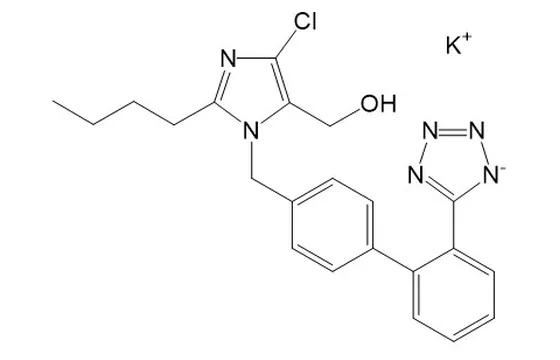
先厘清一件事:钾不是元素杂质。Q3D 的 24 元素清单里没有钾、钠、钙、镁,钾含量属于成盐比例与含量测定的范畴。同理氯离子也不在清单内,它走离子色谱或电位滴定。把对离子当元素杂质报,是这类品种申报里出现频次很高的一个错误。本品种在《中国药典》现行版中有原料与片剂收载One point first: potassium is not an elemental impurity. The 24-element list in Q3D contains no potassium, sodium, calcium or magnesium; potassium content belongs to salt stoichiometry and assay. The chloride ion is likewise outside the list and is handled by ion chromatography or potentiometric titration. Reporting the counter-ion as an elemental impurity is one of the most frequent errors in filings for this class of product. Both the drug substance and the tablets are covered in the current edition of the Chinese Pharmacopoeia[2],但各论只管杂质限度与检验方法,元素杂质怎么评估要自己做。, but the monographs only govern impurity limits and test methods; the elemental impurity assessment is yours to build.
二、Q3D 落到这条路线:真正要盯的只有五个元素2. Applying Q3D to this route: only five elements genuinely need watching
Q3D 的评估逻辑是三件事:给药途径决定用哪套 PDE,日剂量决定换算分母,工艺路线决定候选元素清单The Q3D logic rests on three things: the route of administration decides which PDE set applies, the daily dose decides the denominator, and the process route decides the candidate element list[1]。氯沙坦钾是口服固体,取口服 PDE;日剂量按最大 100 mg 计,浓度限度(ppm)=PDE(μg/天)÷ 日剂量(g/天)。. Losartan potassium is an oral solid, so the oral PDE applies; taking the maximum daily dose of 100 mg, the concentration limit in ppm equals the PDE in μg/day divided by the dose in g/day.
| 元素Element | Q3D 类别Q3D class | 口服 PDE(μg/天)Oral PDE (μg/day) | 按 100 mg/天 折算(ppm)Converted at 100 mg/day (ppm) | 本品种相关性Relevance to this product |
|---|---|---|---|---|
| Cd | 1 | 2 | 20 | 试剂带入,低Carried in with reagents, low |
| Pb | 1 | 5 | 50 | 无机试剂,低Inorganic reagents, low |
| As | 1 | 15 | 150 | 试剂带入,低Carried in with reagents, low |
| Hg | 1 | 30 | 300 | 试剂带入,低Carried in with reagents, low |
| Co | 2A | 50 | 500 | 偶联催化体系,中Coupling catalysis, medium |
| V | 2A | 100 | 1000 | 催化剂配体,中Catalyst ligand, medium |
| Ni | 2A | 200 | 2000 | 氢化或催化剂,中Hydrogenation or catalyst, medium |
| Pd | 2B | 100 | 1000 | 联苯偶联,高Biphenyl coupling, high |
| Cu | 3 | 3000 | 30000 | Ullmann 型偶联,中Ullmann-type coupling, medium |
| Sn | 3 | 6000 | 60000 | 有机锡叠氮环合,高Organotin azide cyclisation, high |
表注:类别与口服 PDE 依据 ICH Q3D(R2)Table note: classes and oral PDEs follow ICH Q3D(R2)[1];折算列为 PDE 除以 0.1 g/天,仅示意量级,实际限度还须结合批数据确认。; the converted column divides the PDE by 0.1 g/day and indicates order of magnitude only; the actual limit still has to be confirmed against batch data.
这张表最有信息量的是最后一列。100 mg 的日剂量把限度抬得很宽——钯 1000 ppm、锡 60000 ppm,看上去怎么做都不会超。很多申报就停在这里,「实测远低于限度,风险可控」一句话结案。但审评关注的不只是数字:宽限度说明灵敏度不是瓶颈,真正的瓶颈是证据链——哪一步进了金属、什么形态、清除靠什么验证。The most informative column in this table is the last one. A 100 mg daily dose lifts the limits very wide — 1000 ppm for palladium, 60000 ppm for tin — so wide that it looks impossible to exceed however you run the process. Many filings stop right here and close with one sentence: measured values far below the limit, risk under control. But reviewers are not looking only at numbers: a wide limit tells them sensitivity is not the bottleneck. The real bottleneck is the chain of evidence — which step introduced the metal, in what form, and what verifies its removal.
三、四氮唑环合:锡、叠氮,以及把整个沙坦类拖下水的审查3. Tetrazole cyclisation: tin, azide, and the review that dragged the whole sartan class in
四氮唑不是天然长在分子上的,它由腈与叠氮化物经 1,3-偶极环加成合起来。工业上常见两类做法:叠氮化钠体系(配活化剂或相转移催化剂),以及有机锡叠氮体系(如三丁基叠氮化锡,在甲苯或二甲苯中加热)。前者便宜但有安全与残留问题,后者反应干净但引入锡。The tetrazole does not grow on the molecule by itself; it is assembled from a nitrile and an azide through a 1,3-dipolar cycloaddition. Two industrial approaches dominate: a sodium azide system with an activator or phase-transfer catalyst, and an organotin azide system such as tributyltin azide heated in toluene or xylene. The first is cheap but carries safety and residue problems; the second reacts cleanly but brings tin in.
有机锡这条路的风险不在总量,在形态。Q3D 的 6000 μg/天 是按元素计的 PDE,不区分形态;而有机锡(尤其三丁基锡)的毒性远高于无机锡,是公认的内分泌干扰物。用总锡去对这个数,等于把两种毒性不同的物质当成一种。真用了有机锡路线,评估要交代形态、交代清除步骤、交代专属检测(例如以形态分析为目的的 LC-ICP-MS)。The risk on the organotin route is not the total amount but the speciation. The Q3D PDE of 6000 μg/day is expressed as the element and does not distinguish forms, whereas organotins — tributyltin especially — are far more toxic than inorganic tin and are recognised endocrine disruptors. Checking total tin against that number treats two substances of very different toxicity as one. If the organotin route was genuinely used, the assessment has to address speciation, address the removal steps, and address a speciation-specific method such as LC-ICP-MS run for that purpose.
叠氮这条路带来另一种麻烦。叠氮化钠在酸性条件下生成叠氮酸,易挥发、剧毒,工艺必须避开酸性环境;残留的叠氮根既不是 Q3D 的 24 元素之一,也不是 Q3C 的任何一类溶剂,它落在两套框架之外。这意味着靠「元素杂质报告 + 残留溶剂报告」覆盖不到它,需要单独的清除验证与专属方法。The azide route brings a different kind of trouble. Sodium azide generates hydrazoic acid under acidic conditions, which is volatile and acutely toxic, so the process must avoid acidic environments; residual azide is neither one of the 24 Q3D elements nor any Q3C solvent class, which places it outside both frameworks. That means an elemental impurity report plus a residual solvent report will not cover it; separate clearance validation and a dedicated method are needed.
更关键的是它与亚硝胺的关系。EMA 曾对含四氮唑的沙坦类发起 Article 31 审查,背景是多个品种检出亚硝胺More importantly, there is the relationship to nitrosamines. EMA once opened an Article 31 referral on tetrazole-containing sartans after nitrosamines were detected in several products[3],落点之一就是四氮唑环合:叠氮路线在含二甲基胺类溶剂的环境中具备生成亚硝胺的条件。所以对氯沙坦钾来说,元素杂质、残留溶剂、亚硝胺其实是同一条路线的三个切面,分开写、互不引用,是最容易被追问的结构性问题。, and one of the focal points was tetrazole cyclisation: the azide route, in a solvent environment containing dimethylamine-type amines, satisfies the conditions for nitrosamine formation. For losartan potassium, then, elemental impurities, residual solvents and nitrosamines are three faces of one route. Writing them separately without cross-referencing is the structural weakness most likely to draw follow-up questions.
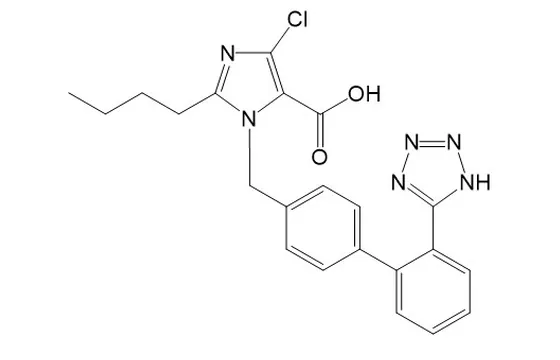
还有一处氯沙坦独有的位置:咪唑 5-位羟甲基,其他沙坦没有这个基团。它会被氧化成醛、再氧化成羧酸——后者就是活性代谢物 EXP3174,在本目录里以「杂质 14」的身份出现。工艺上是副产物,药理上是活性物,写杂质谱时两句话都得说。There is one position unique to losartan: the hydroxymethyl at imidazole position 5, a group the other sartans do not have. It oxidises to an aldehyde and then to a carboxylic acid — the latter being the active metabolite EXP3174, which appears in this catalogue as impurity 14. A by-product in process terms, an active substance in pharmacological terms; both sentences have to be said when writing the impurity profile.
四、残留溶剂:为什么 DMF 是绕不开的那个4. Residual solvents: why DMF is the one you cannot avoid
四氮唑环合需要极性非质子溶剂,DMF 是最常见的选择;咪唑的烷基化同样偏爱 DMF。DMF 属 Q3C 二类溶剂,限度 880 ppm,本身不难测——难的是它与叠氮、与二甲胺的关系。想彻底不用 DMF,往往换 N-甲基吡咯烷酮或二甲基乙酰胺,两者限度更宽但沸点更高、残留更难除。Tetrazole cyclisation needs a polar aprotic solvent, and DMF is the usual choice; imidazole alkylation also favours it. DMF is a Q3C class 2 solvent with a limit of 880 ppm and is not difficult to measure in itself — what is difficult is its relationship to azide and to dimethylamine. Eliminating DMF usually means switching to N-methylpyrrolidone or dimethylacetamide, both of which have wider limits but higher boiling points and are harder to strip.
| 溶剂Solvent | Q3C 类别Q3C class | 限度(ppm)Limit (ppm) | 路线上可能出现的位置Where it can appear on the route |
|---|---|---|---|
| 甲苯Toluene | 2 | 890 | 环合、萃取Cyclisation, extraction |
| 二甲苯Xylene | 2 | 2170 | 环合高温溶剂High-temperature cyclisation solvent |
| DMF | 2 | 880 | 环合、咪唑烷基化Cyclisation, imidazole alkylation |
| 甲醇Methanol | 2 | 3000 | 成盐、精制Salt formation, purification |
| 二氯甲烷Dichloromethane | 2 | 600 | 萃取Extraction |
| 乙腈Acetonitrile | 2 | 410 | 精制Purification |
| 异丙醇、丙酮、乙醇Isopropanol, acetone, ethanol | 3 | 5000 | 成盐、洗涤、干燥Salt formation, washing, drying |
表注:类别与限度依据 ICH Q3C(R8)Table note: classes and limits follow ICH Q3C(R8)[4];三类溶剂按 5000 ppm 或 0.5% 的常规控制水平列出。; class 3 solvents are listed at the customary control level of 5000 ppm or 0.5 percent.
三类溶剂常被误当成「不用管」。Q3C 的原意是这类溶剂毒性低、可按常规限量控制,不是免于检测。异丙醇在成盐步骤用量不小,干燥不彻底时残留可观,顶空 GC 又很成熟,没有理由不测。另一处容易漏的是共线交叉污染:多品种车间里,上一批的二氯甲烷、甲苯完全可能出现在这一批的图谱上,这种检出要能解释来源,否则一定被问专用设备在哪。Class 3 solvents are often misread as needing no attention. What Q3C actually says is that these solvents are of low toxicity and can be controlled to customary limits — not that they are exempt from testing. Isopropanol is used in no small amount at the salt-formation step and can leave a substantial residue if drying is incomplete, and headspace GC is a mature technique, so there is no reason not to test. Another easily missed point is shared-line cross-contamination: in a multi-product plant, dichloromethane or toluene from the previous batch can perfectly well appear in this batch's chromatogram, and such a detection has to be explained — otherwise you will be asked where the dedicated equipment is.
五、方法:ICP-MS 的四个实操坑5. Method: four practical traps in ICP-MS
方法学层面,ICH Q2(R2) 已经把准确度、精密度、专属性、线性与范围、检出限与定量限、耐用性都框住了At the method level, ICH Q2(R2) already frames accuracy, precision, specificity, linearity and range, detection and quantitation limits, and robustness[5]。氯沙坦钾这类含氯、含钾、含四氮唑的基质,落到 ICP-MS 上有四个具体的坑。. For a matrix like losartan potassium, containing chlorine, potassium and a tetrazole, there are four concrete traps when it reaches ICP-MS.
一是消解与基体。The first is digestion and matrix.微波消解用硝酸即可,但钾盐基质会产生明显信号抑制,稳妥做法是把标准曲线配在同浓度钾基质里,或用钪、锗、铟、铋分质量段做内标。基体匹配做不好,镍和铜会系统偏低。 Nitric acid microwave digestion is sufficient, but a potassium-salt matrix causes marked signal suppression; the safe approach is to prepare the calibration curve in a potassium matrix of matched concentration, or to use scandium, germanium, indium and bismuth as internal standards across the mass ranges. With poor matrix matching, nickel and copper read systematically low.
二是锡。The second is tin.若路线用了有机锡,消解必须能把碳锡键打断。常规硝酸微波消解对无机锡没问题,对有机锡可能矿化不完全、回收率偏低;这类样品要加硫酸或采用灰化辅助,并用加标回收验证,不能拿无机锡标准品做条曲线就交差。 If the route used an organotin, the digestion must break the carbon–tin bond. Routine nitric acid microwave digestion handles inorganic tin without trouble but may mineralise organotins incompletely, giving low recovery; such samples need sulfuric acid or ashing assistance, verified by spike recovery. Running a curve off an inorganic tin standard and calling it done is not acceptable.
三是挥发损失。The third is volatilisation loss.锡、汞、锇在开口赶酸、高温蒸干时会损失。密闭消解、控制赶酸温度、赶酸后立即定容,是把损失压下去的基本动作。汞尤其明显,这也是很多实验室给汞单独配一条标线的原因。 Tin, mercury and osmium are lost during open-vessel acid evaporation and high-temperature evaporation to dryness. Closed digestion, controlled evaporation temperature, and making up to volume immediately after evaporation are the basic moves that hold the loss down. Mercury is the most conspicuous case, which is why many laboratories run a separate calibration line for it.
四是污染。The fourth is contamination.钯、铂最容易被玻璃器皿与不锈钢器械污染,取样用的不锈钢药匙、金属研钵都是来源。做钯时取样与制样要全程用陶瓷或塑料器具,并做全流程空白。 Palladium and platinum are the elements most easily contaminated by glassware and stainless-steel tools; stainless spatulas and metal mortars used for sampling are sources. When working on palladium, sampling and preparation should use ceramic or plastic implements throughout, with a full procedural blank.
还有一问常被跳过:这些元素在成品里以什么形态存在。ICP-MS 测的是总量,测不出形态。只用无机试剂和钯催化剂的路线,总量够用;用了有机锡的路线,总量只回答了一半。One question is often skipped: in what form these elements exist in the finished product. ICP-MS measures total content and cannot see speciation. For a route using only inorganic reagents and a palladium catalyst, total content is enough; for an organotin route, total content answers only half the question.
六、风险评估报告怎么写才不被退回6. How to write the risk assessment so it is not sent back
氯沙坦钾在国内的申报密度很高。截至 2026-11-03,CDE 公开受理记录里相关条目 367 条、申报单位 122 家,其中仿制 123 条、补充申请 139 条、新药 34 条、进口与进口再注册合计 65 条Losartan potassium is filed very heavily in China. As of 2026-11-03 the CDE public acceptance records hold 367 related entries from 122 applicants: 123 generics, 139 supplemental applications, 34 new drugs, and 65 imports and import re-registrations combined[6]。补充申请比仿制还多,说明存量批文的工艺变更频繁——每次变更都可能动到溶剂与催化剂,也就每次都要重做元素杂质评估。. Supplemental applications outnumber generics, which says process changes to existing approvals are frequent — and every change can touch solvents and catalysts, so every change means redoing the elemental impurity assessment.
一份站得住的报告通常是四段。第一段画路线:把每一步的试剂、溶剂、催化剂、设备材质列成表,标出哪些位置可能引入 24 元素中的哪一个。设备材质最常被漏——搪玻璃釜密封、不锈钢离心机接触面、干燥箱内胆。A report that holds up usually has four parts. The first maps the route: list the reagents, solvents, catalysts and equipment materials for each step, marking which positions can introduce which of the 24 elements. Equipment material is the most frequently omitted — glass-lined reactor seals, stainless centrifuge contact surfaces, dryer interiors.
第二段给数据:三批商业规模批次的全谱扫描,加上方法学验证。全谱扫描的意义在于证明「没考虑到的元素也确实没有」,而不只是测你担心的那几个。The second gives data: a full-spectrum scan on three commercial-scale batches, plus method validation. The point of a full-spectrum scan is to demonstrate that the elements you did not think of are genuinely absent, not merely to measure the ones you worried about.
第三段做清除论证:对检出或可能检出的元素,说明它在哪一步被除去(洗涤、结晶、The third argues clearance: for each element detected or plausibly present, state at which step it is removed (washing, crystallisation, 活性炭activated carbon↗、蒸馏),并给出该步骤前后的含量对比。这一段最容易追问,因为它直接关系到工艺变更后风险是否改变。 or distillation) and give the content before and after that step. This is the section most likely to draw questions, because it bears directly on whether risk changes after a process change.
第四段是结论:实测值与折算限度并列,说明控制策略(工艺控制、定期检测、跳批检测)。不要写「远低于限度,故无需控制」——限度宽不等于可以不管,Q3D 要的是控制策略,不是一次性证明。The fourth is the conclusion: set measured values alongside the converted limits and state the control strategy (process control, periodic testing, skip-lot testing). Do not write that values are far below the limit and therefore need no control — a wide limit does not mean nothing needs managing, and Q3D asks for a control strategy, not a one-off demonstration.
七、横向对比:哪些沙坦能类比,哪些不能7. Cross-comparison: which sartans can be used as analogues and which cannot
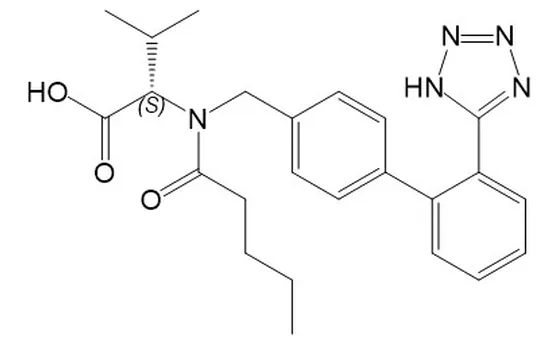
沙坦类的元素杂质风险,取决于分子里有没有四氮唑、四氮唑怎么合。The elemental impurity risk of a sartan depends on whether the molecule contains a tetrazole and how that tetrazole is assembled. 缬沙坦Valsartan、厄贝沙坦Irbesartan、坎地沙坦酯Candesartan cilexetil都带联苯四氮唑,路线逻辑与 both carry a biphenyltetrazole and their route logic is close to 氯沙坦钾losartan potassium相近,钯与锡这两个风险位点可以类比, so the palladium and tin risk positions can be compared directly[3]。
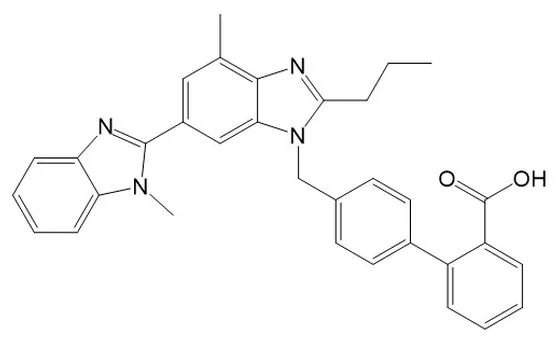
替米沙坦Telmisartan是个反例。它的酸性基团是羧酸而非四氮唑,分子里没有叠氮环合这一步,锡的风险直接消失,钯的风险取决于联苯怎么搭。把氯沙坦的模板整段搬过去,会写出一堆与工艺无关的元素。 is the counter-example. Its acidic group is a carboxylic acid rather than a tetrazole, there is no azide cyclisation step in the molecule, the tin risk disappears outright, and the palladium risk depends on how the biphenyl is built. Transplanting the losartan template wholesale will produce a list of elements with no bearing on the process. 阿齐沙坦Azilsartan也类似:用噁二唑酮环,不走叠氮路线。 is similar: it uses an oxadiazolone ring and does not go through an azide route.
杂质谱的差异也不能混谈。氯沙坦在酸性条件下会生成二聚型降解物,有研究用 Q-TOF、二维核磁与红外把三个酸性降解产物鉴定为含四氮唑与咪唑的环芳烃型结构Impurity profile differences cannot be lumped together either. Losartan forms dimeric degradants under acidic conditions, and one study used Q-TOF, two-dimensional NMR and IR to identify three acidic degradation products as cyclic aromatic structures containing both tetrazole and imidazole[7];另一项高分辨质谱非靶向筛查在原料药里检出 35 个降解产物,10 个用对照品确认,定量限低到 0.01–0.5 ng/mL; another non-targeted high-resolution mass spectrometry screen detected 35 degradation products in the drug substance, confirmed 10 of them against reference standards, and reached quantitation limits as low as 0.01–0.5 ng/mL[8]。两组数据说明:这个品种的有机杂质谱本身就很宽,元素与溶剂只是其中一角。. Both datasets say the same thing: the organic impurity profile of this product is itself very broad, and elements and solvents are only one corner of it.
反过来也一样:替米沙坦、The reverse holds as well: telmisartan and 阿齐沙坦Azilsartan↗的降解路径与氯沙坦不同,把氯沙坦的二聚体结论套过去同样不成立。凡要横向引用,先确认两个结构前提——四氮唑在不在,咪唑羟甲基在不在。 degrade by different paths from losartan, and carrying the losartan dimer conclusion across fails just as badly. Before citing across products, confirm two structural premises: whether the tetrazole is present, and whether the imidazole hydroxymethyl is present.
八、四个常见误区8. Four common misconceptions
误区一:把钾当元素杂质控制。Misconception one: controlling potassium as an elemental impurity.钾不在 Q3D 的 24 元素清单里,它属于成盐比例与含量测定。用 ICP-MS 测钾既浪费方法开发资源,也会在审评时暴露对框架的理解偏差。 Potassium is not on the 24-element Q3D list; it belongs to salt stoichiometry and assay. Measuring potassium by ICP-MS wastes method development resources and exposes a misreading of the framework at review.
误区二:报一个总锡,就认为有机锡已被覆盖。Misconception two: reporting total tin and believing organotins are covered.Q3D 的 PDE 按元素计、不区分形态,而有机锡的毒性远高于无机锡。用了有机锡路线,就要交代形态与专属检测,总锡只是起点。 The Q3D PDE is expressed as the element and does not distinguish forms, while organotins are far more toxic than inorganic tin. On an organotin route, speciation and a dedicated method have to be addressed; total tin is only the starting point.
误区三:日剂量低,所以元素杂质不用认真做。Misconception three: a low daily dose means elemental impurities need no serious work.100 mg 确实把限度抬宽了,但 Q3D 要的是风险评估与控制策略,不是「算出来很宽所以不用管」。宽限度下更容易出现「未检出但无方法支撑」的问题。100 mg does widen the limits, but Q3D asks for a risk assessment and a control strategy, not for the observation that the arithmetic comes out wide. Under wide limits the more common failure is a not-detected result with no method behind it.
误区四:元素、溶剂、亚硝胺三份报告各写各的。Misconception four: writing the element, solvent and nitrosamine reports separately.三者同源,都指向四氮唑环合那一步。分开写而不互相引用,等于把最关键的工艺信息切成三块,审评一定会要求你合起来讲一遍。 All three share an origin and all three point at the tetrazole cyclisation step. Writing them apart without cross-referencing cuts the most important process information into three pieces, and review will certainly ask you to tell it as one story.
常见问题(FAQ)Frequently asked questions
氯沙坦钾的钾含量需要按元素杂质控制吗?Does the potassium content of losartan potassium need to be controlled as an elemental impurity?
路线里用了叠氮化钠,需要检测叠氮根残留吗?If sodium azide is used on the route, does residual azide need testing?
100 mg 日剂量算出来钯限度 1000 ppm,是不是太宽了?The palladium limit works out to 1000 ppm at a 100 mg dose — is that not too wide?
有机锡路线一定要换成叠氮化钠路线吗?Must an organotin route be switched to a sodium azide route?
残留溶剂用顶空 GC 测,为什么还要做方法适用性?If residual solvents are measured by headspace GC, why is method suitability still needed?
元素杂质评估做完一次,工艺变更后还要重做吗?Once the elemental impurity assessment is done, must it be repeated after a process change?
为什么说氯沙坦的杂质谱比其他沙坦更宽?Why is the impurity profile of losartan broader than that of the other sartans?
相关品种与对照品Related products and reference standards
- 氯沙坦钾 / Losartan PotassiumLosartan Potassium(共 74 个杂质/衍生物条目)(74 impurity and derivative entries)
- 缬沙坦 / ValsartanValsartan(共 72 个杂质/衍生物条目)(72 impurity and derivative entries)
- 替米沙坦 / TelmisartanTelmisartan(共 80 个杂质/衍生物条目)(80 impurity and derivative entries)
- 厄贝沙坦 / IrbesartanIrbesartan(共 35 个杂质/衍生物条目)(35 impurity and derivative entries)
参考资料与来源References and sources
- ICH,ICH Q3D(R2)《元素杂质指导原则》:24 个元素分为三类并给出口服、注射、吸入途径的 PDE,元素杂质限度由 PDE 与最大日剂量换算ICH Q3D(R2) Guideline for Elemental Impurities: the 24 elements are grouped into three classes with PDEs for the oral, parenteral and inhalation routes, and elemental impurity limits are derived from the PDE and the maximum daily dose,访问日期 2026-11-03, accessed 2026-11-03
- 中国药典委员会,Chinese Pharmacopoeia Commission, 《中华人民共和国药典》现行版收载氯沙坦钾原料药及其片剂(各论条目与检验方法以现行版为准)The current edition of the Pharmacopoeia of the People's Republic of China covers losartan potassium drug substance and its tablets (monograph entries and test methods as given in the current edition),访问日期 2026-11-03, accessed 2026-11-03
- 欧洲药品管理局(EMA),European Medicines Agency (EMA), Angiotensin-II-receptor antagonists (sartans) containing a tetrazole group:Article 31 referral,对含四氮唑沙坦类的亚硝胺杂质来源与工艺控制进行审查Angiotensin-II-receptor antagonists (sartans) containing a tetrazole group: Article 31 referral, reviewing the sources of nitrosamine impurities and process controls across tetrazole-containing sartans,访问日期 2026-11-03, accessed 2026-11-03
- ICH,ICH Q3C(R8)《残留溶剂指导原则》:二类溶剂按 PDE 给定浓度限度(甲苯 890 ppm、DMF 880 ppm、二甲苯 2170 ppm、二氯甲烷 600 ppm、乙腈 410 ppm),三类溶剂按 5000 ppm 或 0.5% 常规控制ICH Q3C(R8) Guideline for Residual Solvents: class 2 solvents carry concentration limits derived from PDEs (toluene 890 ppm, DMF 880 ppm, xylene 2170 ppm, dichloromethane 600 ppm, acetonitrile 410 ppm), and class 3 solvents are controlled at the customary 5000 ppm or 0.5 percent,访问日期 2026-11-03, accessed 2026-11-03
- ICH,ICH Q2(R2)《分析方法验证》:准确度、精密度、专属性、线性与范围、检出限与定量限、耐用性等验证要素ICH Q2(R2) Validation of Analytical Procedures: accuracy, precision, specificity, linearity and range, detection and quantitation limits, robustness and the other validation elements,访问日期 2026-11-03, accessed 2026-11-03
- 国家药品监督管理局药品审评中心(CDE),Center for Drug Evaluation (CDE), NMPA, 受理品种信息检索:氯沙坦钾相关受理记录 367 条、申报单位 122 家,其中仿制 123 条、补充申请 139 条、新药 34 条、进口 32 条、进口再注册 33 条(抓取时间 2026-11-03;口径为公开受理记录,不等于获批家数)Acceptance information search: 367 acceptance records relating to losartan potassium from 122 applicants — 123 generics, 139 supplemental applications, 34 new drugs, 32 imports and 33 import re-registrations (retrieved 2026-11-03; the count covers public acceptance records and is not the number of approved applicants),访问日期 2026-11-03, accessed 2026-11-03
- Journal of Pharmaceutical and Biomedical Analysis(2016),The novel acid degradation products of losartan: Isolation and characterization using Q-TOF, 2D-NMR and FTIR(酸性强制降解生成三个未知降解物 LD-I、LD-II、LD-III,相对保留时间 3.63、3.73、3.91,结构为含四氮唑与咪唑的环芳烃型二聚体)The novel acid degradation products of losartan: isolation and characterization using Q-TOF, 2D-NMR and FTIR (acidic forced degradation generated three unknown degradants, LD-I, LD-II and LD-III, at relative retention times of 3.63, 3.73 and 3.91, with cyclic aromatic dimer structures containing both tetrazole and imidazole),访问日期 2026-11-03, accessed 2026-11-03
- Journal of Separation Science(2024),Application of Advanced High-Resolution Mass Spectrometric Techniques for the Analysis of Losartan Potassium Drug Substance Degradation Products(非靶向筛查检出 35 个降解产物,其中 10 个以对照品确认,定量限 0.01–0.5 ng/mL)Application of Advanced High-Resolution Mass Spectrometric Techniques for the Analysis of Losartan Potassium Drug Substance Degradation Products (non-targeted screening detected 35 degradation products, 10 of them confirmed against reference standards, with quantitation limits of 0.01–0.5 ng/mL),访问日期 2026-11-03, accessed 2026-11-03
说明:本文为 CATO 佳途技术团队原创整理,其中引用的法规、药典与公开文献内容已在上方标注来源,仅用于技术交流与检索参考,不构成质量标准或法规建议;具体品种的检测方法、限值与申报要求,请以现行法规、药典正文及官方发布为准。Note: this article was prepared by the CATO technical team. Regulatory, pharmacopoeial and published literature content cited here is sourced above and is provided for technical exchange and reference only; it does not constitute a quality standard or regulatory advice. For the test methods, limits and filing requirements of any specific product, the current regulations, pharmacopoeial texts and official publications govern.
本站产品信息仅供科研检索与选型参考,不作为质量标准依据;技术参数、纯度与结构确证以随货 COA 及我方书面确认为准。本文涉及的产品均为科研用途,不用于人体或动物诊断、治疗。Product information on this site is for research searching and selection reference only and is not a basis for quality standards; technical parameters, purity and structural confirmation are governed by the certificate of analysis supplied with the goods and by our written confirmation. All products discussed here are for research use and are not intended for human or animal diagnosis or treatment.