Metoprolol Succinate Is a 2:1 Salt, So Every Percentage Has Two Denominators
Metoprolol succinate carries two molecules of base for every molecule of acid, and that ratio sits underneath every number in the specification without ever being written into it. Assay, impurity limits, the 1.0 mg per day cap and the clinical dose equivalence all move by the same 22 per cent, and the impurity catalog shows a molecule whose risks come from two synthetic steps rather than from storage.
Two bases and one counter-ion
Key points
- Metoprolol succinate is bis(metoprolol) succinate, C34H56N2O10, 652.8: two metoprolol bases of 267.36 each for one succinate of 118.09, so the base fraction is 81.9 per cent and the salt-to-base ratio is 1.221[1].
- Metoprolol tartrate is also a 2:1 salt, C34H56N2O12, 684.8, with a base fraction of 78.1 per cent, which is why 95 mg of the succinate and 100 mg of the tartrate carry almost the same amount of base[1].
- ICH Q3A sets identification at 0.10 per cent or 1.0 mg per day, whichever is lower, and the extended-release strengths run from 25 to 400 mg per day, so the percentage governs at every strength and the absolute cap never binds[2][3].
- The impurity catalog traces the molecule rather than its degradation: EP impurity A is the N-ethyl homologue, EP impurity M is the bis-isopropylamino propanol from double opening of the epoxide, and glycidol is listed as well[4].
Metoprolol is a phenoxypropanolamine: an aromatic ether at one end, a secondary amine at the other, and a hydroxyl in the middle. The salt in the extended-release tablet is not the hydrochloride and not the tartrate. It is the succinate, and the succinate carries two bases. The formula is C34H56N2O10, the mass is 652.8, and the name in the pharmacopoeia is often written as the hemisuccinate, which is the same thing said from the other side: half a mole of succinic acid per mole of metoprolol.
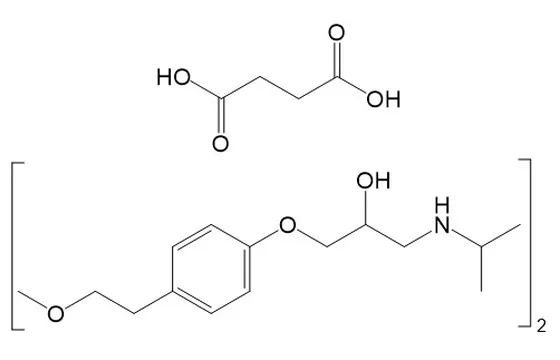
The catalog makes the naming trap visible. The salt appears as an item in its own impurity catalog under the hemisuccinate name, CAS 98418-47-4, and the tartrate appears beside it at CAS 56392-17-7, C34H56N2O12, 684.8[1]. A reader who assumes that the entry ending in a salt name is an impurity will misread the list. Both are the drug, in two counter-ions.
The class shows the same split: bisoprolol fumarate carries the 2:1 arithmetic with a different acid, while carvedilol is supplied as the free base and has no counter-ion denominator at all.
That stoichiometry is not a bookkeeping curiosity. It decides what a percentage means. A specification written against the salt treats 652.8 as the unit. A specification written against the base treats 267.36 as the unit. The two differ by a factor of 2.442 for a single base, or, for the salt as a whole, by the base fraction of 81.9 per cent.
The 22 per cent hidden in the word as
Work the numbers. Two moles of metoprolol at 267.36 give 534.72. One mole of succinic acid at 118.09 brings the salt to 652.81. The base fraction is 534.72 divided by 652.81, or 81.91 per cent, and the reciprocal is 1.221. Every quantity in the specification inherits that factor, and nothing in a chromatogram tells you which basis the analyst used.
| Quantity | On the base | On the succinate salt | Ratio |
|---|---|---|---|
| Metoprolol content of 100 mg of salt | 81.9 mg | 100 mg | 1.221 |
| An impurity at 0.10 per cent of the salt | 0.122 per cent | 0.10 per cent | 1.221 |
| An assay result of 99.0 per cent of the salt | assayed as the salt | 99.0 per cent | not comparable |
| The same 99.0 per cent expressed on the base | 99.0 per cent | 120.9 per cent | impossible as a salt assay |
Table 1. The same measurement written on two denominators. The fourth row is the check that catches a basis error: an assay above 100 per cent on the salt is arithmetically impossible and is the usual signature of a result calculated on the base and reported as the salt.
The last row is worth keeping in a review checklist. A certificate of analysis that reports 99.5 per cent and does not say whether the figure is on the base or on the salt cannot be compared with a specification, and a laboratory that switches basis between development and commercial release will produce an apparent shift in purity that no batch actually underwent. The same applies to impurity results: 0.10 per cent of the salt is 0.122 per cent of the base, so a limit of 0.10 per cent becomes a 22 per cent tighter limit if the denominator changes without the number changing.
There is a clinical version of the same factor. Ninety-five milligrams of the succinate carries 77.8 mg of metoprolol base, and 100 mg of the tartrate carries 78.1 mg, which is why both strengths exist in formularies and why a switch between salts is not a switch between doses. A generic that reformulates from one salt to the other without recomputing the base has changed the dose by a few per cent, which is small in pharmacology and large in a bioequivalence dossier.
Where the 1.0 mg per day column stops mattering
ICH Q3A gives three thresholds and two of them are expressed as the lower of a percentage and an absolute daily amount: identification at 0.10 per cent or 1.0 mg per day, qualification at 0.15 per cent or 1.0 mg per day[2]. The absolute column exists to protect patients on high doses, where a percentage of a large daily intake would allow an unreasonable mass. Whether it binds depends entirely on the dose.
Metoprolol succinate extended-release tablets are supplied as 25, 50, 100 and 200 mg, with a starting dose of 25 to 100 mg daily in hypertension, 100 mg daily in angina, and a maximum studied dose of 400 mg per day[3]. That range is wide enough to test both columns.
| Daily dose | 1.0 mg as a percentage of the dose | Identification threshold that applies | 0.05 per cent in absolute terms |
|---|---|---|---|
| 25 mg | 4.0 per cent | 0.10 per cent | 12.5 micrograms |
| 50 mg | 2.0 per cent | 0.10 per cent | 25 micrograms |
| 100 mg | 1.0 per cent | 0.10 per cent | 50 micrograms |
| 200 mg | 0.50 per cent | 0.10 per cent | 100 micrograms |
| 400 mg | 0.25 per cent | 0.10 per cent | 200 micrograms |
Table 2. The absolute cap of 1.0 mg per day against the dose range of the extended-release tablet. At every strength the percentage is the stricter of the two, so the second column of the ICH table never sets the limit for this drug.
The conclusion is useful because it simplifies the specification and because it is easy to state in a filing: for metoprolol succinate, the percentage thresholds govern throughout the dose range, and the absolute caps can be shown not to bind. The same arithmetic in the opposite direction explains why a 4 g daily dose of a different drug collapses the two-tier structure entirely. The rule is the same; the outcome depends on the dose.
The reporting threshold deserves its own sentence. At 0.05 per cent, a 25 mg dose reports impurities down to 12.5 micrograms, and a 400 mg dose reports down to 200 micrograms. The same percentage is a sixteen-fold difference in mass, so a method validated at the low strength is not automatically fit for the high one, and the sensitivity requirement should be written against the smallest marketed dose rather than the largest.
The impurity map is a map of two steps, not of storage
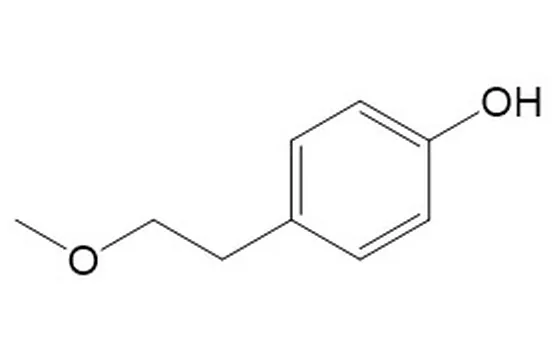
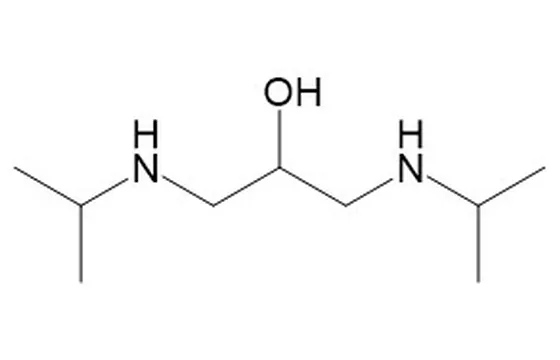
Read the catalog by name and the chemistry announces itself. EP impurity B is 4-(2-methoxyethyl)phenol, CAS 56718-71-9, C9H12O2, 152.19: the aromatic partner before the side chain is installed[4]. Glycidol appears at CAS 556-52-5, C3H6O2, 74.08, the epoxide that opens to give the propanol chain. EP impurity M is 1,3-bis(isopropylamino)propan-2-ol at CAS 343785-33-1, C9H22N2O, 174.28, which is what happens when the epoxide is opened by the amine at both ends instead of one[4].
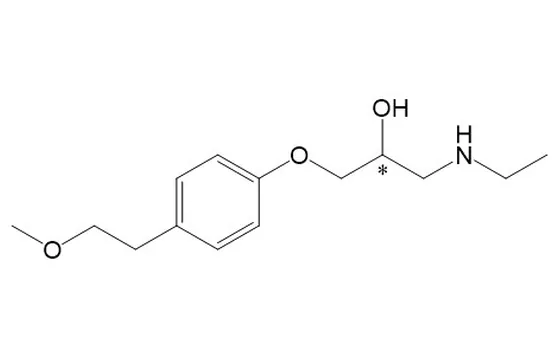
Two more records complete the picture. EP impurity A is 1-(ethylamino)-3-[4-(2-methoxyethyl)phenoxy]propan-2-ol at CAS 109632-08-8, C14H23NO3, 253.34: the same molecule with an ethyl group where the isopropyl should be, which is a statement about the purity of the amine used in the amination step rather than about the drug[4]. EP impurity O at CAS 154784-36-8, C27H41NO6, 475.6, is the bis adduct in which one isopropylamine has been alkylated twice, so a single nitrogen carries two metoprolol chains[4].
None of these is a degradant. They are process fingerprints, and that has two consequences. First, a stability programme will not find them, because nothing in the storage conditions creates an ethyl group or a second chain. Second, a forced-degradation package cannot qualify them, because qualification is about exposure to a degradant, and these compounds were never absent from the patient population in the first place. ICH Q11 makes the same point from the other direction: the impurities that matter are the ones the route can make, and the control strategy is built at the steps that make them[5].
The practical reading is that a related-substances method for this drug has to be developed against a route, not against a chromatogram. An applicant who buys the EP letters and stops there will cover the pharmacopoeial set and miss the adducts, because the adducts are the ones that require a synthetic step to prepare and are therefore the ones a catalog tends to list late.
The number of applicants in the Chinese acceptance database, for context on how many files carry the same arithmetic:
Two nitrosation sites, one on the drug and one on a reagent
Metoprolol has one secondary amine, the isopropylamino nitrogen, and one hydrogen on it. The N-nitroso derivative is in the catalog at CAS 138768-62-4, C15H24N2O4, 296.36, which is the drug plus NO minus H[4].
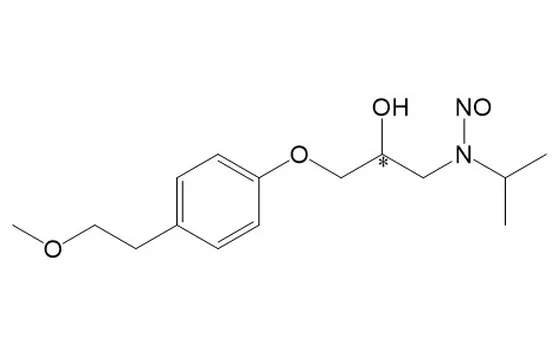
The same catalog carries a second nitroso compound that has nothing to do with the drug: N-nitroso bis(2-hydroxypropyl)amine at CAS 53609-64-6, C6H14N2O3, 162.19, the nitrosated form of a secondary amine reagent of the same family[4].
Both matter, and they fail in different ways. The first is a nitrosamine of the active substance and belongs in the drug-substance specification. The second is a nitrosamine of a reagent, and it belongs in the assessment of starting materials and of the equipment train: the reagent is itself a secondary amine, so nitrosation does not require the drug to be present, and a shared vessel or a recycled solvent is enough of a route into the product.
The limit arithmetic has the same shape as the threshold arithmetic and a very different scale. The ICH M7 threshold of concern is 1.5 micrograms per day[6]. At 25 mg per day that is 60 ppm. At 400 mg per day it is 3.75 ppm. One impurity, one specification, two limits that differ by a factor of sixteen, and the difference comes from the dose rather than from the chemistry. This is the point at which a single limit across all strengths becomes indefensible, and it is also the point at which the compendial reporting threshold of 0.05 per cent, which is 500 ppm, stops being relevant: it sits two orders of magnitude above the number that matters.
What the counter-ion does not fix
Succinic acid is a counter-ion, not an impurity, and the specification should not treat it as one. It is also not inert. A monoester of metoprolol and succinic acid would consume one acid per base instead of one per two, raising the mass per base from 326.4 to 367.4. A titration of the basic nitrogen would not miss that: it would report a titre about 11 per cent low, and the result would be read as weak potency rather than as a change in stoichiometry. A chromatographic assay calibrated against the 2:1 salt would show the same drop and invite the same misreading, which is why neither method on its own proves that the ratio is what the label says.
That asymmetry is worth knowing before it appears in a deviation. It means the assay method and the impurity method answer different questions about the same event, and it means a specification written only as a titration is blind to a change in stoichiometry. The defense is a chromatographic assay with a stated basis, plus a counter-ion content test, which together pin the ratio rather than assuming it.
The extended-release formulation adds a second layer. The tablet is a matrix or a coated multiparticulate, and the release is controlled by the dosage form rather than by the salt. A change in the salt, in particle size, or in the fraction of fines will change the release profile without changing the assay, which is why the dissolution method for this product has to be discriminating rather than merely reproducible. None of that is visible in the impurity data, and all of it sits in the same dossier.
Reference standards for a 2:1 salt
The catalog lists 65 metoprolol succinate entries, with EP letters A through O, the two nitroso compounds at 138768-62-4 and 53609-64-6, glycidol at 556-52-5, and the phenol at 56718-71-9: [see all metoprolol succinate entries](metoprolol succinate impurity and derivative entries)
Two of those entries are the drug rather than an impurity, the hemisuccinate at 98418-47-4 and the tartrate at 56392-17-7, and a buyer who does not read the names will order the wrong one. For a method that has to demonstrate the 2:1 ratio, both are useful: one is the sample, the other is a control that shows what a different counter-ion does to the same chromatogram.
Frequently Asked Questions
Is metoprolol succinate the same as metoprolol hemisuccinate?
Why does the specification need to state whether a percentage is on the base or the salt?
Does the 1.0 mg per day cap ever apply to metoprolol succinate?
How much metoprolol base is in 95 mg of the succinate?
Is EP impurity A a degradation product?
Why are there two N-nitroso compounds in the catalog?
What limit applies to N-nitroso metoprolol at different strengths?
Does the succinate counter-ion affect the assay?
Related Substances and Reference Standards
- Metoprolol Succinate (- impurity / derivative entries)
- Bisoprolol Fumarate (- impurity / derivative entries)
- Carvedilol (- impurity / derivative entries)
References and Sources
- PubChem, National Center for Biotechnology Information, Metoprolol succinate (C34H56N2O10, 652.8) and metoprolol tartrate (C34H56N2O12, 684.8), used here for the 2:1 stoichiometry, the base fraction and the salt-to-base ratio, accessed 2026-11-18
- International Council for Harmonisation, ICH Q3A(R2), Impurities in new drug substances, identification at 0.10 per cent or 1.0 mg per day and qualification at 0.15 per cent or 1.0 mg per day, whichever is lower, accessed 2026-11-18
- DailyMed, US National Library of Medicine, Metoprolol succinate extended-release tablets, prescribing information: strengths of 25, 50, 100 and 200 mg, starting doses of 25 to 100 mg, and the statement that doses above 400 mg per day have not been studied, accessed 2026-11-18
- PubChem, National Center for Biotechnology Information, Records for CAS 56718-71-9, 501-94-0, 556-52-5, 109632-08-8, 343785-33-1, 154784-36-8, 138768-62-4 and 53609-64-6, used for formulas, masses and the structural relationships described in the text, accessed 2026-11-18
- International Council for Harmonisation, ICH Q11, Development and manufacture of drug substances, on identifying the steps that generate impurities and the controls placed on them, accessed 2026-11-18
- International Council for Harmonisation, ICH M7(R2), Assessment and control of DNA reactive (mutagenic) impurities, threshold of toxicological concern of 1.5 micrograms per day, accessed 2026-11-18
This article was prepared by the CATO technical team. Regulatory, pharmacopoeial and published literature content cited above is attributed in the reference list. It is provided for technical exchange and search reference only and does not constitute a quality specification or regulatory advice. For any specific substance, the applicable test methods, limits and filing requirements are governed by the current regulations, pharmacopoeial monographs and official publications.
Product information on this site is provided for research search and selection reference only and is not a quality specification; technical data, purity and structural confirmation are governed by the shipped COA and our written confirmation. All products mentioned are for research use only, not for human or animal diagnostic or therapeutic use.