Metronidazole at 2.25 Grams a Day: Where the 0.10 Per Cent Impurity Limit Quietly Stops Applying
Metronidazole↗ has almost no chemistry to degrade: no ester, no amide, no chiral centre, 171 daltons. What it does have is a gram-sized daily dose and two independent substituent choices on the ring, which together produce a family of isobaric analogues and a set of thresholds that behave nothing like the ones a 1 mg product uses. The interesting part is arithmetic, not chemistry.
Note: product names shown in red (marked with ↗) are links - click through to the product page for structure, CAS number, purity and lead time.
A 171-dalton molecule carrying a gram-sized dose
Key points
- Metronidazole is C6H9N3O3, 171.15, CAS 443-48-1: a 2-methyl-5-nitroimidazole carrying an N-hydroxyethyl group, and the nitroimidazole is the only chromophore, with an absorbance maximum near 322 nm[1].
- The adult amebiasis regimen is 750 mg three times daily[1], so every threshold has to be read at 2.25 g per day, not at the milligram scale most impurity work assumes.
- At that dose the absolute caps in ICH Q3A(R2) bind before the percentages do, and the effective identification threshold falls to 0.05 per cent at 2 g per day or more[2].
- Metronidazole is mutagenic in vitro including in the Ames test, while in vivo mammalian studies have not shown genetic damage[1]; that combination is why a 1.5 microgram per day TTC cannot be the controlling number[3].
Metronidazole, the parent of the metronidazole entry set, is small even by the standards of old antibiotics. C6H9N3O3, 171.15, CAS 443-48-1: a five-membered imidazole ring with a methyl at C2 and a nitro at C5, and a hydroxyethyl group on the ring nitrogen. There are no chiral centres, no ester, no amide, nothing that hydrolyses on the shelf. A molecule with that little chemistry looks like a molecule with no impurity problem.
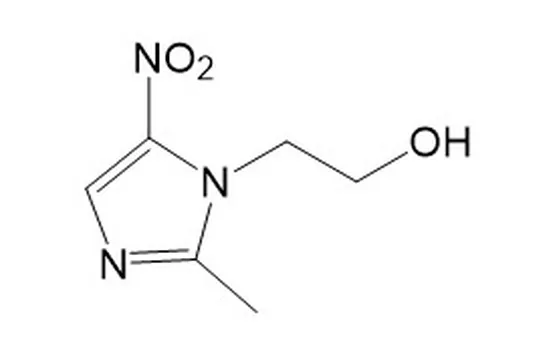
The dose changes the question. The adult regimen for acute intestinal amebiasis is 750 mg three times daily[1], which is 2.25 g per day, and serious anaerobic infections are treated in the same range. At 2.25 g per day, one per cent of the daily dose is 22.5 mg. An impurity present at the reporting threshold is present at a quantity that would be a main component in a 1 mg product.
Two things follow. The analytical problem is not sensitivity: a nitroimidazole absorbs strongly near 322 nm[1], so a UV detector sees picomoles without effort. The problem is selectivity and the arithmetic of thresholds. Everything else in this article is a consequence of those two.
Two substituent variables generate the entire family
Look at what the nitration and the alkylation can do. The ring can be nitrated at C4 or at C5. The ring nitrogen can carry hydrogen, a hydroxyethyl group, an ethoxyethyl group, or an acetic acid. Oxidation of the hydroxyethyl gives an acid, oxidation of the ring gives a hydroxyimidazole, and hydrolysis can strip the side chain altogether.
| Entry in this catalogue | Formula and mass | Nitro position | N-substituent |
|---|---|---|---|
| Metronidazole, 443-48-1 | C6H9N3O3, 171.15 | 5 | hydroxyethyl |
| Isometronidazole, 705-19-1 | C6H9N3O3, 171.15 | 4 | hydroxyethyl |
| 2-(5-nitroimidazol-1-yl)ethanol, 5006-68-8 | C5H7N3O3, 157.13 | 5 | hydrogen |
| 2-(4-nitroimidazol-1-yl)ethanol, 5006-69-9 | C5H7N3O3, 157.13 | 4 | hydrogen |
| 2-methyl-5-nitroimidazole, 696-23-1 | C4H5N3O2, 127.10 | 5 | none, ring only |
| 4-nitroimidazole, 3034-38-6 | C3H3N3O2, 113.08 | 4 | none, ring only |
| Ethoxyethyl homologue, 16156-94-8 | C8H13N3O4, 215.21 | 5 | ethoxyethyl |
| Acetic acid analogue, 1010-93-1 | C6H7N3O4, 185.14 | 5 | acetic acid |
| Hydroxymetronidazole, 4812-40-2 | C6H9N3O4, 187.15 | 5 | hydroxyethyl, ring hydroxylated |
Table note: formulas and masses as held in this catalogue and confirmed against PubChem records[4]; the position and substituent columns are structural assignments from those records.
Read down the mass column and the design of the problem becomes visible. Two of these rows share 171.15 exactly, and two more share 157.13 exactly. An impurity family built from two independent substituent choices will always produce isobaric pairs, because changing the position of a nitro group does not change the formula.
The drug and its positional isomer weigh the same to four decimals
Metronidazole and isometronidazole are the same molecule with the nitro group one carbon over. Same formula, same nominal mass, same exact mass, same isotope pattern, same fragments in the mass spectrometer. There is no spectroscopic measurement that separates them, and no mass-spectrometric measurement either. Only retention does.
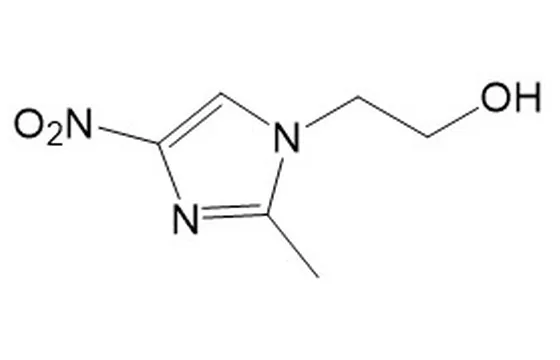
This is not a hypothetical. The 4-nitro isomer is a genuine consequence of nitrating 2-methylimidazole, which gives both the 4- and the 5-nitro products, and the alkylation step does not remove either. What it does remove is the option of calling the second peak an unknown: an isobaric peak at the right retention time is either the isomer or nothing.
Three practical consequences. System suitability has to include isometronidazole, because a suitability test built only on the parent proves resolution from the solvent front and nothing else. Forced degradation will not generate the isomer, so a study designed to find degradants will conclude, correctly and uselessly, that the isomer is absent. And the mass spectrometer, which most laboratories reach for first when a peak is unidentified, is the one instrument that cannot help.
The 157.13 pair behaves identically. The des-methyl 5-nitro compound and its 4-nitro sibling differ only in the ring, both elute before the parent, and both sit in the region where a generic gradient has its worst resolution.
Where the percentage stops being the limit
ICH Q3A(R2) sets thresholds for impurities in a drug substance by maximum daily dose, and two of the three thresholds are written as a percentage or an absolute amount, whichever is lower[2]:
| Maximum daily dose | Reporting | Identification | Qualification |
|---|---|---|---|
| Less than 2 g per day | 0.05 per cent | 0.10 per cent or 1.0 mg per day | 0.15 per cent or 1.0 mg per day |
| 2 g per day or more | 0.03 per cent | 0.05 per cent | 0.10 per cent |
The lower-of rule is where gram doses bite, and the crossover is exact. A 1.0 mg per day absolute cap equals 0.10 per cent at a dose of 1 g per day. Above 1 g, the absolute cap is the smaller number and the percentage becomes decorative. Work it through:
| Daily dose | 0.10 per cent equals | Absolute cap | Effective identification threshold |
|---|---|---|---|
| 1.0 g | 1.00 mg | 1.0 mg per day | 0.10 per cent, the two agree |
| 1.5 g | 1.50 mg | 1.0 mg per day | 0.067 per cent |
| 2.0 g | 2.00 mg | 0.05 per cent row applies | 0.05 per cent |
| 2.25 g | 2.25 mg | 0.05 per cent row applies | 0.05 per cent |
Table note: derived from the thresholds in ICH Q3A(R2)[2]; doses are the labelled amebiasis regimen and points either side of it, not product-specific claims.
Now the second effect. At 2.25 g per day the reporting threshold drops to 0.03 per cent, which is 0.68 mg per day. The reporting threshold is therefore almost as large in absolute terms as the identification threshold was at 1 g. A laboratory that qualified its method at 0.05 per cent against a 1 g assumption is working above the reporting threshold of the product it is actually testing.
Why 1.5 micrograms per day is not available as an answer
The instinct, for a nitroaromatic ring, is to reach for ICH M7(R2) and its 1.5 microgram per day total threshold of concern[3]. Run the number before committing to it. At 2.25 g per day, 1.5 micrograms per day is 0.67 parts per million, or 0.000067 per cent. That is roughly five hundred times below the reporting threshold, and below the limit of quantification of any conventional related-substances method by a wide margin.
The deeper objection is mechanistic. M7 is built for the case where the drug substance is not itself DNA reactive and the impurity is a trace contaminant whose risk can be treated as additive and dose-independent. Here the parent is the mutagen. The labelling states that metronidazole has shown mutagenic activity in vitro including in the Ames test, while in vivo mammalian studies have not demonstrated genetic damage[1], and the carcinogenicity studies in mice were run at dose levels comparable to the maximum recommended human dose[1]. The structure-activity work across 48 nitroimidazoles and related imidazoles puts the activity on the ring rather than on the side chain[5]. An impurity that is a nitroimidazole is not a different hazard from the parent; it is the same hazard, and its acceptable level has to be argued relative to the parent's own qualified exposure rather than against an absolute microgram figure.
That is why the pharmacopoeial route exists for this molecule. A general threshold cannot discriminate between a ring fragment at 127 daltons and a chain-oxidised analogue at 185 daltons, and neither can a TTC. A named impurity with its own limit can.
Specified limits do work a general threshold cannot
Related-substances monographs for molecules of this age are written as a list. Named impurities get individual limits; everything else is capped by a single unspecified-impurity limit; and the total is capped again. The structure looks bureaucratic until you try to control this family with one number.
Two cases show why. The ring fragment 2-methyl-5-nitroimidazole, C4H5N3O2, 127.10, is what remains when the hydroxyethyl is lost, and it is the smallest species in the family that still carries the nitroimidazole. It is also the one whose toxicology is least like the parent's, because it has no side chain to modulate uptake. A generic 0.10 per cent unspecified limit would allow it at 2.25 mg per day. A named limit can be set at whatever the qualification package supports.
The second case is more awkward. This catalogue lists secnidazole at 3366-95-8 and dimetridazole at 551-92-8 among the metronidazole entries, because both are nitroimidazoles that the same chemistry can produce and both are marketed drugs in their own right. Being a drug is not an argument for exemption. A specified impurity that happens to be another approved API still needs its own limit, and the limit is set by the product's exposure, not by the other product's approval.
On the product side, ICH Q3B(R2) applies the same lower-of logic with different numbers: 0.1 per cent reporting and 0.5 per cent identification at 1 g per day or less, and 0.05 per cent and 0.2 per cent above that[6]. A 400 mg tablet and a 2.25 g daily regimen of the same tablet land in different rows, which is a specification decision made at the product level and often missed when a single method is transferred between strengths.
The method: 322 nm is the easy part
Detection is not the constraint. The nitroimidazole chromophore absorbs near 322 nm with a molar absorptivity high enough that a 1 mg/mL solution needs dilution by two orders of magnitude[1]. The constraints are retention, resolution and the injection solvent.
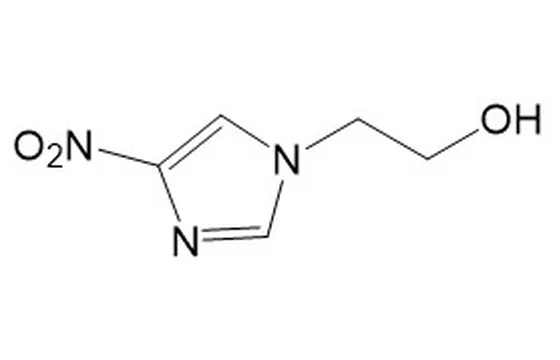
Retention first. Metronidazole is small, polar and uncharged across the working pH range, so a high-aqueous reversed-phase method gives it a capacity factor that is adequate rather than comfortable. The des-methyl acids at 157.13 are more polar still and elute earlier, which means the gradient needs a shallow initial segment rather than a hold. A method that starts at 5 per cent organic will put two of the nine entries in this family inside the injection front.
Resolution second. The 4-nitro and 5-nitro pairs differ in dipole and in hydrogen bonding rather than in size, so the selectivity is real but small, and it is sensitive to mobile-phase pH and to temperature. A column oven that drifts by two degrees is enough to swap the order of a pair in a stressed sample.
The injection solvent is the third constraint and the one most often skipped. Dissolving the sample at a strength that gives a good peak height for the parent overloads the early region, and the early region is where the informative impurities are. Dilute for the front, not for the main peak.
What transfers to other nitroimidazoles and what does not
Ornidazole carries a chloromethyl instead of a methyl and a chloropropanol side chain instead of a hydroxyethyl. The nitration still gives two positions, the alkylation still gives two chain lengths, and the threshold arithmetic travels unchanged because it depends only on dose. The impurity map does not travel: the chlorine adds a dehalogenation route that metronidazole does not have, and the larger side chain changes the retention order of everything.
Tinidazole carries an ethylsulfonyl group, which is a much stronger electron-withdrawing substituent than a methyl. That changes the reduction potential of the nitro group, and the reduction potential is what determines how readily the ring is activated. A limit transferred from metronidazole on the grounds that both are 5-nitroimidazoles is a limit transferred without a basis.
See the full variety list for the rest of the class. The general rule for the family: share the method development strategy, share the threshold arithmetic, and rebuild the impurity list for every molecule. The list is a function of the substituents, and the substituents are what make them different drugs.
Reference standards for a family, not a compound
This catalogue holds 53 metronidazole entries, and the useful way to read them is as a grid rather than a list: two nitration positions by four side-chain states, with the ring fragments at the bottom. For routine work the set that carries the most information is small: the parent at 443-48-1, isometronidazole at 705-19-1 as the resolution marker, the two des-methyl acids at 5006-68-8 and 5006-69-9 as the front-end markers, and 2-methyl-5-nitroimidazole at 696-23-1 as the fragment whose limit has to be argued rather than borrowed. [See every metronidazole entry](Metronidazole)
One habit is worth building. Because the positional pairs are isobaric, a standard characterised only by mass and by a certificate is not characterised at all; the assignment rests on the chromatographic behaviour of that particular lot. Keep the retention data with the standard, and re-check the assignment whenever the method changes column chemistry.
show how many applicants are working to the same thresholds, which is the practical reason the arithmetic in this article matters more than it looks.Frequently Asked Questions
Is isometronidazole a process impurity or a degradant?
Why does the identification threshold fall below 0.10 per cent?
Can the 1.5 microgram per day TTC be applied to a nitroimidazole impurity?
Does the mass spectrometer resolve the 4-nitro and 5-nitro isomers?
Is 322 nm the right detection wavelength?
Why are secnidazole and dimetridazole in the metronidazole catalogue?
Does the same threshold arithmetic apply to metronidazole products?
What is the first experiment to run on an unknown peak in this family?
Related Substances and Reference Standards
- Metronidazole (53 impurity / derivative entries)
- Ornidazole (58 impurity / derivative entries)
- Tinidazole (19 impurity / derivative entries)
- Ambroxol (72 impurity / derivative entries)
References and Sources
- U.S. National Library of Medicine, DailyMed, FLAGYL (metronidazole) capsules: prescribing information, including 750 mg three times daily for acute intestinal amebiasis, absorbance near 322 nm, and the statement that metronidazole has shown mutagenic activity in vitro including the Ames test while in vivo mammalian studies have not demonstrated genetic damage, accessed 2026-11-12
- International Council for Harmonisation, ICH Q3A(R2), Impurities in new drug substances: reporting, identification and qualification thresholds by maximum daily dose, including the lower-of rule for the identification and qualification limits, accessed 2026-11-12
- International Council for Harmonisation, ICH M7(R2), Assessment and control of DNA reactive (mutagenic) impurities in pharmaceuticals to limit potential carcinogenic risk: the 1.5 microgram per day total threshold of concern, accessed 2026-11-12
- U.S. National Library of Medicine, PubChem, Metronidazole, CAS 443-48-1, C6H9N3O3, 171.15; isometronidazole, CAS 705-19-1, C6H9N3O3, 171.15; 2-(4-nitro-1H-imidazol-1-yl)ethan-1-ol, CAS 5006-69-9, C5H7N3O3, 157.13; 2-(5-nitro-1H-imidazol-1-yl)ethanol, CAS 5006-68-8, C5H7N3O3, 157.13, accessed 2026-11-12
- Environmental and Molecular MutagenesisEvaluation of the mutagenic and genotoxic activities of 48 nitroimidazoles and related imidazole derivatives by the Ames test and the SOS chromotest, Environmental and Molecular Mutagenesis 1992, DOI 10.1002/em.2850190212 (publisher site blocks automated access; cited by DOI)
- International Council for Harmonisation, ICH Q3B(R2), Impurities in new drug products: reporting, identification and qualification thresholds by maximum daily dose, accessed 2026-11-12
This article was prepared by the CATO technical team. Regulatory, pharmacopoeial and published literature content cited above is attributed in the reference list. It is provided for technical exchange and search reference only and does not constitute a quality specification or regulatory advice. For any specific substance, the applicable test methods, limits and filing requirements are governed by the current regulations, pharmacopoeial monographs and official publications.
Product information on this site is provided for research search and selection reference only and is not a quality specification; technical data, purity and structural confirmation are governed by the shipped COA and our written confirmation. All products mentioned are for research use only, not for human or animal diagnostic or therapeutic use.