Nicotinamide: Three Compounds With One Formula, and the Nitrile That Never Hydrolyzed
Most impurity profiles are stories about time. Nicotinamide↗ is a story about selectivity: four of its first five lettered impurities are one reaction step away from the drug substance, and three of them weigh exactly the same as the parent. That combination makes the molecule a good test of whether a method is specific or merely precise.
Note: product names shown in red (marked with ↗) are links - click through to the product page for structure, CAS number, purity and lead time.
A vitamin whose impurity list is a selectivity map
Key points
- Nicotinamide is C6H6N2O, 122.12, CAS 98-92-0. Three separate compendial impurities in this catalogue share that exact formula: the parent, picolinamide and isonicotinamide.
- The amide sits between two neighbors in the same reaction sequence. Incomplete hydration leaves 3-cyanopyridine, C6H4N2; over-hydrolysis gives nicotinic acid, C6H5NO2. Both are catalogued and both are measurable in the same run.
- At a 500 mg daily dose the identification threshold stays at 0.10 percent rather than dropping to an absolute limit, because 1.0 mg/day corresponds to 0.20 percent[1].
- None of the three isobars can be identified by mass or by ultraviolet spectrum alone. Retention, and only retention, separates them, so every peak needs its own standard.
Most impurity profiles are stories about time: a molecule degrades, a peak grows, a shelf life shortens. Nicotinamide is not one of those. Its profile is a story about selectivity, because every significant impurity is a compound the synthesis could plausibly have made and did not quite. This catalogue carries 284 nicotinamide entries, and among the first five lettered impurities, four are one reaction step away from the drug substance.
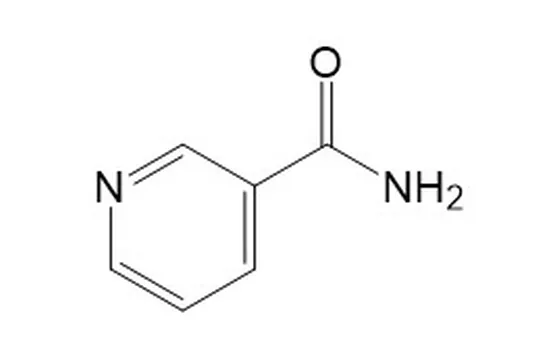
The industrial route explains the pattern. 3-Methylpyridine is ammoxidation-oxidized to 3-cyanopyridine, and the nitrile is then partially hydrated to the amide, usually over a manganese dioxide or copper-based catalyst. Partial hydration is the operative word: stop too early and the nitrile survives, go too far and the amide hydrolyzes to the carboxylic acid. A plant therefore controls the reaction by conversion rather than by purification, and the impurity profile at release is a record of where that conversion landed.
The dose context is mild compared with most of this catalogue. Nicotinamide tablets are commonly 50 or 100 mg, with high-dose regimens reaching 500 mg a day, so the identification threshold is set by percentage rather than by absolute mass: 1.0 mg/day at 500 mg/day equals 0.20 percent, well above the 0.10 percent default[1]. The percentage limits mean that a 0.08 percent nitrile is a reportable but unidentified peak, which is precisely the situation where a laboratory reaches for a reference standard it does not have.
Impurity B: the nitrile that never hydrolyzed
3-Cyanopyridine, CAS 100-54-9, is EP impurity B. It is the smallest possible marker of an incomplete reaction, and it has one property that makes it analytically awkward: it is far more lipophilic than the amide it precedes. On a C18 column with a water-acetonitrile gradient, the nitrile elutes well after the parent, in a region where nothing else of interest sits, which is convenient. On a polar-embedded or HILIC column run for the isobars, it moves to the other end of the chromatogram. Method transfer between the two platforms therefore requires re-identification, not just re-validation.
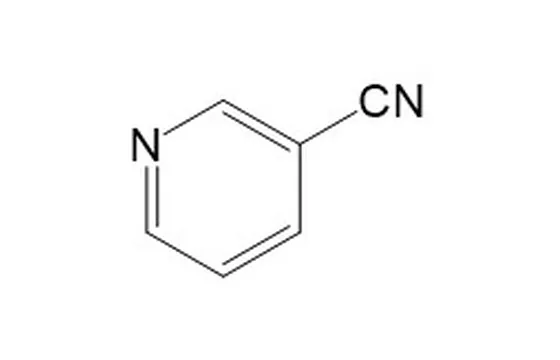
What makes the nitrile interesting is not its toxicity, which is unremarkable for an aromatic nitrile, but its evidentiary value. A batch with 0.02 percent nitrile and 0.01 percent acid has been run to a conversion that favors the amide; a batch with 0.15 percent nitrile and no acid has been stopped early and purified afterwards. The ratio of the two tells a reviewer more about the process than either number alone, and it is the sort of argument that belongs in section 3.2.S.3.2 rather than in a specification.
The acid on the other side, and why the boundary is blurry
Nicotinic acid, C6H5NO2, CAS 59-67-6, is both a process impurity and a degradation product, and this is the one place in the molecule where the two cannot be separated by context alone. It is formed in the reactor when hydration overshoots, and it is formed in the tablet when residual moisture and an acidic excipient meet the amide over eighteen months. This catalogue carries it as a separate variety with 103 entries, which is a hint about how much analytical work the compound attracts in its own right.
Separating the two contributions is a spiking question, not a chromatographic one. Add nicotinic acid to placebo at the specification level, store it under accelerated conditions, and see whether the spiked amount stays put. If it does, the acid in the drug product is process-derived; if it grows, hydrolysis is running in the package and the specification needs a degradation-based justification rather than a batch-history one. The same experiment settles whether the limit should be tightened for a hygroscopic formulation.
Impurities C and D: two isomers that should not be there
Picolinamide, CAS 1452-77-3, is EP impurity C, and isonicotinamide, CAS 1453-82-3, is EP impurity D. Both are pyridinecarboxamides with the amide at the wrong ring position, and neither can form from nicotinamide by any rearrangement available in a tablet. They enter through the feedstock. Commercial 3-methylpyridine carries 2- and 4-picoline at low levels, ammoxidation converts all three to the corresponding nitriles, and hydration is not selective enough to reject them.
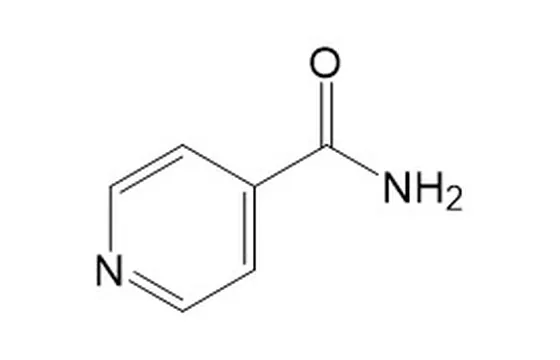
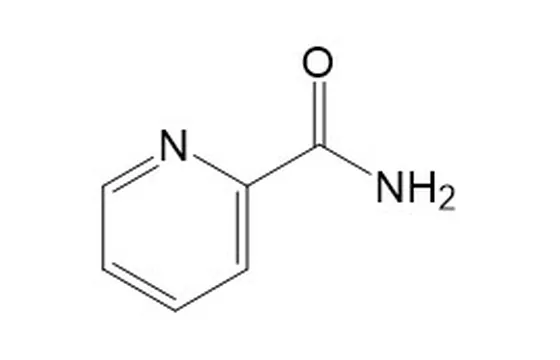
The two behave differently on a column, and the difference is worth knowing before method development starts. The para isomer is symmetrical and behaves almost exactly like the parent, which is why it is the harder of the two to resolve. The ortho isomer can form an intramolecular hydrogen bond between the amide N-H and the pyridine nitrogen, which changes its solvation, its retention and its peak shape, and which also makes it the one that responds most strongly to mobile phase pH, and to the metal surfaces it meets in the injector and the column frit[2]. A method developed at pH 3 may resolve the ortho isomer and merge the para one; a method at pH 6.5 may do the reverse.
| Entry | CAS | Formula | Relationship | Origin |
|---|---|---|---|---|
| EP impurity B | 100-54-9 | C6H4N2 | nitrile precursor, two hydrogens fewer | incomplete hydration |
| EP impurity C | 1452-77-3 | C6H6N2O | ortho isomer, same formula | 2-picoline in the feedstock |
| EP impurity D | 1453-82-3 | C6H6N2O | para isomer, same formula | 4-picoline in the feedstock |
| EP impurity E | 1986-81-8 | C6H6N2O2 | pyridine N-oxide, one oxygen more | oxidation |
| nicotinic acid | 59-67-6 | C6H5NO2 | amide hydrolyzed to acid | over-hydrolysis, and hydrolysis on storage |
Table note: letters as catalogued; formulas are the primary identifiers, because three entries share one formula.
Separating three compounds that weigh the same
Nicotinamide, picolinamide and isonicotinamide are isobaric at 122.12 and share a chromophore, so both of the shortcuts analysts rely on are closed. Mass spectrometry returns one number for three structures unless the experiment is MS/MS with a difference in fragmentation, and even then the fragments are similar because the molecules differ only in where the amide sits. Photodiode array returns three nearly superimposable spectra, so peak purity across the main peak is not evidence of anything.
That leaves selectivity, and the practical consequence is that each of the three needs its own reference standard before a method can be called specific. Retention time alone is a weak claim: picolinamide and nicotinamide can swap elution order between a C18 and a phenyl-hexyl phase, and the switch has been observed on the same chemistry from different manufacturers because residual silanols differ. A defensible method document shows the three standards injected individually, then mixed, then spiked into a batch, with resolution reported for both critical pairs[3].
Two further details cost people time. Nicotinamide is polar enough that on a plain C18 column with a high aqueous start it elutes close to the void, where the injection solvent and the buffer salts live, so a sample diluent that differs from the mobile phase will distort the early region. And nicotinamide N-oxide, CAS 1986-81-8, is more polar still and will elute before the parent on every reversed-phase system, which means it is the first peak in the chromatogram and the easiest one to lose in the solvent front.
What the filing has to show
Chinese registration activity for nicotinamide is modest and recent, weighted toward new drug applications and supplementary filings rather than generic copies, which changes what a reviewer looks at.
The questions that matter are narrow. First, specificity for the two ring isomers: how were the peaks assigned, and is there a standard for each? Second, the origin argument for nicotinic acid: is it process or degradation, and what experiment supports the claim? Third, the N-oxide, which is the only entry in the list that is unambiguously oxidative and therefore the one that links the impurity profile to the packaging and the antioxidant strategy. A filing that answers those three, with spiked recovery data and individual standards, tends not to attract a second round on impurities. Each of the lettered entries discussed here has a monograph entry in the Chinese Pharmacopoeia[4].
Where the family comparison misleads
Three pyridine derivatives sit near nicotinamide in this catalogue and each invites an analogy that does not hold. Nicotinic acid is the hydrolysis product, not a sibling API, and its own impurity profile is dominated by different chemistry. Isoniazid is a hydrazide rather than an amide: hydrolyze it and you release hydrazine, which is a genotoxicant, so the stability question there is a toxicological one and not a question of two isobaric peaks. Nikethamide is the N,N-diethyl amide, with no N-H to hydrogen bond and no capacity to form the same dimer, so its chromatography and its impurity map transfer poorly. Pyridoxine is the closest analogue in the catalogue by ring alone: it is a pyridine too, but its three hydroxyls and its own photochemistry dominate everything, and no amide-based reasoning carries across.
The only genuine family statement is about the ring. Any pyridine-3-carboxamide will carry positional isomers if the feedstock does, and any of them will be isobaric with its parent. That is a property of the scaffold, not of the drug, and it is the reason the isomer standards are worth holding even for a product with a modest impurity list.
Three practical traps
Integrating the N-oxide as part of the solvent front is the first; it elutes before the parent on every reversed-phase system, and a gradient that starts at 95 percent aqueous pushes it into the injection peak. Reporting a single unknown at relative retention 0.92 without a standard is the second; in practice that peak is usually the para isomer, and calling it unknown invites a question that a 40 mg standard would have prevented. The third is method transfer between a C18 and a mixed-mode column without re-running the isomer mix, which is how a validated method silently loses specificity for the pair it was validated on.
This catalogue carries 284 nicotinamide entries, including 3-cyanopyridine, picolinamide, isonicotinamide, the N-oxide and the deuterated analogues used as internal standards: nicotinamide reference standards.
Frequently Asked Questions
Are picolinamide and isonicotinamide really impurities of nicotinamide, or just related compounds?
Can the three isobars be distinguished by LC-MS/MS?
Which is the better marker of process control, the nitrile or the acid?
Why does nicotinamide elute so close to the void?
Does the N-oxide need a specification?
Is a 500 mg dose high enough to change the thresholds?
Related Substances and Reference Standards
- Nicotinamide (284 impurity / derivative entries)
- Nicotinic Acid (103 impurity / derivative entries)
- Nikethamide (7 impurity / derivative entries)
- Isoniazid (17 impurity / derivative entries)
References and Sources
- ICH, ICH Q3A(R2) Impurities in New Drug Substances: reporting threshold 0.05 percent, identification threshold 0.10 percent or 1.0 mg per day, qualification threshold 0.15 percent or 1.0 mg per day, whichever is lower, accessed 2026-11-04
- Journal of Colloid and Interface Science (2013), Surface-enhanced Raman scattering of picolinamide, nicotinamide and isonicotinamide: unusual carboxamide deprotonation under adsorption on silver nanoparticles (the three isomers bind metal surfaces through the deprotonated amide, with position-dependent shifts), accessed 2026-11-04
- ICH, ICH Q2(R2) Validation of Analytical Procedures: specificity, resolution between critical pairs, and the requirement to demonstrate that a method is selective for the analytes it claims, accessed 2026-11-04
- Chinese Pharmacopoeia Commission, Pharmacopoeia of the People's Republic of China, nicotinamide monograph and general chapters on related substances (monograph search portal), accessed 2026-11-04
This article was prepared by the CATO technical team. Regulatory, pharmacopoeial and published literature content cited above is attributed in the reference list. It is provided for technical exchange and search reference only and does not constitute a quality specification or regulatory advice. For any specific substance, the applicable test methods, limits and filing requirements are governed by the current regulations, pharmacopoeial monographs and official publications.
Product information on this site is provided for research search and selection reference only and is not a quality specification; technical data, purity and structural confirmation are governed by the shipped COA and our written confirmation. All products mentioned are for research use only, not for human or animal diagnostic or therapeutic use.