Oxaliplatin's Impurity File Is a Ligand-Exchange Sequence, and Platinum Is the Element Q3D Cannot Assess
Oxaliplatin↗ is a square-planar platinum complex in which the oxalate is, in the words of its own labelling, a leaving group. That makes the impurity file predictable: every degradant is a substitution, an oxidation or a dimerisation at one metal centre. The same chemistry explains why the product may not be diluted in saline, why aluminium parts are prohibited, and why an elemental impurity guideline built for contaminants does not know what to do with a drug that is 49 per cent metal.
Note: product names shown in red (marked with ↗) are links - click through to the product page for structure, CAS number, purity and lead time.
One square-planar complex, one designed weakness
Key points
- Oxaliplatin is C8H14N2O4Pt, 397.3, a square-planar Pt(II) complex whose own labelling describes the oxalate as a leaving group[1]. Platinum is 49 per cent of the molecular mass.
- All five European Pharmacopoeia impurities in this catalogue correspond to one event each: oxalate leaving (A), aqua species forming (B), Pt(II) oxidising to Pt(IV) (C), a stereoisomer (D), and a dinuclear species (E).
- Chloride converts the drug into the dichloro complex, which is both an impurity and the active intracellular form; the label therefore forbids sodium chloride as diluent[1][2].
- Q3D assesses an element against a permitted daily exposure. For an API that is 49 per cent platinum, that logic does not transfer, and the aluminium warning on the label shows why[3].
Oxaliplatin is cis-[(1R,2R)-1,2-cyclohexanediamine-N,N'][oxalato(2-)-O,O']platinum, C8H14N2O4Pt, molecular weight 397.3[1][4]. A platinum atom sits at the centre of a square plane, with two nitrogen atoms from a chiral cyclohexanediamine on one edge and two oxalate oxygens on the other. The diamine is locked on. The oxalate is not.
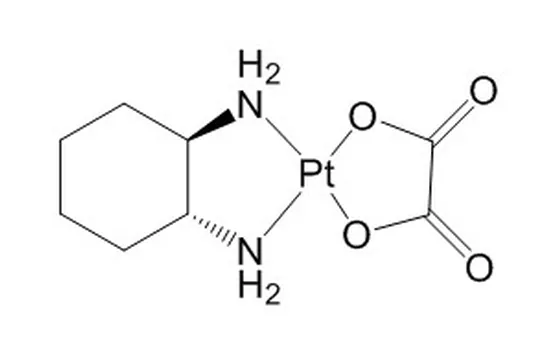
The approved labelling says so in plain language: oxaliplatin is an organoplatinum complex in which platinum is complexed with 1,2-diaminocyclohexane and with an oxalate ligand as a leaving group[1]. That single sentence explains the entire impurity file. A leaving group is, by definition, a group that can be displaced. Anything that can displace it becomes a degradation product; anything that cannot becomes a process impurity.
The formulation is correspondingly plain: 5 mg/mL in water, buffered with 0.03 mg/mL tartaric acid and 0.0123 mg/mL sodium hydroxide, supplied as 50 mg/10 mL or 100 mg/20 mL single-dose vials[1]. No antioxidant and no co-solvent are present. Whatever degrades there degrades because of the complex itself.
Five pharmacopoeial impurities, five different events
This catalogue carries 28 oxaliplatin entries. Five are the lettered European Pharmacopoeia impurities, and the set reads like a checklist of coordination chemistry.
| EP | CAS | Formula | Mass | What happened |
|---|---|---|---|---|
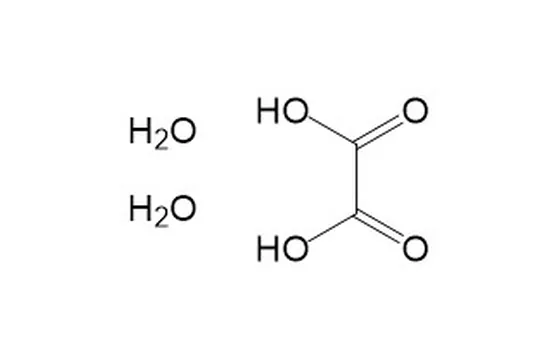
| A | 6153-56-6 | C2H2O4 · 2H2O | 126.07 | the oxalate left the metal and was protonated |
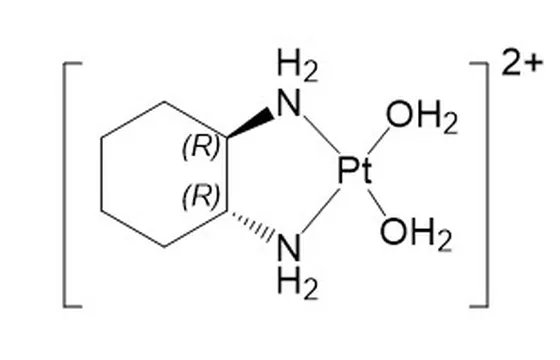
| B | 89955-85-1 | C6H18N2O2Pt | 347.3 | water took the vacated sites; monoaquo and diaquo DACH platinum |
| C | 111321-67-6 | C8H16N2O6Pt | 431.3 | Pt(II) oxidised to Pt(IV); two hydroxo ligands added |
| D | 61758-77-8 | C8H14N2O4Pt | 397.3 | same formula and mass as the parent: a stereochemical variant |
| E | 82398-34-3 | C12H30N6O8Pt2 | 764.5 | two platinum centres in one species, isolated as the dinitrate |
Table note: letter assignments follow the entries as filed in this catalogue; formulas and masses from the catalogue records and PubChem[5]. Impurity A is also carried as the diammonium salt, CAS 6009-70-7.
Impurity B is the one to study first, because the label already tells you it forms in vivo. Oxaliplatin undergoes non-enzymatic conversion in physiological solutions through displacement of the labile oxalate, and the transient species include monoaquo and diaquo DACH platinum[1]. The first degradant in the vial is therefore the species that does the pharmacology in plasma. Its dinitrate salt is also catalogued at 94042-08-7.
Impurity C is different in kind. C8H16N2O6Pt is the parent plus two oxygen and two hydrogen, and PubChem records the structure as a dihydroxo Pt(IV) complex at 431.3[5]. This is an oxidation, not a substitution, and it is why peroxide stress belongs in the forced degradation protocol for a Pt(II) drug. A method that only looks for ligand-exchange products misses it: the Pt(IV) species is more polar and elutes nowhere near the parent.
Impurity D is the quiet one. Same formula, same mass, same isotope pattern. Mass spectrometry cannot find it and neither can ultraviolet spectroscopy, because the chromophore is a metal-centred transition and the two diastereomers differ only in geometry. 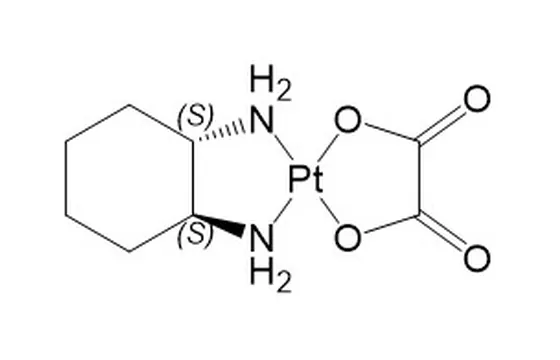
Beyond the monograph: the counter-ion map
The other 20 entries are where the synthesis becomes visible. Group them by what sits in the coordination sphere.
Three entries share the formula C6H14Cl2N2Pt, at CAS 52691-24-4, 61848-66-6 and 61848-62-2. That is the dichloro complex, and three records for one formula means three stereochemical or isomeric descriptions of the same composition[6]. Two entries are the diiodo analogue, C6H14I2N2Pt, at 121958-12-1 and 66845-32-7. Four entries are the free ligand itself, C6H14N2, at 1121-22-8, 20439-47-8, 1436-59-5 and 21436-03-3, with a further two at C8H18N2 that carry methylated diamines.
Iodide is not a plausible degradant of an oxalate complex. Its presence in the file is evidence about the route: platinum is commonly carried through an iodide stage before the diamine and the oxalate are installed, and iodide is hard to strip completely from a soft Pt(II) centre. The catalogue also holds EP impurity B as a dinitrate at 94042-08-7, and a chlorido-aqua cation as its nitrate salt at 1421704-68-8. Nitrate counter-ions do not appear by accident either; they point to nitric acid or to a silver nitrate step, and silver nitrate is the standard reagent for removing chloride from a platinum coordination sphere.
That last inference matters for the elemental impurity assessment, and it should be stated as an inference rather than a fact: if silver is used, silver is the element to look for, and it is not an element that a general pharmacopoeial heavy-metal test will find with any sensitivity.
Chloride is the enemy of the vial and the active form in the cell
The label is unusually direct: dilute with 250 to 500 mL of 5% Dextrose Injection, and do not dilute with sodium chloride solution or any other chloride-containing solution[1]. Diluted solution is good for 6 hours at 20 to 25 °C or 24 hours at 2 to 8 °C.
The chemistry behind that instruction has been measured. In a study of carrier solutions for hyperthermic intraperitoneal chemotherapy, oxaliplatin at 5 mg per 50 mL was stable in 5% dextrose over two hours at 42 °C, while increasing chloride concentration produced increasing degradation rates, reaching under 10 per cent in 30 minutes and under 20 per cent in 120 minutes at 42 °C[2]. The identified degradation product was the dichloro complex [Pt(dach)Cl2] — which the authors describe as the active cytotoxic form of the drug[2].
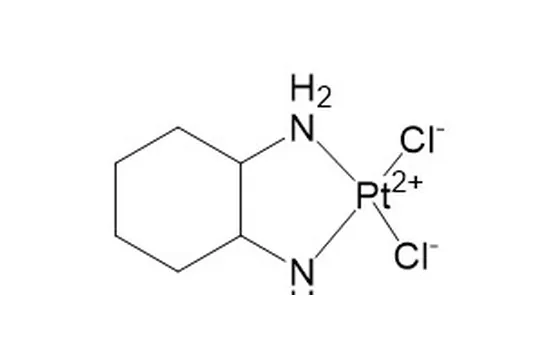
That inverts the usual framing. The species a specification would call an impurity is the species that binds DNA in the tumour cell. A limit on it is therefore a limit on the vial, not on the patient, and any submission language that treats it as a toxicological impurity will invite a question the applicant cannot answer.
The analytical consequence is more immediate. Chloride is everywhere in a chromatography laboratory: in mobile-phase buffers, in the water if the system is not dedicated to HPLC-grade supply, in the Dionex-style suppressor, in a sodium chloride injection used as a diluent in a stability study. A related-substances method for oxaliplatin that runs on a chloride-containing buffer is generating its own analyte. The method must be chloride-free, and the sample diluent must be documented as such.
Q3D assumes the element is the contaminant. Here the element is the drug
ICH Q3D lists 24 elements in three classes and assesses each against a permitted daily exposure[3]. The framework presumes that the element is an unintended addition to a dose of something else. Platinum appears in that list, in Class 2B, alongside palladium, rhodium, ruthenium, iridium, osmium, silver and gold.
For oxaliplatin the presumption collapses. Platinum is 49 per cent of the molecular mass, so a total-platinum result by inductively coupled plasma mass spectrometry is dominated by the API and cannot separate a residue from the product. What matters is speciation: which platinum species are present, and in what proportion.
| Element | Q3D class | How it can enter | Control point |
|---|---|---|---|
| Pt | 2B | the API itself; also colloidal or aqua species | speciation by HPLC, not total Pt |
| Pd | 2B | catalysts and reagent impurities in platinum salt starting material | supplier specification on K2PtCl4 |
| Ag | 2B | silver salts used to strip chloride (inference from the nitrate entries) | ICP-MS on the API, method validated at low ppb |
| Al | 3 | needles, IV sets, glass and closures | label prohibition; component compatibility study |
| I | not listed | iodide stage of the route | anion assay, not an elemental impurity test |
Table note: class assignments from ICH Q3D[3]; entry routes are mechanistic readings of the catalogue and the labelling[1], not supplier disclosures.
The aluminium row is where the toxicological framework and the chemistry diverge. The label prohibits needles and administration sets with aluminium parts, because aluminium has been reported to cause degradation of platinum compounds[1]. Aluminium is Class 3, with a permitted daily exposure in micrograms; the incompatibility operates far below that, and produces a new platinum species rather than an aluminium burden. A Q3D assessment that only counts micrograms will find the element controlled and miss the failure mode.
Residual solvents in a matrix that is half metal
The aqueous formulation suggests a simple solvent story, and it mostly is one: the manufacturing solvents for an oxaliplatin API are water and, at most, a class 3 alcohol used in recrystallisation, so ICH Q3C poses no unusual constraint[7]. The difficulty is not the limit, it is the measurement.
Headspace gas chromatography on a sample that is nearly half platinum by mass loads the column with a non-volatile residue and, more importantly, changes the partition behaviour of the analytes: the matrix is a salt-like solid, not an organic powder, so the equilibration time that was validated on a different API does not transfer. The practical answer is to validate the headspace method on this matrix rather than to adopt a platform method, and to check recovery at the low end, where a class 3 solvent limit is generous but the matrix effect is largest.
There is a second, less obvious solvent issue. Water is not only the vehicle here, it is a reagent: the aqua species that constitute impurity B are formed by water displacing oxalate[1]. Residual water is therefore a stability variable with a chemical consequence, and the specification for water content deserves to be linked explicitly to the impurity B trend rather than treated as a separate compendial test.
Dose arithmetic for a two-weekly infusion
ICH Q3A sets thresholds for a drug substance: a reporting threshold of 0.05 per cent, an identification threshold of 0.10 per cent or 1.0 mg per day whichever is lower, and a qualification threshold of 0.15 per cent or 1.0 mg per day[8]. Every one of those numbers is written per day. Oxaliplatin is given as 85 mg/m2 over 120 minutes every 14 days, or 130 mg/m2 every 21 days[1].
There is no obvious daily dose for a two-weekly infusion, and the choice changes the answer by a factor of fourteen. Averaging 145 mg over 14 days gives roughly 10 mg per day, at which the 1.0 mg absolute cap corresponds to 10 per cent — far above the percentage thresholds, so percentages govern. Counting only the infusion day gives 145 mg, at which the cap corresponds to 0.7 per cent — still above 0.15 per cent, so percentages govern again. The conclusion is robust, but the convention must be stated, because a reviewer comparing two files that used different conventions will see different numbers for the same product.
The dilution step is what makes percentage the only workable unit. A 100 mg vial diluted into 500 mL gives 0.2 mg/mL; the same vial in 250 mL gives 0.4 mg/mL[1]. Any limit expressed in mg/mL is therefore a limit on the infusion, not on the product, and belongs in the compounding instruction rather than in the specification.
Which platinum drugs this reasoning covers, and which it does not
Carboplatin carries a cyclobutane-1,1-dicarboxylate chelate instead of oxalate, and that ligand hydrolyses far more slowly, which is why carboplatin can be given without the chloride prohibition. Cisplatin has two chlorides and no chelating leaving group, so its hydrolysis is fast and its reactive species are aqua complexes formed within minutes. The three share a metal and a geometry, not a stability profile; a method transferred between them fails on selectivity, not on principle.
The catalogue itself shows the porosity of these categories: it files a miriplatin impurity at 61848-62-2 with the formula C6H14Cl2N2Pt, the same composition as the oxaliplatin dichloro records. Two products, one formula, different names. That is what a ligand-exchange family looks like when it is catalogued product by product.
Contrast agents are the instructive negative case. In iohexol and iopamidol the halogen is covalently bound to an aromatic ring and is not an elemental impurity in any sense; iodine does not appear in Q3D at all. Gadolinium chelates are closer in spirit, since the metal is the active centre, but gadolinium is also absent from the list. Platinum is the awkward case: listed, and untreatable as a contaminant.
Domestic filing activity is deep. CDE public records show 246 accepted filings from 84 applicants as of 16 November 2026[9]. These are acceptance records, not approvals; they say only that this impurity file has been reviewed many times against the same five lettered entries.
This catalogue holds 28 oxaliplatin entries: the API, the five lettered impurities, their salts, and the counter-ion series that documents the route. For a ligand-exchange problem the useful set is the one that lets you assign a peak rather than merely count it: see all oxaliplatin entries.
Frequently Asked Questions
Why does the label forbid sodium chloride when the degradation product is described as the active form?
Impurity D has the same formula and the same mass as oxaliplatin. How is it detected at all?
Is total platinum by ICP-MS a meaningful elemental impurity test for this product?
Why is aluminium mentioned on the label if it is only a Class 3 element?
Impurity B is the aqua species. Does that mean water itself is a degradant?
How should the daily dose be defined for a fourteen-day cycle?
Do the three dichloro entries in the catalogue really represent three different substances?
Related Substances and Reference Standards
- Carboplatin (17 impurity / derivative entries)
- Cisplatin (17 impurity / derivative entries)
- Iohexol (33 impurity / derivative entries)
References and Sources
- DailyMed (US National Library of Medicine), oxaliplatin injection prescribing information, Section 11 Description (C8H14N2O4Pt, 397.3, oxalate as leaving group) and Section 2.4 Preparation and Administration (5% dextrose only, no chloride-containing diluents, aluminium prohibition, 6 h and 24 h hold times), accessed 2026-11-16
- Mehta AM, Van den Hoven JM, Rosing H, et al., International Journal of Pharmaceutics 2015;479:23-27, Stability of oxaliplatin in chloride-containing carrier solutions used in hyperthermic intraperitoneal chemotherapy (degradation under 10 per cent at 30 min, under 20 per cent at 120 min at 42 °C; product identified as Pt(dach)Cl2), accessed 2026-11-16
- ICH (International Council for Harmonisation), ICH Q3D(R2): Guideline for Elemental Impurities (24 elements, Class 1, 2A, 2B and 3, permitted daily exposures), accessed 2026-11-16
- PubChem (National Center for Biotechnology Information), Oxaliplatin, CID 9887054: C8H14N2O4Pt, 397.29, accessed 2026-11-16
- PubChem, Dihydroxy oxaliplatin-Pt(IV), CID 15459431: C8H16N2O6Pt, 431.31 (catalogue entry oxaliplatin impurity C, CAS 111321-67-6), accessed 2026-11-16
- PubChem, Dichloro(1,2-diaminocyclohexane)platinum(II), CID 151689: C6H14Cl2N2Pt, 380.18 (catalogue entry, CAS 52691-24-4), accessed 2026-11-16
- ICH, ICH Q3C(R8): Impurities — Guideline for Residual Solvents (Class 3 solvent limits), accessed 2026-11-16
- ICH, ICH Q3A(R2): Impurities in New Drug Substances (reporting 0.05 per cent, identification 0.10 per cent or 1.0 mg per day, qualification 0.15 per cent or 1.0 mg per day), accessed 2026-11-16
- Center for Drug Evaluation, NMPA (CDE), Accepted filing records for oxaliplatin, retrieved 16 November 2026: 246 records from 84 applicants. Acceptance records are not approvals, accessed 2026-11-16
This article was prepared by the CATO technical team. Regulatory, pharmacopoeial and published literature content cited above is attributed in the reference list. It is provided for technical exchange and search reference only and does not constitute a quality specification or regulatory advice. For any specific substance, the applicable test methods, limits and filing requirements are governed by the current regulations, pharmacopoeial monographs and official publications.
Product information on this site is provided for research search and selection reference only and is not a quality specification; technical data, purity and structural confirmation are governed by the shipped COA and our written confirmation. All products mentioned are for research use only, not for human or animal diagnostic or therapeutic use.