Pregabalin: The Impurity Profile of a Molecule That Reacts With Itself
Pregabalin↗ is a small molecule with an unusually large number of ways to react with itself. It carries a free carboxylic acid and a free primary amine on the same chain, which is exactly the pair of groups that closes a five-membered lactam, and exactly the pair that joins two molecules into a ten-membered ring. The impurity profile of this drug is not a list of unrelated degradants. It is a set of products from one reaction, run in three directions.
Note: product names shown in red (marked with ↗) are links - click through to the product page for structure, CAS number, purity and lead time.
A zwitterion with two reactive ends
Key points
- Pregabalin is (S)-3-(aminomethyl)-5-methylhexanoic acid, C8H17NO2, 159.23, CAS 148553-50-8, with one stereocentre and no chromophore.
- Cyclization gives 4-isobutylpyrrolidin-2-one, C8H15NO, 141.21, CAS 181289-23-6, a species eighteen daltons lighter than the parent and structurally unremarkable.
- Because the dose tops out at 600 mg a day, the 0.10 percent identification threshold governs; the absolute-amount limb of Q3A only takes over above 1 g a day[1].
- This catalogue carries 109 pregabalin entries, including four unlabelled compounds with the parent formula and six with C8H15NO2, which no mass spectrometer can tell apart.
The molecule was designed to be a gamma-aminobutyric acid analogue that crosses membranes without being a substrate for the transporters that handle GABA itself. The design works because the amino group sits one carbon further out than in GABA and because the isobutyl branch adds lipophilicity. Neither feature is unusual. What is unusual is that the drug is dosed as the free amino acid rather than a salt, an ester or an amide, which leaves both reactive groups exposed in solid and in solution.
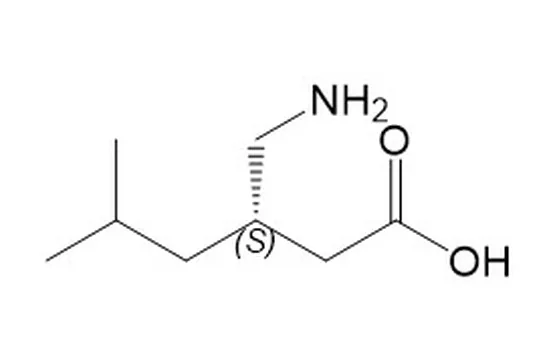
That choice has consequences for everything downstream. A salt would have removed the acid from the equilibrium. An amide would have removed the amine. The free acid and the free amine are what make the drug a zwitterion with good aqueous solubility and no need for a counterion, and they are also what make the lactam inevitable.
The lactam forms because the ring is five-membered and unstrained
Intramolecular amide formation from a gamma-amino acid is not a side reaction in the sense that an oxidation or a hydrolysis is a side reaction. It is the thermodynamic resting place of the molecule once water is removed or once the pH drops far enough to protonate the carboxylate and leave the amine free to attack. Heating the free acid, drying it hard, or storing it in a formulation with a low water activity all push in the same direction.
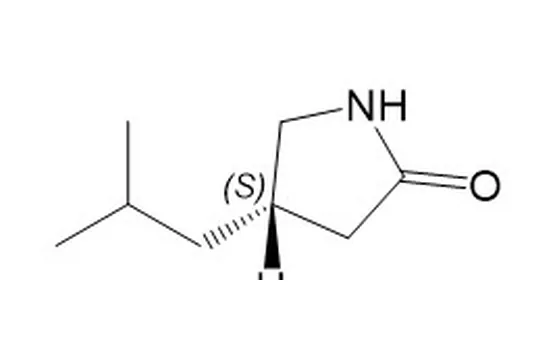
The catalogue carries three entries with the lactam formula, and the reason is stereochemistry. Cyclization does not touch the stereocentre, so the lactam inherits the configuration of the acid it came from. Starting from the (S) drug, the product is the (4S) lactam; the (4R) lactam, CAS 181289-22-5, can only come from the (R) enantiomer, and the racemic lactam, CAS 61312-87-6, is what a partially racemized or racemic starting material would give.
That detail is worth more than it looks. A chiral method that resolves pregabalin from its (R) enantiomer will also resolve the two lactam enantiomers, and the ratio between them is a direct readout of the enantiomeric composition of whatever cyclized. If the (4R) lactam appears at a level that the (R) acid cannot explain, the cyclization happened after a racemization that the acid assay did not catch.
Two molecules, two amide bonds, one ten-membered ring
The intermolecular version of the same reaction is less familiar and more useful analytically. Two pregabalin molecules can condense twice: the amine of one attacks the acid of the other, and the remaining pair closes the ring. The product is a cyclic diamide, 4,9-diisobutyl-1,6-diazecane-2,7-dione, C16H30N2O2, 282.42, CAS 1990538-03-8.
| Species | Formula | Mass | Built from |
|---|---|---|---|
| pregabalin | C8H17NO2 | 159.23 | the drug |
| lactam | C8H15NO | 141.21 | one molecule, one ring, loss of water |
| cyclic dimer | C16H30N2O2 | 282.42 | two molecules, two rings, loss of two waters |
| trimer entry | C24H42N2O4 | 422.6 | three units, further condensation |
Table note: formulas and CAS numbers as catalogued under this variety; the mass column is the nominal molecular weight of the formula as written.
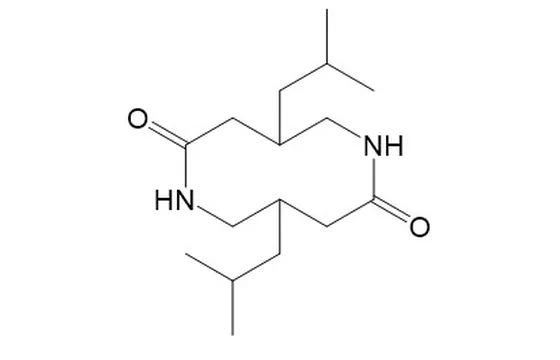
The dimer matters for two practical reasons. It is twice the size of the drug, so it elutes late on a reverse-phase gradient and is easy to miss if the run is short. And it is a ring, not a chain, so it has no free acid and no free amine: it does not ionize, it does not derivatize, and a method built around derivatization of the amine will not see it at all. A related-substances method for this drug has to be able to detect a neutral, lipophilic, high-mass species at the same time as a small polar lactam. That is a wide polarity window for one gradient.
Six entries, one formula, and no mass-based answer
This catalogue lists six compounds with C8H15NO2, two hydrogens fewer than the parent. They are not lactams: they are unsaturated acids, and two of the six are named as the hex-5-enoic and hex-2-enoic analogues. They differ from pregabalin by a double bond in the chain, which changes the mass by 2.016 and nothing else.
Add the four unlabelled entries that carry the parent formula and the analytical problem becomes explicit. The (R) enantiomer, CAS 148553-51-9, is isobaric with the drug and has the same fragmentation. The unsaturated acids are two daltons lighter and again indistinguishable from each other by nominal mass. Isotope-labelled versions exist for both groups, which is the practical answer: a labelled internal standard is the only way to quantify a species that the detector cannot distinguish from something else in the same window.
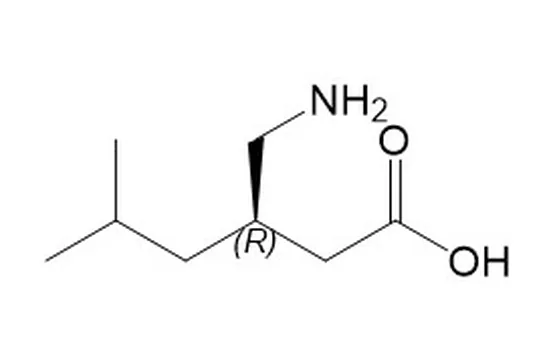
Chiral separation handles the first group and does nothing for the second. A polysaccharide-based chiral column that resolves the enantiomer will not resolve the hex-2-enoic acid from the hex-5-enoic acid, because those two are achiral and differ only in where the double bond sits. Separating them is a matter of shape rather than chirality, and it has to be developed rather than bought.
The route leaves two resolving agents and a protecting group in the record
Pregabalin has been made by more than one route, and the catalogue entries show which chemistry was used at some point in the supply chain. Three entries are decisive.
The first is mandelic acid, C8H8O3, CAS 90-64-2, listed here as a pregabalin entry and catalogued with the European Pharmacopoeia letter that belongs to it. A hydroxy acid has no business being an impurity of an amino acid unless it was used to resolve one; mandelic acid forms a diastereomeric salt with an amine and is one of the classical resolving agents for exactly this kind of molecule. The second is 1-phenylethylamine, C8H11N, CAS 618-36-0, which does the same job from the other side. Both are residues of a resolution, and both would be absent from a process built on asymmetric hydrogenation.
The third is harder to explain away: an entry with C16H32ClNO4Si, CAS 649748-08-3. Silicon does not appear in the pregabalin structure and cannot come from a resolving agent. It can only come from a silyl-protected intermediate, which means that at some point in the development history the acid or an alcohol was carried through a step with a silyl protecting group. An entry like this is a fingerprint of a specific route, and it will be present in a dossier built on that route and absent from one built on another.
The same logic applies to the C9H16O4 entry, CAS 75143-89-4, which is consistent with an isobutyl-substituted glutaric acid of the kind used to build the chain, and to the unsaturated acids described above, which are what a route through an alkene intermediate leaves behind.
Detecting an amino acid that absorbs almost nothing
Pregabalin has no aromatic ring, no carbonyl chromophore worth using, and no conjugated system. At 210 nm it gives an end absorption that is indistinguishable from the acetate, the phosphate or the residual trifluoroacetic acid in the mobile phase, and a method built on that wavelength will be measuring the eluent more than the analyte.
Three approaches work. Derivatization with a chromophore-bearing reagent converts the amine into something that absorbs, which gives good sensitivity and a stable baseline at the cost of a reaction step that has to be quantitative for every species of interest, including the ones that no longer have a free amine. Charged aerosol or evaporative light scattering detection avoids the derivatization and responds to mass, but the response is not uniform across a lactam and a cyclic dimer, so a correction factor has to be established rather than assumed. Mass detection gives the best selectivity and is the only one that separates the isobaric pairs, provided the chromatography has already done the separating.
Whichever is chosen, the validation package has to answer a question that ultraviolet methods never face: what is the response of the dimer relative to the drug, and how was it measured? A method that reports the dimer at the same response factor as pregabalin will under-report it, because a molecule with two amide bonds and no ionizable group behaves differently in almost every detector[2].
In the tablet, the amine finds lactose first
The same primary amine that closes the lactam will also attack a reducing sugar, and lactose is the most common reducing sugar in a solid dosage form. Heating pregabalin with lactose produces Maillard products and their Amadori rearrangement products, and seven of them have been isolated and characterized from formulated material[3]. Seven distinct species means the reaction does not stop at the first condensation, and these are not the products a general related-substances method is designed to find.
This is the part of the profile that a drug substance specification cannot control. The lactam can be limited in the API. The lactose conjugates only exist after the tablet is made, so they belong to the drug product method and to the excipient compatibility study, and they will appear in an accelerated stability programme rather than in a release test.
The practical consequence is that formulation screening has to be done with the amine in mind. A lactose-free formulation removes the problem; a mannitol or a calcium phosphate filler does not react with an amine under normal conditions. Where lactose is retained for compressibility, the conjugate levels become a stability attribute, and the method has to be able to see them at a level below the qualification threshold[1].
What the filing has to defend
Chinese registration activity for pregabalin is large and spread across formulations, which is what a molecule with a 600 mg maximum dose and a dozen generic entrants looks like.
Three questions come up repeatedly. The first is whether the lactam limit is justified by data or by habit: a limit set at 0.1 percent because that is the identification threshold is not the same as a limit set at the level the process can achieve with a margin[4]. The second is the dimer: does the method see it, what is the response factor, and where does it elute relative to the gradient end. The third is the chiral pair: is the (R) enantiomer controlled in the drug substance, and if so, is the lactam enantiomer ratio used as a cross-check.
The general chapters of the Chinese Pharmacopoeia apply in parallel and are worth checking against the ICH tables[5].
A fourth question belongs to the drug product and is often left until late. If the formulation contains lactose, the conjugate level at the end of shelf life has to be predicted from accelerated data, and the prediction has to account for the fact that the reaction is between two solids and therefore sensitive to water content and to compression. A tablet that is chemically stable in a blister can fail in a bottle, and the difference is water.
Which gamma-amino acids compare, and which do not
Gabapentin is the closest relative and the most useful comparison. It also carries an amine and a carboxylic acid close enough together to cyclize, and it also closes a five-membered lactam; the difference is that the carbon they hang from is a quaternary centre bearing a cyclohexane ring instead of an isobutyl group. Everything said here about cyclization applies to gabapentin, and a laboratory that has developed one method has a head start on the other.
Levetiracetam is the counter-example, and it is instructive precisely because it looks similar. It contains a pyrrolidinone ring, which is the lactam that pregabalin forms. It cannot form one because it already is one, so its degradation chemistry runs the other way: hydrolysis opens the ring instead of closing it, and the impurity of interest is the opened acid rather than the cyclized amide. A method transferred between the two drugs without that reversal in mind will look for the wrong species.
Vigabatrin carries the same acid-amine pair but an unsaturated side chain, and its chemistry is dominated by that vinyl group rather than by cyclization. The lesson from the comparison is that the functional group pattern predicts whether a lactam can form, and the rest of the molecule predicts how fast and how far.
This catalogue carries 109 pregabalin entries, including the lactam in three stereochemical forms, the ten-membered cyclic dimer, the trimer, the two resolving agents and a silyl-containing process impurity: pregabalin reference standards. The lactam and dimer series continue on the gabapentin page for laboratories working on both gamma-amino acids.
Frequently Asked Questions
Is the lactam a process impurity or a degradation product?
Why are there three lactam entries in the catalogue?
Can the cyclic dimer be detected by a method that derivatizes the amine?
Does the (R) enantiomer need a chiral method if the route is asymmetric?
What makes lactose worse than other fillers for this drug?
Why is the percentage threshold the operative one at 600 mg a day?
Is the silyl-containing entry evidence of a specific synthesis route?
Related Substances and Reference Standards
- Pregabalin (108 impurity / derivative entries)
- Gabapentin (34 impurity / derivative entries)
- Levetiracetam (74 impurity / derivative entries)
- Vigabatrin (19 impurity / derivative entries)
References and Sources
- ICH, ICH Q3A(R2) Impurities in New Drug Substances: reporting threshold 0.05 percent, identification threshold 0.10 percent or 1.0 mg per day, qualification threshold 0.15 percent or 1.0 mg per day, whichever is lower, accessed 2026-11-05
- ICH, ICH Q2(R2) Validation of Analytical Procedures, including the requirements for response factors and for the quantification of impurities without a reference standard, accessed 2026-11-05
- Journal of Pharmaceutical and Biomedical Analysis, 27 (2002), Synthesis and characterization of pregabalin lactose conjugate degradation products: seven products formed by Maillard reaction and Amadori rearrangement when pregabalin is heated with lactose, accessed 2026-11-05
- ICH, ICH Q6A Specifications: Test Procedures and Acceptance Criteria for New Drug Substances and New Drug Products, including the decision tree for setting impurity limits, accessed 2026-11-05
- Chinese Pharmacopoeia Commission, Pharmacopoeia of the People's Republic of China, general chapters on related substances and on the control of enantiomeric purity, accessed 2026-11-05
This article was prepared by the CATO technical team. Regulatory, pharmacopoeial and published literature content cited above is attributed in the reference list. It is provided for technical exchange and search reference only and does not constitute a quality specification or regulatory advice. For any specific substance, the applicable test methods, limits and filing requirements are governed by the current regulations, pharmacopoeial monographs and official publications.
Product information on this site is provided for research search and selection reference only and is not a quality specification; technical data, purity and structural confirmation are governed by the shipped COA and our written confirmation. All products mentioned are for research use only, not for human or animal diagnostic or therapeutic use.