Quetiapine Impurity Lists Are Half Metabolism and Forced Degradation Cannot Reproduce That Half
Quetiapine↗ has one oxidation-prone sulfur, one cleavable ether tail and a long catalog list that mixes degradants with human metabolites. Separating the two populations is the whole job of the specification.
Note: product names shown in red (marked with ↗) are links - click through to the product page for structure, CAS number, purity and lead time.
A list that mixes three different origins
Key points
- Quetiapine is C21H25N3O2S, 383.5, and the marketed salt is the 1:1 fumarate, which adds 116.07 for a total of 499.6[1].
- The sulfur in the dibenzothiazepine ring is the most oxidation-prone atom in the molecule, so the sulfoxide is the first degradant any forced-degradation study will produce.
- Norquetiapine, the N-dealkylated metabolite, is also a degradant: acid or base hydrolysis of the ether tail gives the same structure the liver makes[2].
- 7-hydroxy quetiapine has the same formula as the sulfoxide and cannot be distinguished from it by mass alone, which is where chromatographic identification earns its keep.
A quetiapine impurity list looks unusually long for a molecule this simple, and the reason is not that the molecule degrades in many ways. It is that the list mixes three populations: genuine degradants, process relatives, and human metabolites that were synthesized for metabolism studies and then entered the catalog because they are commercially available. Writing a specification without separating those three populations is how a control strategy ends up testing for something that cannot form in a tablet.
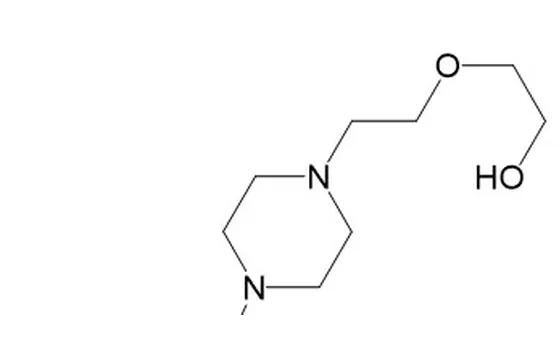
The quetiapine fumarate variety page lists 80 entries. That number is only useful once the entries are sorted by origin, and the sorting is a chemistry question rather than a catalog question.
What the molecule actually is
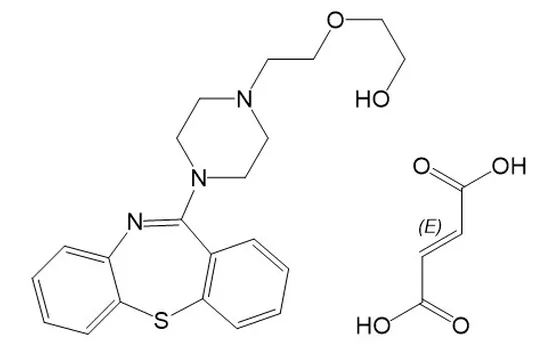
Quetiapine has three recognizable parts. A dibenzothiazepine core provides the tricyclic shape and the sulfur. A piperazine sits at the 11-position and provides a tertiary amine that is protonated at physiological pH. An ethoxyethanol tail hangs off the second piperazine nitrogen and provides two ether oxygens and a terminal alcohol.
Each part fails differently. The sulfur oxidises; the tail is cleaved or oxidised; the piperazine is stable unless something removes the tail and leaves a secondary amine, which changes both the reactivity and the pharmacology. Knowing which part is which turns a list of eighty entries into four short lists.
The fumarate is a separate matter and does not change the impurity chemistry, but it does change the arithmetic. A 1:1 fumarate of 499.6 means every percentage in the specification refers to a molecule that is 76.8 per cent quetiapine base by mass. The same conversion that makes salt-to-base calculations necessary also makes the milligram-per-day column of the guidelines behave differently from the percentage column.
Degradation goes for sulfur first
The thiazepine sulfur is a dialkyl sulfide in a strained ring, and it is the site that every oxidative stress condition will attack. Peroxide, light and heat all give the sulfoxide, C21H25N3O3S, 399.5, which is a single peak on a reversed-phase method and is stable enough to be isolated and characterised.
Two practical consequences follow. First, the sulfoxide is not optional: any forced-degradation package for quetiapine that does not show it has not stressed the molecule hard enough. Second, the sulfoxide is the peak most likely to grow on stability, and its growth is a function of oxygen permeability of the packaging as much as of the formulation.
The carboxylate is the second oxidative degradant and takes longer to appear. Oxidation of the terminal alcohol to a carboxylic acid adds 32 mass units, and the intermediate aldehyde is short-lived enough that it rarely accumulates. A stability program that measures only at 0, 3 and 6 months can miss the carboxylate entirely at the early time points and then find it at 24 months, which is a common surprise in ANDA submissions.
The one degradant that is also a drug metabolite
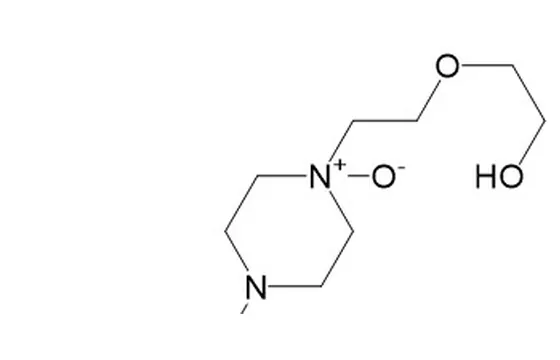
Cleaving the ethoxyethanol tail from the piperazine gives norquetiapine, C17H17N3S, 295.4[2]. The same molecule is the principal human metabolite, formed by CYP3A4, and it is pharmacologically active. That dual identity creates a specific error mode in specification writing: a limit justified by metabolite exposure is not a limit for an impurity, and vice versa.
The practical question is which one the specification is controlling. If the concern is degradation in the product, the limit comes from the forced-degradation and stability data. If the concern is a pharmacologically active metabolite, that is a clinical question and belongs in the clinical section of the filing. Mixing the two produces a limit that is either far too tight for a degradant or far too loose for a metabolite.
Norquetiapine also has a secondary piperazine nitrogen once the tail is gone, which makes it nitrosatable in a way the parent is not. The catalog carries a nitroso-norquetiapine entry at C17H16N4OS. That is not a reason to expect the nitrosamine in every batch; it is a reason to include the possibility in the nitrosamine risk assessment, especially where the same equipment handles nitrite-bearing materials.
Five species, four triggers
The table is the sorting exercise in one place. Three of the five entries can form in a tablet; one forms only in a person; and one forms by two routes at once, which is the norquetiapine case.
| Species | How it forms | Formula and mass | Typical trigger |
|---|---|---|---|
| Quetiapine | the API | C21H25N3O2S, 383.5 | reference |
| Quetiapine sulfoxide | oxidation of the thiazepine sulfur | C21H25N3O3S, 399.5, +16 | peroxide, light, heat |
| Norquetiapine | loss of the ethoxyethanol tail | C17H17N3S, 295.4, minus 88.1 | CYP3A4, and acid or base hydrolysis |
| 7-hydroxy quetiapine | aromatic hydroxylation | C21H25N3O3S, 399.5, +16 | CYP3A4 only |
| Quetiapine carboxylate | oxidation of the terminal alcohol | C21H25N3O4S, 415.5, +32 | oxidative stress, long-term storage |
Masses computed from the molecular formulas; the sulfoxide and the aromatic hydroxyl share a formula and differ only in where the oxygen sits[1].
The useful reading is the right-hand column. A trigger that requires an enzyme cannot be reproduced in a stability chamber, so a metabolite without a chemical trigger does not belong in the specification. A trigger that requires light or peroxide can be reproduced, so a degradant without an enzyme belongs there even if it is also a metabolite.
Where the thresholds land at 800 milligrams
Quetiapine runs up to 800 mg per day. ICH Q3A sets identification at 0.10 per cent or 1.0 mg per day, whichever is lower[3]. At 800 mg, 1.0 mg per day is 0.125 per cent, so the percentage threshold is still the lower of the two and it governs. The milligram column comes close but does not bind, which is different from the sertraline case at 200 mg where the two columns coincide.
For the tablet, ICH Q3B sets identification at 0.5 per cent or 1 mg per day for a maximum daily dose of 1 g or less[4]. At 800 mg, 0.5 per cent is 4 mg, well above 1 mg, so the absolute cap governs the drug product threshold. That is the case where the milligram column actually binds, and it is worth noting because the same molecule switches from percentage-governed in the substance to milligram-governed in the product.
Reading the catalog without mixing the categories
Three entries anchor the sorting. The API is quetiapine, C21H25N3O2S, 383.5. The sulfoxide appears among the numbered impurities with the formula C21H25N3O3S, and there is more than one entry with that formula, so the peak has to be identified by structure and retention rather than by name alone. The carboxylate appears at C21H25N3O4S, one oxygen above the sulfoxide.
Once those are placed, the rest sort quickly: anything with the C17 skeleton is a tail-cleaved relative, anything with an extra oxygen on the ring system is an oxidation product, and anything with a different aryl substitution is a process relative. The impurity reference standards section can be filtered the same way, and the variety index shows which other molecules share the dibenzothiazepine core.
The class comparison is worth making once and not repeating. Olanzapine is a thienobenzodiazepine with no sulfur in the ring, so it has no sulfoxide story at all. Aripiprazole is a quinolinone with a different oxidation site. Neither is a template for quetiapine, and a forced-degradation protocol copied from one of them will stress the wrong bonds.
Frequently Asked Questions
Is norquetiapine a degradation product or a metabolite?
Can 7-hydroxy quetiapine form in a tablet?
Why does the sulfoxide appear under more than one catalog number?
Is the nitrosamine risk on quetiapine itself or on norquetiapine?
Does the fumarate change any of the impurity limits?
At 800 mg per day, which threshold governs the drug substance?
How many forced-degradation conditions are needed to find all of these?
What is the fastest way to tell the sulfoxide from the aromatic hydroxyl?
Related Substances and Reference Standards
- Quetiapine Fumarate (- impurity / derivative entries)
- Olanzapine (- impurity / derivative entries)
- Aripiprazole (- impurity / derivative entries)
References and Sources
- PubChem, National Center for Biotechnology Information, Quetiapine, C21H25N3O2S, 383.5, used here for the formula, the mass and the salt-to-base arithmetic of the 1:1 fumarate, accessed 2026-11-19
- PubChem, National Center for Biotechnology Information, Norquetiapine, C17H17N3S, 295.4, the N-dealkylated metabolite that is also a hydrolytic degradant, accessed 2026-11-19
- International Council for Harmonisation, ICH Q3A(R2), Impurities in new drug substances: reporting 0.05 per cent, identification 0.10 per cent or 1.0 mg per day, qualification 0.15 per cent or 1.0 mg per day, accessed 2026-11-19
- International Council for Harmonisation, ICH Q3B(R2), Impurities in new drug products: reporting, identification and qualification thresholds by maximum daily dose, accessed 2026-11-19
- International Council for Harmonisation, ICH M7(R2), Assessment and control of DNA reactive impurities, relevant to the secondary amine left behind when the tail is cleaved, accessed 2026-11-19
This article was prepared by the CATO technical team. Regulatory, pharmacopoeial and published literature content cited above is attributed in the reference list. It is provided for technical exchange and search reference only and does not constitute a quality specification or regulatory advice. For any specific substance, the applicable test methods, limits and filing requirements are governed by the current regulations, pharmacopoeial monographs and official publications.
Product information on this site is provided for research search and selection reference only and is not a quality specification; technical data, purity and structural confirmation are governed by the shipped COA and our written confirmation. All products mentioned are for research use only, not for human or animal diagnostic or therapeutic use.