Rifampicin Hydrolyses Into Two Halves, and the Balance Closes at 115.18
Rifampicin↗ is an 823 Da ansamycin assembled from a formylrifamycin and a methylpiperazine, joined by a hydrazone. That single bond explains the degradation profile, the mass balance, and a fixed-dose combination problem that has resisted formulation for decades.
Note: product names shown in red (marked with ↗) are links - click through to the product page for structure, CAS number, purity and lead time.
An ansamycin assembled from two halves, held together by one bond
Key points
- Rifampicin, C43H58N4O12, 822.9, CAS 13292-46-1, is a hydrazone: a formylrifamycin joined to 1-amino-4-methylpiperazine through a carbon-nitrogen double bond[1].
- That bond is the weakest point in the molecule and the whole mass balance turns on it: hydrolysis gives 725.8 and 115.18, which sum with the water to 840.9[1].
- Three further reactions are independent of hydrolysis, and the catalogue separates them cleanly by formula: minus two hydrogens, plus one oxygen, and minus water plus acetic acid[1].
- At 600 mg once daily the percentage thresholds govern everything, since the 1.0 mg cap would require a daily intake above one gram[2,3].
Rifampicin belongs to the ansamycins, a family whose name describes the architecture: a long aliphatic chain loops back onto an aromatic core, closing a macrocyclic ring that spans the width of the molecule. The core is a naphthohydroquinone, the loop carries a series of methyls, hydroxyls and a C25 acetate, and at one end sits the group that makes rifampicin different from the rifamycins it is derived from.
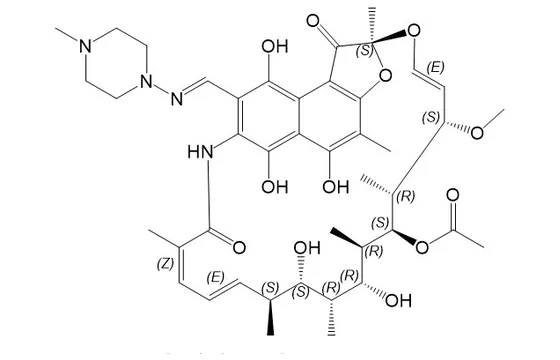
That group is an azomethine. Rifamycin SV carries a formyl group at C3; condensing it with 1-amino-4-methylpiperazine gives a carbon-nitrogen double bond, and the product is rifampicin. C43H58N4O12, 822.9, CAS 13292-46-1[1]. Everything about the molecule's instability follows from the fact that a hydrazone is a hydrolytically reversible bond holding two halves of very different size together.
The visible consequence is colour. The conjugated naphthohydroquinone absorbs in the visible range, so rifampicin is red-orange in solution and its degradants are coloured too. That is convenient in the laboratory and treacherous for a specification: a batch can shift in colour while every specified impurity stays within limits, because the shift is driven by a small fraction of a highly coloured species rather than by total degradant load.
Hydrolysis, and the arithmetic that proves which two products form
Hydrolysis of the azomethine splits the molecule into a formylrifamycin and a small piperazine amine, and the masses are the check on the mechanism: 3-formylrifamycin SV is C38H47NO13 at 725.8, 1-amino-4-methylpiperazine is C5H13N3 at 115.18, water is 18.02[1].
| Species | Formula | Mass | Relation to the drug |
|---|---|---|---|
| Rifampicin | C43H58N4O12 | 822.9 | reference |
| plus water | H2O | 18.02 | the reagent of hydrolysis |
| 3-formylrifamycin SV | C38H47NO13 | 725.8 | the large half |
| 1-amino-4-methylpiperazine | C5H13N3 | 115.18 | the small half |
| sum of the halves | C43H60N4O13 | 841.0 | 822.9 plus 18.02 |
Table note: formulae and masses from the PubChem records for each substance[1]; the last row is the arithmetic of hydrolysis, not a species that exists.
The balance matters beyond bookkeeping: hydrolysis gives two products, of which only one is a plausible peak in the same window as the drug. The amine is small, basic and easy to miss entirely in a method built for a coloured 823 Da molecule, yet it is the half carrying the nitrogen chemistry.
Kinetics follow the usual hydrazone pattern: the rate falls as pH rises toward neutral and climbs again in acid, so the reaction is fastest in the stomach and in any acidic diluent. A stability study in cell culture media measured more than fifty per cent loss over seventy-two hours, part of it as the quinone[4], a reminder that in a buffered system the two pathways run together.
Three reactions that do not involve water: quinone, N-oxide, deacetylation
Hydrolysis is not the only reaction, and this catalogue separates the others by formula with unusual clarity. Four groups stand out.
| Entry | CAS | Formula and mass | Change from the drug |
|---|---|---|---|
| EP impurity A, rifampicin quinone | 13983-13-6 | C43H56N4O12, 820.9 | minus 2 H, hydroquinone oxidised to quinone |
| EP impurity B, rifampicin N-oxide | 125833-03-6 | C43H58N4O13, 838.9 | plus 1 O on the piperazine nitrogen |
| Impurity 3, 25-desacetylrifampicin | 16783-99-6 | C41H56N4O11, 780.9 | minus C2H2O, the C25 acetate removed |
| Impurity 11, N-demethylrifampicin | 13292-45-0 | C42H56N4O12, 808.9 | minus CH2 from the piperazine methyl |
Table note: formulae, masses and positions from the PubChem records and from the entry labels printed in this catalogue[1].
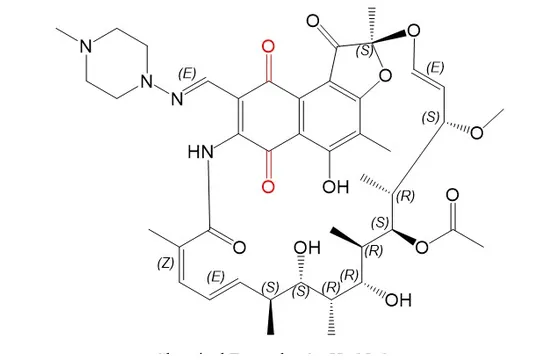
The quinone is the most consequential of the four. Its formation consumes the hydroquinone that gives the molecule its colour and its redox behaviour, and the product is still coloured, so a colour specification cannot distinguish the two. Two hydrogens is a small mass difference on a molecule of 823 Da, which is why the pair separates by chromatography rather than by mass and why a photo-diode array spectrum, useful as it is, is not decisive on its own.
The acetate is a different liability. 25-desacetylrifampicin is the most abundant rifampicin derivative in vivo[4], so the same structure arrives from two directions: as a metabolite in a biological matrix and as a hydrolysis product in a formulation. In an impurity method that does not matter; in a bioanalytical method it does.
Five entries at 808.9, and why elution order is not an assignment
Five entries in this catalogue carry C42H56N4O12 at 808.9, one CH2 below the drug. One of them is labelled N-demethylrifampicin, and the other four are positional or structural variants of the same mass loss.
Demethylation can happen at the piperazine methyl, but the same formula also arises from loss of a methyl elsewhere on the ansa bridge, and the two possibilities are chemically far apart: one changes the basicity of the piperazine, the other changes the lipophilicity of the macrocycle. No mass spectrometer distinguishes them, and their retention on a C18 column differs by less than the peak width on a conventional gradient.
The practical response is to treat the 808.9 cluster as a group: inject a mixed standard, establish that the group resolves from the drug and the quinone, then assign each peak against an individual standard. Assigning by elution order from a single run and carrying that into a dossier is not acceptable.
Why isoniazid in the same tablet makes rifampicin degrade faster
The acid lability would be a manageable formulation problem if rifampicin were always taken alone. It is not. The standard regimen combines it with isoniazid, and fixed-dose combinations put both molecules in one tablet, where they interact.
A recent study of sintered bilayer tablets states the problem in its opening lines: the bioavailability of rifampicin in fixed-dose combination with isoniazid is compromised because rifampicin degrades rapidly under gastric conditions when the two are co-administered[5]. The formulation answer in that work was spatial separation, releasing isoniazid in the stomach and rifampicin further down the tract.
The chemistry explains why the effect is not simply additive. Isoniazid↗ is a hydrazide; rifampicin hydrolysis generates an aldehyde, 3-formylrifamycin SV; an aldehyde and a hydrazide condense. The two pathways feed each other, so a combination product can lose rifampicin faster than either ingredient alone would predict.
For an analyst this changes the stability protocol rather than the specification. A combination product needs a condition in which the two are in contact in the same medium, because a study that stresses each ingredient separately will never reproduce the interaction. It also changes the interpretation of an unknown peak: in a combination product, a peak that sits between the two parent retention times may be a condensation product rather than an impurity of either ingredient, and no single-ingredient reference will identify it.
What Q1A does not ask, and what this molecule needs anyway
ICH Q1A(R2) asks for long-term and accelerated conditions, and ICH Q1B asks for a photostability study with an explicit statement of the light source and the exposure[3]. For this molecule those requirements are necessary but not sufficient, and three additions are worth writing into the protocol.
The first is humidity at the low end. Hydrolysis dominates degradation of the solid, so a sample at 25 degrees Celsius and 60 per cent relative humidity loses more drug than one at 40 per cent, and the difference is a formulation variable rather than a laboratory artefact. Reporting water content beside the assay makes the data interpretable.
The second is a deliberate acid challenge in the dissolution medium. Because the molecule is both poorly soluble at neutral pH and unstable in acid, the usual dissolution window sits between two failure modes. A profile that looks flat may be a solubility ceiling, and one that declines may be hydrolysis; only a mass-balance check on the dissolved fraction separates them.
The third is photostability with a colour readout. A conjugated ansamycin will absorb strongly across the visible range, so the photostability study should record colour or visible absorbance as well as impurity levels. A batch that darkens while all specified impurities remain within limits is telling you that a coloured species is forming below the reporting threshold, which for a 600 mg dose is a low absolute amount.
Detection is easy: everything in this molecule is coloured
Rifampicin is one of the easier molecules in this catalogue to detect and one of the harder to quantify honestly. The visible absorption is intense, so sensitivity is never the constraint; the constraint is that everything coloured absorbs, including the degradants the method is meant to measure.
A single-wavelength method at the absorption maximum reports the sum of the drug and its coloured relatives unless the chromatography separates them. Two consequences follow. Response factors must be measured against the quinone and the N-oxide rather than assumed equal to the drug, because a quinone and a hydroquinone of the same chromophore differ in molar absorptivity. And the wavelength belongs where the difference between them is largest, not where the drug alone absorbs most.
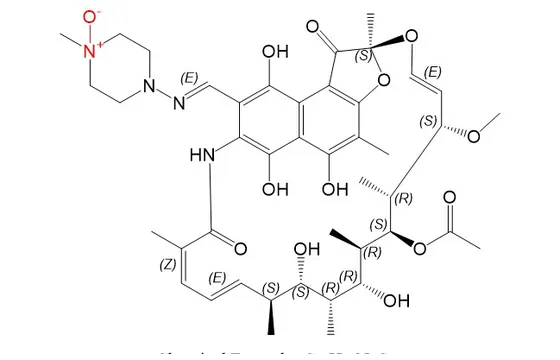
System suitability for this molecule should include the pair that is hardest to resolve, which is usually the drug and the quinone. They differ by two hydrogens and by the redox state of a large aromatic system, so their ultraviolet spectra overlap heavily and their retention differs by less than an analyst expects from a 2 Da mass difference.
Thresholds at 600 mg per day, where the caps never bind
The adult dose in standard regimens is 600 mg once daily[2], which places every threshold in the percentage-governed band, because the 1.0 mg cap would only bind above a daily intake of one gram.
| Threshold | Percentage | Mass at 600 mg per day | Cap | Governing criterion |
|---|---|---|---|---|
| Reporting | 0.05 | 300 micrograms | none | percentage |
| Identification | 0.10 | 0.60 mg | 1.0 mg | percentage |
| Qualification | 0.15 | 0.90 mg | 1.5 mg | percentage |
Table note: percentages and caps from ICH Q3A(R2)[3]; the mass column is arithmetic against 600 mg per day, not a published limit.
Three hundred micrograms is a large absolute amount for a coloured degradant, and that is the point for a reviewer: at this dose the limits are percentages because the dose is high, not because the impurities are benign. A 0.10 per cent specification permits 600 micrograms of the drug's own hydrolysate per tablet, and the justification is toxicological rather than arithmetic.
There is also a regulatory asymmetry worth knowing. Rifampicin is an old molecule with compendial monographs, and the monograph limits on individual named impurities take precedence over the general thresholds. Where a monograph sets a limit for the quinone, that limit governs, and the ICH thresholds govern only the unspecified impurities the monograph does not name[3].
Rifapentine transfers, rifabutin does not, isoniazid reacts
Two neighbouring rifamycins are useful comparisons, and one is a trap.
Rifapentine carries a cyclopentyl instead of a methyl on the piperazine and is more lipophilic. Its stability problem is the same shape: degradation at gastric pH with 3-formylrifamycin as the product, and poor solubility at intestinal pH. A study of pH-responsive solid dispersions showed that reducing gastric release reduced degradation to 3-formylrifamycin and that one polymer increased total exposure roughly fourfold[6]. The mechanism transfers; the numbers do not, because the lipophilicity is different.
Rifabutin is the instructive negative case. It shares the core but its substituent is not a hydrazone, so the hydrolysis route that dominates here does not exist for it, and a protocol copied from rifampicin over-tests hydrolysis while under-testing oxidation. The hydrazide problem in combination products has its own history (the isoniazid case).
Isoniazid completes the set, and it is the reason the combination product needs its own study. A hydrazide in the same tablet as a molecule that hydrolyses to an aldehyde is not a neutral excipient, and the interaction is chemical rather than physical.
Standards for a molecule whose degradation is also its metabolism
This catalogue holds 16 rifampicin entries, three of them EP-lettered. The ones that carry this argument are the drug at 13292-46-1, the quinone at 13983-13-6, the N-oxide at 125833-03-6, the 25-desacetyl derivative at 16783-99-6, and the demethylated entry at 13292-45-0. [See every rifampicin entry](Rifampicin)
Two handling notes. Prepare and inject promptly in a neutral diluent, because an acidic one hydrolyses the azomethine between preparation and injection and the result is an impurity the method created. And keep the quinone standard away from light and air, because a hydroquinone that oxidises on the bench will calibrate the very reaction being measured.
show what the applicant population looks like, which matters here: with a mature molecule and a monograph, most of the analytical work has been done before, and the differentiation is in doing it correctly rather than in doing it first.Frequently Asked Questions
Why does rifampicin lose potency faster in a fixed-dose combination than alone?
Is the mass balance of rifampicin hydrolysis really two products?
Can the quinone and the drug be distinguished by mass spectrometry?
Which impurity is also the main human metabolite?
Do I need a photostability study if the product is in an opaque blister?
Why are there five entries at 808.9 in the catalogue?
At 600 mg per day, is the 1.0 mg cap ever relevant?
Does the monograph or the guideline set the limit?
Related Substances and Reference Standards
- Rifampicin (15 impurity / derivative entries)
- Rifapentine (6 impurity / derivative entries)
- Rifabutin (13 impurity / derivative entries)
- Isoniazid (17 impurity / derivative entries)
References and Sources
- U.S. National Library of Medicine, PubChem, Rifampicin, CAS 13292-46-1, C43H58N4O12, 822.9; rifampicin quinone, CAS 13983-13-6, C43H56N4O12, 820.9; rifampicin N-oxide, CAS 125833-03-6, C43H58N4O13, 838.9; 25-desacetylrifampicin, C41H56N4O11, 780.9; N-demethylrifampicin, CAS 13292-45-0, C42H56N4O12, 808.9; 3-formylrifamycin, C38H47NO13, 725.8; 1-amino-4-methylpiperazine, C5H13N3, 115.18, accessed 2026-11-14
- Chinese Society for Tuberculosis, Chinese Medical AssociationGuidelines for off-label use of anti-tuberculosis drugs, in which rifampicin 600 mg once daily appears as the standard adult dose
- International Council for Harmonisation, ICH Q3A(R2) and Q3B(R2) thresholds, and Q1A(R2) and Q1B photostability requirements for drug substances and products, accessed 2026-11-14
- Biochemical PharmacologyRifampicin and its derivatives: stability, disposition, and affinity towards pregnane X receptor, reporting more than fifty per cent degradation in medium over seventy-two hours and 25-desacetylrifampicin as the most abundant derivative in vivo
- AAPS Journal, Single-step sintered 3D-printed fixed-dose combined bilayer tablets: rifampicin degrades rapidly under gastric conditions when co-administered with isoniazid, accessed 2026-11-14
- Carbohydrate PolymersCellulose-based amorphous solid dispersions enhance rifapentine delivery: reduced gastric release lowers degradation to 3-formylrifamycin and one polymer raises total exposure about fourfold
This article was prepared by the CATO technical team. Regulatory, pharmacopoeial and published literature content cited above is attributed in the reference list. It is provided for technical exchange and search reference only and does not constitute a quality specification or regulatory advice. For any specific substance, the applicable test methods, limits and filing requirements are governed by the current regulations, pharmacopoeial monographs and official publications.
Product information on this site is provided for research search and selection reference only and is not a quality specification; technical data, purity and structural confirmation are governed by the shipped COA and our written confirmation. All products mentioned are for research use only, not for human or animal diagnostic or therapeutic use.