Risperidone and the Plus-Sixteen Mass Unit: Four Positions, Three Nitrogens, and One Impurity That Is an Approved Drug
Risperidone↗ is C23H27FN4O2 at 410.49, and its catalogue carries six separate entries at C23H27FN4O3. The added oxygen is not one impurity. It is four positions spread over three nitrogens and two ring carbons, and one member of that set is a drug substance with its own monograph.
Note: product names shown in red (marked with ↗) are links - click through to the product page for structure, CAS number, purity and lead time.
Six entries at one formula, and a seventh that is a product
Key points
- Risperidone is C23H27FN4O2, 410.49; every mono-oxygenated relative is C23H27FN4O3, 426.49, a gain of 15.995 with the hydrogen count unchanged[1].
- The oxygen can sit on the piperidine nitrogen, the pyrimidinone bridgehead, the benzisoxazole nitrogen, or on carbon at C7 or C9, and the catalogue files a separate entry for each placement.
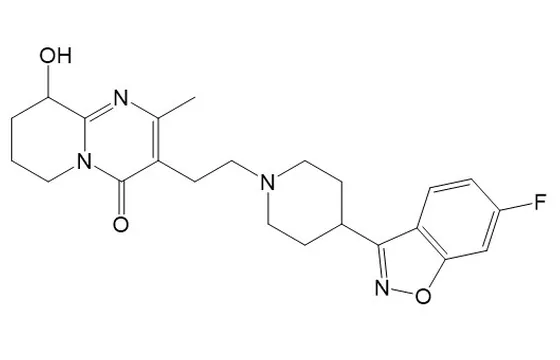
- The C9 member is paliperidone, a separate drug substance with its own monograph, so one structure is a specification limit in one product and an assay item in the other[2].
- No nitrogen in risperidone carries a hydrogen, so the N-nitroso branch of ICH M7 does not open for the parent; the 426.49 family is a purity problem, not a genotoxicity problem[3].
A related-substances method for risperidone is usually written around one question: can the column resolve the N-oxide from the parent. That question is too small. Six entries sit at 426.49 and they behave nothing alike. One elutes ahead of the parent. Two are diastereomers of each other. Two are carbon-hydroxylated and fall inside the parent window. A sixth is a different drug.
Treating that set as one unspecified band produces the two failures that fill deficiency letters. Either the method reports one number for four peaks, or the specification sets one limit for structures whose permitted intakes differ by orders of magnitude.
Where an oxygen can actually land
Three nitrogens, one tetrahydropyridine ring, four different kinds of site. The piperidine nitrogen is a plain tertiary alkylamine, no delocalisation, the most nucleophilic atom in the molecule. The bridgehead nitrogen of the pyrido[1,2-a]pyrimidin-4-one shares its lone pair with the adjacent carbonyl, so it is a far weaker nucleophile. The benzisoxazole nitrogen already carries an oxygen, because that ring is a cyclic oxime.
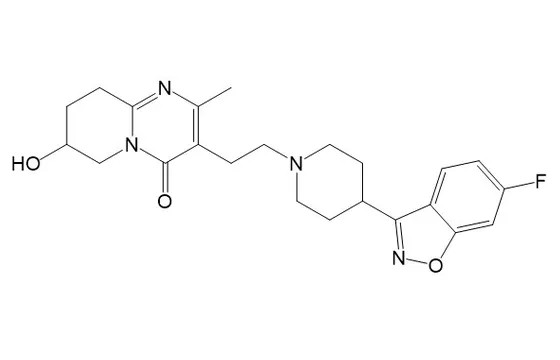
The carbon sites matter more. The tetrahydropyridine ring has two methylenes allylic to the enaminone double bond, which is why C9 is the position CYP enzymes hydroxylate and also the position peroxide and light reach first. C7 is one carbon away, and hydroxylation there differs from the C9 isomer by nothing except the position of one hydrogen and one hydroxyl.
That is the difficulty in one sentence: a shift of one substituent around a six-membered ring, with formula, nominal mass, accurate mass and ultraviolet spectrum all identical.
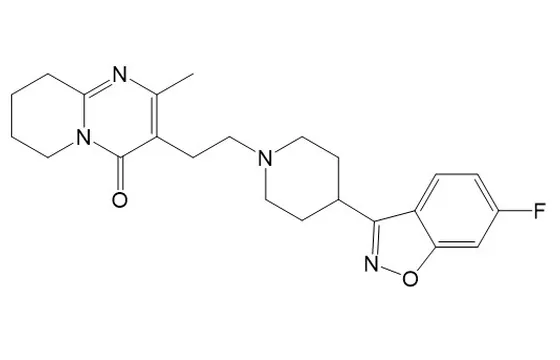
Three nitrogens, three N-oxides, and one cis-trans pair
Peroxide stress gives N-oxides first, because the piperidine nitrogen is the most nucleophilic atom in the molecule. Published impurity work isolated a more polar and a less polar species from manufactured material and identified them by mass, NMR and single-crystal diffraction as the N-oxide and 9-methylene risperidone[4]. Oxidation adds 15.995 and makes the molecule more polar. Dehydrogenation removes 2.016 and makes it less polar, because the new exocyclic double bond extends conjugation.
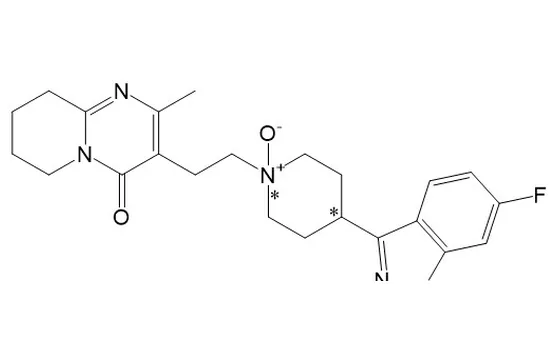
The N-oxide is not one species. The N-O bond sits either on the same face of the piperidine ring as the benzisoxazole at C4 or on the opposite face, and in a 1,4-disubstituted ring those are diastereomers, not conformers. A ring flip moves both substituents and never converts one relationship into the other. The catalogue carries cis and trans entries alongside a third that specifies no geometry, all three sharing one formula.
Two reference standards are therefore needed where most laboratories buy one. A single unspecified N-oxide standard assigns one of two peaks and leaves the other unidentified, and because the diastereomers do not share a response factor, the reported total depends on which one dominates. The pyrimidinone N-oxide, adjacent to a carbonyl, is thermally fragile; the benzisoxazole N-oxide fragments differently again. None of the three should be run on an assumed factor of one.
The 413.5 and 430.5 series belong to the synthesis, not the shelf
The benzisoxazole is a masked oxime. Cleaving the N-O bond and hydrolysing the imine gives an ortho-hydroxy ketone, carried in the catalogue at C23H28FN3O3, 413.49: one nitrogen lost, one oxygen and one hydrogen gained, plus three units from the parent. It is also a human metabolite, which is why it appears in catalogues at all, but it is a genuine hydrolytic degradant and should be expected under acid and light.
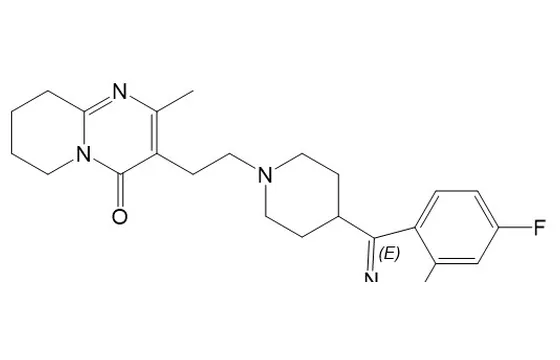
Two nearby entries cannot come from risperidone at all. The oxime at C23H28F2N4O2, 430.50, and the ketone at C23H27F2N3O2, 415.49, both carry two fluorines where the drug substance carries one. The oxime is the parent plus fluorine and hydrogen, 20.01 units; the ketone is the parent plus fluorine minus nitrogen, 4.99 units. Nothing in storage adds fluorine, so both come from upstream, where the 2,4-difluorophenyl building block is cyclised to the benzisoxazole and the cyclisation can stall at the oxime.
That distinction decides which specification owns the peak. A process relative belongs in the drug substance specification, limited by starting-material control and by clearance across the last crystallisation. A degradant belongs in the product specification, limited by stability data. Filing the 430.50 oxime as a degradant invites the question of why stability samples never show it.
At 427 daltons, mass spectrometry is not identification
A method that reports a peak at m/z 427 and calls it the N-oxide is reporting a mass defect, not a structure. Six entries and one drug substance sit within a milliDalton, and three of the seven are N-oxides on three different nitrogens. Collision-induced dissociation separates them if the fragments are chosen for the purpose: the benzisoxazole N-oxide loses oxygen from the heterocycle, the piperidine N-oxide gives the amine with a neutral loss of 16, and the hydroxylated isomers fragment through the tetrahydropyridine ring[5].
Two artefacts undermine the mass axis further. Amine N-oxides are reduced back to the parent in electrospray sources, so one injection gives a 427 signal and an enhanced 411 signal that is not a second impurity. In the other direction, a hot interface strips oxygen from the pyrimidinone N-oxide and manufactures a 411 signal that looks like parent.
Ultraviolet detection has its own bias. A piperidine N-oxide changes polarity and retention far more than absorbance at 280 nm, so area per cent under-reports it. The hydroxylated isomers are the opposite case: same chromophore, comparable absorbance, and area per cent is approximately right. That is the reason to separate the two families in the method rather than in the calculation.
A sixty-four-fold dose range and three different thresholds
Risperidone is dosed from 0.25 mg per day in young children with autistic disorder to 16 mg per day in adults with schizophrenia, a range of sixty-four-fold[6]. ICH Q3B(R2) builds its thresholds out of exactly that variable, so the same impurity has three different permitted levels depending on which tablet the patient takes[7].
| Maximum daily dose | Q3B identification | Q3B qualification | Governing column |
|---|---|---|---|
| 0.25 mg | 1.0 per cent or 5 micrograms | 1.0 per cent or 50 micrograms | percentage: 1.0 per cent is 2.5 micrograms |
| 4 mg | 0.5 per cent or 20 micrograms | 1.0 per cent or 50 micrograms | both equal: 0.5 per cent is exactly 20 micrograms |
| 6 mg | 0.5 per cent or 20 micrograms | 1.0 per cent or 50 micrograms | absolute: 20 micrograms is 0.33 per cent |
| 16 mg | 0.2 per cent or 2 mg | 0.5 per cent or 200 micrograms | percentage in both cases |
Table note: thresholds from ICH Q3B(R2) Attachment 1, applied to the daily doses authorised for risperidone[7]. Reporting is 0.1 per cent at all four doses, since none exceeds 1 g per day.
Three things follow. At 4 mg the two identification columns coincide exactly at 0.5 per cent and 20 micrograms, which is a useful check when a reviewer asks which column was applied. At 16 mg the permitted identification level of 0.2 per cent is twice the 0.10 per cent that ICH Q3A(R2) applies to the drug substance[8], so a peak that must be identified in the API can pass unremarked in the tablet; the gap is defensible, because the two guidelines answer different questions, but it has to be explained. And the absolute scale gets lost in the percentages: at 16 mg per day, 0.2 per cent is 32 micrograms, roughly one fiftieth of the lowest therapeutic dose of paliperidone, 1.5 mg. That limit protects the definition of the product, not the patient, and saying so is stronger than implying a toxicological basis the arithmetic does not support.
The one entry that is a product in its own right
Paliperidone↗ is 9-hydroxyrisperidone: the major human metabolite, a marketed antipsychotic, and a catalogue of 72 entries against 36 for risperidone. The peak being limited therefore belongs to a substance with a full toxicology package, in another product, at doses some fifty times the level permitted as an impurity.
So the limit cannot rest on the Q3B argument for degradation products that are also significant metabolites. That argument works when exposure qualifies the metabolite; here the exposure comes from another drug and another indication. The honest justification is that the C9 hydroxy compound is a purity marker for the oxidation state of the molecule, limited at a level the stability data support.
Stability behaviour diverges too. Paliperidone in osmotic tablets lost about three quarters of its content within 24 hours of photolytic stress, while 18 per cent hydrogen peroxide removed about a sixth over 72 hours, with first-order kinetics for oxidation, heat and photolysis[9]. Light, not peroxide, dominates that chromophore, so a protocol copied from risperidone will under-stress paliperidone and produce a falsely clean profile.
Reading the catalogue before writing the specification
The risperidone variety page lists 36 entries including the drug substance, and the sorting takes ten minutes once formula is the organising principle. C23H27FN4O3 belongs to the mono-oxygenated set and needs a position assignment. C23H25FN4O2 is dehydrogenated, and 9-methylene is the member to expect. Two fluorines means a process relative from the benzisoxazole step. A C16 or smaller skeleton is a building block, which is why an entry count is never an impurity count.
Three comparisons, then stop. Paliperidone shares the formula but not the specification logic, because it is the product rather than the limit. Olanzapine has no benzisoxazole and no tertiary piperidine nitrogen in the same arrangement, so its oxidation chemistry runs on the thiophene and none of this transfers. Aripiprazole does share the N-oxide competing with a dehydrogenation product, which makes it a good check on the analytical strategy and a poor template for the chemistry.
The impurity reference standards index can be filtered by formula, which is faster than by name when the names are numbered, and the variety index puts formula and monograph status side by side.
Five errors that recur in deficiency responses
One number for four peaks. A single unspecified limit over the whole 426.49 region hides the fact that N-oxides and hydroxylated isomers do not share a response factor.
One N-oxide standard for a two-diastereomer problem. The cis and trans forms are separable and nothing in a vial interconverts them.
A process relative filed as a degradant. The difluoro oxime and ketone cannot form from risperidone, so stability data will never show them.
No defined inlet temperature. The pyrimidinone N-oxide loses oxygen on hot surfaces, so the same sample gives different totals on different instruments.
One limit across all six strengths. The 0.25 mg and 16 mg products differ five-fold in permitted identification level.
Frequently Asked Questions
How many impurities does risperidone actually have at plus sixteen mass units?
Is the risperidone N-oxide one peak or two?
Can area per cent be used for the N-oxides?
Does risperidone need a nitrosamine risk assessment?
Why does the 16 mg tablet allow a looser limit than the API?
Is paliperidone an impurity or a metabolite in a risperidone filing?
Which stress condition finds the benzisoxazole opening?
Are there esters or lactones to worry about here?
Related Substances and Reference Standards
- Risperidone (- impurity / derivative entries)
- Paliperidone (- impurity / derivative entries)
- Aripiprazole (- impurity / derivative entries)
References and Sources
- PubChem, National Center for Biotechnology Information, Risperidone, C23H27FN4O2, 410.49, used here for the formula, the mass and the plus-16 arithmetic of every mono-oxygenated relative, accessed 2026-11-20
- PubChem, National Center for Biotechnology Information, Paliperidone, 9-hydroxyrisperidone, C23H27FN4O3, 426.49, confirming that the C9 hydroxy compound is a distinct drug substance rather than a numbered impurity, accessed 2026-11-20
- International Council for Harmonisation, ICH M7(R2), Assessment and control of DNA reactive impurities, relevant to the absence of any N-H bond in the risperidone skeleton, accessed 2026-11-20
- Journal of Pharmaceutical and Biomedical Analysis, Elsevier, Sattanathan et al., Structural studies of impurities of risperidone by hyphenated techniques, 40(3):598-604, 2006: isolation and single-crystal confirmation of the N-oxide as the more polar impurity and 9-methylene risperidone as the less polar one, accessed 2026-11-20
- PubChem, National Center for Biotechnology Information, 7-Hydroxyrisperidone, CAS 147663-04-5, C23H27FN4O3, 426.49, an isobaric regioisomer of the C9 compound differing only in the position of one hydroxyl, accessed 2026-11-20
- DailyMed, US National Library of Medicine, RISPERDAL (risperidone) tablets, prescribing information: daily dose ranges from 0.25 mg in autistic disorder to 16 mg in adult schizophrenia, accessed 2026-11-20
- International Council for Harmonisation, ICH Q3B(R2), Impurities in new drug products, Attachment 1: identification and qualification thresholds by maximum daily dose, used for the 0.25 to 16 mg table, accessed 2026-11-20
- International Council for Harmonisation, ICH Q3A(R2), Impurities in new drug substances: reporting 0.05 per cent, identification 0.10 per cent or 1.0 mg per day, qualification 0.15 per cent or 1.0 mg per day at doses up to 2 g per day, accessed 2026-11-20
- Biomedical Chromatography, Wiley, Cassol et al., Stability, degradation impurities and decomposition kinetics for paliperidone from osmotic tablets, 32(11):e4348, 2018: photolysis dominant, with about a quarter of content remaining after 24 hours, accessed 2026-11-20
This article was prepared by the CATO technical team. Regulatory, pharmacopoeial and published literature content cited above is attributed in the reference list. It is provided for technical exchange and search reference only and does not constitute a quality specification or regulatory advice. For any specific substance, the applicable test methods, limits and filing requirements are governed by the current regulations, pharmacopoeial monographs and official publications.
Product information on this site is provided for research search and selection reference only and is not a quality specification; technical data, purity and structural confirmation are governed by the shipped COA and our written confirmation. All products mentioned are for research use only, not for human or animal diagnostic or therapeutic use.