Semaglutide: 4,113.58 Da, and a Catalogue That Numbers to 263
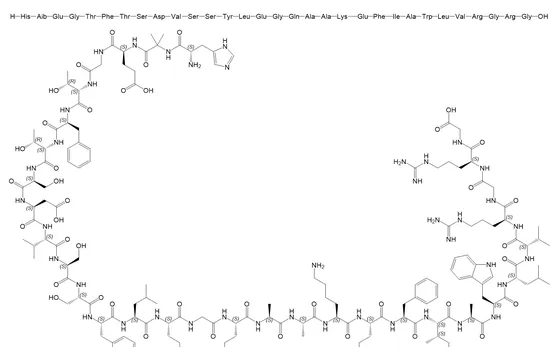
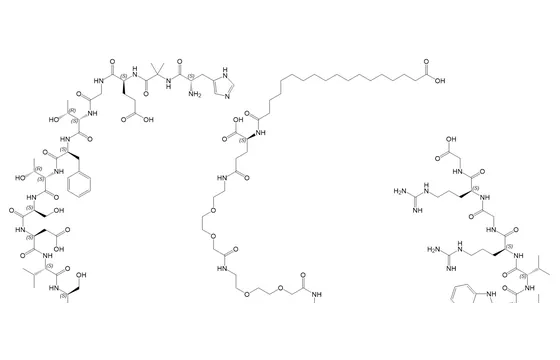
Semaglutide↗ is C187H291N45O59 at 4113.58, a 31-residue GLP-1 analogue acylated through Lys26 with a C18 diacid carried on a gamma-glutamate and two AEEA units. Its catalogue holds 49 entries whose numbers run to 263 and skip by tens, which tells you how the supplier indexes its shelf rather than how many impurities the molecule has. The classes that actually matter here are narrow: deamidation at 0.984 mass units, isomerisation at zero, the D-amino acids that are invisible without hydrolysis, and loss of a side chain that weighs more than 650.
Note: product names shown in red (marked with ↗) are links - click through to the product page for structure, CAS number, purity and lead time.
Key points
Key points
- Semaglutide is C187H291N45O59 at 4113.58, dosed once weekly at 0.25 to 2 mg for diabetes and 2.4 mg for weight management, so the daily-equivalent dose is in the hundreds of micrograms rather than in milligrams[1,2].
- For synthetic peptides the identification threshold is 0.10 per cent of the drug substance, per the FDA guidance for highly purified synthetic peptide products[3]. At a 2.4 mg weekly dose, 0.10 per cent is 2.4 micrograms per week, which is below the 1.5 microgram per day M7 intake. The peptide rule binds first.
- Deamidation moves the molecule by 0.984 mass units, which is 0.024 per cent of 4113.58. Isomerisation moves it by zero. Neither can be assigned on a nominal-mass instrument.
- The catalogue records the deacylated peptide explicitly as entry 50, 873874-39-6, and records one salt form as entry 240 hydrochloride. Forty-nine entries under numbers that reach 263 is a supplier index, not a count of impurities[2].
- Solution stability is a pH problem with a narrow failure window: the isoelectric point is 5.4 and degradation peaks between pH 4.5 and 5.5, while the recommendation is to formulate above pH 7.0.
A small-molecule impurity profile is a list of compounds with different formulae, different masses and usually different chromophores. A peptide impurity profile is the same molecule with a one-atom edit. That single difference changes every part of the analytical problem: what separates, what detects, what can be named, and what a certificate can honestly claim. Semaglutide makes the point sharply because its side chain is large enough to fall off as a discrete entity while its backbone edits stay within a mass unit of the parent.
What 4,113.58 Da does to a specification
The drug substance has 187 carbons, 291 hydrogens, 45 nitrogens, 59 oxygens and one sulfur, and it is a single molecular species rather than a mixture of glycoforms, which is what makes a synthetic peptide specifiable at all[2]. The specification still has to cover four kinds of impurity that behave completely differently under analysis: backbone edits that change mass by less than one unit, stereochemical edits that do not change mass at all, side-chain truncations that remove hundreds of mass units at once, and small-molecule fragments left over from the building blocks.
The 0.10 per cent threshold applies to peptide-related impurities, and its arithmetic is worth doing once. At 2.4 mg once weekly, 0.10 per cent is 2.4 micrograms per dose, or 0.34 micrograms per day averaged over the week[1,3]. The ICH M7 default intake of 1.5 micrograms per day is four times more permissive. On a peptide dosed in micrograms, the impurity threshold is tighter than the genotoxic threshold, which is the opposite of the situation on a 500 mg small molecule and the reason a peptide dossier cannot borrow a small-molecule template.
There is a practical consequence for method sensitivity. A 2.4 mg dose in a 1 mL injection means the drug is at 2.4 mg per mL, and 0.10 per cent of that is 2.4 micrograms per mL. That is comfortably within the reach of a UV detector at 214 nm, because the peptide backbone absorbs there. It is not comfortably within reach of a UV detector at 280 nm, where only the single tryptophan contributes.
The acyl chain is a removable part, not a decoration
Semaglutide carries a C18 fatty diacid on Lys26, connected through a gamma-glutamate and two AEEA linkers. The chain exists to bind albumin and extend the half-life, and it is large: losing the whole assembly removes more than 650 mass units, which is enough to change the chromatographic behaviour, the ionisation efficiency and the aggregation tendency of the molecule in one step[2].
The catalogue records that species directly as entry 50, the peptide without the octadecanedioyl-gamma-glutamate-AEEA-AEEA side chain, CAS 873874-39-6[2]. It is not a hypothetical degradant. It is the product of an incomplete acylation or of a hydrolysis that removes the whole tail, and it is the single most structurally distinctive entry in the series, because every other entry differs from the parent by a handful of atoms while this one differs by a whole functional domain.
The analytical consequence is that a method developed on the parent will place the deacylated peptide far from the main peak and possibly outside the gradient window entirely. A method transfer that does not test the deacylated standard will pass system suitability and still miss the largest degradation product on the molecule. That is a specific, common failure, and it is the peptide equivalent of a small-molecule method that never injects the dimer.
0.984, zero, and minus 18.011
Three numbers organise the backbone chemistry. Deamidation of an asparagine or a glutamine to the corresponding acid adds 0.984 mass units: one nitrogen and two hydrogens leave as ammonia, one oxygen arrives. Isomerisation of an aspartate to isoaspartate changes nothing at all in mass, because the atoms are the same and only the peptide bond moves from the side-chain carboxyl to the backbone carboxyl. And formation of a succinimide intermediate removes water, 18.011 units, which is why the succinimide is a distinct peak rather than a transient that no one sees[4].
The isobaric pair is the trap. Aspartate and isoaspartate have identical formulae, identical masses and, on many C18 methods, nearly identical retention. They are different molecules with different stability and different immunogenic potential, and no mass spectrometer can tell them apart without fragmentation or enzymatic digestion. Any specification that says isoaspartate without saying how it was assigned is a specification that has not been demonstrated, only asserted.
Thermal stress on this molecule produces a defined set of species rather than a smear. A published study identifies thirteen known impurities across stress conditions and finds six that form under every condition tested, at m/z values of 2717.21, 4129.64, 3762.28, 3456.94, 2967.5 and 839[4]. The spread of those values is the point: some are small fragments of the backbone, some are near the parent mass, and one is at 839, which is a fragment ion or a small peptide rather than a near-intact impurity. Charge states have to be assigned before any of them can be converted into a neutral mass, and papers that report only m/z leave that step to the reader.
D-amino acids: the class that needs hydrolysis
Stereochemical impurities on a peptide are the hardest class to characterise and the easiest to overlook, because they are isobaric with the parent and chromatographically close to it. A published characterisation of semaglutide formulations identifies low-level D-Ser at position 8, D-His at position 1 and D-Asp at position 9, and the method is worth understanding because it is not a chromatographic separation at all[5].
The workflow is a sequence of chemical steps wrapped around an analytical one: collect the impurity peak off-line by reversed-phase UPLC, lyophilise it, hydrolyse it in deuterated hydrochloric acid with suppressants that limit racemisation during hydrolysis, derivatise the released amino acids with a chiral reagent, and then separate and detect the derivatives by UPLC with high-resolution tandem mass spectrometry against authentic standards. The deuteration is what makes the assignment trustworthy: without it, the hydrolysis step itself racemises part of the sample and manufactures the impurity being measured.
That is the transferable lesson. D-amino acid control is a validated-method problem in the full sense, not a column-choice problem. An applicant who buys a D-His standard and injects it on a chiral column has demonstrated that the standard elutes somewhere; the applicant who hydrolyses a collected fraction in deuterated acid has demonstrated that the impurity is in the drug.
pH 5.4 and the window between 4.5 and 5.5
The isoelectric point of semaglutide is 5.4, and a preformulation study that varies pH, buffer species and molarity finds the degradation maximum precisely in the 4.5 to 5.5 window, which is where the molecule carries no net charge and where solubility and conformational stability are both at their worst[6]. The same study finds the peptide stable at pH 1.2 for a day at 25 and 40 degrees, stable for three hours at 80 degrees, and recommends a finished-product pH above 7.0.
That recommendation is a formulation decision with an analytical consequence. A method buffered at pH 4.5 to match a generic mobile phase is a method that decomposes its own sample on the autosampler, and the resulting impurity profile is a property of the autosampler rather than of the drug. The first thing to check in a semaglutide method is the sample diluent pH, not the gradient.
Buffer species matter as much as pH. Phosphate accelerates deamidation through general base catalysis, citrate chelates trace metals and can either suppress or promote oxidation depending on the metal inventory, and the molarity determines how much of either effect you get. Two methods with the same pH and different buffers will give different impurity ratios on the same batch, which is a reproducibility problem before it is a stability problem[6].
The solid state loses its helix before it loses its chemistry
Thermal stress on the solid shows a sequence that is easy to miss if the only detector is HPLC. Infrared and circular dichroism measurements keep the native alpha-helix intact up to 60 degrees, but the helical content falls from 49.07 per cent to 43.75 per cent at 60 degrees and to 0.2 per cent at 80 degrees, which means the molecule has lost essentially all of its secondary structure before the chemical impurity profile has had time to develop[7].
The same study finds the material amorphous under every condition tested, with three thermal events: loss of residual water, enthalpy recovery associated with physical ageing, and thermal decomposition. Enthalpy recovery overlaps the glass transition, which limits what conventional differential scanning calorimetry can report, and modulated DSC is needed to separate them. None of this appears on a chromatogram, and all of it is reversible only up to a point: a lyophilised peptide that has lost its helix at 80 degrees will not refold on cooling, and its receptor binding will not recover.
For a specification, the practical residue of that finding is a storage statement with a number in it rather than an adjective, and a stability protocol that includes a conformational measurement at the accelerated condition. A purity assay at 99 per cent and a collapsed helix are entirely compatible with each other, and only one of them predicts whether the product works.
The mass ladder, with the charge state stated
The table below converts the reported m/z values into neutral-mass deltas under an explicit assumption, namely that the ion is singly charged. That assumption is stated rather than hidden, because the paper reports m/z and the conversion is where most errors in this kind of table are introduced.
| Species | Mass change | Expected position | Detectable by |
|---|---|---|---|
| Deamidation (Asn or Gln to acid) | plus 0.984 | 4114.56 | high-resolution MS only |
| Oxidation (Met or Trp) | plus 15.995 | 4129.58, reported at m/z 4129.64 | UV and MS |
| Succinimide intermediate | minus 18.011 | 4095.57 | UV and MS |
| Aspartate to isoaspartate | zero | 4113.58 | separation plus digestion |
| D-amino acid substitution | zero | 4113.58 | hydrolysis, chiral derivatisation |
| Acyl chain loss | about minus 658 | reported at m/z 3456.94 | UV, large shift in retention |
Two rows of that table cannot be resolved by mass at all, and they are the two that matter most for immunogenicity. A specification that leans on high-resolution mass spectrometry for everything will assign the deamidation correctly and will never see the isoaspartate or the D-amino acid, because both are the same mass as the drug. Those two need separation and, for the stereocentres, chemistry before separation[5].
What 49 entries and a 263 ceiling actually mean
The catalogue lists 49 entries for this peptide: the drug, 47 numbered impurities, and one salt. The numbers run to 263 and skip in blocks, so the highest number is roughly five times the number of entries[2]. That ratio is the clearest possible demonstration that a numbered impurity list is a shelf index. A supplier who stocks what customers ask for will accumulate numbers faster than compounds, because every customer has a different internal numbering and somebody has to map them.
The filing population makes the opposite point. Semaglutide has been accepted at CDE 506 times by 59 companies, an order of magnitude more than the small-molecule varieties discussed alongside it, and that population is what produces a 49-entry catalogue with a 263 ceiling
. Demand creates numbering, and numbering is not chemistry.Two entries are worth flagging for the dossier. Entry 50 at 873874-39-6 is the deacylated peptide, discussed above. Entry 240 exists twice, as the free peptide and as its hydrochloride at 1973409-34-5, which is a reminder that salt forms of a 4 kDa molecule change the weighing basis by a few per cent and the counter-ion by a defined amount, and that a certificate without a salt statement is not a weighing instruction[2].
The peptide neighbours fail differently
Tirzepatide is the natural comparison and the comparison is not flattering to either molecule, because tirzepatide is a 39-residue dual agonist with a C20 chain and a different linker, so its degradation chemistry is a superset in some respects and a different problem in others. A method transfer between the two is a method redevelopment, and the shared vocabulary of GLP-1 impurities hides that.
Liraglutide is the older analogue, 31 residues like semaglutide, acylated with a C16 chain on a different linker and with a different substitution pattern that makes it more prone to aggregation at neutral pH. Its catalogue is small, which reflects commercial demand rather than chemical simplicity. The lesson from comparing the three is that the peptide backbone sets the mass ladder and the side chain sets the stability, and the two have to be specified separately.
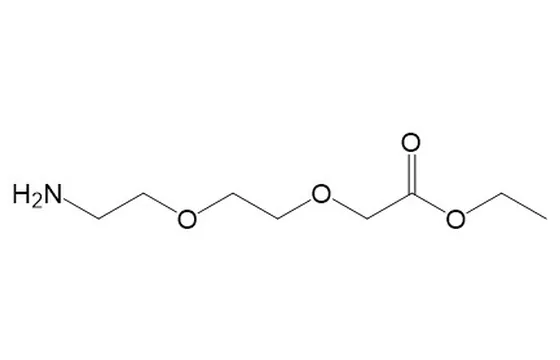
The full semaglutide series should be read with that split in mind: the numbered entries below 1,000 Da are fragments and linker pieces, the entries near 4,000 Da are backbone edits and truncations, and the two groups need different methods, different standards and different acceptance criteria.
What to write into the specification
Five items carry a peptide specification, and each has to name its method because the same nominal parameter means different things depending on how it was measured. Purity by area normalisation at 214 nm, with the caveat that response factors across a peptide backbone are more similar than across small molecules but not identical. Peptide-related impurities at 0.10 per cent, identified individually where the guidance requires it. Deamidation and oxidation as separate reported groups, because they have different toxicological weight and different control strategies. Isoaspartate and D-amino acids as method-defined items, with the assignment procedure written down. And the deacylated peptide as its own line, because it is the largest single modification the molecule can suffer[3,8,9].
The validated stability-indicating method published for this molecule and its neighbour uses an Inertsil ODS-3 column at 4.6 by 250 mm and 5 micrometres, isocratic 0.1 per cent formic acid at pH 2.5 with acetonitrile at 30 to 70, 1 mL per minute, 220 nm, with semaglutide eluting at 1.42 minutes and a limit of detection of 16 nanograms per millilitre[8]. That is a fast, low-pH method, and the low pH is not incidental: it keeps the sample away from the 4.5 to 5.5 window where the molecule degrades fastest.
Frequently Asked Questions
Why is a peptide impurity list not a count of impurities?
Which impurity threshold applies to semaglutide?
Why can mass spectrometry not resolve isoaspartate?
How are D-amino acid impurities actually demonstrated?
Why is pH 4.5 to 5.5 the worst window?
Can a purity assay detect a collapsed helix?
What is the single most important standard to have on the shelf?
Related Substances and Reference Standards
- Semaglutide (48 impurity / derivative entries)
- Tirzepatide (- impurity / derivative entries)
- Liraglutide (- impurity / derivative entries)
References and Sources
- DailyMed, US National Library of Medicine, Semaglutide injection, prescribing information: once-weekly dosing from 0.25 mg to 2.4 mg and storage requirements, accessed 2026-11-22
- PubChem, National Library of Medicine, Semaglutide, CAS 910463-68-2: molecular formula C187H291N45O59, molecular weight 4113.6, and the Lys26 acyl chain with gamma-glutamate and two AEEA units, accessed 2026-11-22
- US Food and Drug Administration, ANDAs for certain highly purified synthetic peptide drug products that refer to listed drugs of rDNA origin: guidance for industry, including the 0.10 per cent identification threshold, accessed 2026-11-22
- European Journal of Pharmaceutics and Biopharmaceutics, Effect of pH, buffers, molarity, and temperature on solution state degradation of semaglutide using LC-HRMS, 2025: thirteen known impurities and six that form under every condition, accessed 2026-11-22
- Journal of Pharmaceutical and Biomedical Analysis, Characterization of low-level D-amino acid isomeric impurities of semaglutide using liquid chromatography-high resolution tandem mass spectrometry, 2023: D-Ser8, D-His1 and D-Asp9, accessed 2026-11-22
- Journal of Peptide Science, Influence of buffering capacity, pH, and temperature on the stability of semaglutide: a preformulation study, 2025: isoelectric point 5.4 and the degradation maximum between pH 4.5 and 5.5, accessed 2026-11-22
- Pharmaceutical Research, Thermally stressed solid-state stability of semaglutide, 2026: alpha-helical content falling from 49.07 to 43.75 per cent at 60 degrees and to 0.2 per cent at 80 degrees, accessed 2026-11-22
- BMC Chemistry, A multimodal HPLC stability indicating approach for the estimation of semaglutide and tirzepatide in bulk, dosage forms and rat plasma, 2026: Inertsil ODS-3 method and a 16 ng/mL limit of detection, accessed 2026-11-22
- International Council for Harmonisation, ICH Q6B, Specifications: test procedures and acceptance criteria for biotechnological and biological products, the framework applied to peptide specifications, accessed 2026-11-22
This article was prepared by the CATO technical team. Regulatory, pharmacopoeial and published literature content cited above is attributed in the reference list. It is provided for technical exchange and search reference only and does not constitute a quality specification or regulatory advice. For any specific substance, the applicable test methods, limits and filing requirements are governed by the current regulations, pharmacopoeial monographs and official publications.
Product information on this site is provided for research search and selection reference only and is not a quality specification; technical data, purity and structural confirmation are governed by the shipped COA and our written confirmation. All products mentioned are for research use only, not for human or animal diagnostic or therapeutic use.