Sertraline Has Two Chiral Centers and the Monograph Names Only One
Sertraline↗ hydrochloride is sold as a single stereoisomer, and most certificates of analysis say so once, in a line about chiral purity or optical rotation. The molecule has two stereocenters, so four isomers exist, three of them are impurities, and only two of those three can be seen on the reversed-phase method most laboratories run first.
Note: product names shown in red (marked with ↗) are links - click through to the product page for structure, CAS number, purity and lead time.
Four isomers and one of them is the drug
Key points
- Sertraline is 4-(3,4-dichlorophenyl)-N-methyl-1,2,3,4-tetrahydronaphthalen-1-amine. The base is C17H17Cl2N, 306.2, and the hydrochloride is C17H18Cl3N, 342.7[1][2].
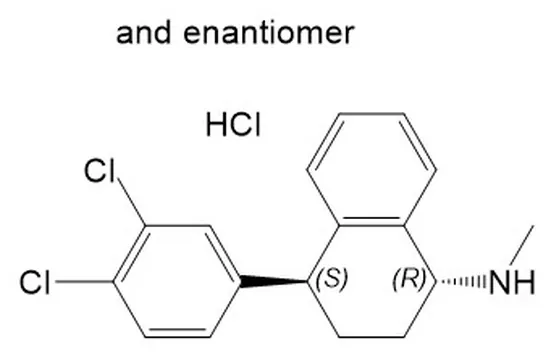
- The tetrahydronaphthalene carries two stereocenters, at C1 and C4, so four isomers exist. The drug is the cis (1S,4S) isomer; the other three are the (1R,4R) enantiomer and two trans diastereomers.
- On an achiral C18 method the enantiomer has the same retention time and the same fragment ions as the API. Only a chiral stationary phase, or a chiral additive, separates the pair[3].
- At the 200 mg per day maximum the absolute cap of 1.0 mg per day equals 0.5 per cent, so the 0.10 per cent identification threshold of ICH Q3A governs the specification, not the milligram figure[4].
Most certificates of analysis for sertraline hydrochloride describe the molecule in one line: a chiral purity or an optical rotation, sometimes both. That single line is doing more work than it looks like. It is the only place in the document where the three non-drug isomers are accounted for, and on the reversed-phase method that most laboratories run first, one of those three cannot be seen at all.
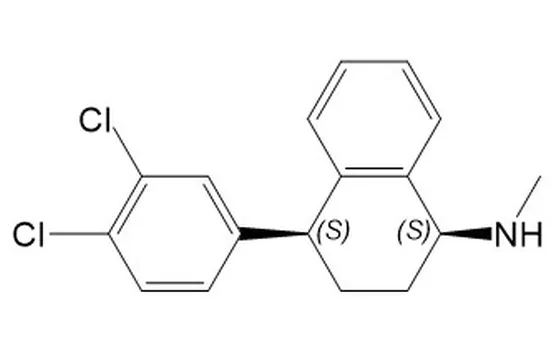
The salt form is the one in the tablet: sertraline hydrochloride, C17H17Cl2N·HCl, and the added proton changes nothing about the stereochemistry.
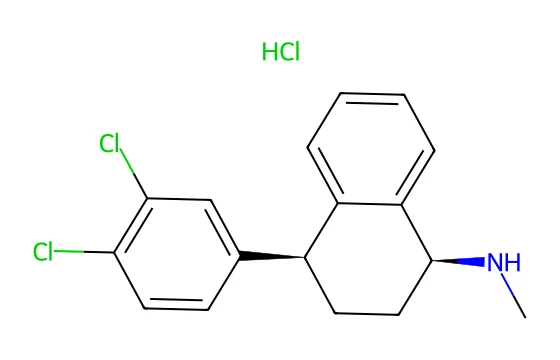
The catalog makes the scale of the problem concrete. The sertraline hydrochloride variety page lists 66 entries, and the salt itself appears twice: the base at CAS 79617-96-2 and the hydrochloride at CAS 79559-97-0. Everything else on that page is either a process relative, a metabolite, or a stereoisomer.
Two centers, and only one of them sets the shape
The two centers are not equivalent. C4 carries the 3,4-dichlorophenyl group and fixes which face of the saturated ring the aryl group sits on. C1 carries the methylamine, and its configuration is read relative to C4. When the two substituents are cis, the molecule has the shape that binds the serotonin transporter; when they are trans, the aryl group and the amine point to opposite faces and affinity drops sharply.
That is why the trans pair is a process problem rather than a design problem. A reductive amination that is not fully stereoselective, or a ketone intermediate that enolizes before reduction, will deliver a mixture of cis and trans material. The cis pair is then split by resolution into (1S,4S) and (1R,4R). Resolution is efficient for the enantiomer and useless for the diastereomer, because the trans material is a different molecule in every physical sense.
The practical consequence is that a sertraline route has two separate stereochemical failure modes, and they surface in two different assays. Trans material shows up on the achiral related-substances method. The unwanted cis enantiomer does not.
Why the enantiomer disappears on a C18 method
Enantiomers have identical physical properties in an achiral environment: same molecular weight, same partition coefficient, same fragmentation, same ultraviolet spectrum. On a C18 column with an achiral mobile phase they are the same peak, and no amount of resolution tuning changes that. A method with a 0.10 per cent disregard limit will pass a batch that contains one per cent of the (1R,4R) isomer without generating a single extra peak.
Two approaches close the gap. The first is a chiral stationary phase, usually a polysaccharide carbamate coated on silica, run in normal phase or in polar organic mode; amylose and cellulose carbamates differ in which of the two cis enantiomers they retain more strongly, and the choice is empirical. The second is supercritical fluid chromatography on the same type of stationary phase, which is faster and is now common in release testing. A chiral mobile phase additive works in principle and is fragile in practice: the additive competes with the analyte for the stationary phase, so small changes in additive concentration move both retention and selectivity.
Whichever route is chosen, the method has to demonstrate resolution between the two cis enantiomers, not merely retention of one of them. A system suitability criterion of resolution not less than 1.5 between the enantiomer and the API peak is the minimum, and it should be checked on every column lot, because chiral columns vary more between lots than C18 columns do.
The four isomers at a glance
The table is the whole argument in one place. Two of the four isomers are visible on the method most laboratories start with; the third is only visible on a chiral method; and the fourth is the drug.
| Isomer | Relation | Ring fusion | Reversed-phase C18 | Chiral phase | Standard |
|---|---|---|---|---|---|
| (1S,4S) | the drug | cis | co-elutes with nothing else | first peak | the API itself |
| (1R,4R) | enantiomer | cis | same retention as the API | baseline resolved | yes, chiral |
| (1S,4R) | trans diastereomer | trans | resolved from the API | resolved | yes |
| (1R,4S) | trans diastereomer | trans | resolved from the API | resolved | yes |
Behaviour summarized from the configuration at C1 and C4; retention order is method dependent and must be proven on the actual column[1].
Reading it the other way round is the useful exercise: if the specification quotes a single chiral purity figure and nothing else, the two trans diastereomers are covered by the achiral method and the enantiomer by the chiral one. If the specification quotes only an achiral impurity profile, one of the four isomers is unaccounted for.
Where the numbers come from at 200 milligrams
ICH Q3A sets identification at 0.10 per cent or 1.0 mg per day, whichever is lower, and qualification at 0.15 per cent or 1.0 mg per day[4]. Sertraline runs from 25 mg to 200 mg per day. At 200 mg, 1.0 mg per day is 0.5 per cent, so the percentage threshold is the lower of the two and it governs at every strength in the range. The milligram column never binds for this drug, which is worth knowing before someone argues that a 0.4 per cent peak is acceptable because it is under a milligram.
For the tablet, ICH Q3B sets identification at 0.5 per cent or 1 mg per day for a maximum daily dose of 1 g or less[5]. At 200 mg per day the two columns coincide exactly: 0.5 per cent of 200 mg is 1 mg. That coincidence is a useful sanity check when a specification is being drafted, and it is the only strength in the range where the two arithmetic routes agree.
None of this sets a limit for the enantiomer. Q3A and Q3B are generic thresholds for unspecified impurities; once an impurity is named and specified, its limit is justified by batch history, by the capability of the process and by the pharmacopoeial monograph, not by the guideline table. A chiral purity of 99.5 per cent area is a common commercial figure, and it is a process capability statement, not a regulatory derivation.
What the catalog holds, and what it does not
A catalog page for a two-center molecule collects four different kinds of material, and mixing them up is the most common way a related-substances section becomes unreadable. For sertraline the split looks like this. There are process relatives such as N-methylsertraline, C18H19Cl2N, 320.3, which is one methyl short of a full alkylation and appears when the amination is incomplete[3]. There are dechloro analogs, which come from a starting material that was not fully chlorinated. There are stereoisomers, the subject of this article. And there are metabolites, the hydroxy and glucuronide derivatives that appear in plasma and in urine but have no business being specified as impurities in a drug substance.
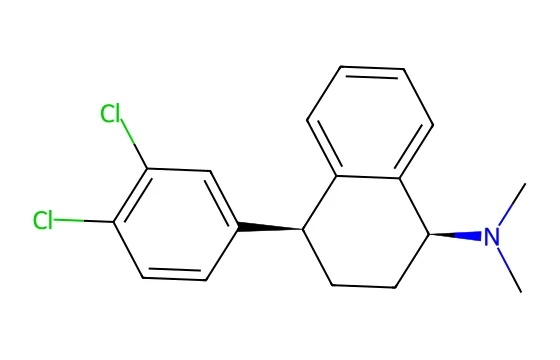
The metabolite entries are not noise. They matter when a laboratory is asked to identify an unknown peak in a stability sample and reaches for the nearest catalog number; a hydroxy metabolite that has never been shown to form in the formulation will send the investigation in the wrong direction. The distinction is worth stating in the method validation report: which entries are process-derived, which are degradation-derived, and which are only biological.
Choosing standards for a two-center molecule
Three standards carry the stereochemical argument: the enantiomer, the trans diastereomer, and the API itself as the system suitability marker. The enantiomer standard must be certified for chiral purity and for the absence of the trans pair; a standard that is 98 per cent enantiomer and 2 per cent trans will make a good method look bad. The trans standard is easier to obtain and is usually needed only once, for peak identification.
Where the catalog is thin, the practical substitute is the racemate: a 1:1 mixture of the two cis enantiomers is the cleanest way to prove that a chiral method resolves the pair, because both peaks are present at equal height. It is a system suitability tool, not a calibrant, and it should not be used to assign a chiral purity value.
The sertraline hydrochloride variety page collects the stereoisomers, the process relatives and the salt forms in one place, and the impurity standards section of the catalog can be filtered the same way: impurity reference standards by variety, and the full variety index when the question is which other molecules share the same tetrahydronaphthalene core.
Frequently Asked Questions
Does the pharmacopoeial letter for the enantiomer match between EP and USP?
Can the enantiomer be quantified on a C18 method with a chiral mobile phase additive?
If the API comes from a single supplier, is an enantiomer standard still needed?
What does the 1.0 mg per day cap mean at 200 mg?
Are the trans diastereomers controlled in the specification?
Is N-methylsertraline a process impurity or a metabolite?
Why does a certificate of analysis show a single chiral purity figure?
Is optical rotation still acceptable as the only stereochemical control?
Related Substances and Reference Standards
- Sertraline Hydrochloride (- impurity / derivative entries)
- Sertraline (CAS 79617-96-2)
- Sertraline Hydrochloride (CAS 79559-97-0)
References and Sources
- PubChem, National Center for Biotechnology Information, Sertraline, C17H17Cl2N, 306.2, the (1S,4S) base, used here for the stereocenter count and the molecular formula, accessed 2026-11-19
- PubChem, National Center for Biotechnology Information, Sertraline hydrochloride, C17H18Cl3N, 342.7, the salt form used in tablets, accessed 2026-11-19
- PubChem, National Center for Biotechnology Information, N-methylsertraline, C18H19Cl2N, 320.3, the demethylation relative listed in the catalog at CAS 122873-20-5, accessed 2026-11-19
- International Council for Harmonisation, ICH Q3A(R2), Impurities in new drug substances: reporting 0.05 per cent, identification 0.10 per cent or 1.0 mg per day, qualification 0.15 per cent or 1.0 mg per day, accessed 2026-11-19
- International Council for Harmonisation, ICH Q3B(R2), Impurities in new drug products: identification at 0.5 per cent or 1 mg per day for a maximum daily dose of 1 g or less, accessed 2026-11-19
This article was prepared by the CATO technical team. Regulatory, pharmacopoeial and published literature content cited above is attributed in the reference list. It is provided for technical exchange and search reference only and does not constitute a quality specification or regulatory advice. For any specific substance, the applicable test methods, limits and filing requirements are governed by the current regulations, pharmacopoeial monographs and official publications.
Product information on this site is provided for research search and selection reference only and is not a quality specification; technical data, purity and structural confirmation are governed by the shipped COA and our written confirmation. All products mentioned are for research use only, not for human or animal diagnostic or therapeutic use.