The Nitrosamine in Sildenafil Citrate Sits One Methyl Group Away From the Drug
Sildenafil↗ citrate has no secondary amine. That sentence is the whole nitrosamine argument, and it is also why the argument is usually got wrong. Every nitrogen in the intact molecule is either a ring amide, a sulfonamide or a tertiary methylpiperazine, so a nitrosating agent meeting the drug substance has nothing to attack. The substrate appears one oxidation step later, when the methyl on the piperazine is lost: the resulting desmethyl compound is not only a pharmacopoeial impurity but a secondary amine, and its N-nitroso derivative is the species a specification has to bound. At 100 mg a day that bound is a few parts per million, which is five hundred times below the reporting threshold of the method everyone already runs.
Note: product names shown in red (marked with ↗) are links - click through to the product page for structure, CAS number, purity and lead time.
Six nitrogens, and only one of them matters
Key points
- Sildenafil citrate is C22H30N6O4S with one citric acid, 666.7, CAS 171599-83-0, dosed at 25, 50 or 100 mg with a maximum of one 100 mg dose per day[1].
- The piperazine carries one N-methyl and one N-sulfonyl group. The methyl nitrogen is tertiary and the sulfonyl nitrogen is a sulfonamide, so no N-H amine exists in the drug substance to be nitrosated[1].
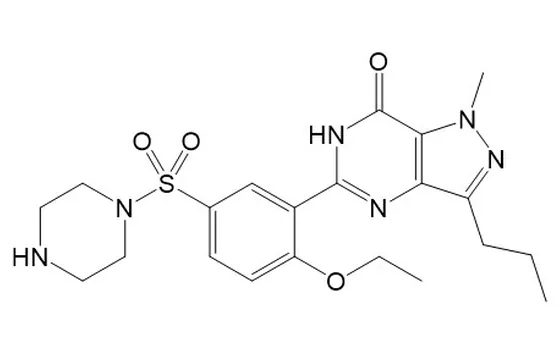
- Oxidation at that same methyl nitrogen gives two pharmacopoeial impurities: the N-oxide (impurity B, C22H30N6O5S) and the desmethyl compound (impurity F, C21H28N6O4S, CAS 139755-82-1), the second of which is a secondary amine[2].
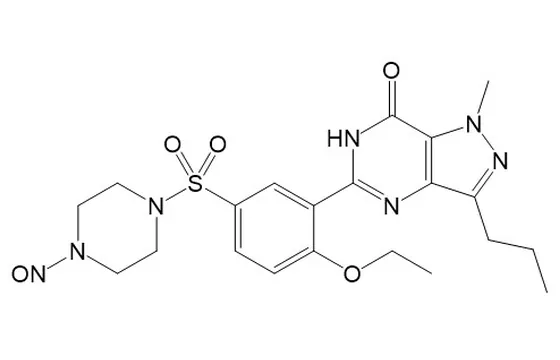
- The catalog carries the N-nitroso derivative of impurity F, C21H27N7O5S, CAS 3104323-42-1 — direct evidence that the risk has been assigned to the degradant rather than to the drug[3].
The nitrogen inventory decides everything, so it is worth walking through it. Sildenafil is a 1-methyl-3-propyl-1H-pyrazolo[4,3-d]pyrimidin-7-one core, carried on a 2-ethoxyphenyl ring and joined through a sulfonyl group to a 4-methylpiperazine, supplied as the citrate: C22H30N6O4S with one molecule of citric acid, molecular weight 666.7, solubility 3.5 milligrams per millilitre in water[1].
Six nitrogens, in four environments. Two sit in the pyrazolopyrimidinone core: a pyrazole nitrogen carrying a methyl, and a pyrimidinone lactam nitrogen carrying a hydrogen. Two sit in the piperazine, one of them methylated and one sulfonylated. The lactam N-H is an amide hydrogen; it is not an amine, and N-nitroso lactams are a different and far less accessible chemistry than nitrosamine formation on an amine. The sulfonamide nitrogen is not basic and does not nitrosate under the conditions that matter in a drug product. The pyrazole N-methyl is aromatic and has no hydrogen to displace.
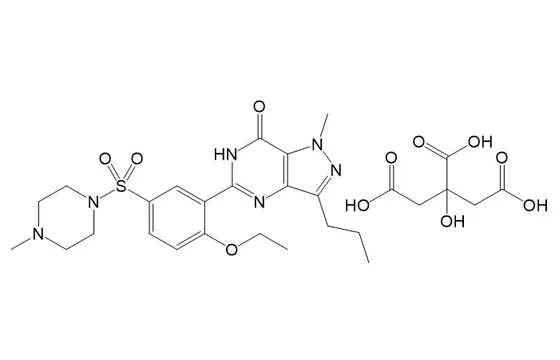
What is left is a tertiary amine. A tertiary amine cannot be nitrosated without first losing a substituent, because nitrosation is a substitution on nitrogen and there is no leaving hydrogen. That is the entire structural basis for saying that the drug substance itself is not an NDSRI precursor — not that it is unreactive, but that the reactive position is blocked by a methyl group.
Three specifications converge on one methyl group
The same methyl group that blocks nitrosation is also the softest position in the molecule, which is why three separate specification entries converge on one nitrogen.
| Species | CAS | Formula | What happened at the piperazine methyl |
|---|---|---|---|
| Sildenafil | 171599-83-0 (citrate) | C22H30N6O4S | nothing, the methyl is intact |
| Impurity B, N-oxide | 1094598-75-0 | C22H30N6O5S | oxygen added to the nitrogen, methyl retained |
| Impurity F, desmethyl | 139755-82-1 | C21H28N6O4S | methyl lost, the nitrogen now carries a hydrogen |
| N-nitroso impurity F | 3104323-42-1 | C21H27N7O5S | nitroso group on the nitrogen that lost its methyl |
| Impurity A | 1391053-95-4 | C23H32N6O4S | propyl replaced by isobutyl, a route artefact |
| Impurity C | 139755-91-2 | C20H26N6O4S | ethoxy replaced by hydroxyl |
Table: the six entries that define sildenafil's degradant chemistry. Formulas and structures checked against PubChem records; the N-oxide assignment for impurity B follows the published oxidative stress work[2].
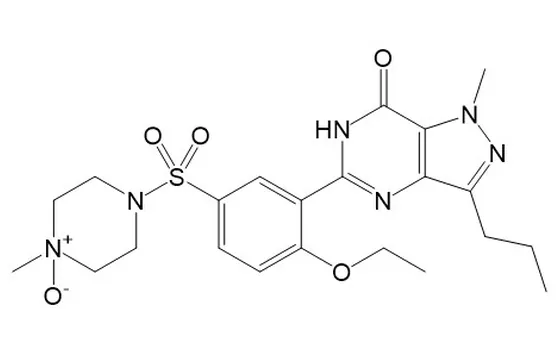
The pairing is chemically coherent. Oxidation of a tertiary amine gives the N-oxide; oxidative dealkylation of the same amine gives the secondary amine. Both are one-electron chemistry at the same atom, they are favoured by the same conditions, and they appear together in forced degradation. The published stress work on sildenafil identifies the N-oxide as the principal oxidative product and assigns it as impurity B[2].
Once the methyl is gone the nitrogen is secondary, and a secondary amine in the presence of any nitrosating source — nitrite in an excipient, nitrogen oxides in air, a nitrosating impurity in a package — will form the N-nitroso compound. That is the species at CAS 3104323-42-1, C21H27N7O5S, and its existence in the catalog is the practical admission that the risk belongs to the degradant.
What changes when the risk sits on the degradant
Three practical consequences follow from placing the risk on impurity F rather than on the drug.
First, the risk assessment has a defined substrate. It is not a generic question about sildenafil and nitrite; it is a question about how much desmethyl compound a batch contains, how much nitrite is available in the formulation, and whether the two can meet. A batch with impurity F at the limit of quantification and a nitrite-free formulation is a defensible negative. A batch with percent-level impurity F and a wet granulation is not.
Second, the control levers are different from the ones used for sartans. There is no tetrazole and no azide in the route, so the classical purge argument does not apply. What applies is keeping the tertiary amine reduced: avoiding peroxide-containing excipients, avoiding nitrite-preserved grades, controlling the oxidative step, and where necessary adding an antioxidant whose own nitrosation liability has been checked.
Third, the analytical target is not the drug. A method that quantifies sildenafil at 0.05 percent is measuring something three orders of magnitude larger than the limit that matters,
The arithmetic that makes the monograph irrelevant
Nitrosamine limits are not derived from the 1.5 microgram threshold of toxicological concern defined in ICH M7(R2)[4]. They are derived from a compound-specific or category-based acceptable intake, and the category approach assigns four values: 26.5, 100, 400 and 1500 nanograms per day[5]. Dividing each by the daily dose converts the intake into a concentration in the drug substance, which is the number a specification can use.
| Acceptable intake | Limit at 100 mg per day | Limit at 60 mg per day | Ratio to the 0.05 percent reporting threshold |
|---|---|---|---|
| 26.5 ng per day | 0.265 ppm | 0.44 ppm | 1,900 fold lower |
| 100 ng per day | 1 ppm | 1.67 ppm | 500 fold lower |
| 400 ng per day | 4 ppm | 6.67 ppm | 125 fold lower |
| 1500 ng per day | 15 ppm | 25 ppm | 33 fold lower |
Table: the four category values converted to concentration at the two daily doses sildenafil is used at — 100 mg once daily for erectile dysfunction and 20 mg three times daily, 60 mg, for pulmonary arterial hypertension. A 0.05 percent threshold is 500 ppm[6].
The conclusion does not depend on which category the impurity lands in. Whether the acceptable intake is 26.5 or 1500 nanograms a day, the resulting limit sits between a fifth of a part per million and fifteen parts per million, and the reporting threshold of the pharmacopoeial related-substances test is 500 parts per million. The nitrosamine is invisible to the method by a factor of at least thirty and by as much as nineteen hundred.
That is the point worth carrying into a filing. The question is not whether the existing method can be adjusted; it cannot. A dedicated procedure with a limit of quantification at or below one tenth of the applicable limit is the only route, which for the tightest category means an LOQ near 0.03 parts per million in the drug substance.
Dose is the only variable that moves the limit
Sildenafil is the middle case in a comparison that is easy to run and rarely run properly. Three drugs share the N-methylpiperazine motif, and the limit each one inherits is set almost entirely by dose.
At 800 mg a day, imatinib's 100 nanogram acceptable intake becomes 0.125 parts per million. At 100 mg, sildenafil's becomes 1 part per million. At 20 mg, olanzapine's becomes 5 parts per million. Same structural feature, an eighty-fold spread in the number that has to be met, and the only variable is how much of the drug the patient swallows.
The comparison has a limit. Sharing the motif means sharing the chemistry of demethylation; it does not mean sharing the chemistry of nitrite exposure. Imatinib↗ is a mesylate, and mesylate salts carry their own alkyl sulfonate question; olanzapine's thiophene ring oxidises on its own schedule; sildenafil is neither. What transfers is the arithmetic and the structural logic, not the control strategy.
See sildenafil citrate, imatinib mesylate and olanzapine for the three entry sets, and vardenafil hydrochloride and tadalafil for the same therapeutic class built on different cores, where none of this reasoning applies unchanged.
Detection at a concentration the method was never built for
Detection is a mass spectrometry problem, not a chromatography problem, and the chromatography still has to do real work because the analyte sits at a concentration where background matters.
The N-nitroso compound is 489.5, thirty-nine mass units above the drug, and it carries the same pyrazolopyrimidinone core. Positive electrospray will ionise it, but atmospheric pressure chemical ionisation is often preferred for nitrosamines because it is less susceptible to the ammonium adduct and solvent-cluster chemistry that makes low-level electrospray work tedious. Either way the transition is chosen from the nitroso loss, and the identity of the peak has to be confirmed against a characterised standard rather than against a mass.
The sample preparation matters as much as the detector. Nitrosamines are volatile, they adsorb, and they are formed artefactually by anything in the workflow that supplies nitrite — rubber septa, some filter membranes, water standing in a plastic line. A method that reports a hit at 0.5 parts per million in a blank injection is telling you about the plumbing.
Two further points belong in the validation package. The LOQ should be at or below a tenth of the limit, so 0.03 parts per million for the tightest category and 1.5 for the loosest. And the recovery should be established from the drug substance matrix rather than from a neat standard, because the citrate salt buffers the solution and changes the ionisation of everything in it.
Which of the 131 entries are not impurities
The catalog for this molecule runs to 131 related entries, and a large fraction of them are not impurities of the manufacturing process at all. Separating them saves time and prevents a specification line that cannot be defended.
Route artefacts. Impurity A, C23H32N6O4S at CAS 1391053-95-4, is despropyl isobutyl sildenafil: the propyl chain of the pyrazole replaced by an isobutyl group of the same carbon count. That is a branched alkylating agent in the propyl introduction step, and it is a supplier-audit question rather than a formulation one. Impurity C, C20H26N6O4S at CAS 139755-91-2, is the O-desethyl compound, the ethoxy group hydrolysed to a hydroxyl.
Adulterant analogues. Norneosildenafil, C22H29N5O4S at CAS 371959-09-0, and the thio analogues that replace a carbonyl oxygen with sulfur are not process impurities of sildenafil. They exist because counterfeit and supplement products contain them, and a laboratory screening those products needs the standards. Putting them in a drug substance specification is a category error with its own cost: every additional specified impurity needs a validated method, a limit and a stability trend.
Dimer and adduct entries. C47H62N12O11S2 and several C23H32N6O3S2 entries fall here. They are worth having when a forced-degradation study has produced an unknown at the right mass, and worth leaving out of a routine panel.
China is where most of this work is being done. CDE's public acceptance records list 353 filings from 189 applicants for sildenafil citrate, and the tablet is nearly all of it (retrieved 10 November 2026).
Assembling the argument in the right order
What a file needs is smaller than the catalog suggests, and the order in which the pieces are assembled matters more than the number of them.
Start with the structural argument: no N-H amine in the drug substance, one in the principal oxidative degradant, therefore the risk assessment targets the degradant. Then the quantitative argument: the limit is between 0.265 and 15 parts per million depending on category, and in either case the routine method cannot see it. Then the control argument: what keeps impurity F low, what keeps nitrite out, and what the batch data show over the shelf life. A reviewer who has those three in that order does not usually ask for a fourth.
The alternative — declaring a documented negative — is legitimate and often cheaper, but it has a precondition that is easy to miss. A negative is only as good as the method that produced it, so the LOQ of the confirmatory procedure becomes the effective limit of the claim. An LOQ of 5 parts per million supports a negative against a 15 part per million limit and supports nothing at all against a 1 part per million one.
What to keep on the shelf
The set that answers the question is compact: the drug substance, impurity F at CAS 139755-82-1 as the substrate, the N-nitroso derivative of impurity F at CAS 3104323-42-1 as the analyte, and impurity B at CAS 1094598-75-0 because the N-oxide and the desmethyl compound are two outcomes of the same oxidation. Add impurity A at CAS 1391053-95-4 when the alkylating agent is under audit. All of them sit in one entry set: sildenafil citrate reference standards and related entries.
Frequently Asked Questions
Does sildenafil citrate itself form a nitrosamine?
Which pharmacopoeial impurity is the nitrosamine precursor?
Why is the limit in parts per million rather than percent?
Can the existing related-substances method be extended to cover it?
Does the dose form change the limit?
Is the N-oxide related to the nitrosamine?
Are norneosildenafil and the thio analogues impurities?
What if the risk assessment concludes there is no risk?
Related Substances and Reference Standards
- Sildenafil Citrate (132 impurity / derivative entries)
- Imatinib Mesylate (55 impurity / derivative entries)
- Olanzapine (50 impurity / derivative entries)
- Vardenafil Hydrochloride (59 impurity / derivative entries)
References and Sources
- U.S. National Library of Medicine, DailyMed, VIAGRA (sildenafil citrate) tablets prescribing information: 25, 50 and 100 mg strengths, maximum one dose per day, molecular weight 666.7, solubility 3.5 mg per mL, chemical name and excipient list, accessed 2026-11-10
- Scientific Reports, 2021;11:15875, Eco-friendly stability-indicating RP-HPTLC method for sildenafil analysis, characterization and biological evaluation of its oxidized stress degradation product: identification of sildenafil N-oxide as impurity B, accessed 2026-11-10
- U.S. National Library of Medicine, PubChem, Compound records for sildenafil, desmethylsildenafil, sildenafil N-oxide, despropyl isobutyl sildenafil, O-desethyl sildenafil and norneosildenafil, accessed 2026-11-10
- International Council for Harmonisation, ICH M7(R2) Assessment and Control of DNA Reactive (Mutagenic) Impurities in Pharmaceuticals: hazard classes, the 1.5 microgram per day threshold of toxicological concern and control options, accessed 2026-11-10
- U.S. Food and Drug Administration, Recommended Acceptable Intake Limits for Nitrosamine Drug Substance-Related Impurities: the five predicted carcinogenic potency categories and their recommended acceptable intake limits of 26.5, 100, 400 and 1500 nanograms per day, accessed 2026-11-10
- International Council for Harmonisation, ICH Q3A(R2) Impurities in New Drug Substances: reporting, identification and qualification thresholds, accessed 2026-11-10
This article was prepared by the CATO technical team. Regulatory, pharmacopoeial and published literature content cited above is attributed in the reference list. It is provided for technical exchange and search reference only and does not constitute a quality specification or regulatory advice. For any specific substance, the applicable test methods, limits and filing requirements are governed by the current regulations, pharmacopoeial monographs and official publications.
Product information on this site is provided for research search and selection reference only and is not a quality specification; technical data, purity and structural confirmation are governed by the shipped COA and our written confirmation. All products mentioned are for research use only, not for human or animal diagnostic or therapeutic use.