Sofosbuvir: Seven Entries Share One Formula, and the Spectra Cannot Tell Them Apart
Sofosbuvir↗ is a 529.5 Da phosphoramidate prodrug with six stereocenters, and the one created last in the synthesis sits on phosphorus. That single fact decides how its impurities are found, named and limited, and why seven catalogue entries can share one molecular formula and still be four different problems.
Note: product names shown in red (marked with ↗) are links - click through to the product page for structure, CAS number, purity and lead time.
One molecule, six stereocenters, and a prodrug that only works in one form
Key points
- Sofosbuvir is C22H29FN3O9P, 529.5, CAS 1190307-88-0: a uridine base on a 2-fluoro-2-methyl furanose, an L-alanine isopropyl ester, and a phenyl phosphoramidate built around a pentavalent phosphorus[1].
- The molecule has six stereocenters and only one of the 64 combinations is the drug. The phosphorus epimer is itself a catalogued substance, PSI-7976, CAS 1190308-01-0, identical in formula and nominal mass[1].
- Seven entries in this catalogue share the formula of the drug, and they are not all stereoisomers: one carries the phosphoramidate on the 3 prime oxygen instead of the 5 prime oxygen.
- The adult dose is one 400 mg tablet once daily, which puts every ICH Q3A threshold in the percentage-governed band, where the 1.0 mg and 1.5 mg absolute caps never bind[2,3].
Sofosbuvir is a phosphoramidate prodrug of a uridine nucleoside, and almost every analytical difficulty it presents comes from the way that prodrug is assembled. The nucleoside is 2 prime-deoxy-2 prime-fluoro-2 prime-methyl uridine; onto its 5 prime hydroxymethyl sits a phosphorus carrying a phenoxy group, an isopropyl ester of L-alanine and a double-bonded oxygen. C22H29FN3O9P, 529.5, CAS 1190307-88-0[1].
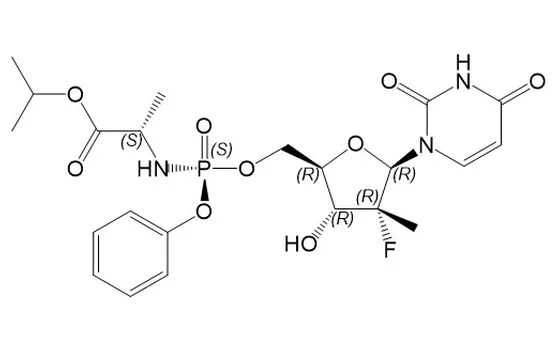
A free phosphate diester carries two negative charges at physiological pH and does not cross a cell membrane. Masking one charge with a phenol and the other with an amino acid ester gives a neutral species that enters the hepatocyte, where esterases and a phosphoramidase remove the masks and release the monophosphate[4]. The amino acid is L-alanine because the enzymes doing the second step are stereospecific.
That is the problem in one sentence: the prodrug is only a prodrug in one stereochemical form. Phosphorus with four different substituents is a stereocenter, and here the four are all different, so coupling an aryl phosphorochloridate with the amino acid ester produces both configurations and the pair has to be separated[5]. Routes that set phosphorus before coupling, such as the oxazaphospholidine approach, change the ratio rather than the requirement. Gilead's development codes record the consequence: the drug was PSI-7977, the epimer PSI-7976, and PSI-7976 sits in this catalogue as CAS 1190308-01-0 under the label Impurity 27.
Seven entries with the same formula, and four different failure modes
This catalogue holds 83 entries for sofosbuvir. Seven of them share C22H29FN3O9P, the formula of the drug, and the way they differ is more interesting than the fact that they do.
| Entry | CAS | Formula and mass | What differs from the drug |
|---|---|---|---|
| Sofosbuvir | 1190307-88-0 | C22H29FN3O9P, 529.5 | none |
| Impurity 27, PSI-7976 | 1190308-01-0 | same | configuration at phosphorus only |
| Impurity 34, impurity C | 1496552-28-3 | same | alanine carbon inverted |
| Impurity 46, impurity A | 1496552-16-9 | same | alanine carbon and phosphorus both inverted |
| Impurity 137, D-alanine analogue | 1064684-71-4 | same | alanine carbon inverted, phosphorus not specified |
| Impurity 16, impurity G | 1337482-15-1 | same | phosphoramidate on the 3 prime oxygen, 5 prime hydroxymethyl free |
| Impurity 127 | 2648597-80-0 | same | no public structure record, treat as unassigned |
Table note: formulas, masses and configurations from the PubChem records for each CAS number[1]; the catalogue labels are as printed on each entry and do not follow a single numbering authority.
The first five rows are one idea stated five ways: two adjacent stereocenters, the alanine alpha carbon and the phosphorus, give four combinations and all four are present. Only one of them is the drug. Because the centers are adjacent, epimerisation at either produces a substance of 529.5 Da that differs from the drug by nothing a mass spectrometer can weigh.
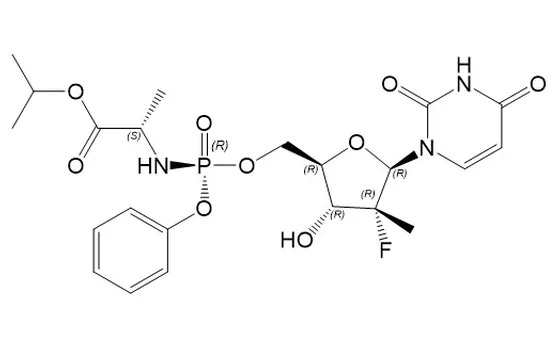
The sixth row is a different kind of problem. Impurity G carries the phosphoramidate on the 3 prime oxygen and leaves the 5 prime hydroxymethyl free. It has the same atoms in the same order of connectivity until the point where the phosphorus is attached, and after that point the molecule is a different molecule. No stereochemical language applies to it, and no chiral method will separate it from anything.
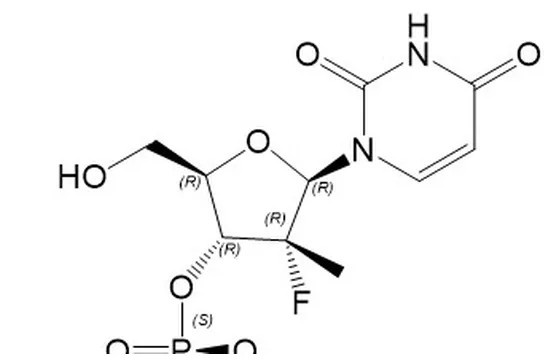
This matters for method design more than for specification writing. A method developed against a spiked mixture of the drug and its phosphorus epimer will look excellent and will have said nothing about the regioisomer, which elutes close to the drug because the two differ in hydrogen bonding rather than in size.
Why tandem mass spectrometry does not rescue an isobaric impurity
Every row in that table has the same nominal mass, and tandem mass spectrometry does not rescue the situation the way an unfamiliar analyst expects. The drug and its epimer differ in the orientation of a P=O bond and an N-H bond, so they fragment through the same cleavages and give the same product ions; what changes is the ratio between them, which is not a basis for quantitation without a standard.
The uridine chromophore absorbs strongly near 260 nm, so all seven substances respond well, and a method that looks sensitive on the drug may be blind to a co-eluting regioisomer. Sensitivity and selectivity are separate measurements, and only one is easy to demonstrate.
Sofosbuvir impurity work is therefore standard-driven: the epimer cannot be identified by mass, ultraviolet spectrum or library match, only by injecting a standard beside the sample. Everything downstream, the response factor and the limit included, rests on that injection.
The achiral column is the right tool, and the chiral one is a mistake
The instinct on seeing the word stereocenter is to reach for a chiral column. For sofosbuvir that instinct is wrong. A chiral stationary phase separates enantiomers, which are mirror images and behave identically in an achiral environment. The drug and PSI-7976 are diastereomers, with different melting points, different solubilities and different retention on an ordinary C18 column.
So the method is reversed-phase, and the difficulty is the smallness of the difference rather than the absence of a mechanism. The two species differ in the orientation of two hydrogen-bonding groups on the same face of the molecule, which moves retention by a fraction of a minute on a conventional gradient. Three levers are worth knowing.
Temperature comes first. Because the selectivity comes from hydrogen bonding rather than lipophilicity, the retention ratio between the pair is unusually temperature-sensitive, and a method transferred from 25 to 35 degrees Celsius without re-checking resolution may no longer resolve anything. A column thermostat belongs in the method description, not in the instrument log.
Gradient shape comes second. A shallow segment around the elution window buys resolution far more cheaply than a longer column, because the retention difference is small and constant while peak width grows with the square root of length.
System suitability comes third. A stated resolution between drug and epimer, verified with a spiked preparation on every run, is the only evidence that the method still works. Without it, a slowly degrading column reports a clean batch.
The 2 prime-chloro analogue: plus 16 Da is not enough to identify anything
Not every isobaric confusion in this set is isobaric. Two entries carry C22H29ClN3O9P at 545.9, CAS 1496552-50-1 and 1496552-51-2, and the difference from the drug is one atom: chlorine where the drug has fluorine, plus 15.97 Da[1].
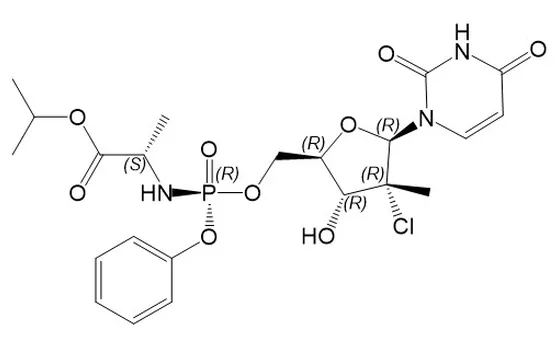
Fifteen point nine seven daltons is also what a hydroxylation or an amine oxidation would give, so the mass alone does not identify it. Chlorine is the tell: its natural abundance gives an M plus two peak about one third the height of the M peak, and no combination of carbon, hydrogen, nitrogen, oxygen, fluorine and phosphorus produces that pattern at this mass. In ultraviolet there is nothing to see, because the chromophore is unchanged; the only hint is a retention shift, chlorine being larger and more lipophilic than fluorine.
The origin is a reagent question rather than a stability question. The 2 prime position is set by a halogenation step, and a chlorinating agent, or chloride in a fluorinating feed, delivers the chloro nucleoside, which then couples exactly as the correct intermediate does. A specification on the halogenated intermediate is cheaper than a limit on the drug, and a stability programme will never find this impurity because it is not formed on storage.
What the numbering does not tell you, and which rows are not impurities
The catalogue numbering deserves a warning of its own. The 83 sofosbuvir entries carry serial numbers up to 164 with large gaps, so the highest number in the set is not a count of anything. The serials come from supplier catalogues and dossier tables that were never harmonised.
Two consequences follow. First, ordering by number is unreliable; ordering by CAS number and checking the structure is not. Second, six of the 83 rows are not sofosbuvir impurities at all: the C18H17F5NO5P cluster is the pentafluorophenyl phosphoramidate reagent family used to install the phosphorus, for example isopropyl (R)-(perfluorophenoxy)(phenoxy)phosphoryl-L-alaninate, CAS 1337529-56-2[1]. An analyst who spikes all 83 entries into one system suitability mixture is preparing a mixture no batch could ever contain.
Our catalogue maps no EP or USP impurity letters for this product, and that absence is informative: sofosbuvir entered the pharmacopoeias with sponsor-defined nomenclature, so there is no letter system to hang structures on. A supplier number refers to a supplier series, and the only stable identifier is the CAS number.
Limit arithmetic at 400 mg once daily, where percentages govern everything
One 400 mg tablet once daily is the adult dose[2], and that single number settles the threshold discussion. ICH Q3A sets reporting at 0.05 per cent, identification at 0.10 per cent or 1.0 mg per day whichever is lower, and qualification at 0.15 per cent or 1.5 mg per day whichever is lower[3].
| Threshold | Per cent | Mass at 400 mg per day | Absolute cap | Which one governs |
|---|---|---|---|---|
| Reporting | 0.05 | 0.20 mg | none | per cent |
| Identification | 0.10 | 0.40 mg | 1.0 mg | per cent |
| Qualification | 0.15 | 0.60 mg | 1.5 mg | per cent |
Table note: percentages and absolute caps from ICH Q3A(R2)[3]; the mass column is the arithmetic of those percentages against a 400 mg daily intake, not a published limit.
The absolute caps only begin to govern above 1 g and 1.5 g of daily intake respectively, so at 400 mg the specification is a set of percentages and nothing else. That has a consequence that is easy to miss: 0.10 per cent is 0.4 mg of a diastereomer per tablet, and 0.4 mg of a substance that differs from the drug by the orientation of one P=O bond is a large quantity of a molecule that cannot be activated efficiently.
Activation of a phosphoramidate is stereospecific at more than one step, and the regiochemistry of the cleavage is itself a studied problem[6]. A prodrug carrying the wrong configuration at phosphorus is not simply a less potent analogue; it is a substrate the activating enzymes handle poorly. The 0.10 per cent limit is therefore doing potency work, not toxicology work.
That distinction belongs in the dossier. A limit justified by assay and content uniformity is a different argument from one justified by a threshold of toxicological concern, and reviewers read them differently. Sofosbuvir carries no structural alert that would bring ICH M7 into the discussion, no aromatic amine, no N-nitroso entry in this catalogue and no alkylating fragment; the framework that governs is Q3A, and the justification should say so instead of importing a mutagenic-impurity argument the molecule does not need.
What transfers to remdesivir, and why entecavir is the wrong comparison
Three comparisons are worth making, because they define the boundary of what can be copied from one antiviral to another.
Remdesivir is the closest analogue: also a single-isomer phosphoramidate prodrug with a phosphorus stereocenter, an amino acid ester and an aryloxy group. The analytical logic applies without modification, including the check for the 3 prime versus 5 prime regioisomer. What does not transfer is the chromophore; remdesivir is built on a pyrrolotriazine rather than a uridine, so detection wavelength and response factors differ, and a method copied across will be sensitive in the wrong place.
Entecavir is the instructive negative case. It contains no phosphorus; its stereochemistry sits on a carbocyclic ring and an exocyclic double bond, so its impurity problem is an enantiomer and geometric-isomer problem that needs a chiral method. Copying a sofosbuvir method to entecavir, or the reverse, produces a method that separates nothing it was meant to separate.
Ledipasvir and Velpatasvir sit on the other side of the same combination products. They are NS5A inhibitors with no phosphorus and no nucleoside, and their chirality is carried by amino acid and fused-ring centers. Their impurity families are unrelated to the chemistry described here, even though they are dispensed in the same tablet.
The rule that survives all four cases: a phosphorus stereocenter in a prodrug is an impurity problem an achiral column can solve, and a carbon stereocenter in an active substance is usually an enantiomer problem that needs a chiral one. Confusing the two costs a method development cycle.
Reference standards for a molecule whose impurity names do not exist
This catalogue holds 83 sofosbuvir entries, of which the five that carry this argument are the drug at 1190307-88-0, the phosphorus epimer at 1190308-01-0, the 3 prime regioisomer at 1337482-15-1, the D-alanine analogue at 1064684-71-4 and the 2 prime-chloro analogue at 1496552-50-1. [See every sofosbuvir entry](Sofosbuvir)
Two handling notes come out of the chemistry. The phosphoramidate P-N bond is hydrolytically labile, so a low-pH diluent turns the sample into the drug, the free amino acid ester and the phosphate before the injection is finished; a method that runs for an hour at pH 2 is running a reaction, and the impurity it reports may be one it created. The epimer pair should also be weighed as separate solutions rather than as a mixed standard.
show how many applicants have already had to answer these questions, which is the practical argument for starting from a named standard rather than from a peak.Frequently Asked Questions
Can I quantify the phosphorus epimer by area per cent without its standard?
Do I need a chiral column for sofosbuvir?
Which substance is sold as Sofosbuvir Impurity 27?
Is the 2 prime-chloro analogue covered by the same limit as the epimer?
Why is there no EP or USP impurity letter for these substances?
Can the phosphoramidate hydrolyse during sample preparation?
Is the regioisomer visible on a method developed for the epimer?
Related Substances and Reference Standards
- Sofosbuvir (82 impurity / derivative entries)
- Remdesivir (29 impurity / derivative entries)
- Entecavir (59 impurity / derivative entries)
- Velpatasvir (32 impurity / derivative entries)
References and Sources
- U.S. National Library of Medicine, PubChem, Sofosbuvir, CAS 1190307-88-0, C22H29FN3O9P, 529.5, and its phosphorus epimer PSI-7976, CAS 1190308-01-0; sofosbuvir impurity G, CAS 1337482-15-1, the 3 prime-O regioisomer; sofosbuvir impurity A, CAS 1496552-16-9; sofosbuvir impurity C, CAS 1496552-28-3; D-alanine sofosbuvir, CAS 1064684-71-4; the 2 prime-chloro analogue, CAS 1496552-50-1, C22H29ClN3O9P, 545.9; and the pentafluorophenyl phosphoramidate reagent, CAS 1337529-56-2, C18H17F5NO5P, 453.3, accessed 2026-11-13
- U.S. National Library of Medicine, DailyMed, Sovaldi (sofosbuvir) tablets, prescribing information: recommended adult dosage one 400 mg tablet once daily, storage below 30 degrees Celsius, accessed 2026-11-13
- International Council for Harmonisation, ICH Q3A(R2), Impurities in new drug substances: reporting, identification and qualification thresholds of 0.05, 0.10 and 0.15 per cent, and the 1.0 mg and 1.5 mg per day alternatives, accessed 2026-11-13
- Chemical Reviews, Synthesis of nucleoside phosphate and phosphonate prodrugs: the charge-masking rationale for phosphoramidate and phosphonate prodrugs, and the stereospecificity of their enzymatic activation, accessed 2026-11-13
- The Journal of Organic Chemistry, Stereoselective synthesis of nucleotide analog prodrugs (ProTides) via an oxazaphospholidine method: setting the phosphorus stereocenter before coupling rather than separating a diastereomeric mixture afterwards, accessed 2026-11-13
- Biochemistry, Regiochemical analysis of the ProTide activation mechanism: why the position of the phosphoramidate on the sugar decides whether the prodrug is activated, accessed 2026-11-13
This article was prepared by the CATO technical team. Regulatory, pharmacopoeial and published literature content cited above is attributed in the reference list. It is provided for technical exchange and search reference only and does not constitute a quality specification or regulatory advice. For any specific substance, the applicable test methods, limits and filing requirements are governed by the current regulations, pharmacopoeial monographs and official publications.
Product information on this site is provided for research search and selection reference only and is not a quality specification; technical data, purity and structural confirmation are governed by the shipped COA and our written confirmation. All products mentioned are for research use only, not for human or animal diagnostic or therapeutic use.