Sunitinib: An Impurity With the Same Mass, the Same Fragments, and None of the Activity
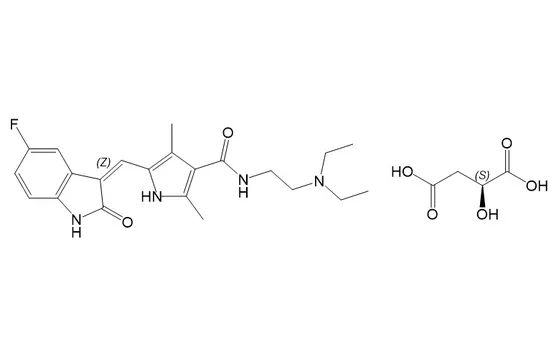
Sunitinib↗ malate is a 532.6 salt whose active ingredient is a 398.5 molecule defined by one double bond. The drug is the (Z) isomer; the (E) isomer is the same formula, the same nominal mass, the same fragment ions and essentially none of the pharmacological activity. There is no pharmacopoeia monograph to fall back on, so the entire control strategy has to be argued from first principles, stability data and ICH Q3A(R2).
Note: product names shown in red (marked with ↗) are links - click through to the product page for structure, CAS number, purity and lead time.
One double bond decides everything
Key points
- Sunitinib base is C22H27FN4O2 at 398.5;[1] the malate salt is C26H33FN4O7 at 532.6 in a 1:1 ratio.
- The approved substance is the (Z) isomer at the indolinone 3-ylidene. The (E) isomer has identical formula, identical nominal mass and different geometry.
- The catalogue lists 62 entries with numbers running to 116 and gaps, but sunitinib has no EP or USP monograph, so no letter system exists to anchor them.
- Two degradants carry clean mass signatures: N-desethyl at 370.43, minus 28.05, and an oxidative fragment at 300.29.
Sunitinib is built from three pieces: a 5-fluoro-indolin-2-one, an exocyclic methylene at the 3-position, and an N-(2-diethylaminoethyl) carboxamide on the pyrrole side. The exocyclic double bond is not decoration. It fixes the orientation of the two halves of the molecule, and that orientation is what fits the kinase hinge region.
Chemically, that double bond is a liability. It is conjugated with the indolinone carbonyl and the pyrrole ring, which stabilises it, but it also lowers the barrier to rotation around the adjacent single bonds and creates a chromophore that absorbs through the ultraviolet and into the visible. Sunitinib solutions are visibly yellow-orange for exactly this reason, and the same conjugation that makes the colour makes photoisomerisation possible.
The malate salt adds a second consideration: sunitinib malate crystallises as a 1:1 salt, and the free base is what the specification expresses. The salt is C26H33FN4O7 at 532.6, one malic acid per sunitinib molecule. Salt formation changes solubility and crystallinity, not the isomer ratio, but it does change the matrix in which isomerisation is measured: a form conversion during storage can shift assay and related substances at the same time, and the two effects are easy to confuse.
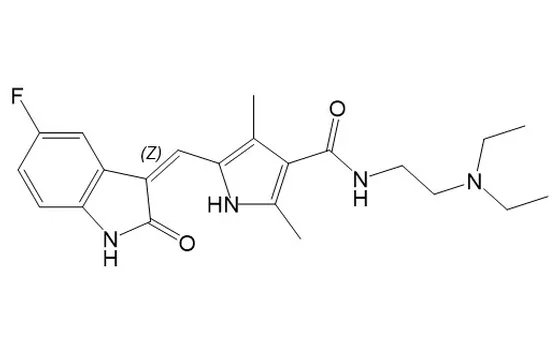
Z and E: the same mass, the same fragments
Geometric isomerism at the 3-ylidene produces two molecules with the same connectivity and different spatial arrangement. Both are C22H27FN4O2 at 398.5. Both give the same nominal molecular ion and, in most collision cells, the same product ions, because fragmentation follows bond cleavage and the bonds are the same.
This is the defining analytical problem for sunitinib. A high-resolution mass spectrometer will not tell the two apart: the exact masses are identical to four decimal places. An MS/MS library will not tell them apart. Even nuclear magnetic resonance needs the right experiment — the nuclear Overhauser effect between the pyrrole proton and the indolinone ring is what establishes which side of the double bond the substituents sit on.
Ultraviolet spectroscopy helps more than mass spectrometry here. The two isomers have different extinction coefficients at the long-wavelength band because the conjugation path is different, and a photodiode array ratio across two wavelengths is a practical way to flag a peak that has the right mass but the wrong shape. It is a screening tool, not an identity test.
The practical consequence for a specification is blunt: the (E) isomer cannot be controlled by a mass-based method. It needs a chromatographic system that resolves it from the parent, and it needs an identity assignment backed by an authentic standard whose geometry was established independently.
The analytical trap is on the column, not in the sample
Because the two isomers interconvert, the chromatogram can create its own impurity. Acidic mobile phases, elevated column temperature, long residence time in the autosampler and strong light during sample preparation all push the equilibrium. A method that shows 0.4% of the (E) isomer may be reporting the mobile phase rather than the batch.
Three experiments settle the question. First, inject a freshly prepared sample and the same sample after six hours in the autosampler at controlled temperature, and compare the isomer ratio. Second, run the method with the column at 25 °C and at 40 °C; a ratio that moves with temperature indicates on-column conversion. Third, run a dark control alongside the light-exposed sample, which is required by ICH Q1B anyway[2].
The injection solvent matters as much as the mobile phase. Sunitinib is poorly soluble in water, so samples are usually prepared in methanol, acetonitrile or a dilute acid. A strongly acidic diluent will isomerise the analyte before it ever reaches the column. A neutral or mildly buffered diluent is slower but more honest.
None of this is exotic. It is the standard set of experiments for any molecule with a photolabile double bond, and it is routinely skipped because the (E) peak is small and the method passes system suitability. The failure mode is a batch that passes release testing and fails on stability, with the difference traced back to sample handling.
N-desethyl at minus 28.05: the impurity mass spectrometry can see
The diethylaminoethyl chain is the most exposed part of the molecule. Oxidative dealkylation removes one ethyl group and gives the N-ethyl analogue, C20H23FN4O2 at 370.43, which is 28.05 Da below the parent — a clean loss of C2H4[3]. The catalogue carries it as Sunitinib Impurity 2, CAS 356068-97-8.
This is the easy impurity. The mass difference is large enough to be unambiguous at unit resolution, the fragment is more polar than the parent and elutes earlier on a reversed-phase gradient, and a standard is commercially available. It also forms under stress conditions that are simple to run: peroxide oxidation, or prolonged exposure to air at elevated temperature.
The control point is the synthesis, not the storage. The diethylaminoethyl side chain is introduced late in the route, and residual monoethyl intermediate carries straight through to the drug substance. If the impurity appears at a level that does not grow on stability, the investigation belongs in the route and in the purging power of the final crystallisation, not in the packaging.
There is a regulatory angle too. Because sunitinib has no monograph, the limit for this impurity is not inherited from a pharmacopoeia. It is set by the applicant from batch history, spiking studies and stability, using the Q3A(R2) thresholds as the ceiling rather than as the answer.
The 300.29 fragment: oxidative cleavage of the bridge
Oxidation does not only attack the side chain. It also cleaves the exocyclic double bond, and the indolinone half survives as a smaller acid-type fragment. The catalogue lists Sunitinib Impurity 1, CAS 452105-33-8, C16H13FN2O3 at 300.29 —[4] roughly the fluorinated oxindole fragment with its substituent, and clearly not a whole-molecule derivative.
Fragments of this size matter for a different reason than isomers do. They are chemically distinct, they are easy to identify by mass, and they are easy to mistake for extraction artefacts if the sample preparation includes a strong acid or a metal surface. Sunitinib is a chelator by design; the indolinone and the pyrrole together form a bidentate motif that binds kinases and will also bind iron and copper from stainless steel frits.
That is a real method-development consideration. Metal-catalysed oxidation on an HPLC frit produces a fragment peak that grows with column age and disappears when the column is replaced. If the peak is assigned to the batch, the batch is blamed for the hardware. Use a biocompatible or PEEK-lined flow path when the fragment sits anywhere near the reporting threshold.
The fragment also sets a specificity requirement: the method must resolve it from the parent and from the desethyl impurity, which sits between them in retention on most C18 systems. Three peaks, three mechanisms, one gradient.
No monograph, 62 entries, numbers to 116
Sunitinib has no EP monograph and no USP monograph. That single fact changes the meaning of every number in the catalogue. With a monograph, a letter has a defined structure and a defined limit. Without one, a number is a supplier's key, and 62 entries numbered up to 116 with gaps reflect a supplier's inventory rather than a molecule's chemistry.
Read the list and three groups appear. The first is genuine process-related material: desethyl, the indolinone fragment, protected intermediates from the route, and geometric isomers. The second is stress artefacts generated to populate a catalogue: N-oxides, hydrolysed amides, and dimers that may never appear in a real batch. The third is labelled material — deuterated and 15N analogues used as internal standards.
Only the first group belongs in a specification, and the selection logic is the one described in the listed-versus-unlisted framework, and even there the decision is data-driven. A potential impurity becomes a specified impurity when it appears in a batch or in a stress study above the reporting threshold, or when it is a known degradant of the dosage form. Everything else is a candidate, not a commitment.
This is where teams without a monograph overspend. Buying thirty numbered impurities to cover a hypothetical profile produces a validation package that describes chemistry the product does not have, and a specification that cannot be defended because none of the limits was ever challenged. The defensible route is the opposite: start from the route, the stress data and the stability trend, then buy the standards that the data demand.
Setting limits at a 50 mg dose
The arithmetic is simpler than the chemistry. At a 50 mg daily dose, the Q3A(R2) reporting threshold of 0.05% corresponds to 25 µg per day, and the identification and qualification threshold of 0.10% corresponds to 50 µg per day[5]. The absolute 1.0 mg ceiling never binds at this dose, so the percentage thresholds govern everything.
In practice a specification will set tighter internal limits than the regulatory ceiling, because the stability trend has to stay inside the shelf-life claim. If the (E) isomer grows at 0.05% per year at 30 °C and the release limit is 0.3%, a 24-month shelf life is comfortable; if it grows at 0.15% per year, the same release limit leaves no margin and the packaging or storage condition has to change.
For the desethyl impurity the same logic applies with a different slope, because it is largely a route impurity and should be flat on stability. A flat profile allows a release limit close to the regulatory threshold without risk. A rising profile does not.
The specification also needs a decision on unspecified impurities. A 0.10% limit for any unspecified impurity, with a total of 0.5%, is conventional; it is also the clause that determines how many standards a laboratory must keep on the shelf, because every peak that could exceed 0.10% has to be identifiable on demand.
Method design and the certificate
A workable related-substances method for sunitinib malate resolves four things: the (E) isomer, the desethyl impurity, the indolinone fragment and the parent, in that order of analytical difficulty[6]. A C18 column with a phosphate or formate buffer at pH 3–4 and a shallow acetonitrile gradient usually separates the last three; the isomer pair needs the shallower segment and a controlled temperature.
Detection at 425 nm is selective for the conjugated chromophore and suppresses malate and most process impurities, but it also suppresses the fragment, which lacks the full conjugation. A dual-wavelength approach — 425 nm for the parent and isomer, 254 nm or 280 nm for the fragment and desethyl — is more work and less blind.
On the certificate, four items deserve attention. Identity of the isomer: does the certificate state (Z) or (E) explicitly, and on what evidence. Salt form: is the standard the base or the malate, because 398.5 and 532.6 are not interchangeable in a calculation. Purity method: mass balance or area percentage. And water content, because the malate is hygroscopic enough that an uncorrected weighing drifts.
The conclusion is uncomfortable but useful. Sunitinib is a molecule where the most important impurity cannot be seen by the most common detector, where the second most important one can be created by the method itself, and where no pharmacopoeia will write the limits for you. That combination is exactly why the (E) isomer deserves its own line in the specification rather than a place among unspecified impurities.
Frequently Asked Questions
Is the sunitinib (E) isomer detectable by LC-MS?
Does sunitinib have a pharmacopoeial monograph?
What is the mass of the N-desethyl impurity?
Why does the 300.29 fragment appear in some batches and not others?
What dose should be used for ICH Q3A threshold arithmetic?
Why is the injection solvent a critical method parameter?
Can a generic C18 gradient separate sunitinib from its degradants?
Is the malate salt relevant to impurity calculations?
Related Substances and Reference Standards
- Sunitinib (62 impurity / derivative entries)
References and Sources
- PubChem, U.S. National Library of Medicine, Sunitinib, CID 5329102: C22H27FN4O2, molecular weight 398.5, with the (Z) configuration stated in the systematic name, accessed 2026-11-26
- International Council for Harmonisation, ICH Q1B, Photostability testing of new drug substances and products: the dark control and the near-UV exposure option, accessed 2026-11-26
- PubChem, U.S. National Library of Medicine, Sunitinib impurity 2, CAS 356068-97-8: C20H23FN4O2, molecular weight 370.43, the N-desethyl analogue, accessed 2026-11-26
- PubChem, U.S. National Library of Medicine, Sunitinib impurity 1, CAS 452105-33-8: C16H13FN2O3, molecular weight 300.29, the fluorinated indolinone fragment, accessed 2026-11-26
- International Council for Harmonisation, ICH Q3A(R2), Impurities in new drug substances: thresholds, qualification and the treatment of specified and unspecified impurities, accessed 2026-11-26
- International Council for Harmonisation, ICH Q2(R2), Validation of analytical procedures: specificity, resolution and relative response factors, accessed 2026-11-26
This article was prepared by the CATO technical team. Regulatory, pharmacopoeial and published literature content cited above is attributed in the reference list. It is provided for technical exchange and search reference only and does not constitute a quality specification or regulatory advice. For any specific substance, the applicable test methods, limits and filing requirements are governed by the current regulations, pharmacopoeial monographs and official publications.
Product information on this site is provided for research search and selection reference only and is not a quality specification; technical data, purity and structural confirmation are governed by the shipped COA and our written confirmation. All products mentioned are for research use only, not for human or animal diagnostic or therapeutic use.